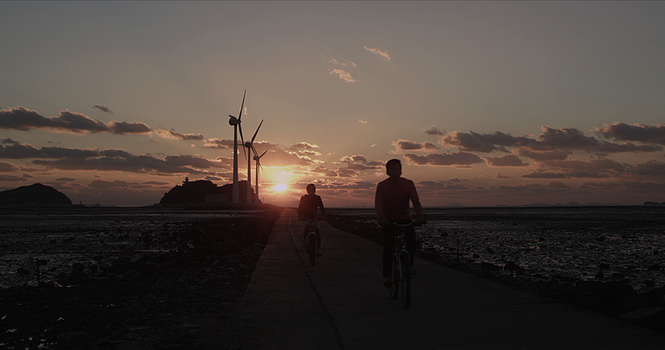
I Saw You (너를 봤어)

MAD SAD BAD (신촌좀비만화) – ★★★☆☆

MAD SAD BAD (신촌좀비만화)

MAD SAD BAD (신촌좀비만화)

Omnibus film MAD SAD BAD (신촌좀비만화) has the notable distinction of featuring not only three of Korea’s top name directors in the form of Ryoo Seung-wan (류승완), Han Ji-seung (한지승) and Kim Tae-yong (김태용), but also for serving as the opening film for the 15th Jeonju International Film Festival. The collective work is quite a landmark for an opening film due to the use of 3D, which is, in part, used to emphasis the new vision and production role of KAFA+ (The Korean Academy of Film Arts).

The three segments are each designed to explore human relationships through a connection to a form of popular culture. Director Ryoo Seung-wan helms the first short titled Ghost (유령), about a boy who is addicted to his cell phone; director Han Ji-seung is responsible for I Saw You (너를 봤어), which is concerned with a futuristic zombie apocalypse; and finally director Kim Tae-yong explores the life of a young girl with an autistic brother in Picnic (피크닉).

In the interest of fairness, each short within the omnibus has been reviewed individually, in the order in which they appear onscreen.

Ghost (유령)

Ghost (유령)

Ghost (유령) –  ★★★☆☆

Ghost depicts teenager Seung-ho (Lee David (이다윗) who is more concerned with the digital world of chat rooms, sms, and computer games rather than reality. When Woo-bi (Son Soo-hyeon (손수현), a girl from his chatroom, claims she is in danger from an abusive boyfriend, Seung-ho teams with Bi-jen (Park Jeong-min (박정민) to help her.

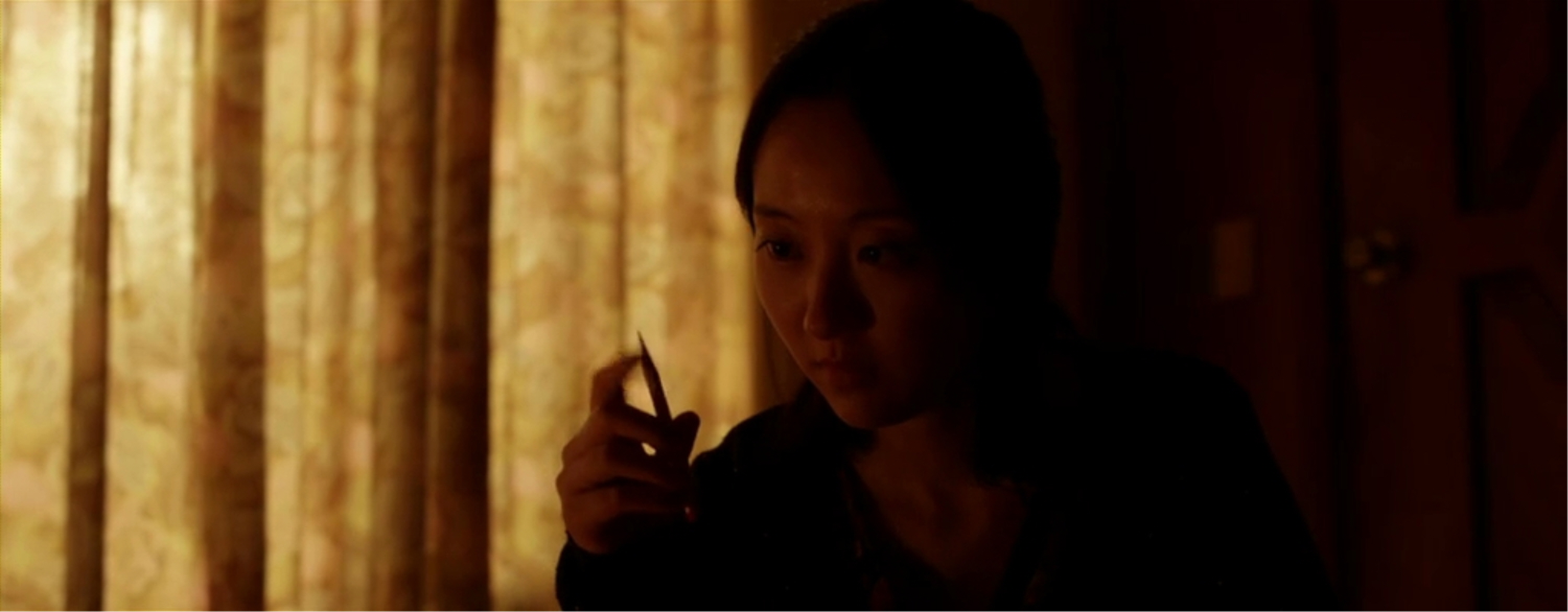
Based on a true story, Ghost is quite a departure from director Ryoo Seung-wan’s typically action-orientated projects, and he ably handles the focus on low-key personal drama. Scenes featuring Seung-ho’s bedroom are expertly filmed and wonderfully convey his fractured relationship with reality, while the social pressures from his school and father are competently expressed. However the tension that a film such as Ghost requires is curiously absent, particularly when Seung-ho and Bi-jen attempt to help Woo-bi. The use of 3D is also quite unnecessary  as the drama rarely features it effectively.

Luckily the ever-reliable Lee David holds everything together well, with his likeable ‘everyman’ charm again forcing audiences to empathise with his plight. That said, the actor is never pushed into new territory and as such his performance doesn’t contain the intensity of his prior work, yet Lee David does what he can with the material on offer. It’s Park Jeong-min, however, who gives a wonderful performance as the socially inept Bi-jen. Complete with thick-rimmed glasses, protruding jaw and nervous ticks, Park’s characterisation is a radical departure from his previous roles conveying angst and social-dislocation with aplomb.

I Saw You (너를 봤어)

I Saw You (너를 봤어)

I Saw You (너를 봤어) – ★★☆☆☆

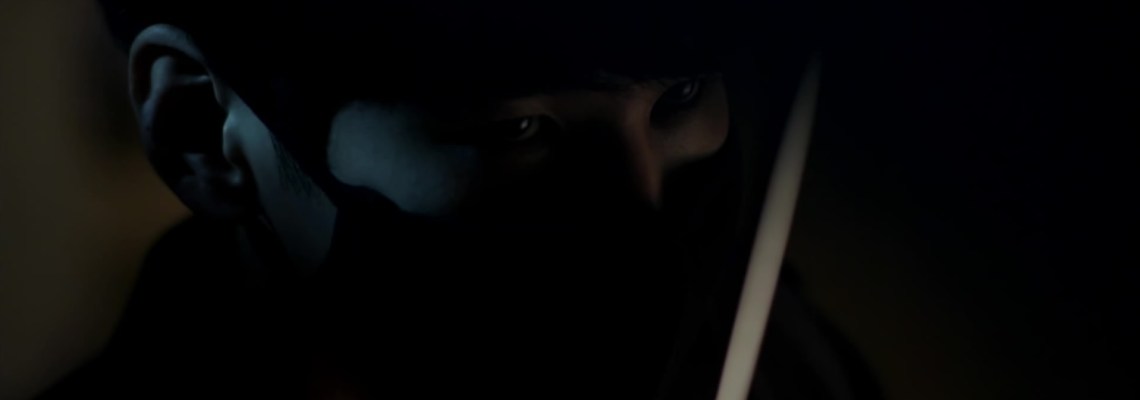
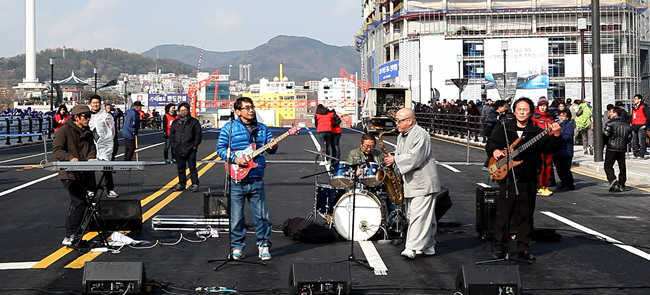
In the not-too-distant future, zombies have emerged causing catastrophe in their wake. Yet the arrival of a cure for the affliction has allowed the undead to rejoin society. Factory manager Yeo-wool (Park Ki-woong (박기웅) presides over zombie laborers, pushing them to work harder and harder. When a zombie named Si-wa (Nam Gyoo-ri (남규리) attempts to communicate with him, Yeo-wool begins to understand their connection.

Director Han Ji-seung’s I Saw You is certainly the weakest within the omnibus. Poorly scripted, badly acted, and featuring precious little depth, the superficial rom-com-zom is a hollow experience. Director Han’s ambition is clearly bigger than his budget, yet instead of scaling down the film into a more focused piece he has constructed a poor imitation of a large production, one where the narrative veers wildly resulting in a lack of interest in the central couple. There is an attempt to emphasise the importance of memory as with Eternal Sunshine of the Spotless Mind, yet it becomes lost amongst the various narrative tangents and oddities.

Bizarrely, I Saw You also fails to use the 3D technology effectively. This is the one production within the omnibus where the genre lends itself to fun 3D antics, however the potential isn’t capitalised on, resulting in a rather bland offering.

Picnic (피크닉)

Picnic (피크닉)

Picnic (피크닉) – ★★★★☆

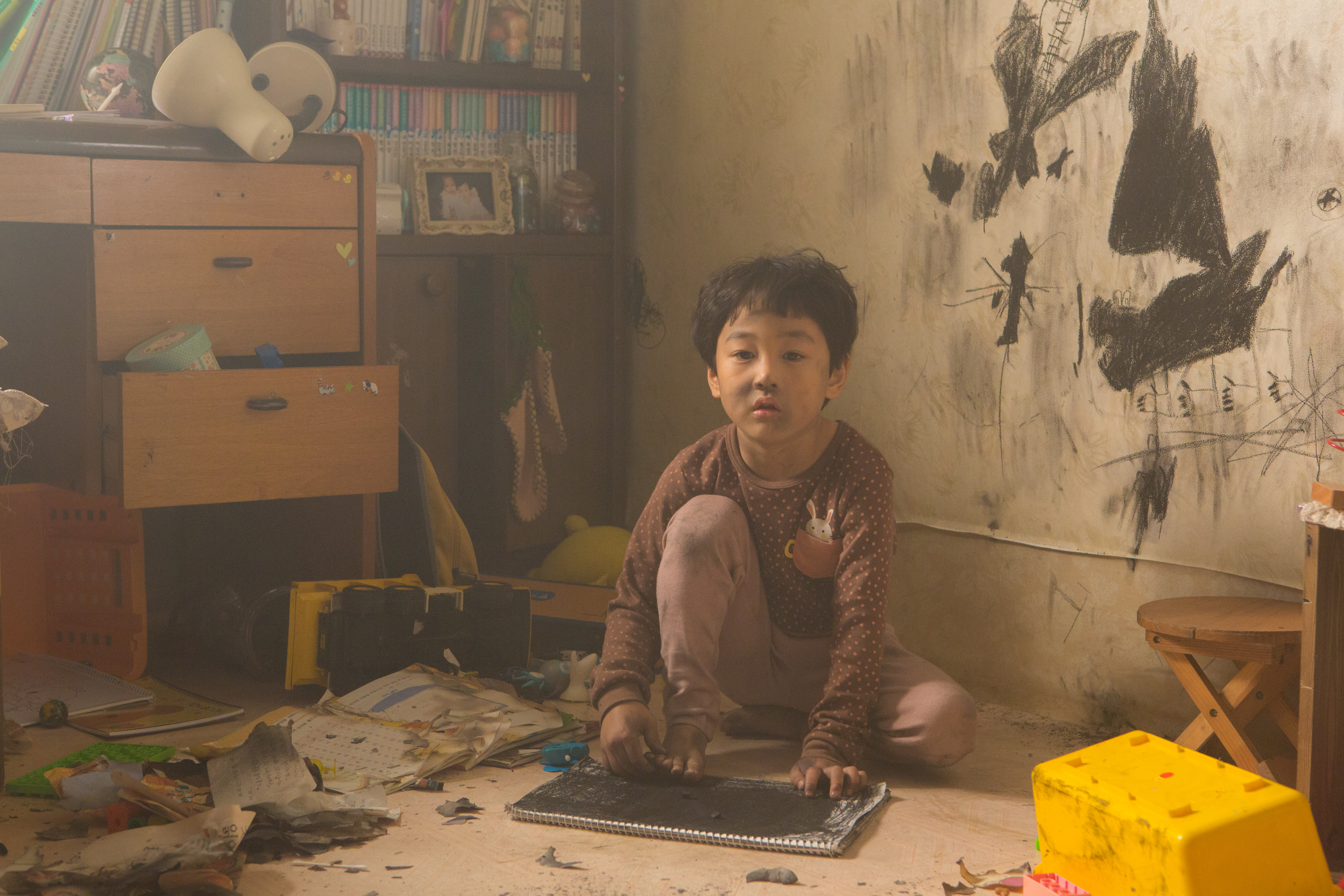
Su-min (Kim Su-an (김수안) lives a humble life with her seamstress mother (Park Mi-hyeon (박미현) and autistic younger brother. Despite her young age Su-min is often forced to take responsibility for her sibling, and her only respite is to lose herself with the ages of a romantic comic book.

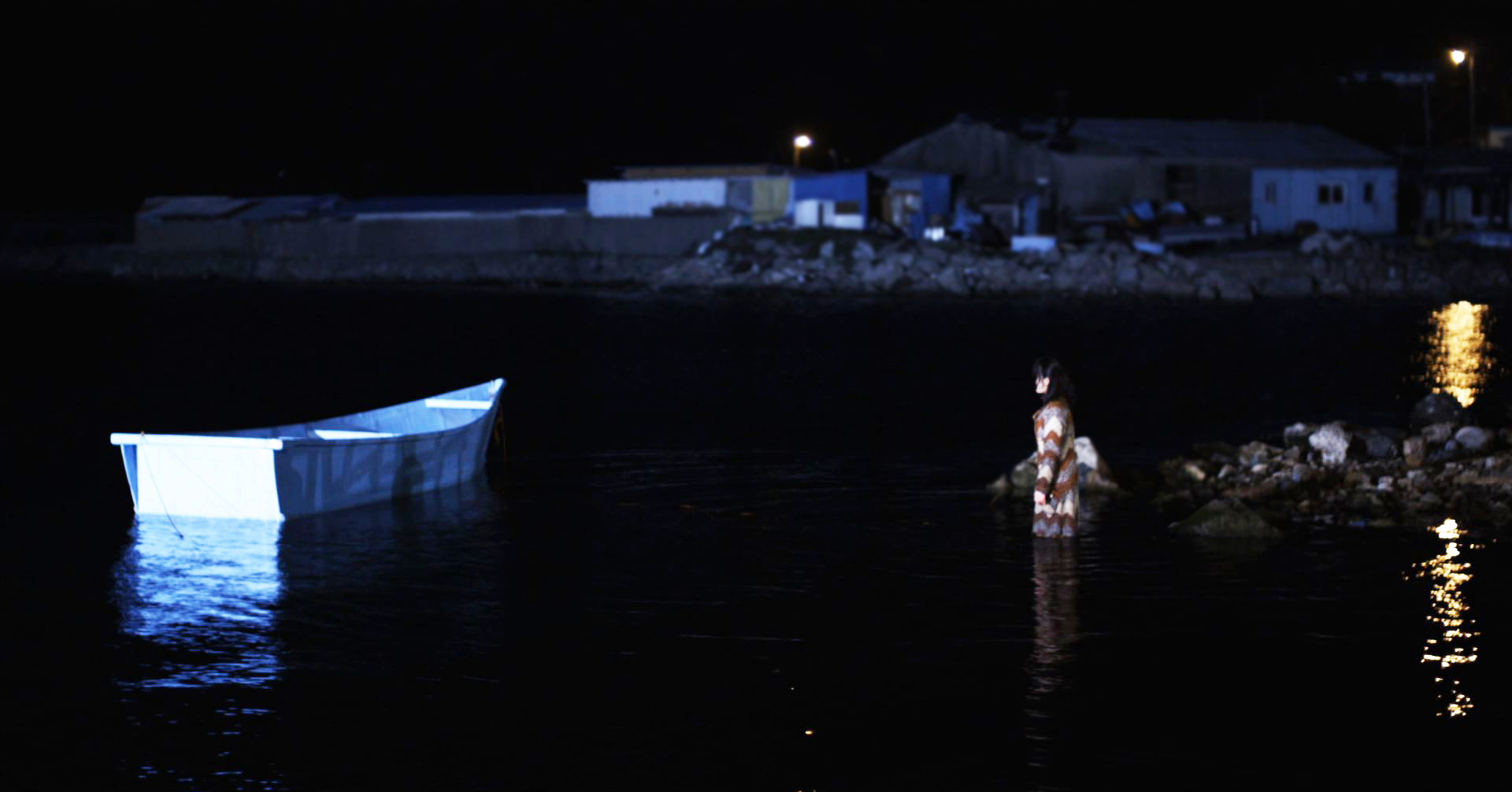
Picnic is a beautifully told, wonderfully charming story of youth and innocence, and is undoubtedly the most accomplished segment with the entirety of MAD SAD BAD. Screenwriter Min Ye-ji has constructed a poignant, sensitive and compelling story regarding those who live on the fringes of society, one which is elegantly depicted by director Kim Tae-yong. Director Kim ‘s uncanny ability to deeply understand and convey his characters motivations is once again apparent as he portrays a frustrated, overburdened young girl with an acute sense of subtly and artistry. Director Kim is also the only director in the omnibus to employ 3D effectively. Picnic features some truly sumptuous cinematography which the 3D technology vibrantly brings to life, particularly scenes of nature as with a pier at sunset and a mysterious forest.

The compulsion of the film rests on young actress Kim Su-an’s shoulders, and she delivers wonderfully. Her performance is continually captivating and displays a quality that belies her youth, proving that her prior films, including Berlinale winner Sprout, were no fluke. Kim’s charismatic performance conveys an adult sense of responsibility and independence alongside a youthful innocence and vitality, generating a deep sense of empathy and that never fails to entertain.

★★★☆☆

Festival News Jeonju International Film Festival (제15회 전주국제영화제) Korean Festivals 2014 Reviews
The 11th Green Film Festival in Seoul

The 11th Green Film Festival in Seoul

The 11th Green Film Festival in Seoul

The 11th Green Film Festival in Seoul

The Green Film Festival in Seoul (제 11회 서울환경영화제) is gearing up for it’s 11th installment, and is due to take place from May 8th until 15th.

This year the environmentally focused festival will be held across three cinemas in the Gwanghwamun area – Cinecube, Indiespace, and the Seoul Museum of History – which are all located close to each other (please see below for the map). While previous incarnations of the event were concerned with the importance of green issues, the 11th edition intends to focus more on entertaining, rather than serious, productions that deal with the environment.

GFFIS 2014 Map

GFFIS 2014 Map

The programs in this year’s festival include traditional categories such as Green Panorama and Green Competition yet are also joined by Eco Thriller, Ancient Futures, Green Asia, Green Panorama in Korea, Children of the Earth, and Animals, Our Sweet and Wild Companion.

The trailer below gives a glimpse of the films being shown throughout the festival, and the wide variety of topics that will be explored throughout.

Opening Film

The Kings of Summer

Director Jordan Vogt Roberts

The Kings of Summer

The Kings of Summer

Premiering at the Sundance Film Festival in 2013 to critical praise, director Jordan Vogt Roberts’ coming of age drama has been described as akin to the classic 1986 film Stand By Me for capturing the lives and attitudes of disaffected youth so sincerely. The Kings of Summer depicts the story of three teenagers who decide to spend the season in the woods free from their interfering parents. However as they build a house for themselves and learn to live of the land, the trio are faced with trials that test their ideas of friendship and the importance of family.

Please see below for the trailer:

To visit the official Green Film Festival in Seoul website, please click here.

Festival News Korean Festivals 2014 The Green Film Festival in Seoul (제 11회 서울환경영화제)
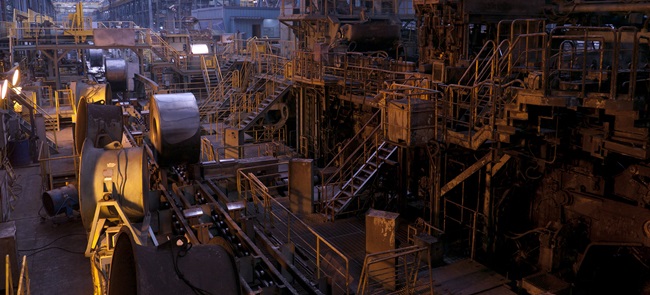
The POSCO furnaces are a hellish landscape exemplifying human kind's desire to create their own divinity

A Dream Of Iron (철의 꿈) – ★★★★☆

A Dream Of Iron (철의 꿈)

A Dream Of Iron (철의 꿈)

When his partner decides to end to their relationship in order to become a Buddhist monk, director Kelvin Kyung Kun Park is devastated. Unable to understand her desire to reject contemporary civilisation in search of spiritual enlightenment, director Park decides to search for something tangible and godly to win her back. Yet in his quest to do so the director begins to explore Korea’s recent history, and becomes aware of human kind’s complex relationship with what is considered holy.

A Dream Of Iron (철의 꿈)

The composition is consistently stunning

A Dream of Iron is a gorgeously shot, beautifully sincere documentary. Director Park fully displays his history as an artist with some truly majestic cinematography that rarely fails to leave mouths agape, and is a stunning testament to human kind’s unbridled ambition and search for the divine. Premiering at the 2014 Berlinale and awarded the NETPAC Prize (alongside fellow Korean documentary, Non-Fiction Diary), A Dream of Iron has been turning heads internationally for it’s sensitivity and depth in attempting to find God in modernity.

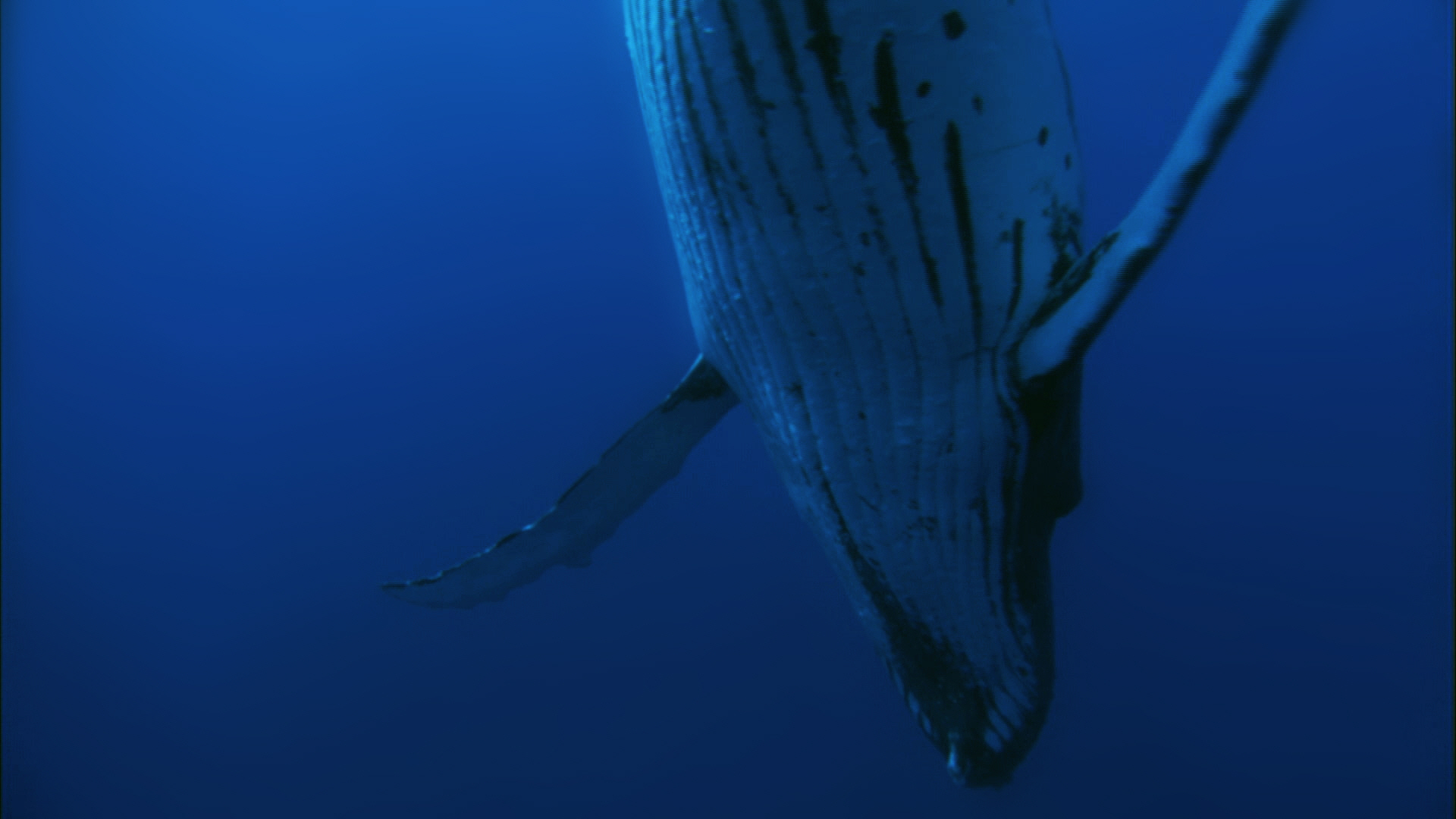
Director Park elegantly combines imagery from different periods of Korean history in exploring how spiritualism has evolved. Early Koreans worshipped whales as heralds of the divine, and their grace and mysterious grandeur are artfully captured throughout the film. Such scenes are contrasted with Buddhist ceremonies whose monks attempt to achieve enlightenment through rituals, and with the modern age in a shipbuilding steelworks. In each instance the camerawork, cinematography and use of colour are absolutely sumptuous. The gentle and tranquil blue hues of life under the ocean are juxtaposed with the burning reds and yellows of molten metal at the steelworks, eloquently articulating how humanity has exchanged heavenly creatures for a hellish landscape in the pursuit of conquering, and recreating, godliness.

Notions of divinity throughout the ages are explored leading to the age of iron

Notions of divinity throughout the ages are explored leading to the age of iron

In examining the transition, director Park employs historical footage of former dictator Park Chung-hee and his unrestrained fervour for modernity. In telling scenes the director depicts how Park systematically destroyed the old to make way for his new vision, and in one particularly effective moment cuts from a whale to a sign baring ‘HYUNDAI’, acutely conveying the exchange of deities. Rather than examining the chaebols (Korean companies) however, A Dream of Iron is focused on POSCO (Pohang Iron and Steel Company) and the history of the organisation. The old footage of steelworkers and the history of protest within Korea is a consistently fascinating viewing experience, while the religious terminology used by the corporation itself lends itself to director Park’s themes all too easily.

The music throughout A Dream of Iron is incredibly well used, particularly in the jaw-dropping aerial shots of the shipyard and the Park Chung-hee era. The sense of foreboding and darkness that is created through such sequences are powerful and provocative, particularly when contrasted with notions of the divine from prior eras. As the director explores the contrast ever further, both he and the audience gradually being to understand that his ex-partner may well have a strong case to leave after all.

The POSCO furnaces are a hellish landscape exemplifying human kind's desire to create their own divinity

The POSCO furnaces are a hellish landscape exemplifying human kind’s desire to create their own divinity

Verdict:

A Dream of Iron is a gorgeously shot documentary by director Kelvin Kyung Kun Park that explores Korea’s difficult relationship with notions of the divine. By contrasting scenes of majestic whales, Buddhist ceremonies, and hellish scenes from the POSCO steelworks, director Park has crafted an elegant and powerful examination of Korean modernity. The film’s success in achieving the NETPAC award at Berlinale is wholly justified as A Dream of Iron is a stunning testament to human nature’s unbridled ambition.

★★★★☆

Festival News Jeonju International Film Festival (제15회 전주국제영화제) Korean Festivals 2014 Reviews
Who is the mysterious new tenant?

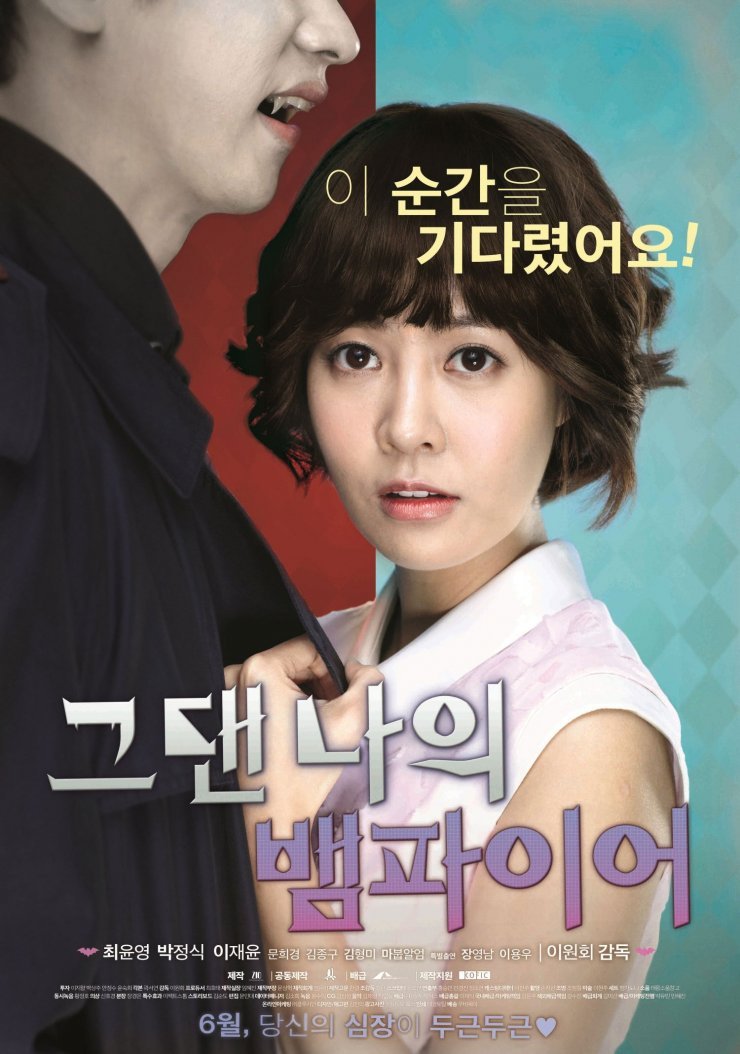
You Are My Vampire (그댄 나의 뱀파이어) – ★★☆☆☆

You Are My Vampire (그댄 나의 뱀파이어)

You Are My Vampire (그댄 나의 뱀파이어)

Struggling screenwriter Nam Gyu-jeong (Choi Yoon-yeong (최윤영) has multiple dilemmas to contend with. She has a huge crush on her best friend’s boyfriend, the local police officer; her divorced parents are both behaving mysteriously; her laptop has died and she cant afford to replace it; and a disquieting, black-clad new tenant has begun staying in her father’s building. As Gyu-jeong begins researching for her next project involving a vampiric protagonist, she becomes convinced that the enigmatic stranger known as Gang Nam-girl (Park Jeong-sik (박정식) is also a bloodsucker due to his aversion to sunlight and distaste for garlic…or he could be just plain weird. As Gyu-jeong seeks the truth about Nam-girl and the assortment of people in her life, the comical situations that arise help her to discover the path of love is often far from smooth.

Who is the mysterious new tenant?

Who is the mysterious new tenant?

You Are My Vampire (그댄 나의 뱀파이어) is a quirky romantic comedy that is unfortunately lacking in both areas. The comedic scenes that emerge throughout the course of the film are entertaining enough to be smile inducing – for example the mystery man’s name is Gang Nam-girl (Gangnam girl) – yet rarely offers more, while the burgeoning romance between Gyu-jeong and her ‘vampire’ is forced to the point of being contrived. The reason for this ultimately belongs to array of supporting characters who number far too many, and director Lee Won-hoi’s (이원회) desire to give each of them a narrative arc forces You Are My Vampire into a film comprised of a series of vignettes rather than a compelling whole with a strong emotional core. The rom-com does display hints of the madcap narrative devices that made How to Use Guys With Secret Tips such a thrill, but unfortunately they never extend into something provoking the same kind of enjoyment.

Gyu-jeong wears quirky clothes while selling side dishes to get Nam-girl's attention and discover his secrets

Gyu-jeong wears quirky clothes while selling side dishes to get Nam-girl’s attention and discover his secrets

While the comedy tends to prompt titters rather than laughs, You Are My Vampire also offers some stimulating social issues through the supporting cast. Gyu-jeong’s parents are divorced yet remain friends, and the jokes that arise between the three of them are refreshing compared to traditional Korean rom-com fare. Similarly Gyu-jeong’s crush on her best friend’s boyfriend and the resulting dilemmas are conveyed without the pretense and melodrama inherent in other stories, while Nam-girl’s sad history and the storyline involving Bangladeshi friend Mabub are welcome. However, Mabub is also the victim of a racially offensive joke regarding his armpit odor, which is uncalled for and very disappointing. As the comedy gently continues, You Are My Vampire falls into the trap that often blights Korean rom-coms by incorporating a heavy dose of melodrama to force narrative closure. It’s an unnecessary addition, but luckily director Lee quickly moves focus back to the central couple and their unconventional attraction to each other.

WIth all the mysteries going on, can Gyu-jeong and Nam-girl get it together?

WIth all the mysteries going on, can Gyu-jeong and Nam-girl get it together?

You Are My Vampire (그댄 나의 뱀파이어) attempts to capitalise on contemporary culture’s fascination with supernatural love stories, by offering a decidedly quirky rom-com between a struggling screenwriter and man who displays all the hallmarks of vampirism. Director Lee Won-hoi (이원회) employs quite gentle comedy throughout that provokes sniggers rather than laughs, while the over-abundant supporting cast force the film into a series of vignettes rather than a compelling whole. While the approach to social issues is refreshing, the contrivances and lack of strong emotional core make the rom-com a mildly entertaining experience.

★★☆☆☆

Festival News Jeonju International Film Festival (제15회 전주국제영화제) Korean Festivals 2014 Reviews
Sookhee (숙희)

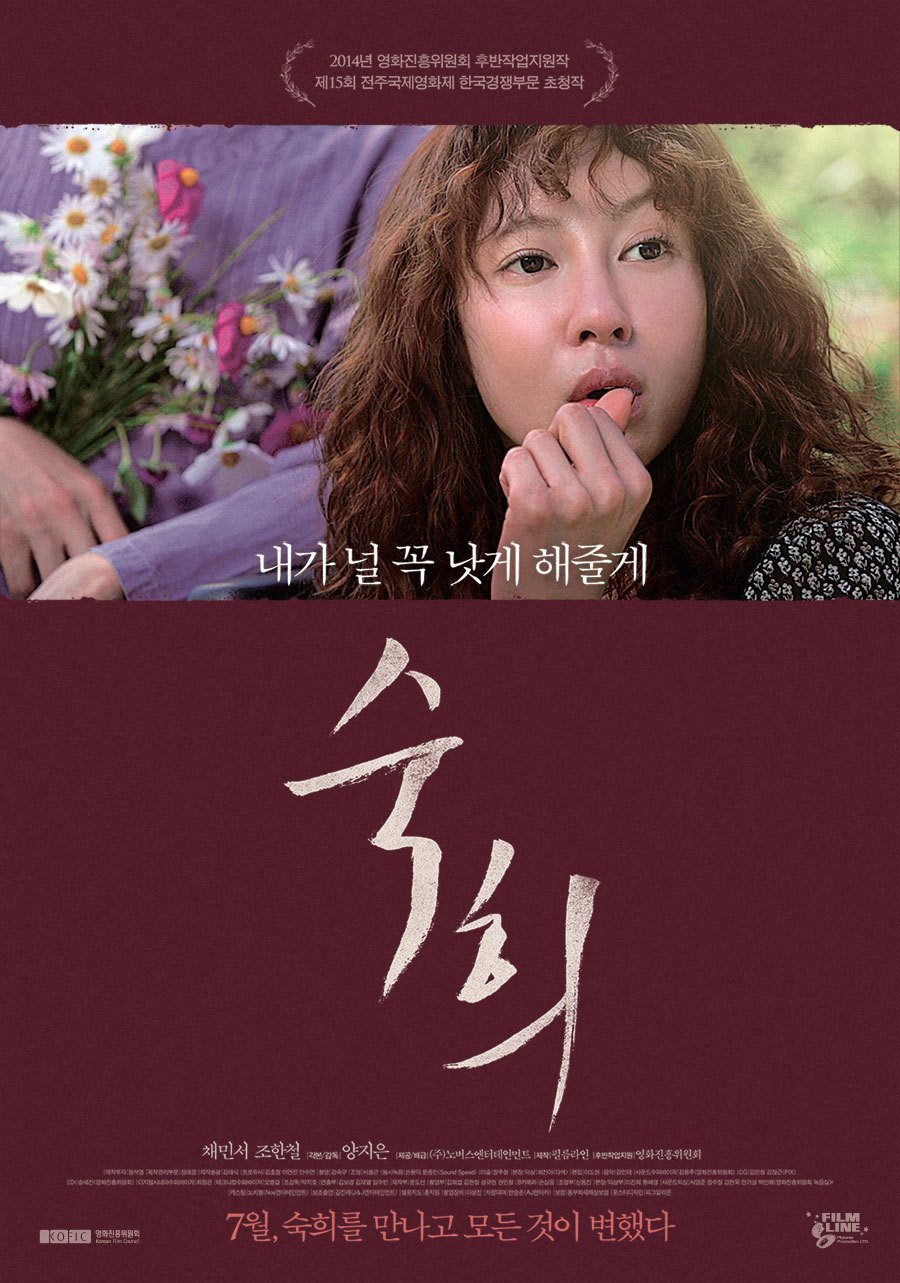
Sookhee (숙희) – ★★☆☆☆

Sookhee (숙희)

Sookhee (숙희)

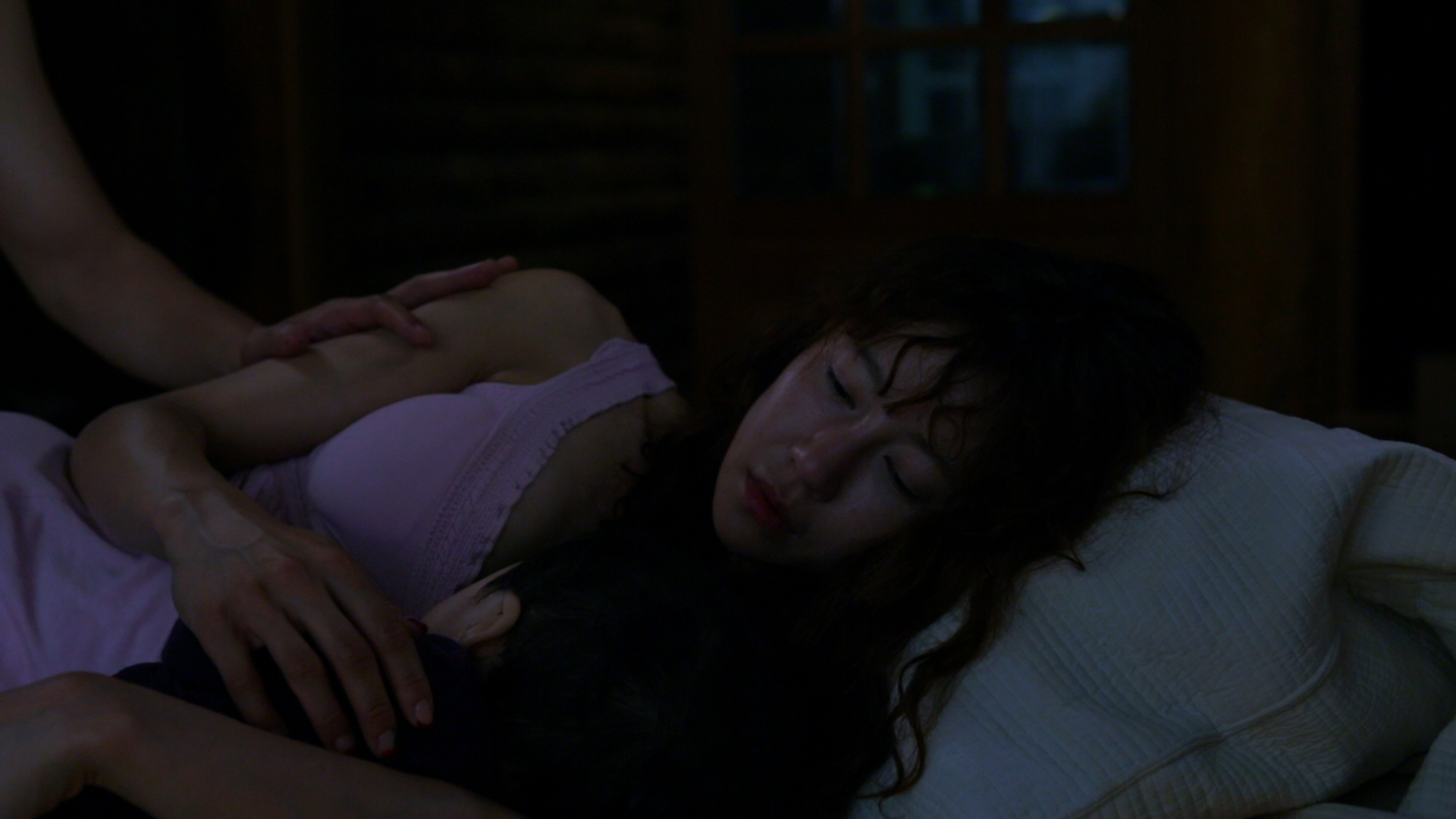
When highly-conservative philosophy professor Yoon (Jo Han-cheol (조한철) suffers a stroke due to overwork and stress, his wife does the best she can to nurse him back to health. Yet when she cannot cope any longer, she enlists the help of quirky caregiver Sookhee (Chae Min-seo (채민서), whose patients all seem to remarkably recover. Sookhee, however, is more than she seems and her techniques vary from kind and sweet to threatening and sexual.

Sookhee (숙희)

Sookhee is a free spirit

Imagine Mary Poppins as a sexually charged sociopath who take care of conservative, misogynistic stroke sufferers. That is quite possibly the most apt description of Sookhee (숙희), a bizarre film with a huge identity crisis and a large undercurrent of meanness. The mish-mash of an array of generic conventions, as well as Sookhee’s constantly schizophrenic characterisation, make the story an incredibly surreal experience. Writer/director Yang Ji-eun (양지은) doesn’t appear to be sure what kind of film she wants to helm, as the narrative – and characters – veer in all directions without really exploring any. Ironically this is both compelling as well as frustrating, as the odd machinations consistently surprise. Yet beneath all the bizarre goings-on is an ordinate amount of unwarranted, appalling misogyny. Masculine fantasies frequently arise and typically instigate violence. Throughout the film Sookhee is routinely beaten and sexually assaulted by the men in her life adding an acutely nasty dimension to an otherwise jovial film, which is all the more surprising given that director Yang is one of the few female filmmakers presenting her work at JIFF 2014. Sookhee perpetuates the archaic ideology that free-spirited women need to be tamed and dominated by violence and sex.

Sookhee is the victim of an inordinate amount of misogyny

Sookhee is the victim of an inordinate amount of misogyny

What director Yang does well lies in her use of colour. Scenes featuring Sookhee are beautifully vibrant and sumptuous, often featured in the countryside far from the realm of men, conveying her liberation from patriarchy alongside pagan, or wiccan, sensibilities. Professor Yoon, in contrast, is located within an absence of colour. The washed-out palette wonderfully conveys his conservatism and strict adherence to the rules of men, bolstered by the repetition of academic and religious iconography. As Sookhee enters Yoon’s world and ‘educates’ him through her odd mix of fear and sexual liberation, his world gradually becomes more colourful as he heals. Yet therein also lies problems, as Yoon’s trajectory is more of a vapid devolution than one of enlightenment. Director Yang is attempting to explore Oedipal issues and gender roles through Sookhee’s maternal and Yoon’s infantile roles, and by reversing old-fashioned patriarchal positions of power and sex. However the message is lost beneath the deluge of oddities and mean-spirited misogyny, alongside the unintentionally humourous overacting.

Sookhee's former patients seek to 'tame' her through sexual violence

Sookhee’s former patients seek to ‘tame’ her through sexual violence

Verdict:

Sookhee is a peculiar film about a free-spirited caregiver who helps stroke sufferers through a bizarre mix of fear and sex. The tone and themes within the surreal film spiral wildly throughout, creating a huge identity crisis from beginning to end while the undercurrent of needless misogyny casts a dark shadow over proceedings. Writer/director Yang Ji-eun does well in employing colour to convey the sensibilities of the two central protagonists, yet the messages regarding reversal of patriarchal relationship and sexual roles are subsumed beneath utter oddity and meanness.

★★☆☆☆

Festival News Jeonju International Film Festival (제15회 전주국제영화제) Korean Festivals 2014 Reviews
In an iconic scene, Sang-goo begins protesting in central Seoul

Another Promise (또 하나의 약속) – ★★★☆☆

Another Family (또 하나의 약속)

Another Promise (또 하나의 약속)

Another Promise (AKA Another Family) (또 하나의 약속) arrived in Korean cinemas in February on a wave of controversy. Based on the true story of a young woman who contracted leukemia while working at a Samsung semiconductor plant, and her father’s subsequent battle to bring the chaebol (conglomerate) to justice, the film was mired in difficulties before it even began. With production companies refusing to fund the film writer/director Kim Tae-yoon (김태윤) turned to crowdfunding, and the resulting flood of private donations helped Another Promise to become the first film in Korean cinematic history to be fully fund in this manner. Furthermore, popular actors including Park Cheol-min and Kim Gyoo-ri offered to appear in the film for free which helped to generate even greater public interest.

Premiering at the 2013 Busan International Film Festival to favourable reviews, Another Promise received global attention for challenging the most powerful company in Korea, prompting an article from The Guardian which went viral amongst Korean film enthusiasts. Later, when the film was finally granted a nationwide release, Another Promise was again the victim of controversy when it became widely reported that Megabox and Lotte Cinema, two of Korea’s biggest cinema chains, were accused of suppressing the number of screens on which the film was to be played. Despite huge public interest and advance ticket sales, The Hankyoreh reported that Megabox reduced the number of screens from 15 to 3 two days before release (which subsequently changed after public outcry), while Yonhap News stated Lotte Cinema allocated a measly 21 out of 99 theaters to showing the film and that most screenings occurred during early morning or late at night. Yet despite being being shown on a paltry 192 screens throughout February (in contrast, Miss Granny had 1024), Another Promise was the 8th biggest film of the month which is a remarkable achievement indeed. Yet controversy aside, is Another Promise any good?

Taxi driver Sang-goo teams with labor rights worker Nan-joo to take on the conglomerate

Taxi driver Sang-goo teams with labor rights worker Nan-joo to take on the conglomerate

Taxi driver Sang-goo (Park Cheol-min (박철민) is thrilled when his daughter Yoon-mi (Park Hee-jeong (박희정) is offered a job at the Jinsung semiconductor plant. As one of the leading companies in Korea, to be a worker at Jinsung is considered a great boon particularly for a humble family. Yet when Yoon-mi returns home months later extremely ill her worried family take her to hospital, where she is diagnosed with leukemia. As representatives from Jinsung arrive demanding paperwork to be signed and using money as bribes, Sang-goo is determined to discover the cause of his daughter’s disease. Teaming up with labor rights worker Nan-joo (Kim Gyoo-ri (김규리), the duo track down other sick workers and informants in a desperate attempt to finally bring the conglomerate to justice.

Another Promise is a film that very much wears its heart on its sleeve, which is both a blessing and a curse. As it is based on a true story, Another Promise is of course a highly emotional film that undoubtedly resonates strongly, particularly with Korean audiences. However director Kim’s decision to employ melodrama at almost every opportunity undermines the strength of the film’s message, which is a great shame. The most powerful scenes are also the most understated, in which the shocking abuses of power and the traumatized expressions of victims are allowed to speak for themselves, effectively conveying the full strength of the story. Yet far too often melodramatic devices are utilised, and over-simplified caricatures of ‘the perfect family’ and ‘the villain’ are expressed, which tends to make the film feel contrived while the direction and camerawork are competent yet akin to a TV film, also serving to weaken the importance of the story. That said, when scenes are done well they are utterly compelling and poignant, rarely failing to be tear-inducing.

In an iconic scene, Sang-goo begins protesting in central Seoul

In an iconic scene, Sang-goo begins protesting in central Seoul

Holding the film together is veteran actor Park Cheol-min, who arguably gives a career-best performance as the bereaved father. Park has a tendency to overact and has often been typecast in goofy supporting roles due to this, yet he carries Another Promise on his shoulders extremely well. He occasionally slips into his old habits early in the film yet he hits his stride shortly after, providing a remarkably restrained and emotionally charged performance. His speeches are particularly effective as he solemnly fights for justice, and Park’s sincerity continually forces the film to be compelling.

Unfortunately the same cannot be said for the supporting cast who are generally given quite meager roles. Kim Gyoo-ri is surprisingly given sparse screen time as labor rights worker Nan-joo, particularly given her status, although she competently fills the role with the little she’s been given. Other supporting actors fare less well as they tend to serve the purpose of siding with either party, with attempts to expand their backstories proving rather unengaging as there are so many of them it’s impossible to form emotional connections with them all.

Sang-goo gives compelling speeches about the importance of justice and accountability

Sang-goo gives compelling speeches about the importance of justice and accountability

Another Promise (AKA Another Family) (또 하나의 약속) is an important landmark in Korean cinematic history as the first fully crowdfunded film, and it’s clear writer/director Kim Tae-yoon had no choice but to do so given the subject matter. Based on the true story of a girl who contracted leukemia by working at a Samsung plant and her father’s fight for justice, the film has been mired in controversy from the beginning. The result is a highly emotionally charged drama that is often tear-inducing, yet the addition of melodramatic contrivances tends to undermine the film’s message. Yet thanks to a career best performance by Park Cheol-min, Another Promise is a consistently compelling film.

★★★☆☆

Reviews
The 15th Jeonju International Film Festival

JIFF 2014: Korean Competition

The 15th Jeonju International Film Festival

The 15th Jeonju International Film Festival

The Korean Competition at the Jeonju International Film Festival (JIFF) always contains a selection of rare gems of independent cinema.

Last year the big winner of the competition was December which was honoured with the Grand Prize, while Dear Dolphin and Lebanon Emotion won the CGV Movie Collage Awards, respectively. The Audience Critics Prize went to documentary My Place. Interestingly, out of all of the winning films the most successful were Lebanon Emotion – which earned Jung Young-heon the Best Director prize at the Moscow International Film Festival as well as appearing in Vancouver and London – and My Place, which has earned several domestic accolades including the Jury Prize at the Seoul International Film Festival and was invited to the Hot Docs Canadian International Documentary Film Festival.

At JIFF 2014 there are eleven films vying for the coveted Grand Prize. Among the eight features and three documentaries are nine world premieres, which is certainly an impressive lineup. Below is the Korean Competition trailer which features highlights from all the entrants, before more detailed profiles of each film in the program.

Korean Competition

A Dream of Iron (철의 꿈)

Director Park (Kelvin) Kyung Kun (박경근)

A Dream of Iron

A Dream of Iron

A Dream of Iron

A Dream of Iron

Documentary A Dream of Iron arrives as the most celebrated film in the category following a premiere at Berlinale and being awarded the NETPAC prize (alongside Non-Fiction Diary). Unable to understand his partner’s decision to become a Buddhist monk, director Park begins searching for something tangible and awe-inspiring, leading him to Korea’s POSCO steelworks. Contrasting differing ideas of religion and majesty, A Dream of Iron contains stunning cinematography of the country’s struggle with modernity.

A Fresh Start (새출발)

Director Jang Woo-jin (장우진)

A Fresh Start

A Fresh Start

A Fresh Start

A Fresh Start

A Fresh Start marks director Jang Woo-jin’s  feature debut. The film depicts youngsters Ji-yeon and Hye-rin, two lonely individuals who meet regularly at a literature club. When their relationship unexpectedly turns sexual, everything is fine…until Hye-rin discovers that she is pregnant. With both of them already suffering from family-related problems, school issues and the all-too-common depression that afflicts Korean youth, Hye-rin and Ji-yeon struggle with what they should do in such a difficult situation. Furthermore their unsure feelings towards each other are forced into the spotlight as they struggle to find a solution.

Highway Stars (악사들)

Director Kim Ji-gon (김지곤)

Highway Stars

Highway Stars

Highway Stars

Highway Stars

Highway Stars is another documentary entry in the competition, following the life and times of Band Udambara. The ensemble are a fascinating group consisting of former nightclub performers and a Buddhist monk, and the film explores how they make a living by taking night gigs. Nightclubs, it should be noted, are different from clubs in Korea as they are extremely male orientated and often are fronts for illegal activity. Director Kim Ji-gon, whose documentary Grandma Cement-Garden appeared at JIFF last year, returns to explore more individuals forced to the margins of society.

Miss the Train (미성년)

Director Lee Kyung-sub (이경섭)

Miss the Train

Miss the Train

Miss the Train

Miss the Train

Director Lee Kyung-sub has previously helmed a number of short films including last year’s JIFF Cinemascape entry Mr. Vertigo, starring Oh Dal-su. With Miss the Train director Lee upgrades to feature length in depicting the story of So-jin, who grieves the death of her mother, a former shaman. When a strange man forces So-jin to help him find his missing child as he believes she is part of a prophecy, she desperately seeks an escape from the pressures in her life. Yet when she runs away to lie low in a warehouse, she encounters another odd man, and her grasp on reality becomes evermore tenuous as spirits seem to appear before her.

Monkeys (몽키즈)

Director Jung Byeong-sik (정병식)

Monkeys

Monkeys

Monkeys

Monkeys

Monkeys is Jung Byeong-sik’s directorial debut, after working on other films including 2012’s A Confession of Murder and Action Boys in 2006. Monkeys revolves around Gong-hyeok, a man who once had future ambitions of becoming renowned in the music and film industry. Yet now in his late twenties and in dire need to support his family, Gong-hyeok is still no closer to achieving his dreams. Yet when he reconnects with an old friend who has just debuted as a film director, Gong-hyeok cannot help himself and old quarrels suddenly start to reappear and drive a wedge between them. The film is in both colour and black and white.

One For All, All For One (60만번의 트라이)

Director s Park Sa-yu (박사유), Park Don-sa (박돈사)

One For All, All For One

One For All, All For One

One For All, All For One

One For All, All For One

Issues of discrimination are of paramount concern in rugby drama One For All, All For One. The sporting film depicts a Korean rugby team in Osaka who are very successful despite encountering prejudice from society at large. However their indomitable spirits and strong sense of camaraderie help them to overcome any discrimination that comes their way. Sporting dramas are often quite successful in Korea especially as they typically involve national pride, particularly when the opponents are Japanese. Director Park Don-sa is a third generation Korean living in Osaka, while director Park Sa-yu has focused on discrimination against Koreans in Japan in her previous work.

Pohang Harbor (포항)

Director Mo Hyun-shin (모현신)

Pohang Harbor

Pohang Harbor

Pohang Harbor

Pohang Harbor

Drama Pochang Harbor explores the notions of life and death, in conjunction with human development and behaviour, in what looks set to be the most experimental offering in the category. When his father mysteriously goes missing, a man returns to his hometown in order to find him. Yet the man also has alternative reasons for coming home. Following years of working dead-end labour jobs and not settling any roots, the man is searching for something more than the life he has forged. In her feature debut director Mo Hyun-shin employs a host of long shots and keen cinematography to examine the human condition.

Sookhee (숙희)

Director Yang Ji-eun (양지은)

Sookhee

Sookhee

Sookhee

Sookhee

Sookhee tells the story of a conservative, workaholic philosophy professor named Yoon. Unable to take the stress any longer Yoon suffers a stroke and, as his wife is unable to cope, a free-spirited caregiver named Sookhee nurses him to health. Yet her treatments are far from orthodox as she employs a mixture of kindness, fear, and sexual excitement to force Yoon on the road to recovery. Furthermore, the maternal instincts she employs enact a dramatic reversal of traditional gender roles, provoking extreme reactions from the once uptight philosophy professor. Sookhee is director Yang Ji-eun’s first feature film and due to the exploration of sexual issues is described as a ‘daring debut.’

The Wicked (마녀)

Director Yoo Young-seon (유영선)

The Wicked

The Wicked

The Wicked

The Wicked

The competition would be lacking without a new thriller, and luckily director Yoo Young-soon’s debut The Wicked fulfills the criteria. When Se-yeong begins working at a company, her senior I-seon quickly becomes concerned. Se-yeong’s threatening behaviour, as well as her fascination for sharp objects ranging from scissors to small knives, frightens I-seon…particularly as she learns more about her new colleagues unsavory past. Could Se-yeong truly be as wicked as she seems?

The Youth (레디 액션 청춘)

Directors Kim Jin-moo (김진무), Park Ga-hee (박가희), Ju Seong-su (주성수), Jung Won-sik (정원식)

The Youth - Wonderwall

The Youth – Wonderwall

The Youth - Play Girl

The Youth – Play Girl

The Youth is an omnibus of four short stories, each one exploring the lives of Korean youths. The segments are entitled The Rumor, Wonderwall, Enemies All Around, and Playgirl. Within each short film the directors examine the worlds of Korean youngsters as they struggle to discover their identities as well as retain their innocence and hope, even when facing external issues including violence and peer pressure. Director Kim Jin-moo is a hot property after the release of Apostle, a film based on North Korean human rights issues. The film was even selected for overseas screenings at the UN. Furthermore directors Park Ga-hee and Jung Won-sik all have a history in helming shorts, while Ju Seong-su has previously worked in the production departments of several features.

You Are My Vampire (그댄 나의 뱀파이어)

Director Lee Won-hoi (이원회)

You Are My Vampire

You Are My Vampire

You Are My Vampire

You Are My Vampire

Quirky romantic-comedy-drama You Are My Vampire seeks to capitalise on supernatural relationships that are so popular in contemporary culture. Director Lee Won-hoi employs a playful and energetic style in depicting the story of struggling screenwriter Gyu-jeong, who encounters a mysterious black-clad figure who bears an uncanny resemble to a vampire…or he could just be the strangest man she’s ever met. The film features an eclectic supporting cast who, to Gyu-jeong’s dismay, also begin behaving strangely after the arrival of the pale-skinned man.

Festival News Jeonju International Film Festival (제15회 전주국제영화제) Korean Festivals 2014
The 15th Jeonju International Film Festival

The 15th Jeonju International Film Festival

The 15th Jeonju International Film Festival

The 15th Jeonju International Film Festival

The 2014 Jeonju International Film Festival (JIFF) is due to commence from May the 1st through to the 10th.

Now in its 15th installment, JIFF has long been the festival for showcasing up and coming Korean independent talent as well as serving as a platform for international indies to receive attention. This year is of course no exception, as new features have added and programs extended in conjunction with the traditional core categories.

Last year, JIFF provided the launchpad for several notable Korean indie films that later went on to become successful on the international circuit. Family documentary My Place (마이 플레이스) and drama-thriller Lebanon Emotion (레바논 감정) were the most prominent, enjoying lengthy festival runs and scooping several awards domestically and internationally while other productions including Dear Dolphin (환상속의 그대)Cheer Up Mr. Lee (힘내세요, 병헌씨)Talking Architecture, City: Hall (말하는 건축, 시티:홀), and controversial documentary Project Cheonan Ship (천안함프로젝트) also performed well. Breathe Me (울게 하소서) was the most celebrated short film to emerge from the festival, later appearing in Cannes in the prestigious Critics Week category.

This year however sees not only an array of new Korean filmmakers but also some of the most renowned and reputable names in the independent film industry screening their latest work. Furthermore, the festival design is clearly emphasising JIFF as a celebration of elegance and subtle sincerity, as can be viewed in the trailer below.

The big change at JIFF 2014 lies in the greater focus on Korean films. Korea Cinemascape has now become a distinct program in its own right, and while previously more mainstream Korean films were integrated within, the focus has now shifted to more independent and low-budget productions. As such, there are some big names in indie cinema within Korea Cinemascape this year, including Lee Song Hee-il (White Night), Lee Sang-woo (Barbie) and Kim Kyung-mook (Stateless Things), as well as a greater number of world premieres which further cement JIFF’s reputation for discovering new talent.

In addition, two of JIFF’s staple programs – Jeonju Digital Project and Short! Short! Short! – have been amalgamated in order to enhance the overall quality of the productions as well as elevating the films into features. This year, two of of the three films are helmed by Korean directors.

The festival is also now separated into two distinct parts – from May 1st~7th JIFF will operate is normal, while May 8th~10th will focus more on the films in the International Competition. The Closing film has been abolished, and instead the Grand Prize winning film from the International Competition will screen instead.

Opening Film

MAD SAD BAD (신촌좀비만화) 

Directors Ryoo Seung-wan (류승완), Han Ji-seung (한지승), Kim Tae-yong (김태용)

Ghost (유령)

Ghost (유령)

I Saw You (너를 봤어)

I Saw You (너를 봤어)

Picnic (피크닉)

Picnic (피크닉)

MAD SAD BAD is a fascinating and exciting departure from traditional opening films. The 3D omnibus is helmed by three of Korea’s extremely talented directors. In Ghost, director Ryoo Seung-wan (The Berlin File) explores the life of a high school student who retreats from the world and instead finds purpose talking with a girl on SNS. The segment stars red hot indie star Lee David (Pluto, Poetry), Kwak Do-wan (The Attorney, National Security) and model Son Soo-hyeon in her acting debut, while the film itself is based on a true story. In futuristic zombie film I Saw You, director Han Ji-seung (Papa) plays with a variety of genres as he portrays the undead as factory workers. Featuring Park Ki-woong (Secretly Greatly) and kpop star See Ya’s Nam Gyoo-ri (Death Bell), the romantic musical horror will certainly be an attractive affair. Rounding out the omnibus is Picnic by director Kim Tae-yong (You Are More Than Beautiful). When a young girl loses her autistic brother on a picnic trip, her frantic search calls forth the realms of her imagination inspired from her beloved comic books. Child actress Kim Soo-an (Hide and Seek) stars.

Please see below for the MAD SAD BAD trailer.

Festival News Jeonju International Film Festival (제15회 전주국제영화제) Korean Festivals 2014
Director Hong's father always seemed to be on a journey, even in death

My Father’s Emails (아버지의 이메일) – ★★★☆☆

My Father's Emails (아버지의 이메일)

My Father’s Emails (아버지의 이메일)

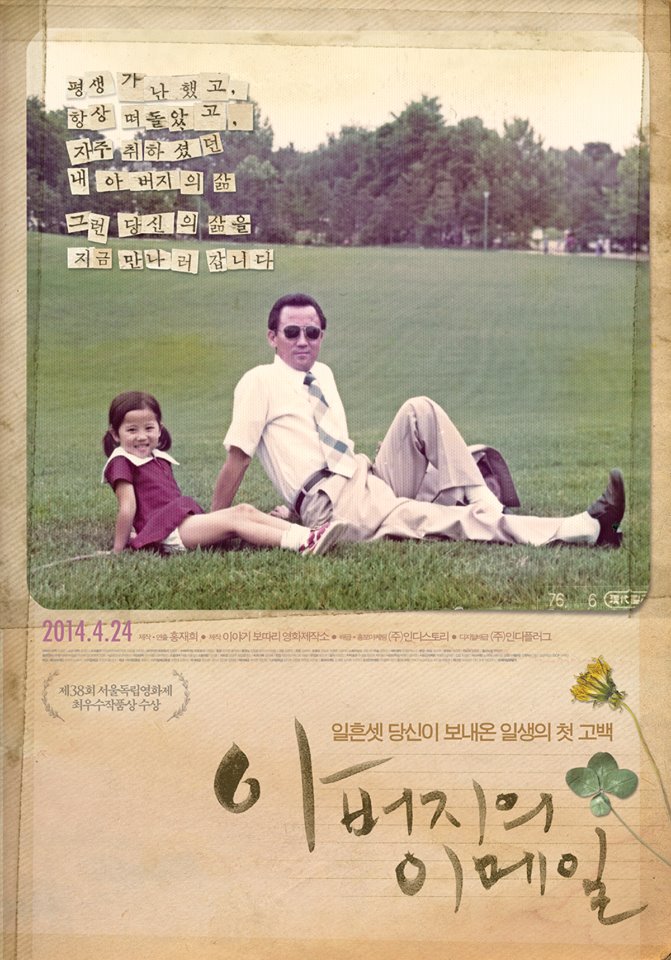
My Father’s Emails (아버지의 이메일) is a lovingly told documentary with an incredible premise. Following her estranged father’s death, director Hong Jae-hee (홍재희) finally decides to read the 43 emails he had sent shortly before he passed away. Initially director Hong had ignored the emails; after years experiencing her father’s alcoholism and domestic abuse, there was little reason to open them. Yet the emails were intriguing, not only as her father was a far cry from being technologically competent but also as she was the only family member to receive them. The contents of the emails were of enormous surprise for the director as her previously reclusive father had written an autobiography of sorts, articulating startling events that forged him into the man she knew.

Fascinated about the father she once despised, director Hong begins exploring his past and his decisions so inherently tied to Korean history. Yet in her quest to understand she is also forced to confront the family trauma that still proves extremely raw for her mother and siblings.

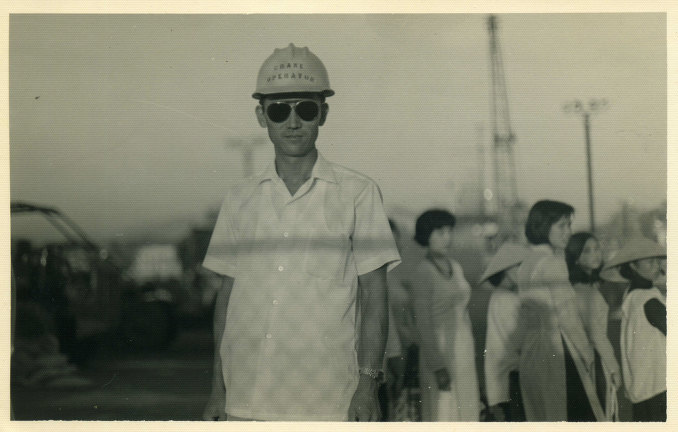
Director Hong's father often worked abroad in a bid to achieve his dreams

Director Hong’s father often worked abroad in a bid to achieve his dreams

One of the great strengths of My Father’s Emails lies in the way director Hong’s father made his life choices in conjunction with pivotal events in recent Korean history. In portraying his formative years and the national issues that influenced him, the documentary therefore becomes not only a personal and intimate portrait of a man struggling to find his way in the world but also takes on an historical significance. Hong combines her startling realisations from the emails about a man she barely knew with interviews of those close to him, old photographs, and occasional reconstructions, all of which bring her father’s journey vividly to life. His arduous migration from North Korea as a penniless teenager through to the successes and failures of his business ventures both domestic and abroad paint a fascinating portrait of the era, and the soul-destroying difficulties endured by those attempting to create a better life. Indeed, there is such a wealth of intriguing information regarding this period that the incredibly fast pace Hong employs to such scenes is puzzling and a tad frustrating. Events are rapidly introduced before moving on to the next, and a slower pace with greater depth would have made the connection with her father – and Korean history – much stronger.

Director Hong does however slow things down when exploring the family trauma left in her father’s wake. The frank interviews with her long-suffering mother as they discuss his alcoholism and domestic abuse is moving and intimate, while the anger displayed by Hong’s siblings clearly articulate the legacy he constructed due to his addiction. Yet what makes these scenes so interesting is that Hong continues to probe for answers as to the cause of her father’s depression and behaviour, refusing to simply judge and desperate to finally understand the man whom she had previously hated for most of her life. It’s a powerful message, and one that Hong captures with sincerity.

Director Hong's father always seemed to be on a journey, even in death

Director Hong’s father always seemed to be on a journey, even in death

My Father’s Emails (아버지의 이메일) is an intimate documentary with a fascinating premise. In exploring the 43 emails sent by her father after his death, director Hong Jae-hee (홍재희) attempts to understand her estranged parental figure. The film is a great examination not only of her father but of recent Korean history, to which his decisions, successes and failures were so inherently tied to, and which in turn formed the basis for tragic family trauma. While it has pacing issues and is somewhat of a documentary of two halves, My Father’s Emails is a moving and sincere account of Hong’s desire to better understand a man she barely knew.

★★★☆☆

Reviews
Yong-ju and Gi-woong contemplate their lives atop Night Flight

Night Flight (야간비행) – ★★★★☆

Night Flight (야간비행)

Night Flight (야간비행)

Premiering to high praise at the 2014 Berlinale, director Lee Song Hee-il’s (이송희일) insightful and thought-provoking drama Night Flight (야간비행) continues to build upon themes explored in his previous work. Homosexuality in contemporary Korea and the resultant alienation are joined by explorations of the country’s notoriously harsh education system as well as social injustice, making the coming-of-age film arguably the director’s most fully formed work to date. With Night Flight, director Lee Song is rapidly cementing his position as Korea’s most prominent and influential queer filmmaker.

Like most teenagers in Korea, high school students and best friends Yong-ju (Kwak Si-yang (곽시양) and Gi-taek (Choi Jun-ha (최준하)  struggle with an overwhelming amount of study and the pressure to attend a top university. Yet the duo’s lives are further complicated as Gi-taek is relentlessly bullied and beaten by the school’s ‘elite’ while Yong-ju, raised by his single-parent mother, is gay and unable to express his sexuality for fear of repercussions. Yong-ju has long harbored a crush on violent head-bully and low-level gangster Gi-woong (Lee Jae-joon (이재준) since middle school, who also attempts to cope with an extremely troubled life. When Yong-ju decides to make a pass at Go-woong, events are then set in motion that forces them all into a powerful confrontation.

Yong-ju harbors a secret crush on fellow student Gi-woong

Yong-ju harbors a secret crush on fellow student Gi-woong

Director Lee Song Hee-il’s films are always absorbing explorations of the alienation gay men experience within contemporary Korea, and Night Flight certainly doesn’t disappoint. Within the film director Lee Song has focused on an area he has previous only briefly touched upon in his short Suddenly, Last Summer – the fraught experiences of gay teenagers. Night Flight is made up of a collection of real life stories the director has acquired over a number of years from the media and word of mouth, and it’s to his credit that they are collated into a convincing, compelling whole. Yet what sets Night Flight apart from director Lee Song’s prior films is that while homosexuality is a central theme it is not the sole focus of the story. A great number of social issues that Korean teenagers experience, including the enormous pressures of the education system, single-parent families, the class divide, and social injustice all feature within the narrative and are insightfully explored throughout. By featuring issues found in other acclaimed teenage indie dramas such as Pluto and Bleak Night, director Lee Song naturalises homosexuality as another facet of identity that youths struggle with as opposed to a constant sense of ‘otherness’, which is a welcome change indeed.

Night Flight is also yet another showcase for director Lee Song’s incredible vision for landscapes and composition. The cinematography is quite striking throughout the film, with the decrepit and poverty stricken environments portrayed with a great sense of foreboding, of a society crumbling under its own archaic issues. The fences and bars that appear throughout the district, so often wonderfully foregrounded, imply the prison within which these long-suffering teens occupy and are unable to escape.

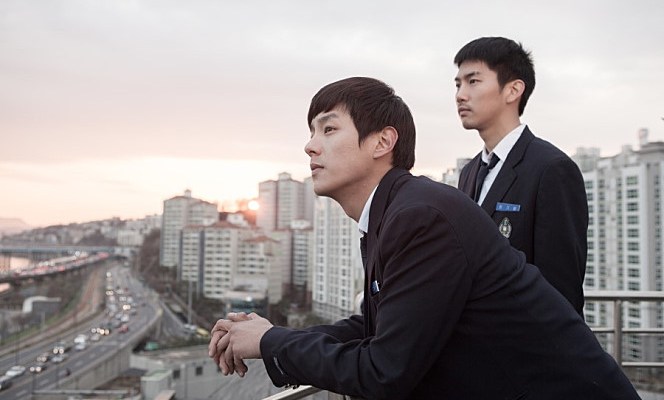
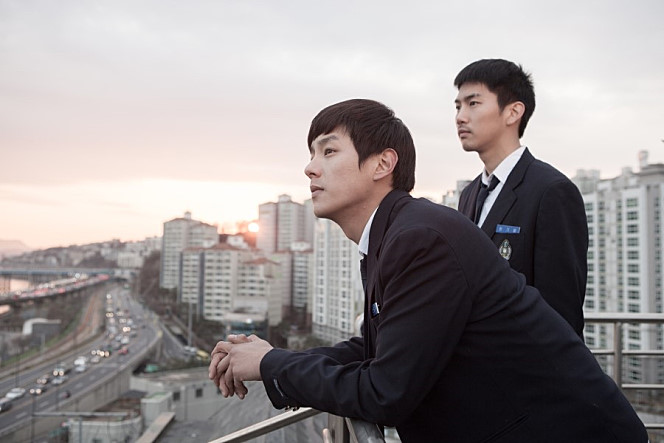
Yong-ju and Gi-woong contemplate their lives atop Night Flight

Yong-ju and Gi-woong contemplate their lives atop Night Flight

Yet the film is not all grim landscapes as director Lee Song allows his characters occasional reprieves in the form of glorious sunsets, particularly atop former gay hotspot bar ‘Night Flight.’ This private arena, situated at the top of a dilapidated building, not only provides a great metaphorical resonance of escapism from the confines of a rigid society but also allows the troubled teens freedom of expression, with the conversations containing penetrating insight into the issues confronting them.

Night Flight is also an interesting variation for director Lee Song as not all of the principal characters are gay. Central protagonist Yong-ju is the only distinct homosexual voice with the film, while his friend Gi-taek exposes the bullying within Korean culture and ambiguous love interest Gi-woong personifies social injustice. All the cast give competent performances in their roles, although their rather obvious older-than-high school ages tends to be a distraction. As the narrative caters for a variety of perceptions and experiences that effect Korean teenagers Night Flight eloquently fits within the canon of provocative films about Korean youth. While the story is a little over-ambitious in attempting to contain so many social issues, Night Flight is well constructed and many of the disparate problems that feature are seen through to their respective conclusions.

The troubled teenagers dream of escape from the confines of a crumbling society

The troubled teenagers dream of escape from the confines of a crumbling society

Night Flight is an insightful and provocative teenage drama by Korea’s most notable queer filmmaker, director Lee Song Hee-il. In exploring homosexual themes of alienation in conjunction with an array of other youth and social issues such as education and the class system, director Lee Song has crafted a powerful coming of age story of identity and the desire for escape. Night Flight is a welcome addition to not only queer but also youth film, and is arguably the director’s most fully formed film to date.

★★★★☆

Jeonju International Film Festival (제15회 전주국제영화제) Korean Festivals 2014 Reviews