The 17th Puchon International Fantastic Film Festival

PiFan 2013: The 17th Puchon International Fantastic Film Festival

The 17th Puchon International Fantastic Film Festival

The 17th Puchon International Fantastic Film Festival

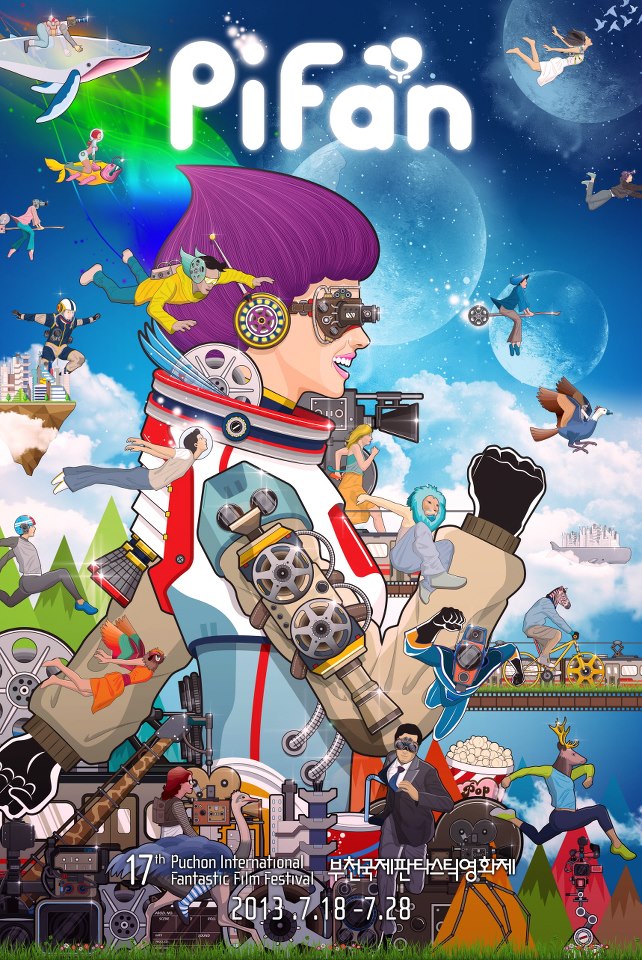
The Puchon International Fantastic Film Festival – or PiFan, for short – is gearing up for its 17th installment commencing this coming July 18th and running through to the 28th.

As is always the case with PiFan, the focus on genre films means a quite eclectic range of screenings from a variety of countries, and the 2013 edition continues the trend. A total of 219 films – 133 feature films and 86 shorts – from 40 countries are on offer, opening with the Asian premiere of animated all-star cast feature The Congress by director Ari Folman, and closing with the World Premiere of Korean film The Terror Live (더 테러 라이브) by director Kim Byeong U (김병우).

The Congress

The Congress

Opening Film The Congress

Israeli director Ari Folman, who previously made waves with Waltz With Bashir in 2008, finally returns to the director’s chair with The Congress. An international co-production between Israel, Germany, France, Luxembourg Poland and Belgium, The Congress features an all-star cast in a story that sees Robin Wright ‘sell’ her image to create a digital actress. However in doing so she can never act again, and more importantly, she loses all rights in the control of her very image. Please see below for the trailer:

The Terror Live (더 테러 라이브)

The Terror Live (더 테러 라이브)

Closing Film The Terror Live (더 테러 라이브)

PiFan wraps up the festival with the world premiere of Korean film The Terror Live (더 테러 라이브). Director Kim Byeong U’s (김병우) thriller features Ha Jeong-woo (하정우) as disgraced anchorman-turned-radio host Yoon Young-Hwa. When a terrorist calls the show threatening to blow up a bridge, Yoon calls it a hoax – only for the bridge to explode. Believing this to be an opportunity to become a TV anchorman once more, Yoon works hard to become involved in the incident, only for it to escalate even further. Please see below for the trailer:

Furthermore, PiFan will feature several films by some of the most prolific directors working today, including Johnnie To – Blind Detective, Drug War -, Miike Takshi – Shield of Straw, Lesson of Evil – and a special program dedicated to Japanese director Tsukamoto Shinya – Tetsuo, The Iron Man, Tetsuo II: The Body Hammer, Tokyo Fist, Bullet Ballet, A Snake of June and Kotoko.

Cult films will be present in the Ourselves, Our Robots: The Thin Line Between Human and Robot showcase, featuring the likes of THX 1138, Robocop, Manborg, The Machine, and Computer Chess. Meanwhile Urban Cult: The Dark Side of the City will feature The Warriors, Escape From New York, Maniac, Maniac Cop 2 and Vigilante.

Fo the full line up and timetable of screenings, please visit the official PiFan website here.

Festival News Korean Festivals 2013 Puchon International Fantastic Film Festival (제17회 부천국제판타스틱영화제)
My Place (마이 플레이스)

My Place (마이 플레이스) – ★★★★☆

My Place (마이 플레이스)

My Place (마이 플레이스)

The best kinds of documentary are the ones where the audience and those within the film itself undertake the same journey of discovery, sharing revelations and introspections about a particular topic that ultimately change the perspectives of those both sides of the camera. This is acutely the case with director Park Moon-chil’s My Place, a highly personal account of the director’s own family history and trauma. Director Park explores the inherently Korean cultural clashes of traditional ideology versus the contemporary, Western individualism contrasted with Eastern collectivism, as well as gender and family politics, all through the microcosm of his own family unit. Beginning with very traditional concerns over his unmarried sister’s pregnancy, the documentary charts how every member of the Park family is forced to re-examine themselves, their pasts, and their choices in order to welcome the new member into the fold. From beginning to end My Place is a heartwarming and illuminating film, thanks in no small part to the director’s wonderfully strong and charismatic sister who challenges familial and cultural issues head-on and emerges victorious.

My Place (마이 플레이스)

Cross-cultural trauma and single motherhood are problematic topics in Korea

Director Park’s sister Peace is very much the heart and soul of My Place, and the documentary is largely centered around the ramifications of her decision to be a single mother. In Korean culture unwed mothers are heavily stigmatized, and the film begins by attempting to address her perceived irresponsibility and whether abortion is a viable option. Yet as director Park converses about the issue with his parents, he begins to re-evaluate his own understanding of his sisters character through considering their shared history, and by interviewing her about her past and the pregnancy. The technique is superb, as the non-judgmental approach allows for layers of psychology and past traumas to be re-examined, and how they impact the decisions of the present. For instance, the film explores how the siblings were born and raised in Toronto which allowed their individuality and creativity to be nurtured, yet their forced relocation back to Korea at a young age provided an enormous culture shock that was difficult to cope with; the director even noting that school assemblies reminded him of the Nazis. The impact was greatest on Peace however, and the home videos and photographs of her childhood authentically capture her fraught and difficult childhood.

Old home videos add authenticity to the journey the family undertake

Old home videos add authenticity to the journey the family undertake

Director Park also applies such frameworks to his mother and father, and in doing so discovers more about what drove them in their youth and what shaped their decision-making processes so long ago. With the revelations of Peace’s unhappy childhood it would be all too easy to blame his parents, and while they indeed acknowledge responsibility for their choices, delving into their history stops the issue from being simple. Such scenes are brilliantly edited within the documentary not only for their seamlessness, but the constantly compelling revelations regarding his parents inspires audience introspection. Each member of the Park household is a fascinating person forged by history, and the loving care that director Park exhibits when filming them is palpable. This particularly applies in regard to Peace, as the directors respect and admiration for his sister clearly grows and develops during the course of the film.

Ironically what forces the family to re-evaluate themselves is the very thing that causes them worry – Peace’s pregnancy. And when her son Soul is born, witnessing the family gathering together and become stronger than ever is extremely poignant. Director Park charts the very early years of Soul’s life in similarly effective style, exploring how each member attempts to find a role in which to provide help and support, and the results are consistently moving, humourous and entertaining. Watching Peace working hard as a single mother, and Soul as he develops a personality of his own, is powerfully absorbing and captured with tenderness and sensitivity. One such scene involves Soul and his grandfather reading a storybook together, and the attempt to bestow morality lessons on the youngster is a beautifully funny moment. Director Park – and the audience – come to realise that the initial concerns over Peace’s pregnancy were unfounded, and that the strength and resilience she exhibits as a single mother are incredibly admirable. As such, My Place is emblematic of changing cultural attitudes, and is a wonderful testament to the love and bonds shared within the family.

Family trauma is revisited and healed through the birth of Peace

Family trauma is revisited and healed through the birth of Peace

Verdict:

My Place is a funny, enlightening, and wonderful documentary about the importance of family. By using his unwed sisters pregnancy as a catalyst, director Park Moon-chil uses his concerns as a springboard in which to explore the history and psychology of his mother, father, and most predominantly his sister Peace. In doing so director Park shares his revelations and changing attitudes with the audience, with each step constantly compelling as the family attempt to heal past traumas in order to welcome the new baby. A superb and lovely documentary.

★★★★☆

International Women's Film Festival in Seoul (서울국제여성영화제) Jeonju International Film Festival (제14회 전주국제영화제) Reviews
A former 'prostitute' throws candy at evil spirits while cursing American GIs.

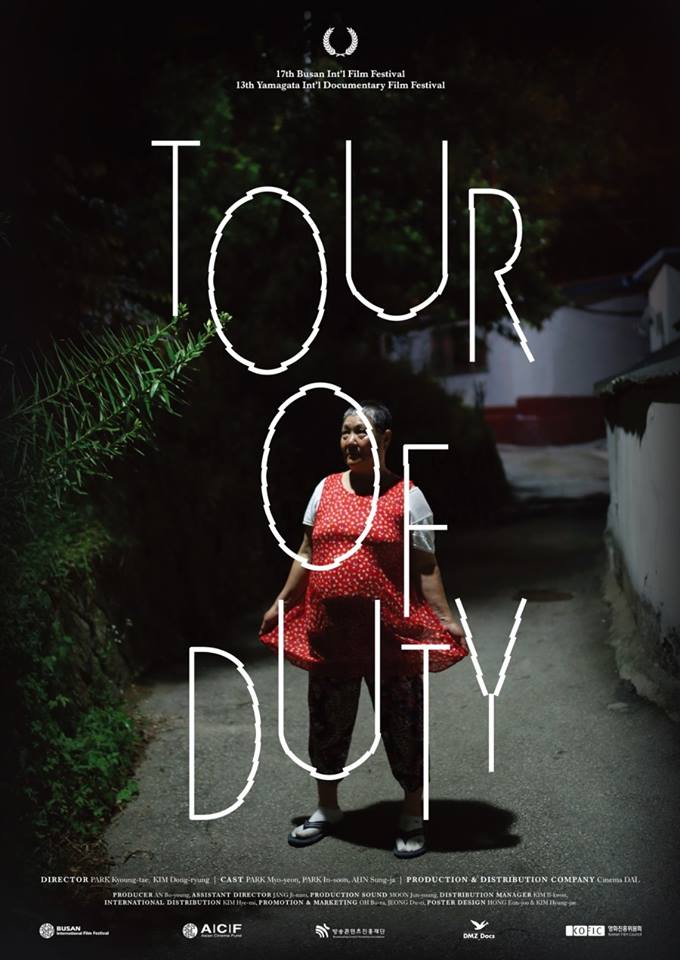
Tour of Duty (거미의 땅) – ★★★☆☆

Tour of Duty (거미의 땅)

Tour of Duty (거미의 땅)

The sexual slavery inflicted upon the women of Korea during the Japanese occupation is an oft-discussed topic in Korean culture, with the euphemistically labelled ‘comfort women’ still striving for acknowledgement of the abuses they suffered. Less debated, however, is how the Korean government similarly forced such atrocities upon the women of the country for the pleasure of the American military, which was required in order to keep ‘peace’ on the peninsula. The hypocrisy involved has been a genuine source of frustration amongst feminists, particularly in regards to terminology – as money was exchanged for such sexual services with the American GIs, the women are often referred to as ‘prostitutes’ despite the subjugation imposed upon them.

Tour of Duty (거미의 땅)

Tour of Duty opens with a heartbreaking tale

Tour of Duty (거미의 땅), by directors Kim Dong-ryung (김동령) and Park Kyoung-tae (박경태), is a documentary that seeks to address the experiences of such ‘forgotten’ women. The film explores the lives of women forced to provide sexual services in a military town in the Uijeongbu area, and the affects of a history of sexual bondage. It is a heart-breaking and gut-wrenching viewing experience as the handful of women who still live in the now dilapidated town share their stories, and the poignancy is difficult to overstate. Directors Kim and Park do well in simply allowing their subjects to recount their traumatic pasts and their own distinct personalities, accompanied by some very attractive cinematography that exemplifies the twisted, labyrinthian landscape of not only the area but also the psychological trauma within. Yet despite such initial potency Tour of Duty loses focus and compulsion due to each director attempting to impart their own creativity on the film, resulting in an incredibly overly-long running time of two and a half hours.

A former 'prostitute' throws candy at evil spirits while cursing American GIs.

A former ‘prostitute’ throws candy at evil spirits while cursing American GIs.

Tour of Duty opens in suitably powerful style, as a now-elderly lady discusses some of the awful abuses she suffered when the military town was fully operational. The frank, almost confessional-tone of the conversation which includes the number of sexual partners and abortions she endured in her youth is beyond moving, while the resilience and resolve that developed as a result is incredible to witness. Similarly, the other women within the documentary are also highly compelling as they recount not only their tragic history, but their current life of squalor. One such woman, who became infected with a venereal disease from an African-American soldier, walks around the desolated military town throwing candies to ward off evil spirits while screaming racial obscenities about the man who gave her the affliction. Another traverses the myriad of maze-like pathways searching through refuse, lamenting the loss of her children. Directors Kim and Park employing stunning cinematography for each woman, employing different and very effective cinematic techniques for each in order to convey the disparate characters within the film. One of the most powerful images in the film comes when trying to locate the town itself on a map. As the camera moves across the Uijeongbu district, the sheer number of former military towns starkly articulates that the women featured within Tour of Duty are symbolic of a great many such stories in the area.

Yet the documentary becomes problematic when it begins to explore the life of an African-American/Korean orphan. Her history, involving childhood abduction by the authorities and forced prostitution – in which she often made to ‘service’ up to 15 soldiers a day – is no less harrowing than the other pasts being recounted. However the manner in which her story is told is highly expressionistic and completely at odds with the prior documentarian aesthetic. As such it is very clear that two directors are collaborating, with their alternative visions never managing to form a cohesive whole. The result is two films that have been edited together in a rather rudimentary fashion, which detracts from the incredible poignancy of what came before. This also gives rise to the other big issue with the film in the form of the two and a half hour running time, which is far, far too long. This is a genuine shame as had the two quite different films been edited separately both would be much stronger pieces of film, particularly the superb documentarian aesthetic in which Tour of Duty began.

A Korean-American orphan explores the old brothels she was forced to work in

A Korean-American orphan explores the old brothels she was forced to work in

Verdict:

Tour of Duty is a powerful documentary about the sexual abuses suffered by Korean women in an American military town in the Uijeongbu district. The stories of sexual slavery are harrowing and poignant, while the government role by both Korea and America in the atrocities, as well as the ‘forgotten’ status of the women, makes for an important and sometimes upsetting viewing experience. Yet the film loses traction as directors Kim Dong-ryung and Park Kyoung-tae seek to impose their quite different visual styles – the documentarian and the experimentalist – and the two disparate aesthetic styles never combine into a cohesive whole and make an overly-long running time of two and a half hours. Despite this, Tour of Duty is a potent reminder of crimes from the recent past that should not be forgotten.

★★★☆☆

International Women's Film Festival in Seoul (서울국제여성영화제) Reviews
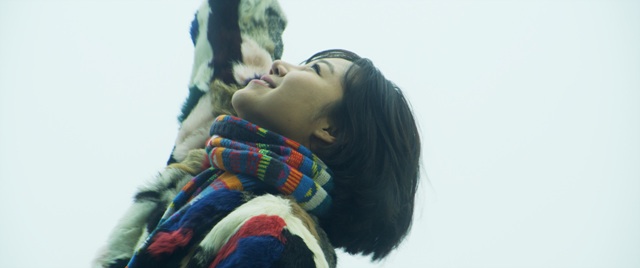
Actress Gong Hyo-jin is wonderfully charismatic as Yeong-hee

You Are More Than Beautiful (그녀의 연기) – ★★★★☆

You Are More Than Beautiful (그녀의 연기)

You Are More Than Beautiful (그녀의 연기)

Kim Tae-yong (김태용) is one of the few directors working in the Korean film industry who actively gives women a ‘voice’.  Rather than define female protagonists through relationships or position them as objects/commodities, director Kim’s films are consistently compelling through the articulation of fully-formed women’s roles.

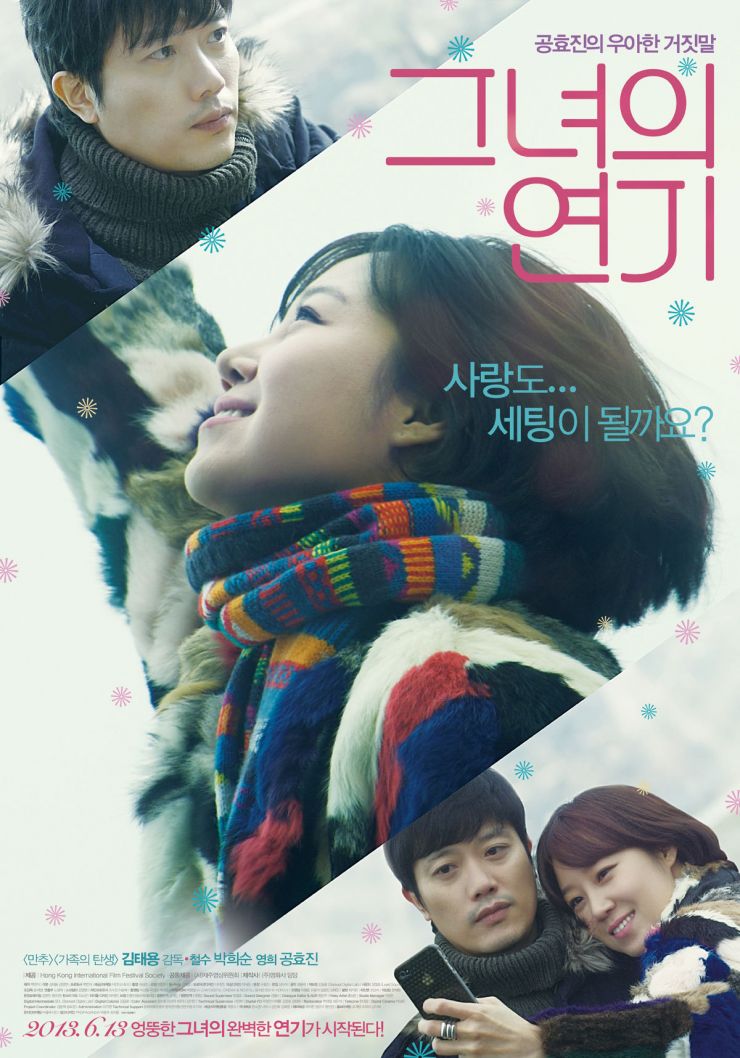
You Are More Than Beautiful (그녀의 연기) fits very much within such a framework. Indeed, the Korean titles literally translates as ‘Her Performance‘, an ironic title referring to both the director’s sensibilties as well as Gong Hyo-jin’s (공효진) outstanding acting talent. The 25 minute Hong Kong co-production is a highly charismatic short film, and despite the limited time frame manages to portray a lovingly nuanced and very entertaining romantic tale.

Upon learning of his terminally ill father’s condition, Jeju Islander Cheol-su (Park Hee-soon (박희순) must quickly return to his hometown to say a final farewell. However, wishing to show his father that he will be taken care of, Cheol-su hires an actress, Yeong-hee (Gong Hyo-jin), to act as his fiancee. Upon meeting the actress at the airport, Cheol-su quickly discovers Yeong-hee’s incredible positivity and charisma as she tries her utmost to fulfill her role.

Yeong-hee and Cheol-su meet at the airport, ready for their roles

Yeong-hee and Cheol-su meet at the airport, ready for their roles

First and foremost, the reason You Are More Than Beautiful is such a lovely short film is due to the superb performance of Gong Hyo-jin. From the moment she enters the film at the airport through to the final credits, the actress is constantly charismatic and it’s impossible not to be won over by her positivity. The title is particularly apt as Gong Hyo-jin is indeed very attractive, yet that is not what defines her character. It is Yeong-hee’s indomitable spirit and her cheeky-yet-playful personality that makes her so compelling to watch. Whether taking pictures in the countryside to reinforce the charade, or simply having a conversation to discover Cheol-su’s personality, Yeong-hee is a beautiful person both inside and out. Yet where the protagonist really shines in in meeting her fake fiancé’s terminally ill father. Her rendition of traditional Korean opera, as well as her interactions with the elderly gentleman, are a joy to behold due to the poignancy and heartwarming comedy embodied by the actress.

Actor Park Hee-soon also provides a great foil as stoic and sombre Cheol-su. The reason for his melancholy seems to go beyond his father’s illness, with the washed out colour palette conveying his depression well. Watching Cheol-su’s reluctance to engage with Yeong-hee’s positivity is wonderfully entertaining, as her zest for life slows chips away at his cold exterior yet he still attempts to keep her at a distance. The mismatched couple convey more heart and emotional connection than most films manage in three times the length, which is an incredible feat.

To flesh out the facade, the couple discover each other's traits

To flesh out the facade, the couple discover each other’s traits

Director Kim has stated that prior to filming You Are More Than Beautiful, all he prepared were the camera and the cast. This is quite surprising as the cinematography is very attractive throughout the film, particularly the manner in which the natural beauty of Jeju Island is captured. The roads and paths, as well as the horse farm, highlight the unspoiled nature of the island and as such conveys the romanticism with which Jeju has become renowned. Similarly, while the great outdoors looks gorgeous, director Kim employs some wonderful symmetrical shots to emphasis different stages of the evolving relationship between Yeong-hee and Cheol-su to great effect.

Yet despite such praise, the film isn’t quite perfect. It’s a credit to director Kim and the actors involved that although a lot of events occur during the 25 minute running time, there is still a desire for more. This certainly could have been achieved with more development ascribed to Cheol-su, whose character isn’t as fully-formed as Yeong-hee. Yet with Gong Hyo-jin on such amazing form it is entirely understandable, as her enthralling charisma and grace make the film so compelling.

Actress Gong Hyo-jin is wonderfully charismatic as Yeong-hee

Actress Gong Hyo-jin is wonderfully charismatic as Yeong-hee

Verdict:

You Are More Than Beautiful is a delightful short film by director Kim Tae-yong. As one of the few directors in the Korean film industry creating fully-developed female roles his films are always interesting, and actress Gong Hyo-jin takes full advantage of the opportunity to perform her acting talent. Throughout the film she is utterly compelling and wonderfully charismatic, living up to the title as her passion for life and positivity make her more than an attractive women. A lovely short film.

★★★★☆


International Women's Film Festival in Seoul (서울국제여성영화제) Reviews
Vulnerability, as well as strength, are portaryed through the ajumma

Azooma (공정사회) – ★★★☆☆

Azooma (공정사회)

Azooma (공정사회)

The revenge thriller is often synonymous with Korean cinema, thanks largely to the successes of director Park Chan-wook and his contemporaries. Yet with the exception of Lady Vengeance, this realm of darkness and violence is very much dominated by men. Despite their stake in the evils perpetuated on the characters, women are marginalized into supporting roles while righteous torture and murder are masculine concerns.

Azooma (공정사회) changes that by having the central female protagonist directly involved in the action, in conjunction with tapping into socio-cultural concerns of child rape and a corrupt and overly-lenient legal system. Due to such content it’s perhaps unsurprising that Azooma – a variation on the spelling of ‘ajumma’, meaning middle-aged woman – is an independent production, giving director Lee Ji-seung (이지승) the freedom to pursue such cathartic female-lead violence. However this freedom is also the films undoing particularly in regard to the editing, which detracts from an otherwise thrilling revenge tale.

A single mother (Jang Young-nam (장영남) is late picking up her daughter Yeon-joo (Lee Jae-hee (이재희) from school, and as the 10 year old walks home alone she is abducted and raped by a man (Hwang Tae-gwang (황태광). Luckily finding Yeon-joo after the incident, the ajumma immediately takes her daughter to hospital for surgery and contacts her estranged husband (Bae Seong-woo, 배성우) for help. Yet he is more concerned with his own reputation, while the detective in charge of the case (Ma Dong-seok (마동석) seemingly couldn’t care less about apprehending the criminal. Devastated by the impotency of law enforcement, the ajumma decides to take the law into her own hands and find the paedophile herself.

Yeon-joo is abducted by a stranger after school

Yeon-joo is abducted by a stranger after school

The original Korean title ‘공정사회’ means ‘fair society’, and the irony is certainly not lost in translation. One of the great strengths of Azooma is the manner in which patriarchy as a whole is conveyed as responsible for what happens to Yeon-joo. Director Lee portrays an array of misogynistic issues that combine to place both mother and daughter as victims within contemporary society, and not just from a crime. Indeed, the reason the ajumma is late to meet Yeon-joo after school is due to a business meeting with a creepy older man, featuring some potent close-ups of her pulling down her skirt and covering herself to avert his gaze. Yet by far the most villainous character in the film is Yeon-joo’s father, who encapsulates the hypocrisy and selfishness of contemporary masculinity acutely well. He is of the ideology that sex is something ‘shameful’ for a female, and his fury that Yeon-joo is taken to a hospital where he knows people is as shockingly offensive as it is sickeningly real. Merely concerned for his own reputation rather than his daughter’s well being, the father brilliantly articulates the survival of traditional misogyny in modern society and serves to build frustration and pressure – for both the ajumma and the audience – incredibly well.

While it may come as a shock to some, Azooma is actually based on a true story. Director Lee does a great job in targeting the overly lenient law system for sex offenders as lacking any credibility, and ultimately forcing the ajumma to locate the criminal alone. Building on issues raised by prior films such as Silenced (also based on a true story) and Poetry, Azooma deftly conveys that even if Detective Ma were concerned with apprehending the paedophile, the criminal would most probably receive a light sentence – perhaps even as little as six months. The scenes in which the paedophile covers any trace of his DNA are simultaneously frightening and repulsive, as it is quite clear that this is not the first time he has committed such an act, and with the indifferent attitude of the police force it will not be the last. The unbelievable obstructions of justice caused by men prompt the ajumma to search for the criminal herself using clues provided by her daughter, and amazingly she finds him. It is here however that the true story ends as the ajumma confronts her daughter’s attacker, leading to suspense-filled sequences.

Due to ineffective police work, the ajumma tracks the criminal herself

Due to ineffective police work, the ajumma tracks the criminal herself

While director Lee builds tension well and continually provides acute criticism of contemporary Korean masculinity and their institutions, he is also given too much free reign in the post-production department. The editing within Azooma is the downfall of the film, as there is simply far too much non-linear editing over the course of the film. There are so many jumps to different times and events that often the suspense and desire for revenge, which took time and effort to generate, dissipates. This is a genuine shame as had the editing been a little more linear, the film would be arguably much more poignant and powerful.

Despite such criticisms the film manages to right itself in a quite thrilling final act in which the ajumma, completely dejected by the maltreatment she and Yeon-joo have suffered, seeks retribution. Simultaneously difficult yet enthralling to watch, the scenes of torture last long in the memory as the ajumma dishes out her own unique brand of justice. It is a testament to the issues within the film that such violence is not only desirable, but actually feels too short; even with the torture, it still seems as if the criminal didn’t suffer enough. It is wonderfully impressive to finally see a Korean woman at the helm of such violence. Even in Lady Vengeance, Geum-ja exists to provide vengeance for other grieving parents. With Azooma, the audience can witness a woman directly affected by a crime take control of the situation and emerge reborn. While all the loose ends are tied up a little too neatly, the violence is highly cathartic while the narrative itself contains numerous areas of debate, and as such Azooma is an impressive revenge thriller.

Disillusioned with patriarchal institutions, the ajumma prepares for her own brand of justice

Disillusioned with patriarchal institutions, the ajumma prepares for her own brand of justice

Verdict:

Azooma is a potent revenge thriller concerned with a mother who seeks retribution after her daughter is raped. Director Lee Ji-seung wonderfully conveys the temperament of the ajumma as she is pushed to breaking point by patriarchal society, and it is enthralling to see a Korean woman at the helm of such violence as it is such a rarity. While the non-linear editing is overly used to the point of dissipating the tension, the narrative is consistently compelling as misogyny is explored, corruption and leniency in law enforcement is exposed, and a female protagonist enacts arguably justifiable vigilante torture.

★★★☆☆

Reviews
Circle Line (순환선)

Modern Family (가족 시네마) – ★★★☆☆

Modern Family (가족시네마 )

Modern Family (가족시네마 )

Modern Family (가족 시네마) is a collection of four short films that explores the different forms of trauma that can occur for contemporary families. Each story is a very interesting and well-crafted vision of the issues facing the family unit, with each respective director’s style shining through in the quest to articulate the emotional complexities of the situation.

The short films deal with a surprising array of topics including unemployment, the loss of a child, parental responsibility and women’s rights in the workplace. What is wonderful about each entry is the sincerity in which the issue is explored. Often subtle and understated, Modern Family is an insightful film about the complexities of family and the attempts to survive in contemporary society.

Yet ironically, as each short film is so interesting, they all feel as if they end too soon. All four directors have chosen potent topics to explore, and the short time limit means that each respective story feels cut short. The depth each director has applied in examining familial issues is powerful yet seems to only scratch the surface of the situation. It is a testament to the director’s skill that each entry causes a desire for more information, but it is a desire that, for the most part, goes unfulfilled.

In the interest of fairness, each short film is reviewed individually, before a final summary.

Circle Line (순환선)

Circle Line (순환선)

Circle Line (순환선) – ★★★★☆

Director Shin Su-won’s (신수원) Circle Line is the most prestigious entry within Modern Family, having won the Canal+ prize at Cannes in 2012. The award is thoroughly deserved, as director Shin employs some wonderful artistic shots and symbolism in exploring the life of a middle-aged man who has recently been made unemployed. To make matters worse, his wife is soon to give birth to their second child. Depressed and ashamed, the man simply travels on the subway circle line all day, searching for jobs on his laptop and observing the assortment of characters that come and go. Director Shin articulates the man’s frustrations superbly through the mise-en-scene and the minor, but highly symbolic, confrontations that arise. Jeong In-gi (정인기) is also terrific as the redundant father-to-be, providing a restrained performance that suddenly explodes when tensions become too much to bear. Circle Line is as much a commentary on contemporary masculinity, economy, and society as it is about family, and it’s the subtle manner in which each area is dealt with that makes the film so compelling.

Star-shaped Stain (별 모양의 얼룩)

Star-shaped Stain (별 모양의 얼룩)

Star-shaped Stain (별 모양의 얼룩) –  ★★★☆☆

Star-shaped Stain is arguably the most poignant film in the omnibus, as director Hong Ji-young (홍지영) examinations a couple whose daughter died through tragic circumstances. Initially the couple seem to be coping extremely well with the loss, however with the anniversary of the youngster’s death the barriers that they have built to cope with the trauma gradually wear down. Director Hong does a great job of gently peeling back the layers of the protagonists, particularly of the mother (Kim Ji-young, 김지영) who feels such a tremendous sense of guilt that she continuously revisits the events of her final encounter with her daughter. The real tragedy comes in the form of the hope that her daughter is alive, as the once composed woman begins to unravel which is genuinely heartbreaking to witness. The moving film is unfortunately cut short just as it starts to become seriously compelling, as the protagonists are pushed into highly emotional and psychological territory but then abruptly ends. This is a real shame as there is a lot more potential to be explored, but which never materializes due to the limitations of the running time.

E.D.571

E.D.571

E.D.571 –  ★★★☆☆

Director Lee Soo-yeon’s (이수연) entry is the only one which adds a more science-fiction sensibility to the exploration of family by setting the story in the year 2030. A workaholic career woman (Seon Woo-seon, 선우선) leads a rather lonely life, living purely to work. Yet it is thrown into disarray when a young girl (Ji Woo, 지우) appears on her doorstep claiming to be her biological daughter, the result of selling an unfertilized egg in order to pay for tuition years prior. The film is a commentary on parental responsibility with the media full of reports about criminal youths and gangs, but with the arrival of the biological daughter it becomes clear that such actions are the results of awful parenting and neglect. However E.D. 571 doesn’t really explore the issue with the depth required for it to be insightful, with mentions of certain situations but lacking the psychological and emotional depth for them to carry any weight. Part of the reason is the decision to shoot the entire confrontation in the woman’s home in the form of a battle of wits which, while certainly interesting, doesn’t really get to the heart of the issues being referenced.

In Good Company (인 굿 컴퍼니 )

In Good Company (인 굿 컴퍼니 )

In Good Company (인 굿 컴퍼니) –  ★★★☆☆

In Good Company is an excellent examination of the misogyny and unfairness women are forced to endure in contemporary Korea. Director Kim Seong-ho (김성호) also wisely shoots his film in the form of a documentary adding a greater sense of realism, while adding dramatic ‘reconstructions’ of the events that occurred as a pregnant worker is forced to resign in order to save a company providing maternity pay. Interestingly, rather than centering the argument around exploitative patriarchy through the male boss – performed ably by Lee Myeong-haeng (이명행) – the narrative emphasises the work ethic within Korean culture, and the lack of female solidarity, as the source of the problem. This is where In Good Company really shines, as the women who should know better and support each other actually perpetuate the misogyny, which is a highly refreshing take on the subject. While the film explores the issues well, it is ultimately let down in the quest to tie up all the narrative loose ends through a contrived finale which undermines what came before.

Verdict:

Modern Family is an insightful collection of 4 short films concerned with trauma in the contemporary family unit. Each director – Shin Su-won, Hong Ji-young, Lee Soo-yeon and Kim Seong-ho – have each produced work that exemplifies their unique styles as well as exploring quite diverse areas, and the omnibus is consistently compelling throughout. The time limitations do have a negative impact on the storytelling however, as just as the narrative begins to push their protagonists in dramatic directions the film is cut short, or the rush to tie everything up leads to contrivances. Despite this, Modern Family is a thought-provoking drama, and a great showcase of directing talent.

 ★★★☆☆

International Women's Film Festival in Seoul (서울국제여성영화제) Reviews
BRA (브라자)

WFFIS 2013: Quick Fire Reviews 3

The quick-fire reviews featured here are from the Asian Short Film and Video Competition (아시아 단편경선):

BRA (브라자)

BRA (브라자)

BRA (브라자) – 7/10

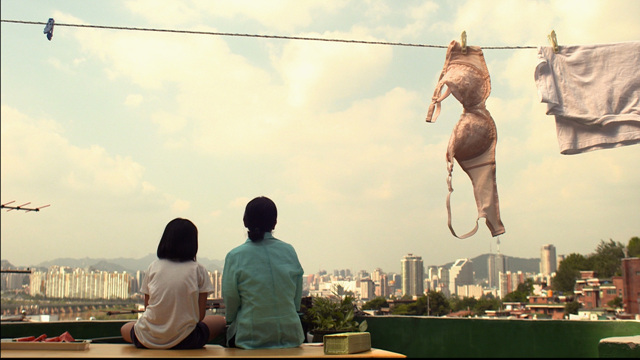
Director Won Jan-di’s (원잔디) coming-of-age drama is a lovely and compelling story about a young girl called Da-young on the verge of entering adolescence  The tale encapsulates a wide spectrum of human emotion as Da-hyung desires to be seen as a woman by the boy she likes, and as such focuses on breasts as the sign of womanhood. As Da-young steals her grandmother’s bra and attempts to create breasts of her own, the film becomes a heart-warming tale of innocence with sweet moments of genuine comedy and drama. Director Won also seeks to create a comparison between Da-young and her grandmother, who is going through similar trials of her own. Yet as the grandmother’s story isn’t as developed as Da-young’s it serves to detract from the main story, although their discussion about entering womanhood is poignant and insightful. Certainly one of the better short films in the competition.

Chunjung (춘정)

Chunjung (춘정)

Chunjung (춘정) – 4/10

To be honest, it’s quite difficult to accurately review Chunjung as the English subtitles were so awful that the story was difficult to follow. Director Lee Mi-rang’s (이미랑) entry follows Chinese immigrant Chunjung, who joins an agency which cons elderly Korean people into parting with their money. It’s illegal of course, yet she forms relationships with the other women working there. It’s an odd film, as Chunjung appears to be mentally ill as well as illiterate, while the women at the agency always seem to talk about finding a man. Ultimately the film does very little to explore either the immigrant experience or Chunjung as a character, although hints of such may have been missed due to the terrible subtitles.

Fitting Room (피팅룸)

Fitting Room (피팅룸)

Fitting Room (피팅룸) – 4/10

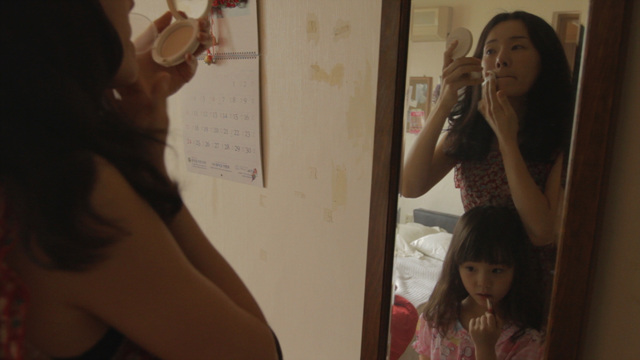
Fitting Room is concerned with a mother who wishes to have a life of freedom, but can’t due to her young daughter. It is extremely difficult to empathise with the mother as she treats her daughter terribly throughout, never talking to her or attempting to understand the youngster. The turning point comes when the mother hides the sleeping girl in a closet in order to have sex with her boyfriend, which seems to be the catalyst for wishing to be a better mum. Director Oh Jung-mi (오정미) is clearly attempting to explore the evolving relationship between a bad single mother and her innocent daughter, but there is little depth due to the lack of dialogue and restriction within an apartment.

Mija (미자)

Mija (미자)

Mija (미자) – 6/10

Director Jeon Hyo-jeong’s (전효정) examination of lonely middle-aged woman Mija is an insightful, poignant, and often comedic short film. Her secret lover is a younger Nepalese man – a feature which sadly instigated gasps amongst the audience – and Mija decides to purchase tickets for them both to visit his homeland. The real power of the film lies in Mija’s desire to overcome her jealousies and her age through cosmetics and other methods, yet is ultimately unable to do so. The film is a poignant and moving depiction of a single middle-aged woman who wishes to change her life, with just enough comedy to keep the narrative from becoming bleak.

Mira's Will (미라의 의지)

Mira’s Will (미라의 의지)

Mira’s Will (미라의 의지) – 5/10

One of the more straightforward comedy offerings, Mira’s Will tells the story of a lonely young woman who has yet to experience her first kiss. The film is often more mildly amusing rather than funny, although the advice given by a friend to enhance her sex appeal – not to wear underwear on a date – adds some laughs. Director Lee Eun-jeong’s (이은정) entry is entertaining, especially witnessing Mira take control of her sexuality in order to seduce a man, but suffers as she is so desperate she’s willing to accept anyone. The film also doesn’t end well as wearing no panties on a date leads to a predictable outcome. However it is refreshing to see a female character take control of her sexuality – and to desire sex – without any connotations of shame, and as such is an enjoyable tale.

The Room of Drink (살롱 드 보아)

The Room of Drink (살롱 드 보아)

The Room of Drink (살롱 드 보아) – 3/10

The Room of Drink is an exploration of the way in which women are exploited in hostess bars by wealthy men. The premise is full of potential, as the hostess bar culture in Korea highlights one of the more accepted forms of misogyny within the country. However the film fails to scratch any of the surfaces that are so ripe for examination. When a pretty, young office worker is asked to drop by such a bar to provide documents for her boss, she is ushered into acting like a hostess, pouring drinks for her boss’ companion and allowing him to touch her. The unease is palpable, although never moves into the realm of tension, while the glares passed between the office worker and the real hostess convey an odd mix of jealousy and judgement that are not really explored. A missed opportunity by director Sohn Hae-sook (손해숙).

Festival News International Women's Film Festival in Seoul (서울국제여성영화제) Korean Festivals 2013 Reviews
Bad Scene (배드신)

WFFIS 2013: Quick Fire Reviews 2

The quick-fire reviews featured here are from the Polemics: The Constellation of the Violence Against Women (쟁점: 보이지 않는 – 폭력의 관계구조) section:

Bad Scene (배드신)

Bad Scene (배드신)

Bad Scene (배드신) – 6/10

Bad Scene depicts the story of struggling actress Jin-hong who, due to her 28 years of age, fails to get the part of a high school student. However there is a role in the film suitable for her, but it involves a lot of nudity. Writer/director Jeon Go-woon (전고운) explores the internal conflict of a woman who wishes to succeed yet must use her body to do so, highlighting the serious issue of the physical exploitation of women in the workplace. Yet ironically the strength of the film doesn’t lie in the main story, but in events that surround it. Jin-hong tapes her breasts to be upright and perky, and sexualizes herself in school uniform, even before the nude role is offered.  In attempting to prepare for the sex scene, Jin-hong asks a male friend to help but in doing so is almost raped, as he protests that she, “started it.”  The psychological and psychical exhaustion she suffers are clear throughout, yet the main problem with Bad Scene is that in depicting her private life the film loses focus on the actual ‘bad scene’ itself and the way women are exploited on camera. A moving and thought-provoking drama that could of benefited from greater focus and/or an extra ten minutes for exploration.

Deviation (도착)

Deviation (도착)

Deviation (도착) – 5/10

Director Lee Min-beh (이민배) explores the ‘male gaze’ and the hypocrisy of masculinity in Deviation. On the subway Su-jin overhears men discussing the leak of a sex tape by a prominent actress, and the rampant misogyny in their ideology as they chastise the actress yet are excited by watching it. However the film then takes an awkward turn as Su-jin visits a police station due to the arrest of her boyfriend, who has been secretly taking pictures of women’s legs. The hypocrisy of the officers is explored as they accuse the boyfriend of perversion yet do so themselves, and make up appallingly sexist reasons for  the crime. Much of the running time is spent in the station which is unfortunate, as the conversations are generally pushed too far beyond the realm of believability for it to be of consequence. Yet director Lee does finish on an ironic and pertinent end note, by directly accusing the audience of sexism through the voyeurism of the camera itself, which is a nice touch.

My, No Mercy Home (잔인한 나의, 홈)

My No Mercy Home (잔인한 나의, 홈)

My No Mercy Home (잔인한 나의, 홈) – 7/10

Documentary My No Mercy Home is a powerful viewing experience, as director Aori (아오리) follows the court case of a young woman – nicknamed ‘Dolphin’ – as she sues her father for rape and sexual assault which commenced in the 8th grade. Yet what is truly shocking about this real-life story is how Dolphin’s family accuse her of lying, despite the evidence to the contrary, and ex-communicated by the mostly female members of the family. Technically the film is quite rough-around-the-edges, yet Dolphin’s story is so heart-breakingly sincere that it highly compelling, albeit difficult, viewing. One of the wonderful elements of My No Mercy Home is the emphasis on other women as villains; while the father is responsible for rape, it is Dolphin’s mother, aunt and sisters, as well as an ex-boyfriend’s mother and various others figures, who turn their backs on the truth and Dolphin’s suffering. While it would have benefited from greater technical prowess, the film is a  sincere and moving documentary.

Festival News International Women's Film Festival in Seoul (서울국제여성영화제) Korean Festivals 2013 Reviews
Actress Gong Hyo-jin is wonderfully charismatic as Yeong-hee

WFFIS 2013: Quick Fire Reviews 1

The first in a series of quick-fire reviews from the 15th Seoul Women’s Film Festival, 2013:

You Are More Than Beautiful (그녀의 연기)

You Are More Than Beautiful (그녀의 연기)

You Are More Than Beautiful (그녀의 연기) – 8/10

Director Kim Tae-yong’s (김태용) You Are More Than Beautiful is a wonderfully charismatic short film, due wholly to the performance of Gong Hyo-jin (공효진). The story involves Jeju Islander – and singleton – Cheol-su, who returns to the island upon hearing that his elderly father is seriously ill. To ease his father’s suffering Cheol-su hires actress Young-hee (Gong) to play the role of his fiancee, so that he may leave this world without worrying about his son. While it certainly sounds like weighty subject matter, Gong’s charisma and grace elevate the film into a heartfelt comedy-drama as her playful personality turns all forms of negativity into keen optimism. Indeed, her rendition of traditional Korean opera is poignantly moving and uplifting, emphasising her caliber as an actress.  As one of the few directors in contemporary Korea cinema featuring women in prominent roles, Kim Tae-yong does incredibly well in simply allowing Gong to act, while his vision captures the Jeju scenery beautifully. A lovely short film.

My Place (마이 플레이스)

My Place (마이 플레이스)

My Place (마이 플레이스) – 9/10

Having already seen My Place at the Jeonju International Film Festival, could director Park Moon-chil’s (박문칠) documentary have the same resonance on a repeated viewing? Absolutely. Experiencing director Park’s evolving perspective on his family is consistently compelling and entertaining, as he changes from a man worried about his sister’s out-of-wedlock pregnancy to a man who comes to admire her strength of character. The personal family trauma that he places on screen is sincere and poignant, and director Park never shies away from the more difficult – and defining – periods from their history. He balances the representation of each family member incredibly well, simultaneously caring yet objective, allowing for each person to openly convey their psychology. An excellent documentary about family hardship and the desire to set things right.

Pluto (명왕성)

Pluto (명왕성)

Pluto (명왕성) – 9/10

Pluto is, quite simply, an excellent film. Director Shin Su-won’s (신수원) second feature length film is a brilliant exploration of the enormous pressure students experience within the Korean education system, and how the competitive nature to join a prestigious university forges a psychologically unbalanced generation. Director Shin’s vision shines throughout with some truly wonderful shots and compositions, articulating the fragile mental states of the protagonists by featuring superb use of the mise-en-scene. Some critics took issue with manner in which the film changes tone from high school drama to cop thriller, yet while the point is valid the evolving aesthetics and conventions do nothing to dampen the power of the story. In fact in doing so, the potency of the drama is elevated as adult institutions are held accountable, while the inclusion of thriller conventions should guarantee a more mainstream appeal. A powerful drama with an important social message, Pluto is certainly one of the best films of the year and it will very interesting to see audience reaction when it’s released nationwide in July.

Festival News International Women's Film Festival in Seoul (서울국제여성영화제) Korean Festivals 2013 Reviews
Minch & Films (민치 앤 필름)

Interview With Documentary Producer Kim Min-chul (김민철) – Part 2

Producer Kim Min-chul

Producer Kim Min-chul

For Part 1 of the interview with documentary producer Kim Min-chul (김민철), please click on the link. In this second part, producer Kim discusses his company Minch & Films, the current environment for Korean documentaries, and his acclaimed and powerfully moving filmography.

Q) Throughout your filmography you seem to be attracted to stories about vulnerable people who find strength despite adversity. Iron Crows (아이언 크로우즈), My Barefoot Friend (오래된 인력거), Planet of Snail and Captain Kang all display this. What is it about these kinds of stories that attracts your interest? Why do you want to make documentaries about these subjects?

A) To be cynically honest with you, I don’t believe that documentaries can change the world. I am also not interested in a “Let’s change the world” type of documentary let alone making documentaries about vulnerable people in unfair world. I also try to avoid the word ‘despite’ in any synopsis or treatment I write. As a producer, what counts for me the most in selecting a project is the ‘chemistry’ I have with the director. The same rule is applied for scouting production crews. I trust my gut feeling or intuition over a profile or CV. As every other producer does, I also make mistakes in selecting projects or scouting crews and it’s usually because I ignored my gut feeling and made decisions based on conditions and situations.

Having recalled how I got involved in those films, I can only say that it’s really a series of coincidences that my filmography looks like this. I want to work with only good people because I don’t separate my professional life from private life. I am not selective about a subject but about filmmakers. I don’t care much about the subject but how a director deals with the subject. To my understanding, documentary is a form of cinema after all so it must be cinematically entertaining.

My Barefoot Friend depicts the life of rickshaw workers in Calcutta

My Barefoot Friend depicts the life of rickshaw workers in Calcutta

Maybe I can put it this way; it’s not me who found the subjects but the directors who share certain values in life, and their tendency of filmmaking, and found me.

When Seung-Jun first pitched Planet of Snail – originally it was titled Hazy Journey of the Illuminating Tree – in April 2009, I showed my clear disinterest by saying, “Good luck,” because I was already depressed to hear how miserable life is for the deaf blind man and his crippled wife. I am not interested in making films I don’t want to watch. I didn’t see any charm in the character description or the subject of disability in the two-page proposal written by Seung-Jun in the very beginning of the project. What convinced me to board the project was the director’s vision I saw in the 10 minutes short film he made of the same protagonists he presented a couple of months after his first pitch. Seung-Jun somehow managed to depict the world of a deaf and blind poet without showing any pitifulness towards the characters. I watched his first feature The Children of God in the very evening of the same day at a film festival and I could almost visualize the film Seung-Jun was going to make.

As for Iron Crows, I was fascinated by the dignity of the characters deliberately depicted as heroes, then I realized that the director Bong-Nam Park’s own experience of living as a gas cutter for 3 years really made him see them as colleagues and working class heroes more than pitiful documentary subjects.
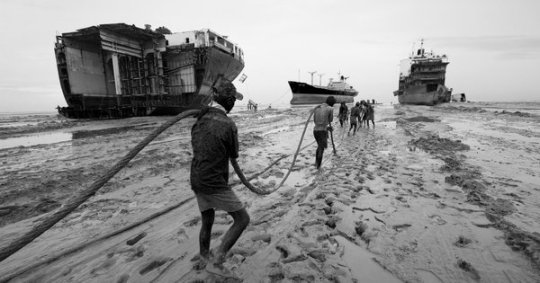
Iron Crows captures the hardships of shipbreakers in Bangladesh

Iron Crows captures the hardships of shipbreakers in Bangladesh

Captain Kang is a film that I put most efforts and am most proud of even though it’s probably not the most successful film. What impressed me the most besides his distinctive cinematography when the director Ho-Yeon pitched his story was his attitude toward the subject. I admire his dignity and humbleness as a filmmaker very much. When I decided to produce it, I was joking to the director that soon the industry would brand me as a disability specialized producer.

Q) There are an incredible amount of Korean documentaries being produced in the industry today, mostly by independent companies. These documentaries are often successful at film festivals, yet fail to reach mainstream audiences. What do you think about the role of Korean documentaries in contemporary cinema? Why do they struggle to become ‘mainstream’?

A) I am not sure what you mean by an incredible amount of Korean documentaries. In my opinion, there are far too little documentaries produced in Korea for the size of the population or the industry and compared to the number of fiction films. I am also not sure if you can say that these documentaries are “successful” in film festival circuit. Can you name 10 successful Korean documentaries in the entire history of Korean cinema without looking up your database? Despite the significant rise of current documentaries, I don’t think there are enough documentaries produced to make any meaningful market analysis in my opinion. And the documentaries are not diverse enough compared to the documentaries that are introduced at international documentary markets and festivals. It seems that most Korean documentaries come from either activism-oriented filmmaker groups or human-interest documentary groups who are often associated with TV documentary production.
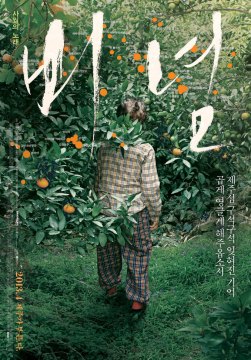
Jeju Prayer (비념) mixes activism and human interest documentary conventions in exploring the 1948 Jeju Island massacre

Jeju Prayer (비념), by Indiestory, mixes activism and human interest documentary conventions in exploring the 1948 Jeju Island massacre

Activism-oriented documentaries often try to convey political agendas directly whereas most human-interest documentaries search for touching, often tear-jerking, human stories of vulnerable, and often pitiful, characters. Knowing how documentary has developed in Korea it’s more than understandable. Knowing how badly freedom of speech is practiced in Korea, I very much appreciate the role of activism-oriented documentaries that fill a niche in the mainstream media. However, I am missing ‘diversity’ here. Why are all the documentaries dealing with serious subjects almost always in a monotonously serious and direct fashion? Why is it hard to see cinematic documentaries? At film festivals and cinemas in Europe and North America I am seeing many diverse styles of documentaries screened and they are often successful these days. Many of them are highly entertaining yet still dealing with serious subjects such as social justice, war or human rights. Personally I would love to see comedy, musical, action noir genre of documentaries made in Korea by Korean filmmakers.

Poor production quality is another thing that makes Korean documentaries invisible in mainstream cinema. Audiences don’t seem to care much whether it’s documentary or fiction when making decisions to watch films in cinema. You can’t force or beg audiences to watch a documentary despite poor production quality while the ticket prices are more or less the same, and it’s their decision which film they choose to spend their leisure time on. We filmmakers need to work on diversity and production quality of the film we make but I also think there is a serious need for more subsidies from the public sector, not only because of its value for the public good but also because documentary is too weak to freely compete in the market. The government needs to have a long-term investment plan on documentaries in order to make it sustainable. Korean cinema is one of the strongest in the international film market and Korean filmmakers really make good films, but they take time and effort. I don’t believe documentary should be an exception.

Q) You have stated in prior interviews that you have co-producers in Europe, America, and Asia. What are the benefits of having international co-productions? Why are they important/significant?

International co-productions are a great source of funding, but aren't always easy

International co-productions are a great source of funding, but aren’t always easy

A) I like to work with international crews with diverse backgrounds. This is one my strengths as a producer and I very much enjoy seeing how the collaboration between filmmakers with different cultural backgrounds creates chemistry and influences the end result of the film. Providing that filmmaking is teamwork, I feel like a great alchemist when intended collaborations work out. I finance part of my films by international co-production in return for working with production crews from the country of co-production. Planet of Snail is one of the successful cases of international co-production as the collaboration with Finnish sound team definitely added a lot to the production quality of the film, and my Finnish co-producer raised the whole expenses spent in Finland. However international co-production is a double-edged sword when it comes to the conditions for spending. The budget raised by international co-production needs to be spent according to the regulations set by each funder. Usually the money needs to be spent in the country of co-production and often they ask to hire local creative talent. It can be very good if there is room for the talent and your co-producer has the right creative talent for your film to work with. What if there is no more room for creative talents? What if you don’t know how to communicate or work with international film crews? Nowadays I see many producers and film professionals who tend to believe that international co-production is a cure for all and blindly jump into the trap of bad co-production. What’s the use of raising international funds if there is no creative talent who can contribute to the film, or you don’t know how to work together?

Q) You have created your own company Minch & Films. What do you hope to achieve through the company? Does having offices in Seoul and Holland benefit Minch & Films in any way?

Minch & Film was established in 2011

Minch & Film was established in 2011

A)  Since 2011, I founded and own my own company Minch & Films currently based in Seoul.

I established Minch & Films to be a true story based production. Currently Minch & Films is based only in Seoul while collaborating with post-production talents in Belgrade (Serbia) and multiple co-production partners in Europe and North America.

Currently Minch & Films (or better as producer Min-Chul Kim) is more known internationally than domestically but we are not only making documentaries for international audiences but also for Korean audiences. We are not sticking to the documentary genre or film as platform but cross over genres and media such as game and comics.

(Please follow this link for Minch & Films facebook page)

Q) Can you give any details about any future documentaries and collaborations you are involved in? Will you use Minch & Films to help promote them?

A) State of Play is a feature documentary about what it takes to be a pro-gamer featuring the e-sports champion Lee Jae-Dong. This is a minor co-production with Visualantics, a emerging documentary production in Belgium. I brought Korean Communication Committee and Seoul Film Commission on board and it’s currently in the final post- production to be released in the summer. (See below for the trailer).

MotoSeoul is a feature documentary about young people living on the edge of Seoul dependent on the speed of motorcycle such as quick service rider, Chinese deliveryman and high school bikey gang in the style of Hong Kong noir movie. It has been developed with Seoul Film Commission’s international co-production development support in 2011 although I have been developing this project since 2006. I am expecting to start production in the summer with Ho-Yeon Won as director (Captain Kang’s director).

Scream For Me Sarajevo is a music documentary about heavy metal legend Bruce Dickinson (Iron Maiden’s frontman) and his band’s journey to war torn Sarajevo during the siege in 1994, and what a music concert meant to the people in the least humane living condition. It’s a music film, a road movie and a documentary about war, bravery and human dignity. I am currently visiting London for the pre-production meeting with Bruce and forming the production team. It’s in the early stage of pre-production.

Q) Finally, what do you think about the current environment of Korean documentaries on the global stage? Are they well received, or are there limitations? For example, how do you promote your films internationally to achieve a high profile?
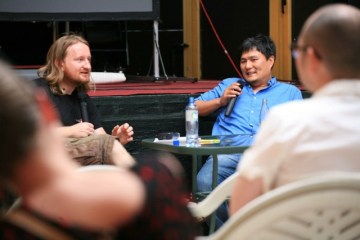
Producer Kim discusses his projects

Producer Kim discusses his projects

A) Relatively more Korean documentaries are introduced to the international market since some of the documentaries achieved some level of international success. However global documentary markets are heavily dominated by European and North American productions while documentaries not only about China as subject but also directed and produced by Chinese are growing significantly in numbers as well as in quality. To promote my films internationally, I participate in pitch forums, film markets and festivals and work with international partners such as sales agent, co-producers, and publicists. I also experiment with multimedia platform. For example, I produced an educational app for learning finger braille language to promote social engagement of Planet of Snail. You can download the app simply by opening the site www.planetofsnail.com on any tablet device such as iPad.

In order for Korean documentaries to be better received, we need more supports from Kofic and other public sector. There are always supporters behind successful documentaries.

Hanguk Yeonghwa is incredibly grateful for Producer Kim for taking the time for this interview, and be sure to look out for his future documentaries on the film festival circuit.

Interviews/Q&As Producers