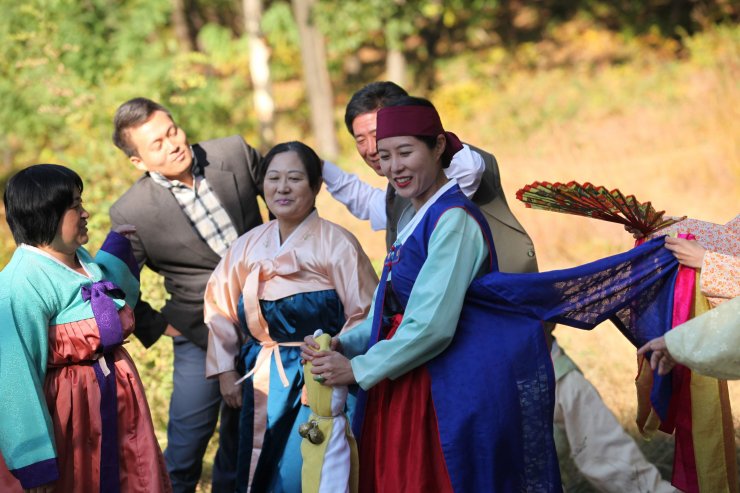
In an iconic scene, Sang-goo begins protesting in central Seoul

Another Promise (또 하나의 약속) – ★★★☆☆

Another Family (또 하나의 약속)

Another Promise (또 하나의 약속)

Another Promise (AKA Another Family) (또 하나의 약속) arrived in Korean cinemas in February on a wave of controversy. Based on the true story of a young woman who contracted leukemia while working at a Samsung semiconductor plant, and her father’s subsequent battle to bring the chaebol (conglomerate) to justice, the film was mired in difficulties before it even began. With production companies refusing to fund the film writer/director Kim Tae-yoon (김태윤) turned to crowdfunding, and the resulting flood of private donations helped Another Promise to become the first film in Korean cinematic history to be fully fund in this manner. Furthermore, popular actors including Park Cheol-min and Kim Gyoo-ri offered to appear in the film for free which helped to generate even greater public interest.

Premiering at the 2013 Busan International Film Festival to favourable reviews, Another Promise received global attention for challenging the most powerful company in Korea, prompting an article from The Guardian which went viral amongst Korean film enthusiasts. Later, when the film was finally granted a nationwide release, Another Promise was again the victim of controversy when it became widely reported that Megabox and Lotte Cinema, two of Korea’s biggest cinema chains, were accused of suppressing the number of screens on which the film was to be played. Despite huge public interest and advance ticket sales, The Hankyoreh reported that Megabox reduced the number of screens from 15 to 3 two days before release (which subsequently changed after public outcry), while Yonhap News stated Lotte Cinema allocated a measly 21 out of 99 theaters to showing the film and that most screenings occurred during early morning or late at night. Yet despite being being shown on a paltry 192 screens throughout February (in contrast, Miss Granny had 1024), Another Promise was the 8th biggest film of the month which is a remarkable achievement indeed. Yet controversy aside, is Another Promise any good?

Taxi driver Sang-goo teams with labor rights worker Nan-joo to take on the conglomerate

Taxi driver Sang-goo teams with labor rights worker Nan-joo to take on the conglomerate

Taxi driver Sang-goo (Park Cheol-min (박철민) is thrilled when his daughter Yoon-mi (Park Hee-jeong (박희정) is offered a job at the Jinsung semiconductor plant. As one of the leading companies in Korea, to be a worker at Jinsung is considered a great boon particularly for a humble family. Yet when Yoon-mi returns home months later extremely ill her worried family take her to hospital, where she is diagnosed with leukemia. As representatives from Jinsung arrive demanding paperwork to be signed and using money as bribes, Sang-goo is determined to discover the cause of his daughter’s disease. Teaming up with labor rights worker Nan-joo (Kim Gyoo-ri (김규리), the duo track down other sick workers and informants in a desperate attempt to finally bring the conglomerate to justice.

Another Promise is a film that very much wears its heart on its sleeve, which is both a blessing and a curse. As it is based on a true story, Another Promise is of course a highly emotional film that undoubtedly resonates strongly, particularly with Korean audiences. However director Kim’s decision to employ melodrama at almost every opportunity undermines the strength of the film’s message, which is a great shame. The most powerful scenes are also the most understated, in which the shocking abuses of power and the traumatized expressions of victims are allowed to speak for themselves, effectively conveying the full strength of the story. Yet far too often melodramatic devices are utilised, and over-simplified caricatures of ‘the perfect family’ and ‘the villain’ are expressed, which tends to make the film feel contrived while the direction and camerawork are competent yet akin to a TV film, also serving to weaken the importance of the story. That said, when scenes are done well they are utterly compelling and poignant, rarely failing to be tear-inducing.

In an iconic scene, Sang-goo begins protesting in central Seoul

In an iconic scene, Sang-goo begins protesting in central Seoul

Holding the film together is veteran actor Park Cheol-min, who arguably gives a career-best performance as the bereaved father. Park has a tendency to overact and has often been typecast in goofy supporting roles due to this, yet he carries Another Promise on his shoulders extremely well. He occasionally slips into his old habits early in the film yet he hits his stride shortly after, providing a remarkably restrained and emotionally charged performance. His speeches are particularly effective as he solemnly fights for justice, and Park’s sincerity continually forces the film to be compelling.

Unfortunately the same cannot be said for the supporting cast who are generally given quite meager roles. Kim Gyoo-ri is surprisingly given sparse screen time as labor rights worker Nan-joo, particularly given her status, although she competently fills the role with the little she’s been given. Other supporting actors fare less well as they tend to serve the purpose of siding with either party, with attempts to expand their backstories proving rather unengaging as there are so many of them it’s impossible to form emotional connections with them all.

Sang-goo gives compelling speeches about the importance of justice and accountability

Sang-goo gives compelling speeches about the importance of justice and accountability

Another Promise (AKA Another Family) (또 하나의 약속) is an important landmark in Korean cinematic history as the first fully crowdfunded film, and it’s clear writer/director Kim Tae-yoon had no choice but to do so given the subject matter. Based on the true story of a girl who contracted leukemia by working at a Samsung plant and her father’s fight for justice, the film has been mired in controversy from the beginning. The result is a highly emotionally charged drama that is often tear-inducing, yet the addition of melodramatic contrivances tends to undermine the film’s message. Yet thanks to a career best performance by Park Cheol-min, Another Promise is a consistently compelling film.

★★★☆☆
Reviews
The 15th Jeonju International Film Festival

JIFF 2014: Korean Competition

The 15th Jeonju International Film Festival

The 15th Jeonju International Film Festival

The Korean Competition at the Jeonju International Film Festival (JIFF) always contains a selection of rare gems of independent cinema.

Last year the big winner of the competition was December which was honoured with the Grand Prize, while Dear Dolphin and Lebanon Emotion won the CGV Movie Collage Awards, respectively. The Audience Critics Prize went to documentary My Place. Interestingly, out of all of the winning films the most successful were Lebanon Emotion – which earned Jung Young-heon the Best Director prize at the Moscow International Film Festival as well as appearing in Vancouver and London – and My Place, which has earned several domestic accolades including the Jury Prize at the Seoul International Film Festival and was invited to the Hot Docs Canadian International Documentary Film Festival.

At JIFF 2014 there are eleven films vying for the coveted Grand Prize. Among the eight features and three documentaries are nine world premieres, which is certainly an impressive lineup. Below is the Korean Competition trailer which features highlights from all the entrants, before more detailed profiles of each film in the program.

Korean Competition

A Dream of Iron (철의 꿈)

Director Park (Kelvin) Kyung Kun (박경근)

A Dream of Iron

A Dream of Iron

A Dream of Iron

A Dream of Iron

Documentary A Dream of Iron arrives as the most celebrated film in the category following a premiere at Berlinale and being awarded the NETPAC prize (alongside Non-Fiction Diary). Unable to understand his partner’s decision to become a Buddhist monk, director Park begins searching for something tangible and awe-inspiring, leading him to Korea’s POSCO steelworks. Contrasting differing ideas of religion and majesty, A Dream of Iron contains stunning cinematography of the country’s struggle with modernity.

A Fresh Start (새출발)

Director Jang Woo-jin (장우진)

A Fresh Start

A Fresh Start

A Fresh Start

A Fresh Start

A Fresh Start marks director Jang Woo-jin’s  feature debut. The film depicts youngsters Ji-yeon and Hye-rin, two lonely individuals who meet regularly at a literature club. When their relationship unexpectedly turns sexual, everything is fine…until Hye-rin discovers that she is pregnant. With both of them already suffering from family-related problems, school issues and the all-too-common depression that afflicts Korean youth, Hye-rin and Ji-yeon struggle with what they should do in such a difficult situation. Furthermore their unsure feelings towards each other are forced into the spotlight as they struggle to find a solution.

Highway Stars (악사들)

Director Kim Ji-gon (김지곤)

Highway Stars

Highway Stars

Highway Stars

Highway Stars

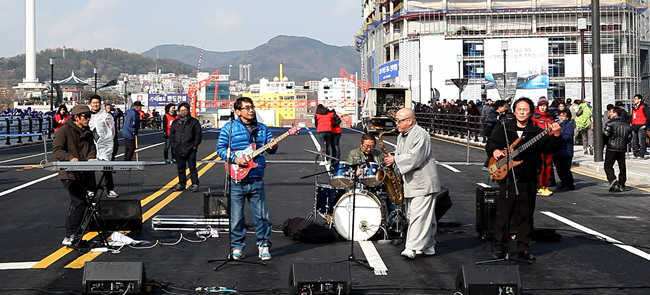
Highway Stars is another documentary entry in the competition, following the life and times of Band Udambara. The ensemble are a fascinating group consisting of former nightclub performers and a Buddhist monk, and the film explores how they make a living by taking night gigs. Nightclubs, it should be noted, are different from clubs in Korea as they are extremely male orientated and often are fronts for illegal activity. Director Kim Ji-gon, whose documentary Grandma Cement-Garden appeared at JIFF last year, returns to explore more individuals forced to the margins of society.

Miss the Train (미성년)

Director Lee Kyung-sub (이경섭)

Miss the Train

Miss the Train

Miss the Train

Miss the Train

Director Lee Kyung-sub has previously helmed a number of short films including last year’s JIFF Cinemascape entry Mr. Vertigo, starring Oh Dal-su. With Miss the Train director Lee upgrades to feature length in depicting the story of So-jin, who grieves the death of her mother, a former shaman. When a strange man forces So-jin to help him find his missing child as he believes she is part of a prophecy, she desperately seeks an escape from the pressures in her life. Yet when she runs away to lie low in a warehouse, she encounters another odd man, and her grasp on reality becomes evermore tenuous as spirits seem to appear before her.

Monkeys (몽키즈)

Director Jung Byeong-sik (정병식)

Monkeys

Monkeys

Monkeys

Monkeys

Monkeys is Jung Byeong-sik’s directorial debut, after working on other films including 2012’s A Confession of Murder and Action Boys in 2006. Monkeys revolves around Gong-hyeok, a man who once had future ambitions of becoming renowned in the music and film industry. Yet now in his late twenties and in dire need to support his family, Gong-hyeok is still no closer to achieving his dreams. Yet when he reconnects with an old friend who has just debuted as a film director, Gong-hyeok cannot help himself and old quarrels suddenly start to reappear and drive a wedge between them. The film is in both colour and black and white.

One For All, All For One (60만번의 트라이)

Director s Park Sa-yu (박사유), Park Don-sa (박돈사)

One For All, All For One

One For All, All For One

One For All, All For One

One For All, All For One

Issues of discrimination are of paramount concern in rugby drama One For All, All For One. The sporting film depicts a Korean rugby team in Osaka who are very successful despite encountering prejudice from society at large. However their indomitable spirits and strong sense of camaraderie help them to overcome any discrimination that comes their way. Sporting dramas are often quite successful in Korea especially as they typically involve national pride, particularly when the opponents are Japanese. Director Park Don-sa is a third generation Korean living in Osaka, while director Park Sa-yu has focused on discrimination against Koreans in Japan in her previous work.

Pohang Harbor (포항)

Director Mo Hyun-shin (모현신)

Pohang Harbor

Pohang Harbor

Pohang Harbor

Pohang Harbor

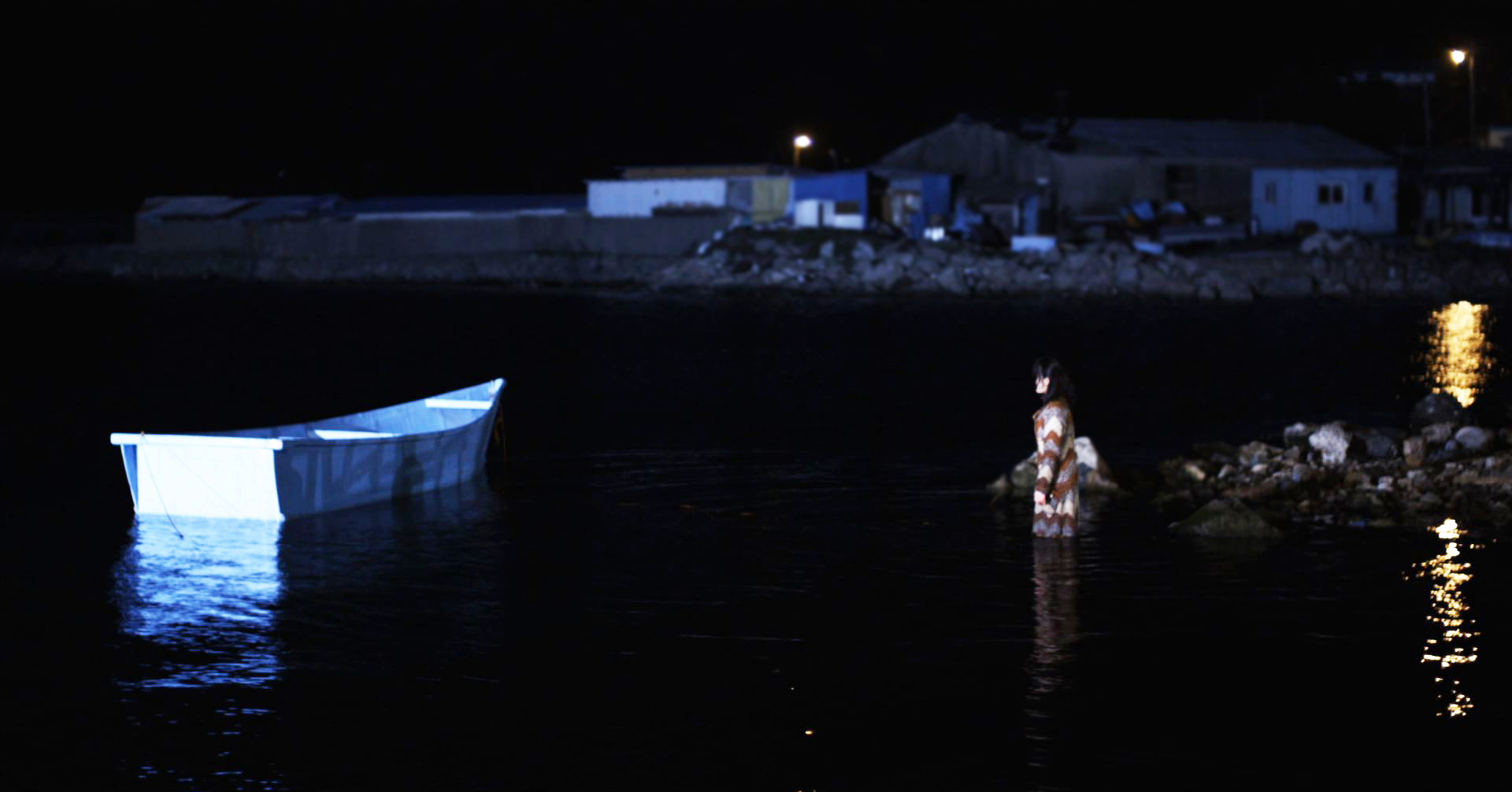
Drama Pochang Harbor explores the notions of life and death, in conjunction with human development and behaviour, in what looks set to be the most experimental offering in the category. When his father mysteriously goes missing, a man returns to his hometown in order to find him. Yet the man also has alternative reasons for coming home. Following years of working dead-end labour jobs and not settling any roots, the man is searching for something more than the life he has forged. In her feature debut director Mo Hyun-shin employs a host of long shots and keen cinematography to examine the human condition.

Sookhee (숙희)

Director Yang Ji-eun (양지은)

Sookhee

Sookhee

Sookhee

Sookhee

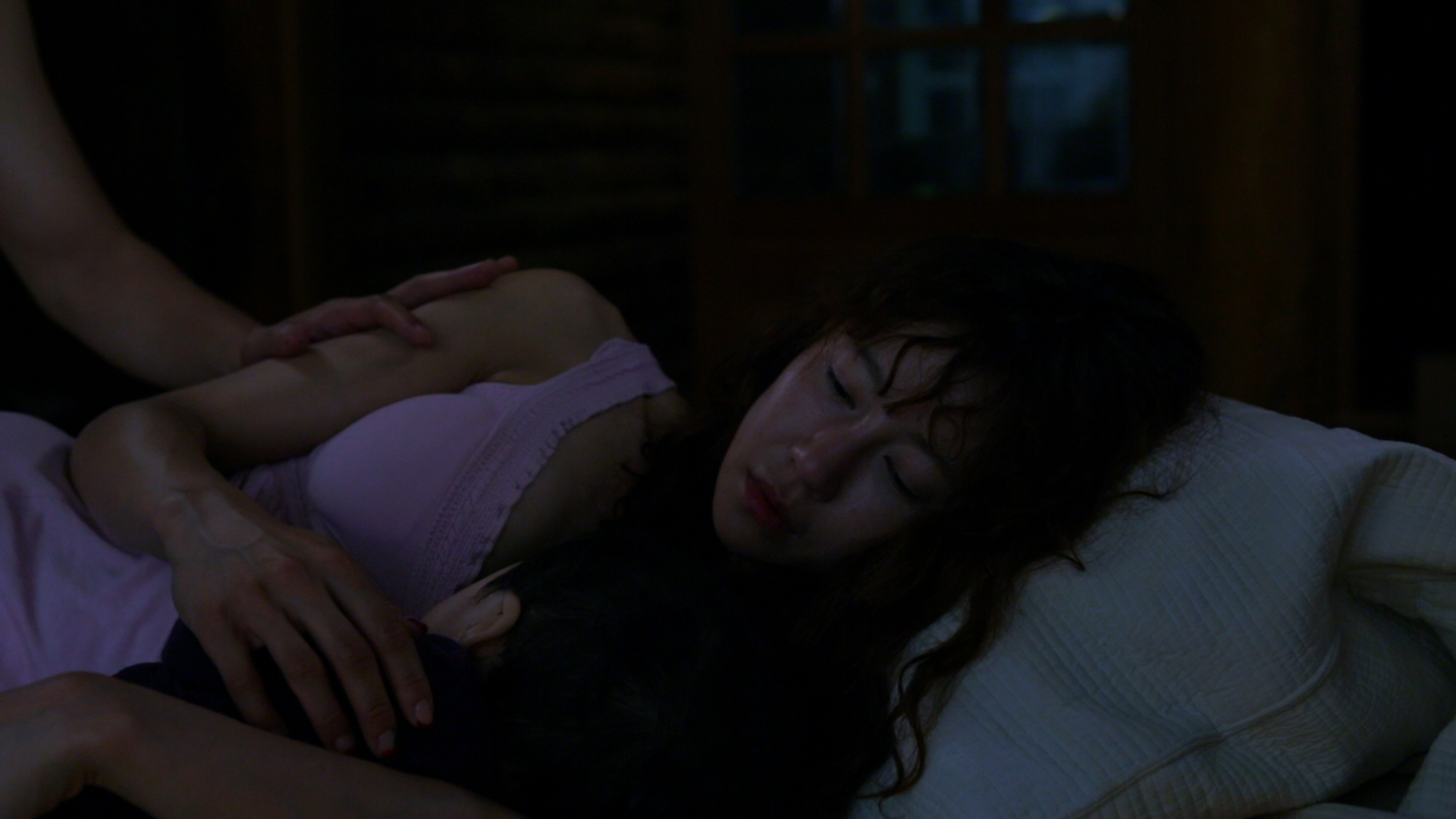
Sookhee tells the story of a conservative, workaholic philosophy professor named Yoon. Unable to take the stress any longer Yoon suffers a stroke and, as his wife is unable to cope, a free-spirited caregiver named Sookhee nurses him to health. Yet her treatments are far from orthodox as she employs a mixture of kindness, fear, and sexual excitement to force Yoon on the road to recovery. Furthermore, the maternal instincts she employs enact a dramatic reversal of traditional gender roles, provoking extreme reactions from the once uptight philosophy professor. Sookhee is director Yang Ji-eun’s first feature film and due to the exploration of sexual issues is described as a ‘daring debut.’

The Wicked (마녀)

Director Yoo Young-seon (유영선)

The Wicked

The Wicked

The Wicked

The Wicked

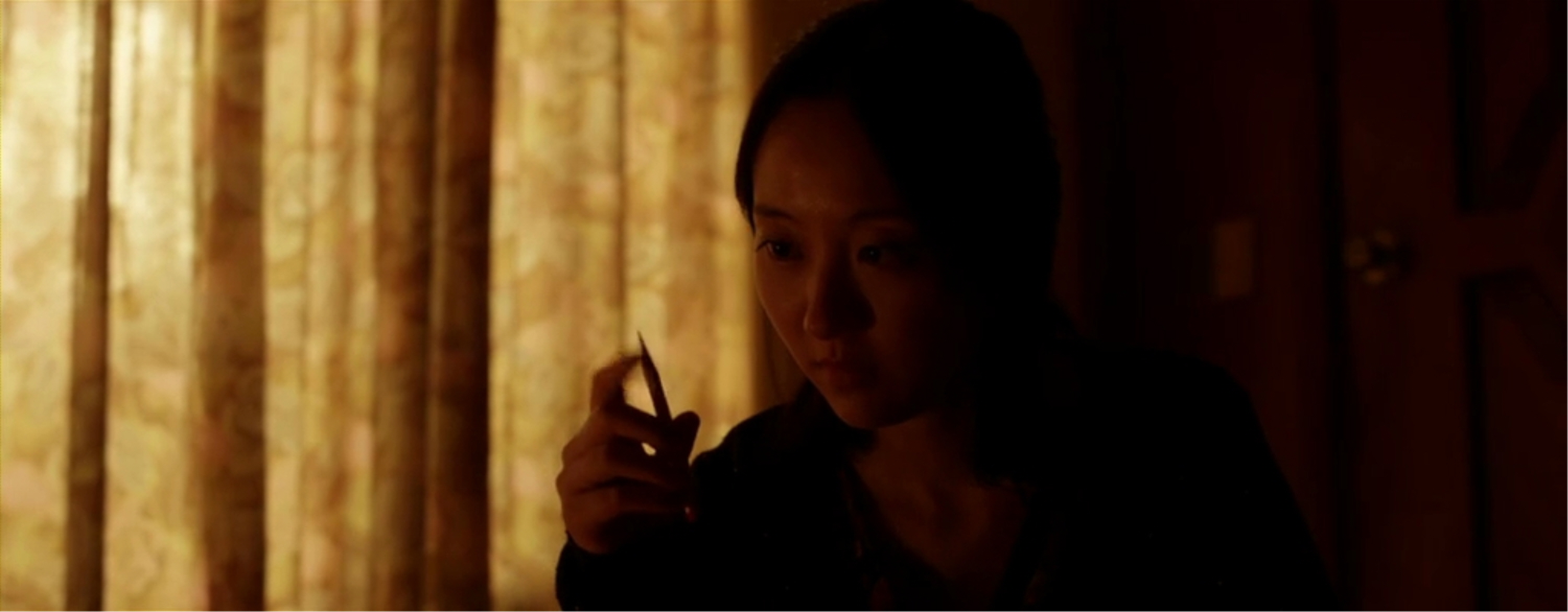
The competition would be lacking without a new thriller, and luckily director Yoo Young-soon’s debut The Wicked fulfills the criteria. When Se-yeong begins working at a company, her senior I-seon quickly becomes concerned. Se-yeong’s threatening behaviour, as well as her fascination for sharp objects ranging from scissors to small knives, frightens I-seon…particularly as she learns more about her new colleagues unsavory past. Could Se-yeong truly be as wicked as she seems?

The Youth (레디 액션 청춘)

Directors Kim Jin-moo (김진무), Park Ga-hee (박가희), Ju Seong-su (주성수), Jung Won-sik (정원식)

The Youth - Wonderwall

The Youth – Wonderwall

The Youth - Play Girl

The Youth – Play Girl

The Youth is an omnibus of four short stories, each one exploring the lives of Korean youths. The segments are entitled The Rumor, Wonderwall, Enemies All Around, and Playgirl. Within each short film the directors examine the worlds of Korean youngsters as they struggle to discover their identities as well as retain their innocence and hope, even when facing external issues including violence and peer pressure. Director Kim Jin-moo is a hot property after the release of Apostle, a film based on North Korean human rights issues. The film was even selected for overseas screenings at the UN. Furthermore directors Park Ga-hee and Jung Won-sik all have a history in helming shorts, while Ju Seong-su has previously worked in the production departments of several features.

You Are My Vampire (그댄 나의 뱀파이어)

Director Lee Won-hoi (이원회)

You Are My Vampire

You Are My Vampire

You Are My Vampire

You Are My Vampire

Quirky romantic-comedy-drama You Are My Vampire seeks to capitalise on supernatural relationships that are so popular in contemporary culture. Director Lee Won-hoi employs a playful and energetic style in depicting the story of struggling screenwriter Gyu-jeong, who encounters a mysterious black-clad figure who bears an uncanny resemble to a vampire…or he could just be the strangest man she’s ever met. The film features an eclectic supporting cast who, to Gyu-jeong’s dismay, also begin behaving strangely after the arrival of the pale-skinned man.

Festival News Jeonju International Film Festival (제15회 전주국제영화제) Korean Festivals 2014
The 15th Jeonju International Film Festival

The 15th Jeonju International Film Festival

The 15th Jeonju International Film Festival

The 15th Jeonju International Film Festival

The 2014 Jeonju International Film Festival (JIFF) is due to commence from May the 1st through to the 10th.

Now in its 15th installment, JIFF has long been the festival for showcasing up and coming Korean independent talent as well as serving as a platform for international indies to receive attention. This year is of course no exception, as new features have added and programs extended in conjunction with the traditional core categories.

Last year, JIFF provided the launchpad for several notable Korean indie films that later went on to become successful on the international circuit. Family documentary My Place (마이 플레이스) and drama-thriller Lebanon Emotion (레바논 감정) were the most prominent, enjoying lengthy festival runs and scooping several awards domestically and internationally while other productions including Dear Dolphin (환상속의 그대)Cheer Up Mr. Lee (힘내세요, 병헌씨)Talking Architecture, City: Hall (말하는 건축, 시티:홀), and controversial documentary Project Cheonan Ship (천안함프로젝트) also performed well. Breathe Me (울게 하소서) was the most celebrated short film to emerge from the festival, later appearing in Cannes in the prestigious Critics Week category.

This year however sees not only an array of new Korean filmmakers but also some of the most renowned and reputable names in the independent film industry screening their latest work. Furthermore, the festival design is clearly emphasising JIFF as a celebration of elegance and subtle sincerity, as can be viewed in the trailer below.

The big change at JIFF 2014 lies in the greater focus on Korean films. Korea Cinemascape has now become a distinct program in its own right, and while previously more mainstream Korean films were integrated within, the focus has now shifted to more independent and low-budget productions. As such, there are some big names in indie cinema within Korea Cinemascape this year, including Lee Song Hee-il (White Night), Lee Sang-woo (Barbie) and Kim Kyung-mook (Stateless Things), as well as a greater number of world premieres which further cement JIFF’s reputation for discovering new talent.

In addition, two of JIFF’s staple programs – Jeonju Digital Project and Short! Short! Short! – have been amalgamated in order to enhance the overall quality of the productions as well as elevating the films into features. This year, two of of the three films are helmed by Korean directors.

The festival is also now separated into two distinct parts – from May 1st~7th JIFF will operate is normal, while May 8th~10th will focus more on the films in the International Competition. The Closing film has been abolished, and instead the Grand Prize winning film from the International Competition will screen instead.

Opening Film

MAD SAD BAD (신촌좀비만화) 

Directors Ryoo Seung-wan (류승완), Han Ji-seung (한지승), Kim Tae-yong (김태용)

Ghost (유령)

Ghost (유령)

I Saw You (너를 봤어)

I Saw You (너를 봤어)

Picnic (피크닉)

Picnic (피크닉)

MAD SAD BAD is a fascinating and exciting departure from traditional opening films. The 3D omnibus is helmed by three of Korea’s extremely talented directors. In Ghost, director Ryoo Seung-wan (The Berlin File) explores the life of a high school student who retreats from the world and instead finds purpose talking with a girl on SNS. The segment stars red hot indie star Lee David (Pluto, Poetry), Kwak Do-wan (The Attorney, National Security) and model Son Soo-hyeon in her acting debut, while the film itself is based on a true story. In futuristic zombie film I Saw You, director Han Ji-seung (Papa) plays with a variety of genres as he portrays the undead as factory workers. Featuring Park Ki-woong (Secretly Greatly) and kpop star See Ya’s Nam Gyoo-ri (Death Bell), the romantic musical horror will certainly be an attractive affair. Rounding out the omnibus is Picnic by director Kim Tae-yong (You Are More Than Beautiful). When a young girl loses her autistic brother on a picnic trip, her frantic search calls forth the realms of her imagination inspired from her beloved comic books. Child actress Kim Soo-an (Hide and Seek) stars.

Please see below for the MAD SAD BAD trailer.

Festival News Jeonju International Film Festival (제15회 전주국제영화제) Korean Festivals 2014
Director Hong's father always seemed to be on a journey, even in death

My Father’s Emails (아버지의 이메일) – ★★★☆☆

My Father's Emails (아버지의 이메일)

My Father’s Emails (아버지의 이메일)

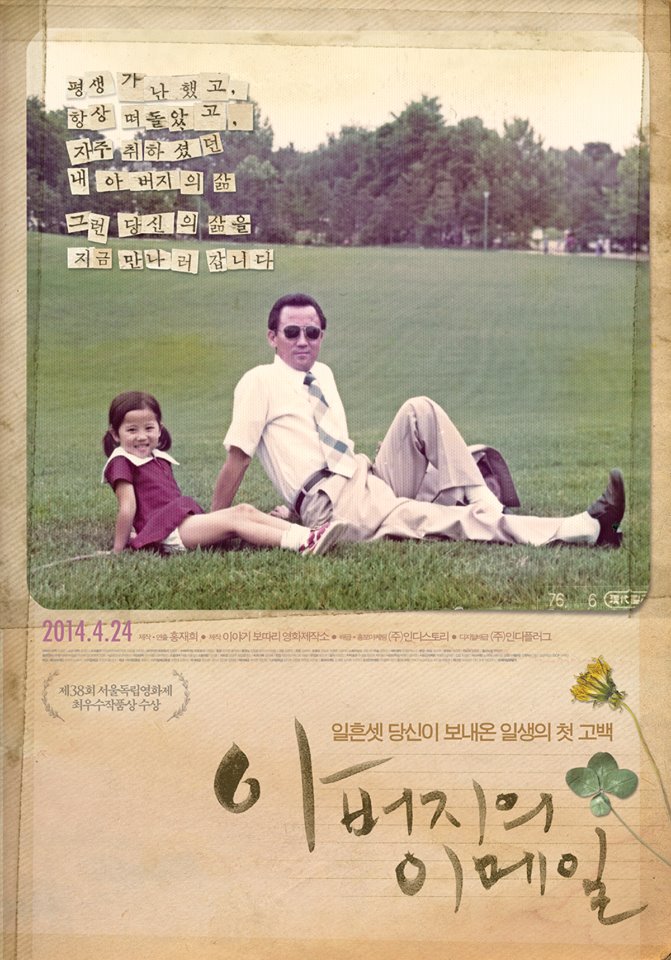
My Father’s Emails (아버지의 이메일) is a lovingly told documentary with an incredible premise. Following her estranged father’s death, director Hong Jae-hee (홍재희) finally decides to read the 43 emails he had sent shortly before he passed away. Initially director Hong had ignored the emails; after years experiencing her father’s alcoholism and domestic abuse, there was little reason to open them. Yet the emails were intriguing, not only as her father was a far cry from being technologically competent but also as she was the only family member to receive them. The contents of the emails were of enormous surprise for the director as her previously reclusive father had written an autobiography of sorts, articulating startling events that forged him into the man she knew.

Fascinated about the father she once despised, director Hong begins exploring his past and his decisions so inherently tied to Korean history. Yet in her quest to understand she is also forced to confront the family trauma that still proves extremely raw for her mother and siblings.

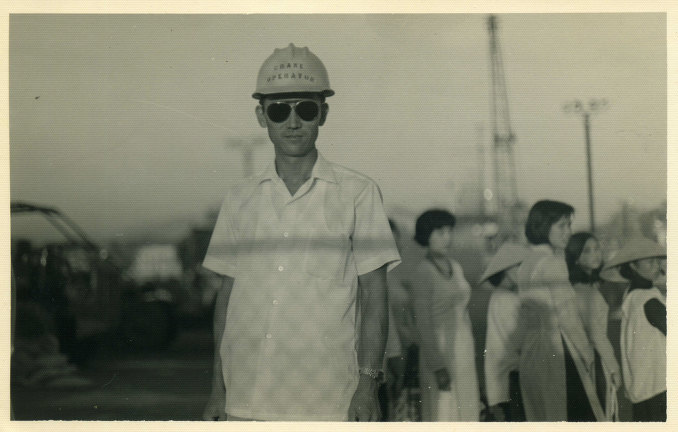
Director Hong's father often worked abroad in a bid to achieve his dreams

Director Hong’s father often worked abroad in a bid to achieve his dreams

One of the great strengths of My Father’s Emails lies in the way director Hong’s father made his life choices in conjunction with pivotal events in recent Korean history. In portraying his formative years and the national issues that influenced him, the documentary therefore becomes not only a personal and intimate portrait of a man struggling to find his way in the world but also takes on an historical significance. Hong combines her startling realisations from the emails about a man she barely knew with interviews of those close to him, old photographs, and occasional reconstructions, all of which bring her father’s journey vividly to life. His arduous migration from North Korea as a penniless teenager through to the successes and failures of his business ventures both domestic and abroad paint a fascinating portrait of the era, and the soul-destroying difficulties endured by those attempting to create a better life. Indeed, there is such a wealth of intriguing information regarding this period that the incredibly fast pace Hong employs to such scenes is puzzling and a tad frustrating. Events are rapidly introduced before moving on to the next, and a slower pace with greater depth would have made the connection with her father – and Korean history – much stronger.

Director Hong does however slow things down when exploring the family trauma left in her father’s wake. The frank interviews with her long-suffering mother as they discuss his alcoholism and domestic abuse is moving and intimate, while the anger displayed by Hong’s siblings clearly articulate the legacy he constructed due to his addiction. Yet what makes these scenes so interesting is that Hong continues to probe for answers as to the cause of her father’s depression and behaviour, refusing to simply judge and desperate to finally understand the man whom she had previously hated for most of her life. It’s a powerful message, and one that Hong captures with sincerity.

Director Hong's father always seemed to be on a journey, even in death

Director Hong’s father always seemed to be on a journey, even in death

My Father’s Emails (아버지의 이메일) is an intimate documentary with a fascinating premise. In exploring the 43 emails sent by her father after his death, director Hong Jae-hee (홍재희) attempts to understand her estranged parental figure. The film is a great examination not only of her father but of recent Korean history, to which his decisions, successes and failures were so inherently tied to, and which in turn formed the basis for tragic family trauma. While it has pacing issues and is somewhat of a documentary of two halves, My Father’s Emails is a moving and sincere account of Hong’s desire to better understand a man she barely knew.

★★★☆☆

Reviews
Yong-ju and Gi-woong contemplate their lives atop Night Flight

Night Flight (야간비행) – ★★★★☆
Night Flight (야간비행)

Night Flight (야간비행)

Premiering to high praise at the 2014 Berlinale, director Lee Song Hee-il’s (이송희일) insightful and thought-provoking drama Night Flight (야간비행) continues to build upon themes explored in his previous work. Homosexuality in contemporary Korea and the resultant alienation are joined by explorations of the country’s notoriously harsh education system as well as social injustice, making the coming-of-age film arguably the director’s most fully formed work to date. With Night Flight, director Lee Song is rapidly cementing his position as Korea’s most prominent and influential queer filmmaker.

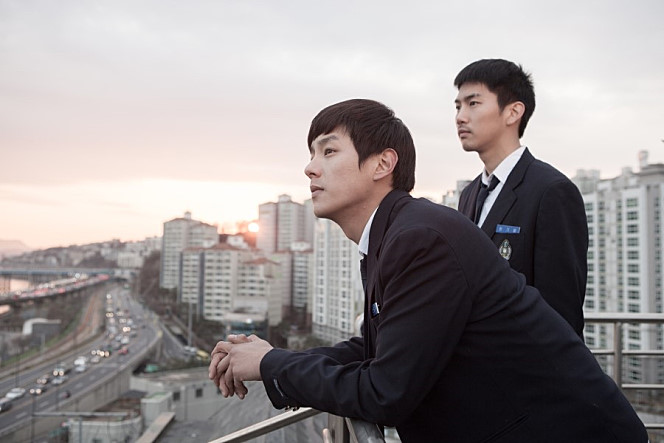
Like most teenagers in Korea, high school students and best friends Yong-ju (Kwak Si-yang (곽시양) and Gi-taek (Choi Jun-ha (최준하)  struggle with an overwhelming amount of study and the pressure to attend a top university. Yet the duo’s lives are further complicated as Gi-taek is relentlessly bullied and beaten by the school’s ‘elite’ while Yong-ju, raised by his single-parent mother, is gay and unable to express his sexuality for fear of repercussions. Yong-ju has long harbored a crush on violent head-bully and low-level gangster Gi-woong (Lee Jae-joon (이재준) since middle school, who also attempts to cope with an extremely troubled life. When Yong-ju decides to make a pass at Go-woong, events are then set in motion that forces them all into a powerful confrontation.

Yong-ju harbors a secret crush on fellow student Gi-woong

Yong-ju harbors a secret crush on fellow student Gi-woong

Director Lee Song Hee-il’s films are always absorbing explorations of the alienation gay men experience within contemporary Korea, and Night Flight certainly doesn’t disappoint. Within the film director Lee Song has focused on an area he has previous only briefly touched upon in his short Suddenly, Last Summer – the fraught experiences of gay teenagers. Night Flight is made up of a collection of real life stories the director has acquired over a number of years from the media and word of mouth, and it’s to his credit that they are collated into a convincing, compelling whole. Yet what sets Night Flight apart from director Lee Song’s prior films is that while homosexuality is a central theme it is not the sole focus of the story. A great number of social issues that Korean teenagers experience, including the enormous pressures of the education system, single-parent families, the class divide, and social injustice all feature within the narrative and are insightfully explored throughout. By featuring issues found in other acclaimed teenage indie dramas such as Pluto and Bleak Night, director Lee Song naturalises homosexuality as another facet of identity that youths struggle with as opposed to a constant sense of ‘otherness’, which is a welcome change indeed.

Night Flight is also yet another showcase for director Lee Song’s incredible vision for landscapes and composition. The cinematography is quite striking throughout the film, with the decrepit and poverty stricken environments portrayed with a great sense of foreboding, of a society crumbling under its own archaic issues. The fences and bars that appear throughout the district, so often wonderfully foregrounded, imply the prison within which these long-suffering teens occupy and are unable to escape.

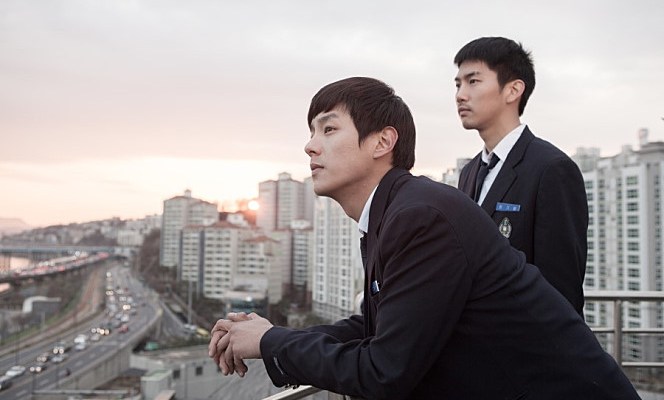
Yong-ju and Gi-woong contemplate their lives atop Night Flight

Yong-ju and Gi-woong contemplate their lives atop Night Flight

Yet the film is not all grim landscapes as director Lee Song allows his characters occasional reprieves in the form of glorious sunsets, particularly atop former gay hotspot bar ‘Night Flight.’ This private arena, situated at the top of a dilapidated building, not only provides a great metaphorical resonance of escapism from the confines of a rigid society but also allows the troubled teens freedom of expression, with the conversations containing penetrating insight into the issues confronting them.

Night Flight is also an interesting variation for director Lee Song as not all of the principal characters are gay. Central protagonist Yong-ju is the only distinct homosexual voice with the film, while his friend Gi-taek exposes the bullying within Korean culture and ambiguous love interest Gi-woong personifies social injustice. All the cast give competent performances in their roles, although their rather obvious older-than-high school ages tends to be a distraction. As the narrative caters for a variety of perceptions and experiences that effect Korean teenagers Night Flight eloquently fits within the canon of provocative films about Korean youth. While the story is a little over-ambitious in attempting to contain so many social issues, Night Flight is well constructed and many of the disparate problems that feature are seen through to their respective conclusions.

The troubled teenagers dream of escape from the confines of a crumbling society

The troubled teenagers dream of escape from the confines of a crumbling society

Night Flight is an insightful and provocative teenage drama by Korea’s most notable queer filmmaker, director Lee Song Hee-il. In exploring homosexual themes of alienation in conjunction with an array of other youth and social issues such as education and the class system, director Lee Song has crafted a powerful coming of age story of identity and the desire for escape. Night Flight is a welcome addition to not only queer but also youth film, and is arguably the director’s most fully formed film to date.

★★★★☆

Jeonju International Film Festival (제15회 전주국제영화제) Korean Festivals 2014 Reviews
Bory's expedition takes her through new and exciting landscapes

Sprout (콩나물) – ★★★★☆

Sprout (콩나물)

Sprout (콩나물)

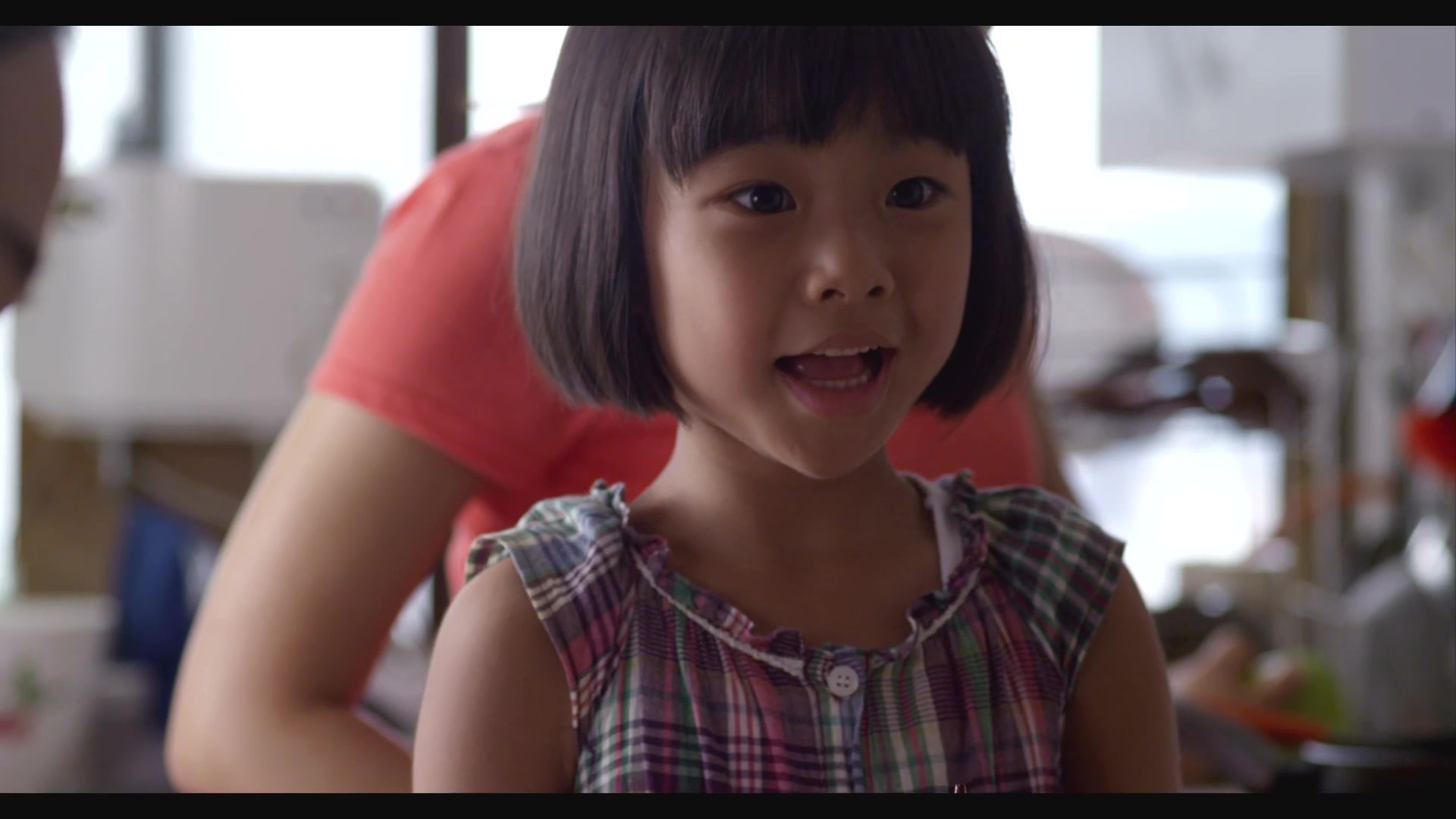
Wonderfully charismatic and beautifully told, writer/director Yoon Ga-eun’s (유가은) short film Sprout (콩나물) is a lovely tale of childhood innocence and discovery. The film has proven to be a hit on the festival circuit, receiving the Crystal Bear for Best Short Film in Berlinale’s Generation Kplus competition in 2014, following a premiere in Busan a year earlier.

As a family gathers to prepare for an ancestral rites ceremony, the women in the family work hard to make enough food for all the members attending. Yet when the mother of the household realises she forgot to buy beansprouts, she becomes worried that the family – particularly the nit-picking uncle – will judge her for not preparing for the ceremony correctly. Taking it upon herself to fix the situation, youngster Bory (Kim Soo-an (김수안) collects her savings and sets out for market alone, encountering a world of new discoveries and experiences in her quest for the all-important beansprouts.

Sprout is a deceptively simple and delightful story, and one that is full of the kind of wonder only a child can experience. Director Yoon captures Bory’s tale and range of emotions masterfully as the youngster traverses the exciting-yet-scary landscape in her attempt to find beansprouts and end her mother’s suffering. In a sense the short film embodies the format of classic Greek myths with Bory as a young contemporary Ulysses on a crusade of her own, encountering challenges she must overcome to fulfill her expedition.

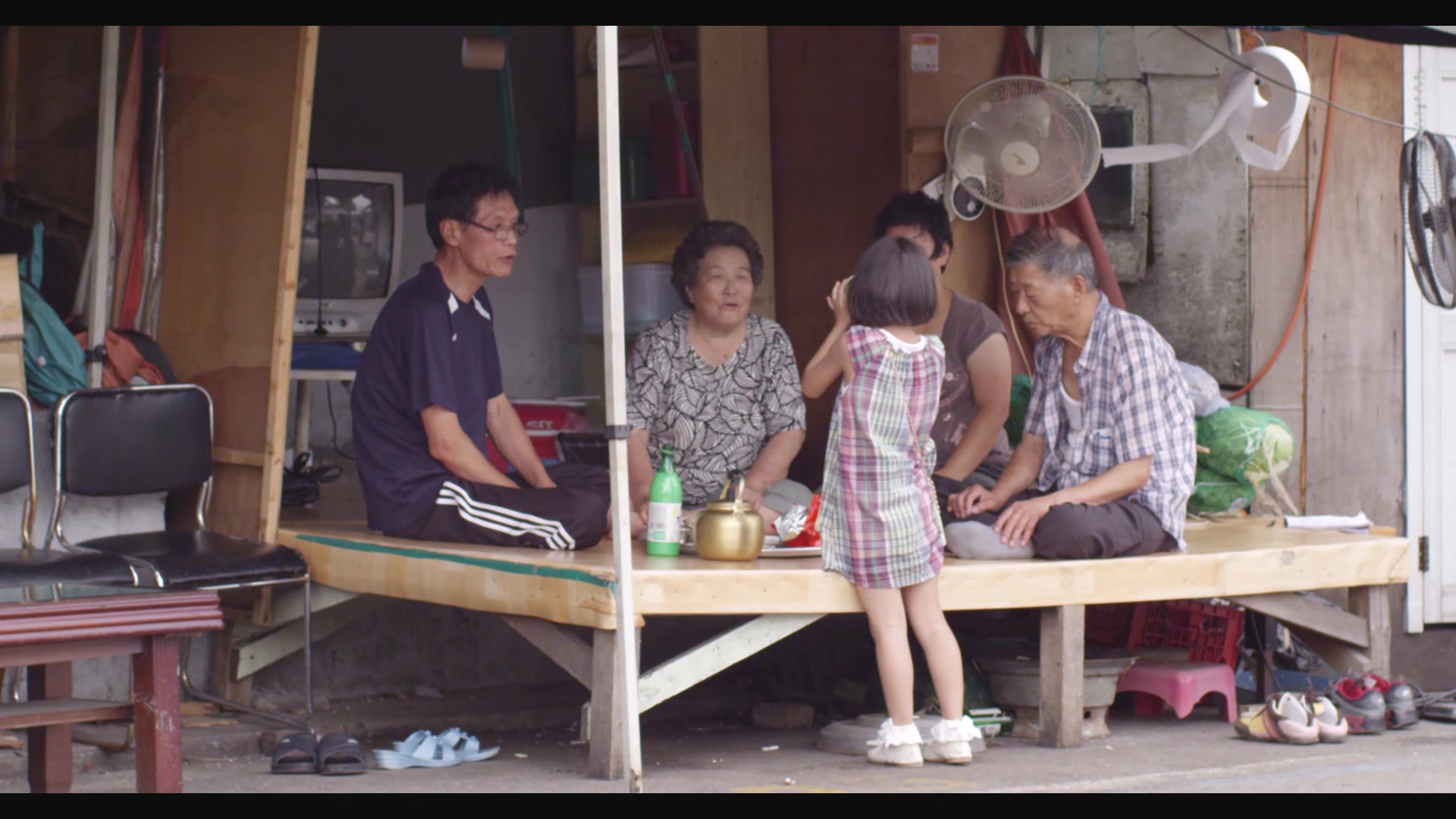
Bory meets a group of elderly residents that cause her to lose track of her quest

Bory meets a group of elderly residents that cause her to lose track of her quest

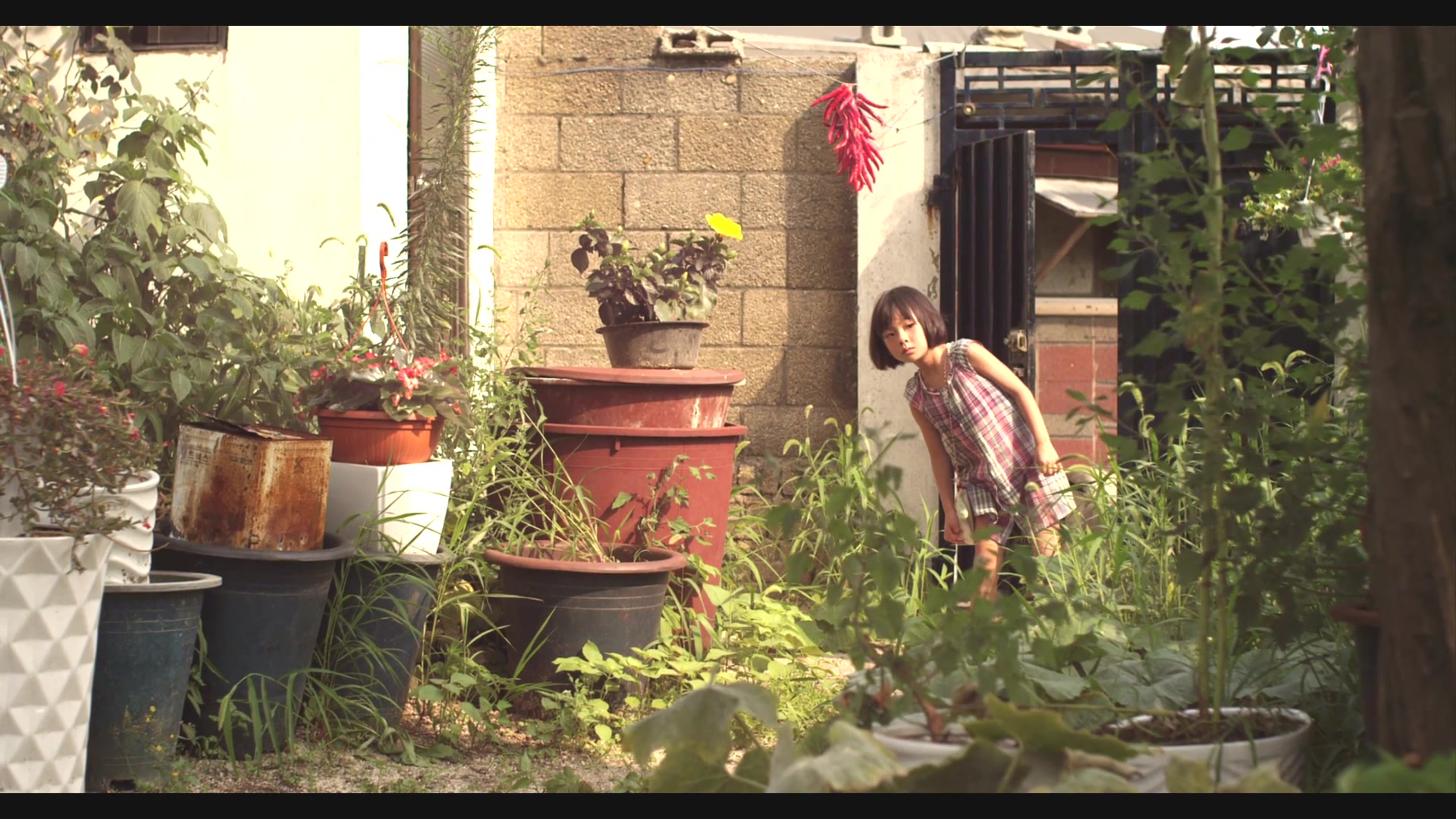
Moments when the tenacious youngster confronts obstacles in her path, meets strangers, and attempts to sneak past a frightening labrador contain a childlike epic sensibility and are constantly endearing and heartwarming, while Bory’s resourcefulness and determination never fail to inspire joy at witnessing her development.

Young actress Kim Soo-an is simply marvelous as Bory. It’s a tall order asking such a young child to carry an entire twenty minute film yet she does so with beguiling ease, performing an astonishing array of emotion during the short running time. As she encounters new experiences, confrontations and develops problem solving skills Kim Soo-an displays sincere curiosity and wonder throughout, conveying a charm beyond her years.

If criticism must be applied to Sprout, it is in the execution of the finale. After organically building Bory’s wonderful tale of exciting new experiences, director Yoon seems to be at a lose for how to end the story naturally. That is not to say the conclusion is bad as it still retains the charm embodied throughout the short film, yet it is an ending that would have benefited from an extra few minutes to conclude Bory’s story with more consistency.

Bory's expedition takes her through new and exciting landscapes

Bory’s expedition takes her through new and exciting landscapes

Sprout is a lovely and endearing tale of youthful innocence. Writer/director Yoon Ga-eun has crafted a very charming and deceptively simple story of a girl on a quest through her neighbourhood for beansprouts, with the new experiences she encounters constantly heartwarming. Young actress Kim Soo-an is marvelous as Bory, displaying sincerity throughout the twenty minutes running time with performance beyond her years, carrying the film with aplomb. In short, Sprout is a lovely, beautifully told story of discovery.

★★★★☆

Reviews
Young Kim Geum-hwa is visited by a plethora of gods on her path

Manshin: Ten Thousand Spirits (만신) – ★★★★☆

Manshin: Ten Thousand Spirits (만신)

Manshin: Ten Thousand Spirits (만신)

Manshin: Ten Thousand Spirits (만신) had the distinction of being the opening film for the 2013 DMZ Documentary Film Festival, and deservedly so. Director Park Chan-kyong’s (박찬경) film not only provides an autobiographical account of renowned shaman – and intangible cultural asset – Kim Keum-hwa, but also explores her life and times in conjunction with an incredibly tumultuous period of (recent) Korean history.

The result is a fascinating look at key components of Korean history and culture through the endurance of Kim Keum-hwa and her dedication to traditional shamanism. By delving into her past and reenacting key moments, issues ranging from the evolving state of feminism, the relationship between North and South Koreas, and the Park Chung-hee era all combine into a  portrait of a woman and a country who have held on to tradition despite the odds.

Kim Geum-hwa endured an awful childhood in North Korea before embracing shamanism

Kim Keum-hwa endured an awful childhood in North Korea before embracing shamanism

Director Park Chan-kyong has previously expressed his interest in shamanism through his excellent short film Night Fishing, yet with Manshin he examines the cultural form in a much more profound fashion. One of the great strengths of the film lies in not only exploring but reenacting Kim Keum-hwa’s life. Talented actresses Kim Sae-ron, Ryoo Hyeon-kyeong and Moon So-ri all depict the shaman at different stages of her development and portray the various trials she was forced to endure with sincerity and depth. These scenes, combined with Kim Keum-hwa’s interviews and quotes from her published work, make the autobiography a palpable and moving account of a woman who has endured much throughout her life. Her marriage at 14 years old in North Korea is a harrowing story of violence and fear, while her embrace of shamanism and emigration to the south years later is one of hope and sorrow; the persecution Kim experienced in her middle-ages despite her dedication to Korean culture adds even further tragedy. Each stage of Kim Keum-hwa’s life would be enough for a novel or film in itself, yet her perseverance through so many challenging events is constantly admirable, while the poignant performances of the three lead actresses, in conjunction with Kim’s interviews via voice-over, add incredible weight to the story.

Brilliantly, in depicting Kim Keum-hwa’s life Manshin also reveals Korea’s astonishing recent history. Director Park seamlessly aligns Kim’s efforts to remain alive and strong with that of the country and culture itself, as the shaman attempts to avoid the Japanese occupation in North Korea, her departure to the south following the outbreak of civil war, and dictator Park Chung-hee’s desire to erase anything considered old or antiquated in his quest to modernise the country. Director Park emphasises Kim’s struggles as national ones, trials dedicated to the preservation of cultural materials and practices despite the odds. As such the film never takes a stance on whether shamanism is real or otherwise, instead focusing on cultural value and national identity, as well as Kim’s empowering status as an intangible cultural asset.

Young Kim Geum-hwa is visited by a plethora of gods on her path

Young Kim Keum-hwa is visited by a plethora of gods on her path

Manshin is also a very attractive documentary. Director Park Chan-kyong certainly has a keen eye for composition, with shots throughout the reenactments of the shaman’s life often akin to paintings. Furthermore symbolism is also skillfully woven within such scenes, from the connotations of finding a shoe through to the appearance of the gods themselves, that add an understated beauty and mysticism. The use of light and colour are consistently appealing and capture the vibrancy of Korean shamanism with confidence, as well as conveying the different stages of Kim’s life, her emotions, and her otherworldly abilities. The animated sequences, which serve to explain philosophies behind shamanism, are exquisite and beautifully convey the uniqueness of Korean culture, and are a genuine delight whenever they appear.

However, Manshin is an extremely ambitious documentary, so much so that the overall film suffers for it. In attempting to contain so much about Kim Keum-hwa’s life, shamanism and Korean history, the film becomes a somewhat superficial exploration, exploring key moments yet tending to gloss over further details as well as occurrences in the intervals between. Manshin often loses focus due to this, and the structure of the film generally is rather loose requiring audiences to ‘stick with it’ for certain periods before getting back on track.

Despite such criticisms, Manshin is a very rewarding documentary, and one that serves to enlighten and entertain in a myriad of ways.

Kim Geum-hwa is persecuted by Protestants during the Park Chung-hee regime

Kim Keum-hwa is persecuted by Protestants during the Park Chung-hee regime

Manshin: Ten Thousand Spirits (만신) is a very enlightening documentary about Kim Keum-hwa, Korea’s premiere shaman. Director Park Chan-kyong beautifully captures, and reenacts with three of the country’s top actresses, the key events of her life from Kim’s youth in North Korea through to her contemporary life in the south. Masterfully, director Park also depicts Kim’s life as a shaman in conjunction with the development of Korea itself and the preservation of cultural identity. While the structure is uneven and the story tends to lose focus, Manshin is a rewarding and illuminating experience.

★★★★☆

Reviews
Venus Talk (관능의 법칙)

Venus Talk (AKA The Law of Pleasures) (관능의 법칙) gets an English subtitled trailer

Venus Talk  (관능의 법칙)

Venus Talk (관능의 법칙)

Venus Talk  (관능의 법칙), also known as The Law of Pleasures, has finally been given an English subtitled trailer by CJ Entertainment.

The comedy drama stars three of Korean cinema’s most talented actresses – Uhm Jung-hwa (Haeundae, Dancing Queen), Moon So-ri (Oasis, A Good Lawyer’s Wife) and Jo Min-soo (Pieta) – as middle aged women dealing with love, life, and everything in-between. The frank exploration of sex and romance has led to Venus Talk being dubbed ‘The Korean Sex and the City‘, and is certainly a refreshing and welcome addition to an industry that often depicts middle-aged women as domestic stereotypes. The film also stars kpop star BoA in a cameo role. Produced by Myung Films and directed by Kwon Chil-in (Wonderful Radio, Hellcats), the adult comedy is based upon a script by Lee Soo-ah, winner of the Grand Prize at the 1st Lotte Entertainment Script Contest.

Venus Talk is released in Korea this Valentine’s weekend, although no word as of yet on an international release. That said, with the all-star cast and CJ quick to create English subtitles for a trailer, it’s possible to speculate that the film will appear overseas in the near future.

Film News
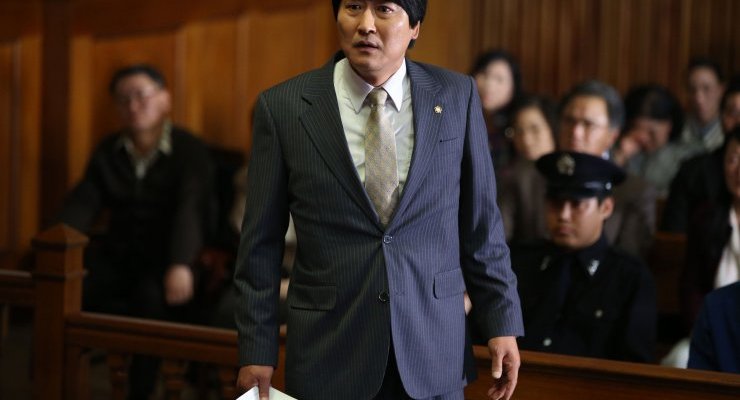
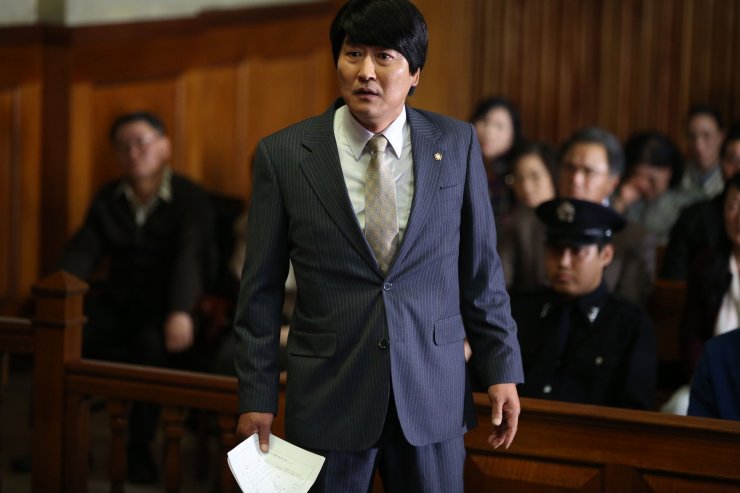
Woo-seok blasts Chun Doo-hwan's regime in an explosive court room battle

The Attorney (변호인) – ★★★★☆

The Attorney (변호인)

The Attorney (변호인)

Gathering over 11 million admissions during its cinematic run, director Yang Woo-seok’s (양우석) highly impressive courtroom drama The Attorney (변호인) has certainly struck a chord with Korean audiences. Inspired by the early years of former president Roh Moo-hyun, the film explores the anti-communist witch hunts and suppression of human rights that targeted students during dictator Chun Doo-hwan’s regime. The Attorney has clearly struck a nerve with film-goers, many of whom were alive – and victimized – during the persecutions, and with regular protests held regarding current President Park-hye’s administration the film is timely indeed.

The Attorney is an incredibly powerful film and a stunning debut for first-time writer/director Yang Woo-seok. The pacing and structure is wonderfully constructed as the underlying messages within are gradually introduced and explored through the central protagonists. The tendency to delve into melodrama is luckily side-stepped and the film is all the stronger for it, with actor Song Kang-ho providing a phenomenal performance that cannot fail to incite emotional resonance within audiences, Korean or otherwise.

Song Woo-seok is very successful is he embarks on his quest to be a top attorney

Song Woo-seok is very successful is he embarks on his quest to be a top attorney

During the early 1980s, attorney Song Woo-seok (Song Kang-ho (송강호) is continually ridiculed by his peers for only graduating high school, yet they are soon embarrassed when Song’s ambition and drive to succeed places him as one of the top lawyers in Busan. As his business is on the verge of expanding, a friend’s son is mysteriously kidnapped by the military authorities. Agreeing to take on the case at great personal risk to himself and his family, Song begins to investigate the human rights abuses perpetrated by Chun Doo-hwan’s regime, leading to an explosive courtroom battle.

The Attorney would be a great accomplishment for any filmmaker, yet as director Yang Woo-seok’s first film it is an incredible achievement. The skill with which he guides the story in no way conveys his novice status, as the pacing of the story and wonderfully fluid camerawork expertly absorbs the audience within the film. Furthermore director Yang’s subtle use of colours is continually highly effective, from the warm hues of the family homestead to the washed-out palette used for scenes of torture. The impressive technical prowess is bolstered by a very well written and extremely well paced script, one that subtly guides the audience through the issues of 1980s Korea (and more specifically, Busan) by way of the struggles of attorney Song Woo-seok. While the film is concerned with human rights abuses, such scenes are only introduced after considerable time has been spent constructing the protagonists, heightening the impact of events significantly. As such it is impossible not to invest in Song’s plight, and the approximately two hour running time simply flies by.

Woo-weok is shocked to discover Jin-woo has been tortured and vows to defend him

Woo-seok is shocked to discover Jin-woo has been tortured and vows to defend him

It is impossible to discuss The Attorney without mentioning Song Kang-ho’s electric performance. Song has a remarkable gift for making his characters likeable and relatable and as the titular lawyer, he consistently conveys a man of dignity who strives for better for himself and his family. Song infuses the role with morality and determination to succeed in conjunction with a comic humility that is ever-endearing, from the rags-to-riches story of his early years through to his successes as a top attorney in Busan. As such, his outrage at the incarceration and torture that transpires is truly palpable while his battle against the insurmountable odds is poignant and inspiring.

Song Kang-ho is also supported by a great cast including the ever-reliable Oh Dal-su – once again in a comic sidekick role – as well as Kim Yeong-ae as a humble restaurant owner. Kim’s performance in particular is incredibly moving following her son’s disappearance, restraining her desperation perfectly as to not step into the realm of melodrama. Kwak Do-won steps into his villainous role with great aplomb as the wonderfully vile as the chief anti-communist torturer. His arrogance and disdain for any who criticise Chun’s military regime makes him the perfect love-to-hate scoundrel, yet the basis on real life events grants a potency that cannot fail to instill anger.

While powerfully moving, The Attorney does have issues. Ironically while the film itself is based on Roh Moo-hyun’s life, the change of name for the lead role insinuates that censorship and freedom of expression are still under threat in contemporary Korea. The torture sequences, so expertly achieved in director Chung Ji-young’s National Security, don’t contain the same gravitas as to convey the horrors of Chun’s regime and what’s at stake in Song’s/Roh’s crusade against injustice. These are small points, yet ones that make  The Attorney just shy of greatness.

Woo-seok blasts Chun Doo-hwan's regime in an explosive court room battle

Woo-seok blasts Chun Doo-hwan’s regime in an explosive court room battle

Based on the early years of former president Roh Moo-hyun, The Attorney (변호인) is a powerful and utterly absorbing court room drama. Director Yang Woo-seok’s debut is wonderfully structured and character-centered, with the exploration of human rights abuses during the Chun Doo-hwan regime naturally emerging through the story that unfolds. Featuring a brilliant performance by Song Kang-ho as the titular lawyer, The Attorney is a timely and poignant film that cannot fail to incite emotional resonance.

★★★★☆

Reviews