The 17th Seoul International Women’s Film Festival (SIWFF) has unveiled the finalists for the Asian Short Film and Video Competition, as well as the ‘I-TEENS’ program.
3 Year 3 Month Retreat
According to festival officials SIWFF 2015 received more submissions than at any point their history for the competition, eventually selecting the final 21 films – 13 Korean and 8 non-Korean – from 415 entries from over 20 Asian nations.
Oh Lucy!
Of the finalists, four will be selected for prizes. The Sungjoo Grand Prize (alongside $9,000 cash) will be awarded to the best film, while two Sungjoo First Prizes (as well as $4,500 each) will be bestowed upon the runners up. Through audience ballots conducted throughout the festival, a film will also be chosen for an Audience Award.
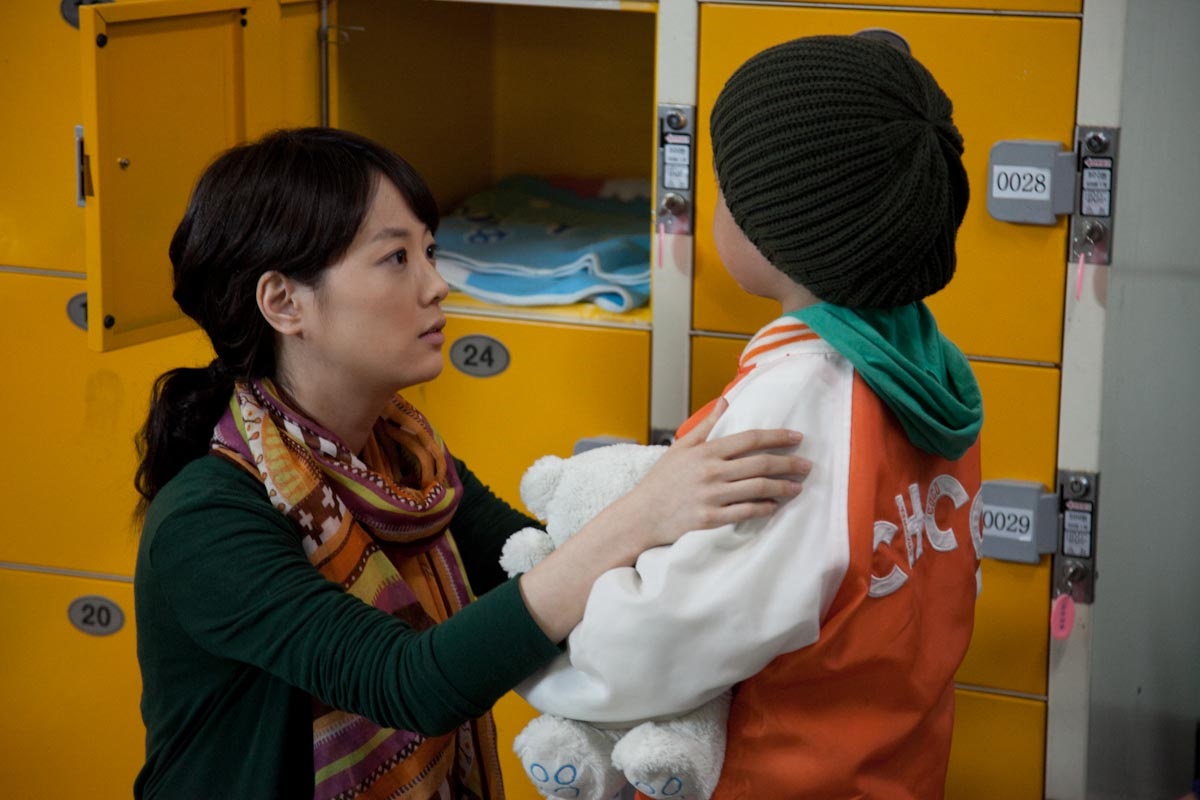
That Day of the Month
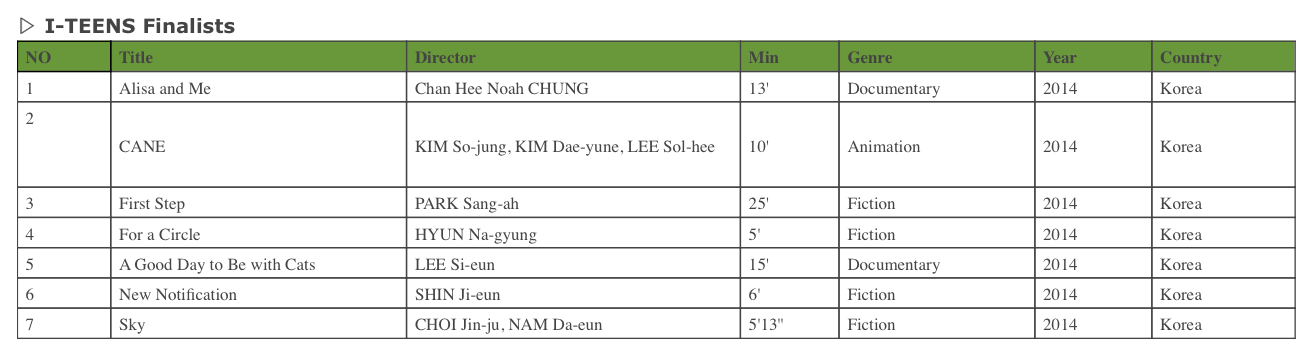
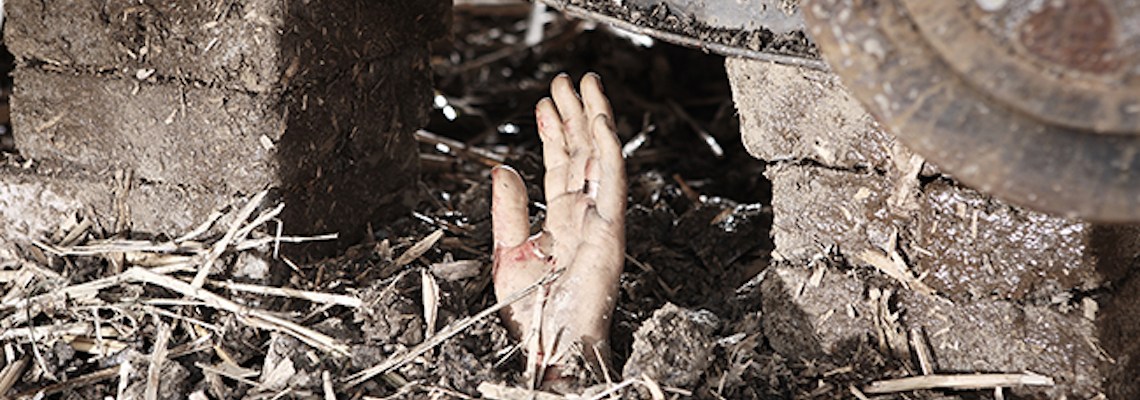
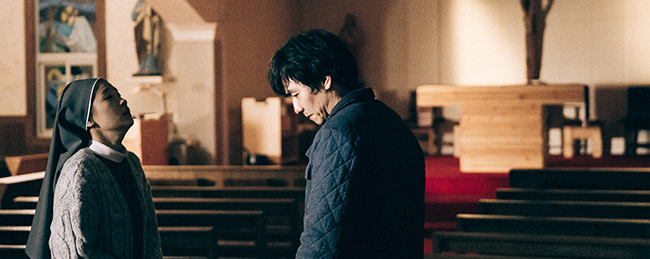
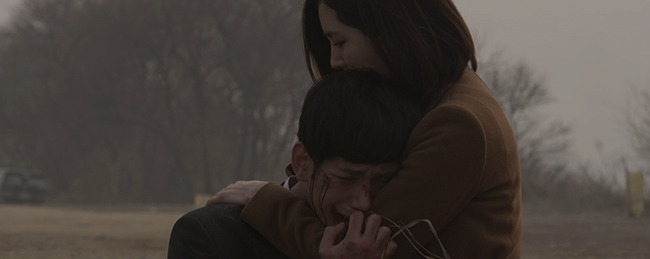
Meanwhile the I-TEENS category, now in its second year, will screen seven films produced by Korean teenage females.
SIWFF will run from May 27th to June 3rd at Megabox in Sinchon.
The 16th Jeonju International Film Festival, which will run from April 30th through to May 9th, has unveiled the full lineup of Korean and foreign films to be screened.
In terms of Korean cinema, in addition to the already previously announced Korean Competition and Korean Competition for Shorts that features new and emerging talent, films from the peninsula will feature within Korean Cinemascape and Korean Cinemascape for Shorts, as well as in other select programs.
With so many independent productions from which to choose, selecting quality films can be somewhat of a daunting task. As such, here are Hanguk Yeonghwa’s Hot Picks for the upcoming festival.
Jeonju Digital Project 2015
Samnye (삼례) – Director Lee Hyun-jung (이현정)
Samnye
Director Lee’s previous JIFF film, Echo of Dragon, appeared in the 2013 Korean Competition and proved her art-house sensibilities. Samnye tells the story of a struggling screenwriter, who meets a charming yet strange girl. Art cinema fans should definitely take a look.
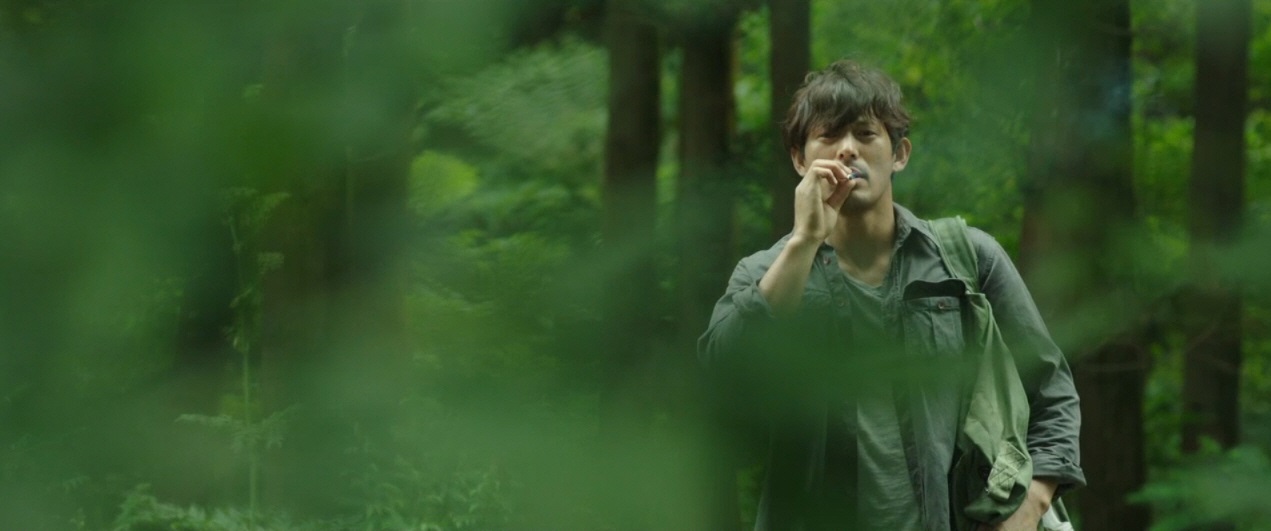
Snow Paths (설행 눈길을 걷다) – Director Kim Hee-jung (김희정)
Snow Paths
Described by JIFF Head Programmer KIM Young-jin as, “undervalued in the Korean film industry,” director Kim (Grape Candy) returns with Snow Paths, a film exploring the life of an alcoholic seeking solace in the mountains who befriends a nun.
Korea Cinemascape
Black Stone (블랙스톤) – Director Roh Gyeong-tae (노경태)
Black Stone
Black Stone premiered at Rotterdam earlier this year. A Korean/French co-production, the film depicts highly controversial issues in contemporary Korea, involving inter-racial families and abuses within the Korean military.
Death in Desert (붉은 낙타) – Director No Zin-soo (노진수)
Death In Desert
Director No has been busy recently with Total Messed Family (JIFF 2013), The Suffered (JIFF 2014), and The Maidroid (Yubari Fantastic Festival 2015). With Death in Desert, he explores an obsessive relationship between a couple who just can’t let go of each other.
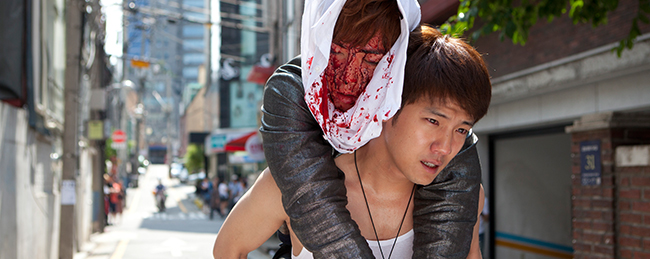
Made in China (메이드 인 차이나) – Director Kim Dong-hoo (김동후)
Made In China
There’s been plenty of buzz around the Kim Ki-duk produced Made in China, which premiered at Tokyo in 2014. Featuring stars Park Ki-woong and Han Chae-ah, the story involves a Chinese eel farmer and a cold-hearted Korean food inspector.
Speed (스피드) – Director Lee Sang-woo (이상우)
Speed
Director Lee is notorious for tackling controversial subject matter within his films, as exemplified by Mother is a Whore, Barbie, and Fire in Hell. Following short film Exit at JIFF 2013, he returns with Speed, a tale of four friends whose lives are intertwined.
Trap (덫, 치명적인 유혹) – Director Bong Man-dae (봉만대)
Trap
Director Bong’s Han River premiered at Busan 2014 to praise for exploring suicide with dark comedy. With Trap, a miserable screenwriter travels to an inn to finish a script, yet falls for the charms of a seductive teenage girl with increasingly dark ambitions.
Korea Cinemascape for Shorts
The Running Actress (여배우는 오늘도) – Director Moon So-ri (문소리)
The Running Actress
Legendary actress Moon So-ri steps behind the camera for The Running Actress, a 24 minute short film. In it, Moon plays a woman trying to balance domestic life and hardships while attempting to forge a career on screen.
Outdoor Screening
Like a French Movie (프랑스 영화처럼) – Director Shin Yeon-shik (신연식)
Like a French Movie
Director Shin has a rare ability to helm films both mainstream (Rough Play) and artistic (The Avian Kind, The Russian Novel). In Like a French Movie, which seems to be one of the director’s artistic endeavours, the protagonists all embody the traits of characters within a French film.
The Wildflower Film Awards has unveiled the nominations for its second edition, with the prizes to be bestowed at a ceremony on April 9th in central Seoul.
The organisation is dedicated to celebrating the achievements of Korean independent cinema, as well as films that have a budget of less than 1 billion won. With the vertically-integrated nature of the commercial industry in Korea such films often have an arduous production and a battle to secure distribution, despite the incredible creativity and insight contained within.
The nominations were selected by a panel of film professionals and cineastes, headed by Korean cinema specialist director Darcy Paquet, a figure renowned for his contributions in promoting films from the region. The committee – which Hanguk Yeonghwa is proud to be a part of – chose the finalists from over 60 features and almost 30 documentaries released throughout 2014.
Out of the 21 films nominated July Jung’s A Girl at My Door leads with seven nods, while Lee Su-jin’s Han Gong-ju and Woo Moon-gi’s The King of Jokgu have five. Lee Yong-seung’s 10 Minutes, Zhang Lu’sGyeongju, andHong Sang-soo’s Hill of Freedomhave four nominations each, respectively.
In the build-up to the awards ceremony, from April 6th~9th screenings of six of the nominees will occur at Seoul Theater, accompanied by Q&A sessions with the filmmakers involved.
Jeonju International Film Festival (JIFF) has announced the ten films that will form the ‘Korean Competition’ category.
The finalists were chosen from an incredible 118 submissions, and all of which are world premieres. In terms of genre, nine of the selected films are fiction while one is a documentary. Interestingly, three of the finalists come from the Korean Academy of Film Arts (KAFA) and Dangook University’s Graduate School of Cinematic Content, with the remaining seven arriving from independent film distribution companies.
The ten finalists will compete for the Grand Prize, CGV Arthouse Award Distribution Support, and the CGV Arthouse Award Upcoming Project Support, respectively.
For the full line-up of Korean feature films within the category, as well as select stills that have been released, please see below.
The 16th edition of the Jeonju International Film Festival (JIFF) has unveiled the finalists for the ‘Korean Competition for Shorts.’
The 20 films have been selected from a staggering 609 entries, with a focus on originality, experimentalism, and controversial themes. The finalists will compete against each other for a selection of prizes, including the Grand Prize, Best Director Award, and Special Jury Award, respectively.
JIFF’s ‘competition for shorts’ program serves as a launching pad for new talent, with films often finding success on the international stage. Director Na Young-kil’s Hosanna, which premiered at JIFF last year, went on to receive the Golden Bear for Short Film at the 2015 Berlin International Film Festival. Premiering at JIFF 2013, director Han Eun-young’s Breathe Me later appeared at the Cannes Film Festival – Critics Week in the same year.
For the full line-up of short films within the competition, as well as select stills that have been released, please see below.
1) The Emotional Society on Stage (Directors Kim Sookhyun, Jo Hyejeong) [2014 / 23min]
2) A Lonely Bird (Director Seojeong Shinwoo) [2015 / 18min]
3) Mind Control (Director Lee Nakyung) [2015 / 16min]
4) The Messenger (Director Son Kyungsoo) [2014 / 13min]
Heels over Head
5) Heels over Head (Director Shim Hyejeong) [2015 / 26min]
6) Uninvited Guest (Director Kang Minseok) [2014 / 31min]
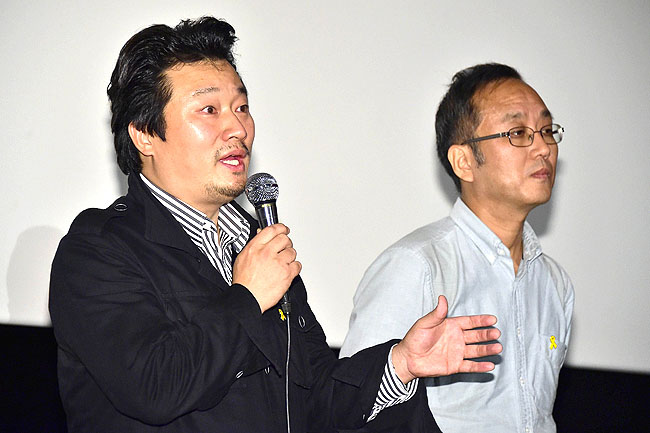
Directors Lee Sang-ho (left) and Ahn Hye-ryong (right) field questions from the audience at the BIFF premiere – AFP
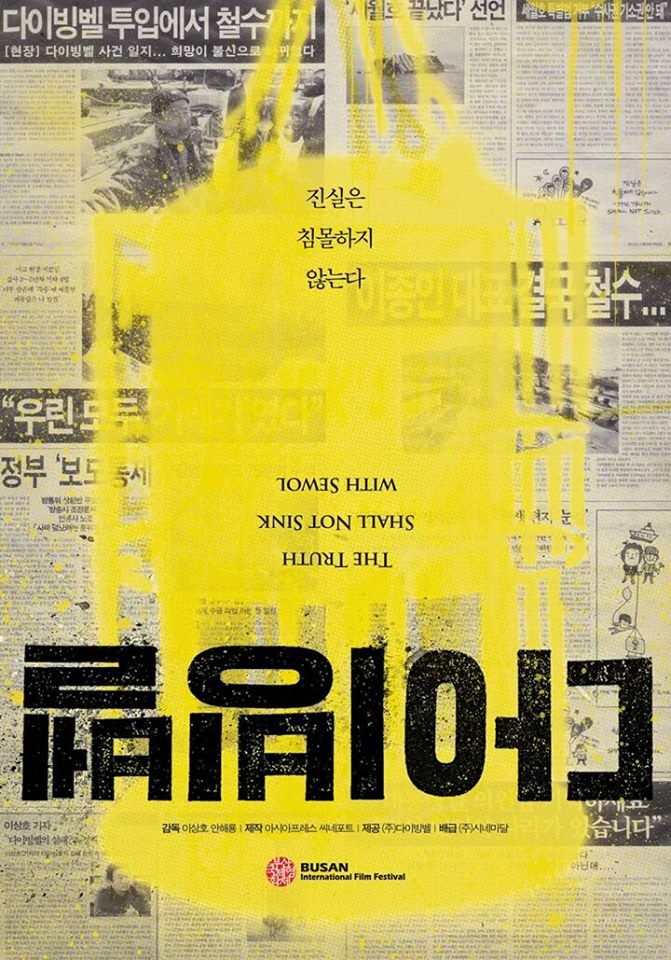
N.B. The following Q&A took place at the premiere of The Truth Shall Not Sink With Sewol (다이빙벨) at the 19th Busan Film Festival (BIFF), on October 6th, 2014.
Please note – the opinions expressed in this article belong solely to the people articulating them. What follows has been transcribed from the translation given by the BIFF translator at the event.
Translator: “the festival people are tense because the mayor threatened to cut off funding if the festival shows this film, and of course the people who made this documentary are also tense because there might be ultra-conservative people who would come and try to mess up this conference.”
The directors come on to the stage to applause.
The Truth Shall Not Sink With Sewol (다이빙벨)
Moderator: “How do you feel about your film being screened here at the Busan Film Festival?”
Director Lee: “There was a lot of controversy over this case, so I will answer frankly and honestly to any questions you might have. Because of the time constraints, I was not able to make the film as ‘complete’ as I had wanted. It’s only God who can take us back to April 16th, the day of the tragedy, but the least we can do is to go back and investigate and find the facts surrounding the incident. I hope that as many people as possible can get to see this film, and I hope that this interest in this film will translate to continued interest in the Sewol tragedy.”
Question: “I’d like to ask, when did you start planning this film? There are some cuts of news footage, so when you were covering this incident, was that when you started planning this film? Or maybe after the uproar had died down? Is that when you started planning this film?”
Director Lee: “Simply put, just like all of you, I was there at Paengmok Harbor and it was there that I realised that the truth was sinking with the ferry and with the children. Most of the mainstream media, whatever they were reporting, was not true, they were lies. And behind the scenes were the power, those in power who wanted to cover up their mistakes, cover their ass. So for three or four days it was a very critical time when the truth was in danger of being covered up forever, so that’s why we kept as much footage as possible, and we tried to film everything. We concentrated back then on the diving bell because we thought the diving bell would be critical in revealing the lies that the government was telling through the coast guard. And there was this sense of urgency because it seemed that people were starting to forget, trying to put the tragedy behind them already, when nothing had been found and discovered. So that’s why we wanted to make this film, in order to keep the memory alive. And we wanted to get it screened at the Busan International Film Festival where there would be a lot of global attention as well, so we were pressed for time, so we were running up against a very tight deadline in making this film.”
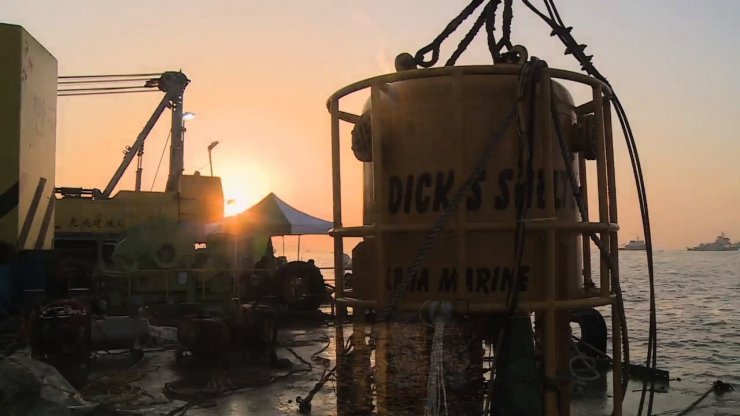
Lee Jong-in (left) is at the center of the diving bell controversy
Question: “You’re here not as a journalist, but as a director. If you have anything that you were not able to say through this film, would you like to share that with us? And Mr Lee Jong-in, the owner of the diving bell, was there a message that he wants to convey? As a member of the audience and as a Korean citizen, I would like to send my encouragement and support for all the people who made this film possible.”
Director Lee: “I’d like to answer both questions. Mr Lee Jong-in, CEO of the diving technology, he did not have a lot of deep thoughts, he was of the same heart and mind as the rest of the citizens. He didn’t make any calculations, he just rushed to the scene because he thought that he could help, because he did have the technology, and he had technology and equipment that the coast guard and the navy did not have and so he offered his help. But during the time when the film was being made, he realised that he was up against something that he could not overcome. And he knew that once the film was made he would be at the center of another controversy yet again, so there were people who asked him to lie low, but he cooperated with the film making because he wanted the truth to be uncovered. I’m a little nervous, so I forgot the other question. Oh yes, as a journalist. I’ve been working as a journalist for 20 years. I was there on the scene as a journalist but as a filmmaker, what disheartened me the most, what broke my heart the most, was leaving out footage that I thought was appropriate for the film. For example, Lee Jong-in was kicked out after the first attempt, and then the journalists found out that the coast guard and the rescue team from the government had attempted to put in a diving bell, their own diving bell, which was a fake diving bell. And that was not in the film. And as you know, there was a lot of online manipulation of public opinion during the presidential elections, and that kind of public opinion manipulation went on during and surrounding the Sewol tragedy, and I was unable to touch on that during the film. So I found that quite regretful. And what really broke my heart was that this diving bell, that was cutting edge technology, there was huge potential for it to save lives, and it had been in operation for 2 hours, compared to the few minutes of the other divers, but then we were threatened, there was even a murder attempt on us, and they were cubing the press. And so I found [not including] that most regretful. We even have legal charges being pressed against us right now.”
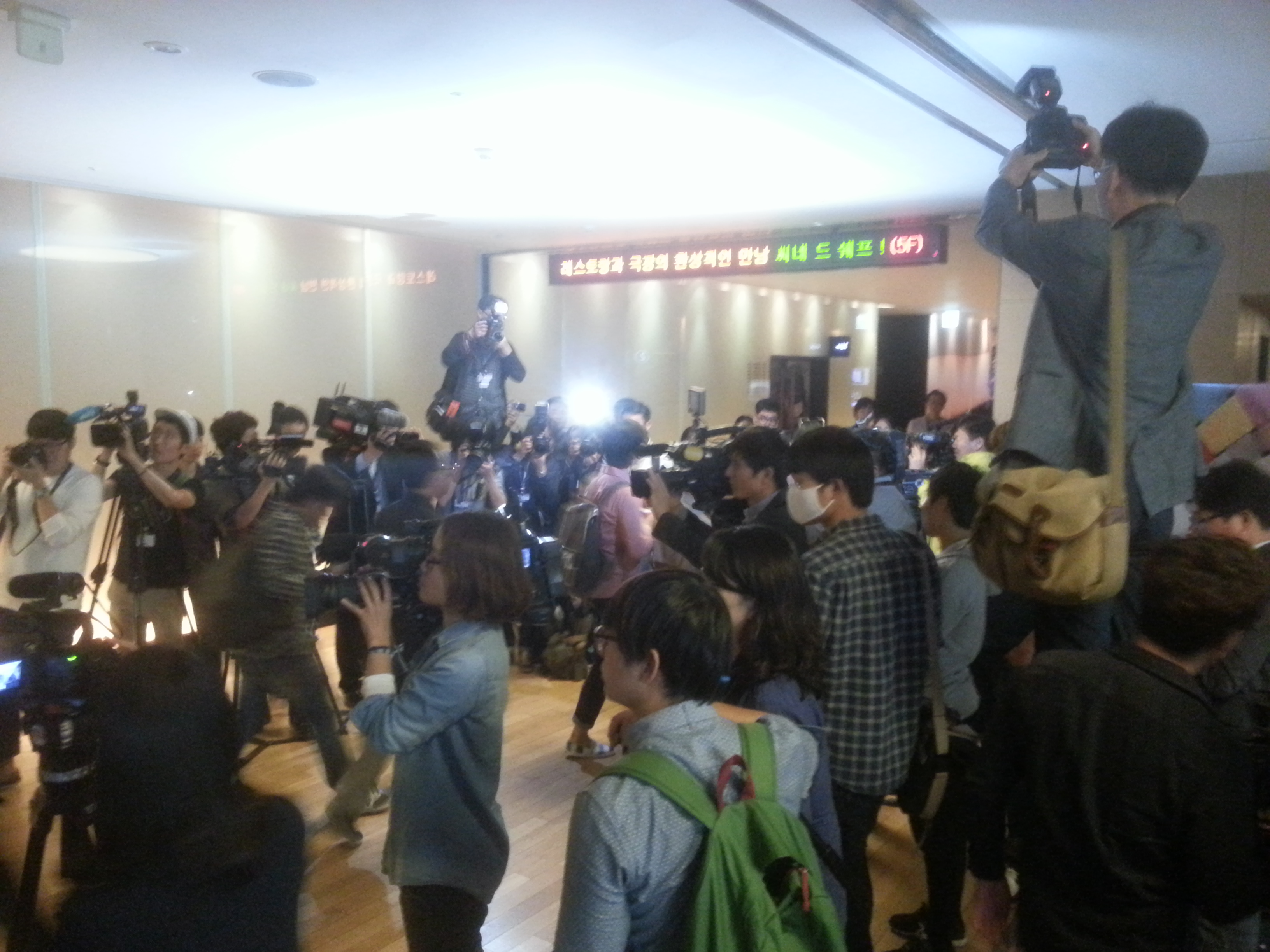
There were chaotic scenes at the BIFF premiere
Question: “There’s controversy over whether this film will eventually be shown or not, so I’m quite taken aback by this press attention. I think it’s this press attention and media attention that gathered so many people here today. And personally I think there are a lot of people in Korea who are starting to forget, they’re trying to erase this whole tragedy from their memories, and so I’m worried about that because we’ve not achieved anything and there’s 10 people who are still missing, and the families of these missing people as well as those who have passed away, they’re all still grieving and in great suffering. Do you have a message for the Korean public?”
Director Lee: “I believed in fair journalism, and that’s why I was working as a reporter for a television station, but I got kicked out, I was dismissed, but I want to continue to try to pursue the truth now this time through film, and I’d like to thank all of you for coming. As you know there was a New York Times article today that after the Sewol tragedy, right afterwards the public was one, they were united in praying for the safe rescue, but then they’ve become divided these days. The bereaved families, they’re getting stoned in public on the streets. I hope that we can go back to, at least mentally and emotionally, to right after the incident and become one again in pursuing the truth. And I hope that through this film [I] will contribute in whatever way to protecting this film as well as protecting the bereaved families.”
Question: “As a college student I really wanted to check out this film and one of the messages is that there was some force, some hidden forces, that were interfering with the diving bell rescue operation. Who do you think would be the people behind it?”
Director Lee claims unanswered questions still remain regarding the rescue efforts
Director Lee: “I will give it to you simply. Since April 16th, what I wanted to know was, why did the children have to die? Why weren’t they rescued? Why didn’t the state protect these children? And as you saw through this diving bell fiasco, survivors who were 30-40 meters underwater, if you just drag them up out of the water, they will die anyway. As you saw in the film, if you go down 75 meters and you dive for a few minutes you still have to decompress for about 30 minutes. So these kids, they were in the ship, and they were trapped inside for a few days, so they have to come up above the water very very slowly, or else they’ll die anyway. But not having such measures at hand, and not coming up with a concrete plan for rescuing them is murder. It’s just murder. The coast guard, not even once, they have never been trained for underwater rescue at all. All they did was float around and circle around the capsized [ship]. And then there was the navy, who were trained. They attempted to go into the scene and start rescue work twice, but they were refused. So it would be the coast guard, the navy and everyone else. Who controls the coast guard as well as the navy? Who has the power? It’s just the president. The president is the only one who can control everyone, or give commands to everyone who was involved in the rescue.”
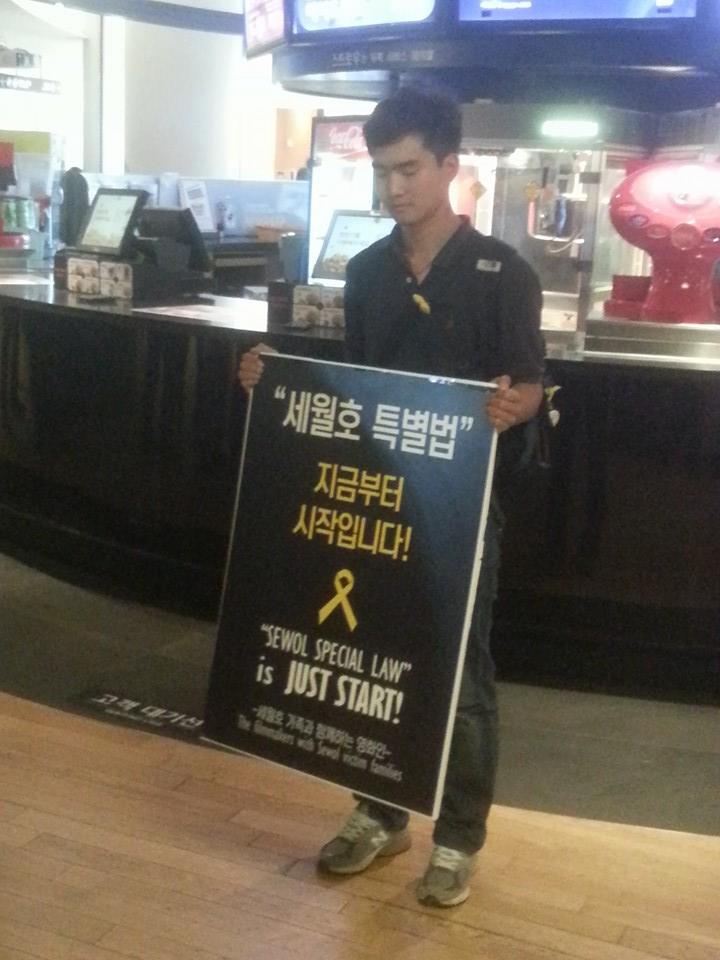
A young man protests in regard to the special Sewol law outside of the screening
Question: “It was very difficult for me to get a ticket to come to see this film and I was shocked. I was not there at the scene, and the only thing I got was the media reports about the diving bell, so I myself thought that it was a failure. And now that I’ve seen this film, I’m truly shocked. And [there’s] so much unfairness. Lee Jong-in is also a victim and I think that everyone in Korea should see this film and I was in tears most of the time. [Audience member begins crying] There’s a limit to how many people can see this film here at the festival, we only have journalists and film festival goers, so I’m lucky that I was able to be one of the few to see this film, and I hope this film will be shown to the wider public in the future. There are people here, and also a lot of journalists so I hope that we will all work together to get this film shown to many people. So my question is, do you think that would be a possibility? Will you be making that effort to get this film shown to more people? And if you have the citizen’s support, the public’s support, I’m sure that this will be released in theaters so that more people can get to see it, more people from the ordinary public. Are you making that effort? Do you have such plans?”
Director Lee: “Well thank you for being moved to tears, first of all. I think getting this shown in public, public screenings for this film will be very very difficult, it will be tough. Facing the uncomfortable truth, in a theater like this, in a public setting like this, this may be the last chance. But we are making that attempt to get this released in theaters and we are working with a deadline of the end of October, so we are making such efforts. I hope that you will all work together to protect this film.”
Question by Oscar-nominated director Joshua Oppenheimer (Act of Killing, The Look of Silence): “We see in your film this incredibly incompetent…or [rather] a rescue effort that’s undertaken in bad faith. And I guess I have two questions. First of all, is it merely incompetence or do you believe that there’s something more going on? And secondly, can you talk a little bit about why the media in Korea, and I don’t think Korea’s alone in this, but why do the feel the media and the mainstream media is so…appears to be so uncritical, so they are placed [into a] terrible stenographers function?”
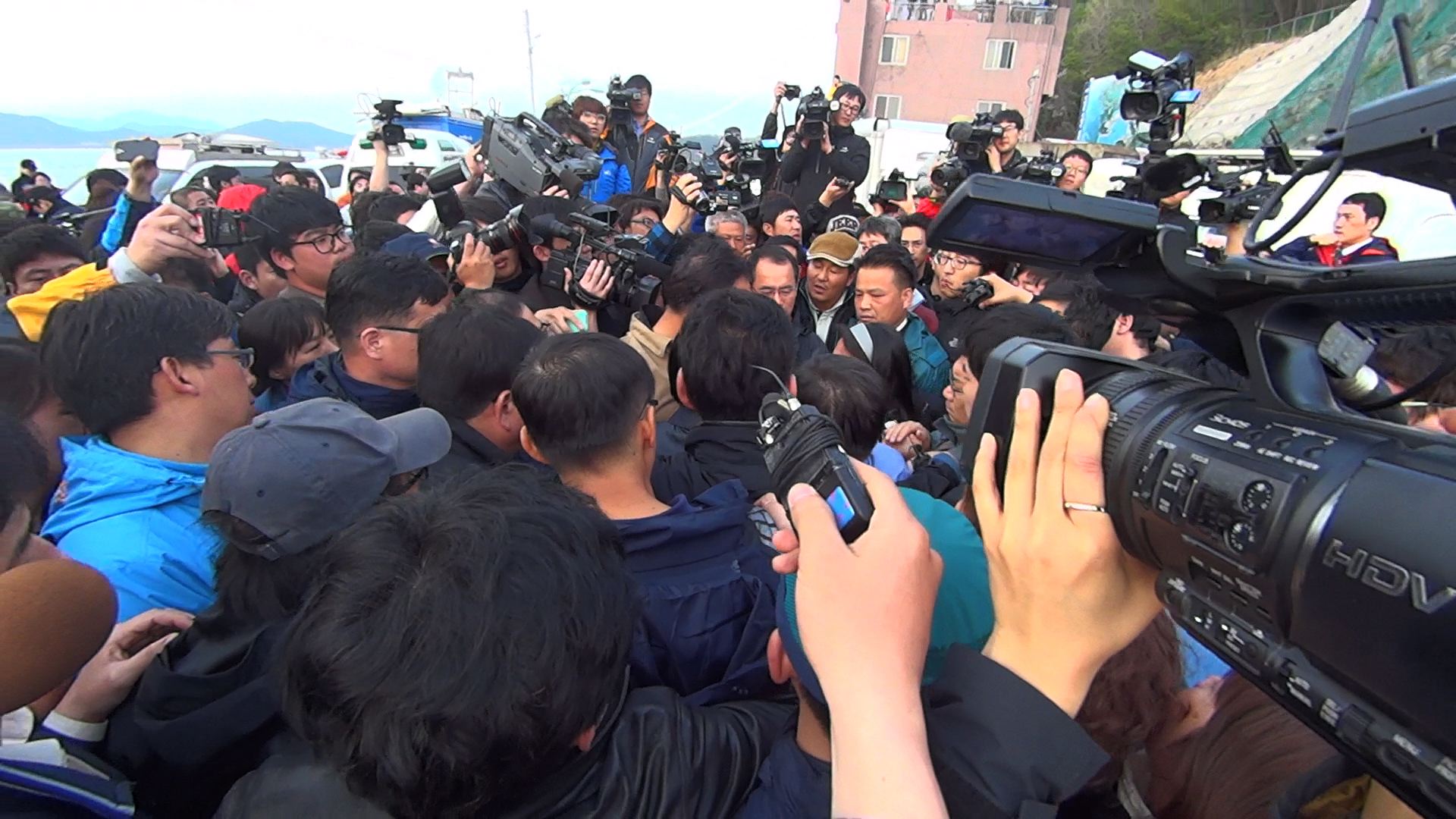
Footage of the media frenzy at the site convey the chaos and demand for answers
Director Lee: “There was the Indonesian version of The Killing Fields recently where there were ordinary and innocent citizens killed [referring to director Oppenheimer’s work] and I’d like to thank you [director Oppenheimer] for deliberately coming to watch this film. Ineptitude or incompetence is the government’s excuse, it’s their main excuse. And yes the government right now is so incompetent that they want to get rid of their incompetent officials, but then they don’t have substitutes, because everyone else is also incompetent. When such a huge tragedy happened, the government did not have in place a system to deal with this tragedy. It means that the state was absent in this case. If the coast guard was incompetent, then they should be taken away and should be replaced by someone more competent, but such decisions, such common sense decisions were not made. It shows how lacking the government is right now in communication skills, and this lack of communication skills has led to this tragedy, led to expanding this tragedy, and I hope that this film will contribute to revealing the incompetence of the government. And the media, the Korean media in this case, they were not just serving the state, but the current government. The media has a say in the government, they are part of the government, and have a stake in the current government. That is why the media are the people who are the most afraid of the president being criticized, because this will reflect on them as well, because they are on the same side. That is why they sent out garbage instead of the truth and this is proof that they are stake holders in this current government. They are not just stenographers, they are stake holders in this government.”
Question: “On the internet I heard yesterday that some members of the grieving families were opposed to this film being shown and of course the Busan city government is saying that they don’t want this film to be screened. So have any of the bereaved families watched this film? And if so, what was their response? And what are your values as a journalist? You must have some value system that you adhere to as a journalist, but in the process of reporting [the incident] the journalists in action went overboard in interviewing students who had just come up, just been rescued.”
Scenes outside of cinema also drew attention
Director Lee: “I think I’m the journalist who was most critised after the tragedy, because on the scene I was an actor in this whole incident, not just a journalist [with an] objective point of view. Didn’t the president say, before she was president, she critised the then president Roh Moo-hyun saying that if you can’t rescue just one person from Iraq, then you don’t deserve to be called a government. But now that she is in office, there were more than three hundred passengers, young passengers, on board the ship and they were left there, trapped there, for days, and not a single one of them was rescued. And in this kind of situation, objectivity is not the value that I should be pursuing, in this kind of case. For example, I clung to the diving bell in trying to attach it to the weight, so yes I was intervening, I was in the scene, but I would continue to do that even if I were to do it again. And the bereaved families, unfortunately they are not diving experts. What I’m saying when I say that the state was absent on the scene, is that there was no control tower. There were many demands made by the grieving families, of course, and it’s only natural. But then the rescue work, and the pursuit of truth right now, it’s all being led by the bereaved families despite their lack of expertise, and the state is not helping them out at all. And the few who were rescued, were rescued by civilian fishermen who just happened to be passing by. And of course it’s only natural that the families don’t have any knowledge about rescue work. And as you saw they hated the journalists, they hated the press, they had to lean on the press and whatever pieces of information that the press gave them, they would cling onto that. In that kind of situation, where was the state in marshaling this confusion?”
The controversial diving bell technology still divides public opinion
Question: “I see this film as kind of a defense for Mr. Lee Jong-in. So in this whole tragedy, what position does this diving bell have? And do you really think that the rescue attempt using diving bell technology was not a failure?”
Director Lee: “Thank you for those short questions. We are all sinners because we were not able to rescue a single person. I came here dressed in black. And the completeness of the film, I don’t have any pride in the quality of the film itself, but it’s the only film that has come out now that deals head on with the Sewol tragedy, and I hope that there will be many more films to follow that can shed more light and maintain interest in this incident.”
Moderator: “Unfortunately we don’t have enough time [for more questions]. Actually I spent a sleepless night, last night. I’ve been with the festival for about 10 years now, working as a moderator whenever the festival has come, and I’ve never stepped on to the red carpet myself. Whenever I moderate for these GVs in the Wide Angle [category] I get to meet so many faces, dark faces and gloomy faces of Korean society from hospices, from women workers in the labour movement, and environment[al] issues. Documentaries are a means of holding on to things we should not forget in order for society to progress. So I hope that these kinds of documentaries will continue to be made in the future, for the benefit of Korean society.”
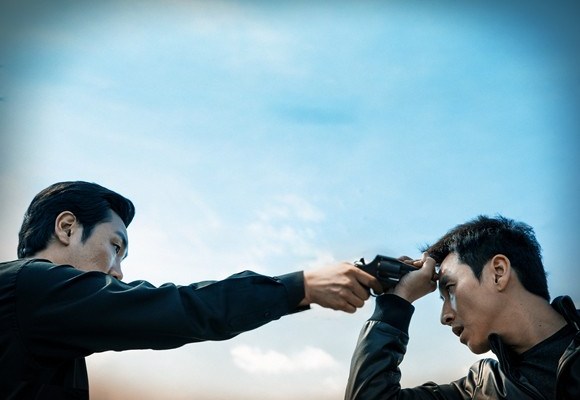
When internal affairs unexpectedly show up at the precinct and begin to investigate, corrupt detective Go Geun-soo (Lee Seon-gyoon (이선균) is forced to make excuses at his late mother’s funeral and race back to prevent his guilt from being unearthed. Driving fast and stressed from his predicament, Go accidently hits and kills a passerby. Secretly disposing of the body and cunningly destroying evidence of his involvement, Go believes he’s in the clear…until he receives an anonymous phone call from a witness (Jo Jin-woong (조진웅) threatening to reveal his sordid crime. Unless Go complies with the demands his world will be over, beginning a frantic game of suspense as they battle to emerge victorious and unscathed.
Already under investigation, detective Go accidently kills a pedestrian and must hide his involvement
From the moment it begins, A Hard Day is an exciting, captivating, and down right thrilling cinematic joyride. Writer/director Kim Seong-hoon (김성훈) has crafted an enthralling and suspense fuelled tale that constantly keeps the audience guessing, through the incorporation of a variety of inspired set-pieces that takes staples of the genre yet reinvents them enough to keep them fresh and appealing. Whether it be the initial hit-and-run incident, the disposal of the body, car chases or physical combat, director Kim builds tension brilliantly to consistently excite and entertain. Alongside editor Kim Chang-ju, who sutures the scenes to incredible effect, the duo have combined to create some of the most gratifying and well made action-thriller sequences in recent memory. Yet despite all the conflict and terrifying situations that arise, the film is never morbid due to the dark ironic humour laced throughout that adds genuine laugh-out-loud moments to the proceedings, a real rarity that serves to both inspire and rejuvenate a genre that has, of late, become quite stagnant. As such the 2 hour and 30 minute running time simply flies by, making A Hard Day one of the most entertaining filmic experiences of the year, and well deserving of its premiere at the Cannes Film Festival.
Detective Go confronts his nemesis to surprising results
Central to the enjoyment of A Hard Day are the wonderfully charismatic performances of Lee Seon-gyoon and Jo Jin-woong. Lee is great as corrupt detective Go, effectively conveying the anti-hero as selfish and unethical but also quite likable and ultimately sympathetic given the fraught circumstances that arise. Lee has an ‘everyman’ quality that he employs effortlessly throughout the film that generates an acute connection with the audience, so much so that it’s entirely possible to forgive Go for his dishonesty and actually root for him as the underdog victim. Jo, meanwhile, appears to absolutely relish the opportunity portraying the villainous blackmailer, to the point where despite his supporting actor status, he threatens to steal the film every time he appears on screen. He is a hulking pillar of evil, yet his comic timing and delivery are so comically entertaining that he’s impossible to dislike, adding a wonderfully fresh dimension to the relationship between the antagonists that is consistently fascinating to watch unfold.
The situation reaches breaking point as the two clash
Verdict:
A Hard Day is one of the most exciting and entertaining action-thrillers of the year. Director Kim Seong-hoon has crafted a thoroughly engaging, suspenseful and darkly humourous tale of corruption that consistently feels fresh through the reinvention of genre traits. Featuring highly charismatic performances from leads Lee Seon-gyoon and Jo Jin-woong, A Hard Day is a thrilling cinematic joyride from start to finish.
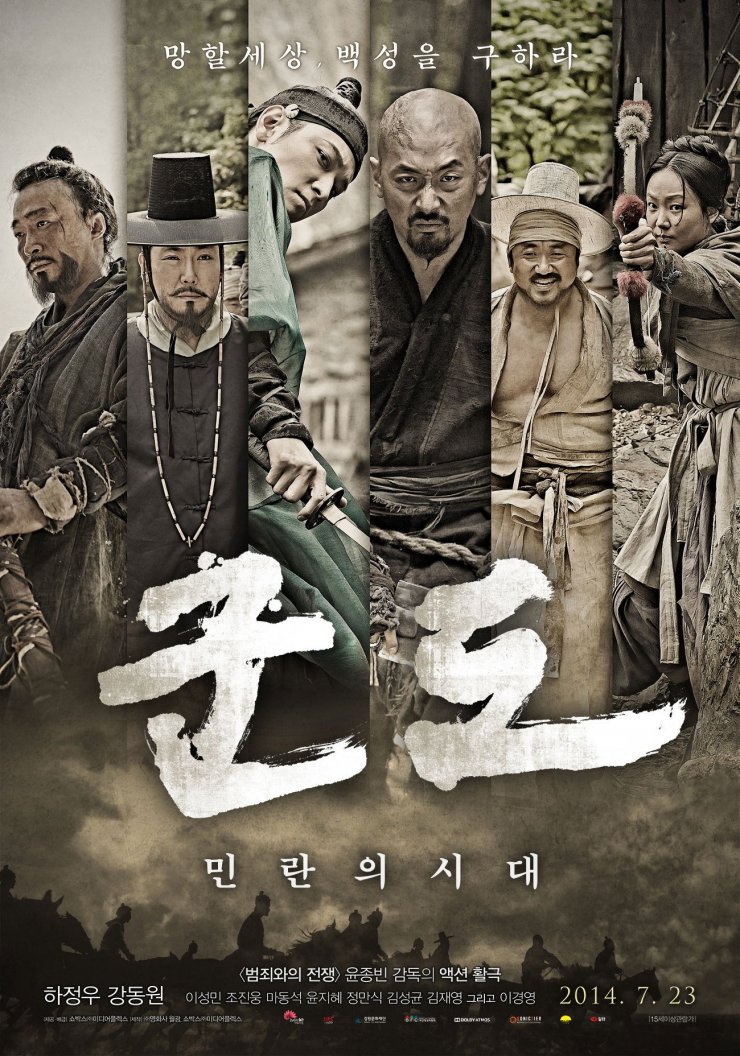
Upon release, summer blockbuster KUNDO: Age of the Rampant (군도:민란의 시대) broke the record for opening day admissions and helped to breath new life into what was a flagging year for Korean cinema…until it was soundly beaten a week later by maritime epic The Admiral: Roaring Currents.
It’s particularly ironic that both tentpole films achieved such a feat, given that they contain such strikingly oppositional philosophies and content. While The Admiral focused on generating hyper-nationalism to achieve success, KUNDO opted for an anti-establishment sensibility, as a group of Robin Hood-esque outlaws band together to fight against the tyrannical Prince.
Curiously, while the ideological leanings of each film differ, both suffer from a similar set of issues. KUNDO, while boasting impressive production values, competent directing and an array of popular stars, ultimately feels rushed and unfinished due to the poorly structured and conceived narrative.
A band of outlaws band together to fight against the vicious prince Jo
Centuries ago, Korea was a land in turmoil. With starvation and death commonplace, corruption in society was rampant, particularly amongst the ruling classes. In the face of so much injustice a group of working class heroes band together to rob from the rich and give to the poor, attempting to appease the suffering of the people. Yet in a nearby city, a greater villainy is brewing. Born to a nobleman and courtesan, Prince Jo (Kang Dong-won (강동원) seeks to usurp his father and reign over the land. Only one challenge to his rule remains – his sister-in-law and her son, the rightful heir. Butcher Dochi (Ha Jeong-woo (하정우) is hired to kill the pair, yet when he cannot, he is viciously betrayed and punished. Furious, Dochi finds a place with the band of thieves and begin their revenge as they plan to halt the Prince’s machinations.
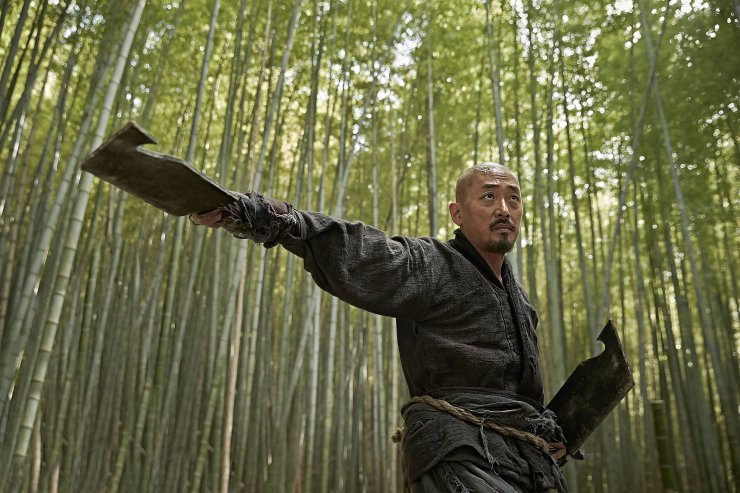
From the moment KUNDO opens, it’s clear that the production values are some of the highest in recent memory and are particularly outstanding. Director Yoon Jong-bin (윤종빈) and his team have noticeably worked hard to put striking visual detail in every shot, from the incredible costumes of the cast through to the great variety of landscapes and arenas in which the action takes place. The attention to detail generates a sense of sincerity and wonder, and is in itself an phenomenal achievement. In regards to each member of the cast, their histories and occupations are wonderfully captured in their costumes whether it be a Buddhist monk, a butcher, or a wealthy prince and significantly contributes to the power of the film, an acute attention to detail that earned designer Jo Sang-gyeong the award for Best Costume Design at the 51st Daejong Film Awards.
The prodction values in KUNDO are outstanding
Yet where KUNDO falters is in the narrative structure, which is consistently haphazard. The story jumps between time lines and characters to confusing effect, and to compensate a random and quite sporadic voice-over attempts to help allay by filling in back stories and histories yet serves to provide only a further sense of disorganization. The poor structure is impossible to miss and insinuates even to the casual cinema-goer that several more drafts of the screenplay were needed before cameras started rolling.
Screenwriter Jeon Cheol-bin is further hampered by an overly – and insanely – large cast which is a huge challenge for any scribe to make each character relevant. While Jeon has clearly worked hard to do so, the sheer amount of protagonists weighs down the film due to the attempt at giving everyone screen time, resulting in a story that lacks conviction or indeed compulsion, and one that is particularly hard to invest in.
Such issues also afflict the actors. As KUNDO focuses primarily on Prince Jo-yoon and butcher Dochi, Kang Dong-won and Ha Jeong-woo have the greater chances to shine. Ha Jeong-woo in particular seems to be having a great time as the butcher-turned-criminal with his cocky and self-assured performance certainly the most enjoyable aspect of the film. Kang Dong-won – in his first film role since completing mandatory military service – also appears to relish portraying the villainous prince. Yet for them and the rest of the enormous supporting cast, the lack of screen time results in highly capable actors providing competent performances, making KUNDO an entertaining but not especially compelling viewing experience.
The villainous prince battles against the uprising
Verdict:
KUNDO: Age of the Rampant is a record-breaking tentpole film of 2014 by director Yoon Jong-bin. Boasting hugely impressive production and costume design as well as a host of capable actors including Ha Jeong-woo and Kang Dong-won, KUNDO is ultimately let down by a haphazard narrative structure, an insane amount of supporting characters, and a story that is hard to invest in. As a result KUNDO is an enjoyable, though unchallenging, viewing experience.
Awaiting (민우씨 오는 날) – or rather, The Day Min-woo Arrives – is part of an omnibus entitled Beautiful 2014, a series of films that explores moments of beauty helmed by some of the most talented filmmakers throughout Asia. Director Kang Je-gyu (강제규), famous for his action/war films including Taegukgi and My Way, is a surprising choice to step up to the microphone for intimate drama Awaiting, yet he has proven himself more than worthy as Awaiting is a beautifully touching and quite lovely short film.
Yoon-hee (Moon Chae-won (문채원) lives alone in Seoul, waiting for her husband Min-woo (Ko Soo (고수) to return home. Every day she is awoken by a phone conversation from Sarah in America, and fills her day with cleaning, shopping, trips to the community center, and making food. Yet Yoon-hee’s memory is slowly beginning to fade, and of late she has taken to writing notes to help get through the day. One day, two people arrive at her home and inform Yoon-hee of some interesting news regarding Min-woo’s whereabouts.
Yoon-hee and Min-woo are a loving couple
Awaiting is a wonderfully moving and distinctly Korean examination on the nature of love and loss. Director Kang Je-gyu has impressively evolved during the four years since his last film, wisely moving away from the sweeping epic sensibilities of his prior films to focus on the intimate nature of the story. Yet his indelible vision is still clearly present throughout as he explores the division of the peninsula from a refreshing perspective, while his stunning visual sensibilities and unique sense of melodrama remain in tact, accompanied by a tender musical score.
The drama is also a deviation for director Kang in that Awaiting is female-centered, and he expresses Yoon-hee’s story with a quiet sensitivity. Moon Chae-won provides a restrained yet poignant performance as the lonely woman waiting for her husband’s return, an while she isn’t especially challenged in the role the actress is quite charismatic and endearing. Yoon-hee’s emotional story is a heartbreaking tale, and one which is elegantly, compassionately, told.
Yoon-hee waits for her husband Min-woo to return
Verdict:
Awaiting is a beautifully moving and quite lovely short film by director Kang Je-gyu, who has impressively altered his epic sensibilities to portray the touching story of a woman waiting for her husband’s return. Compassionate, intimate and distinctly Korean, Awaiting is a poignant and endearing tale of love and loss.
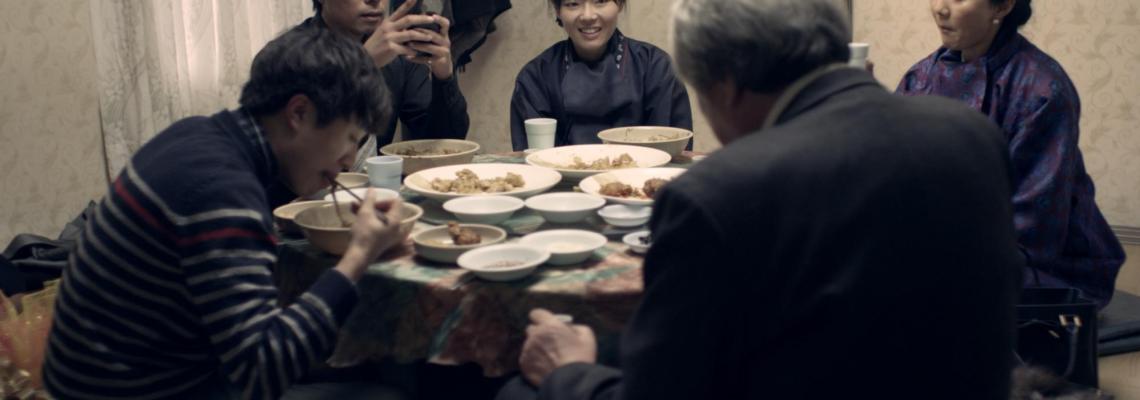
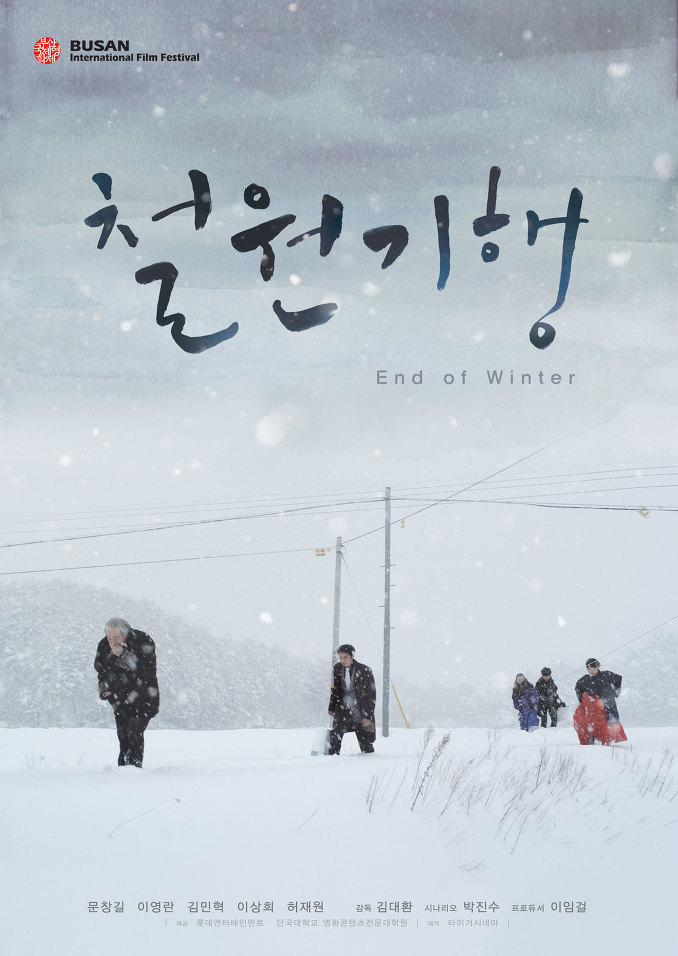
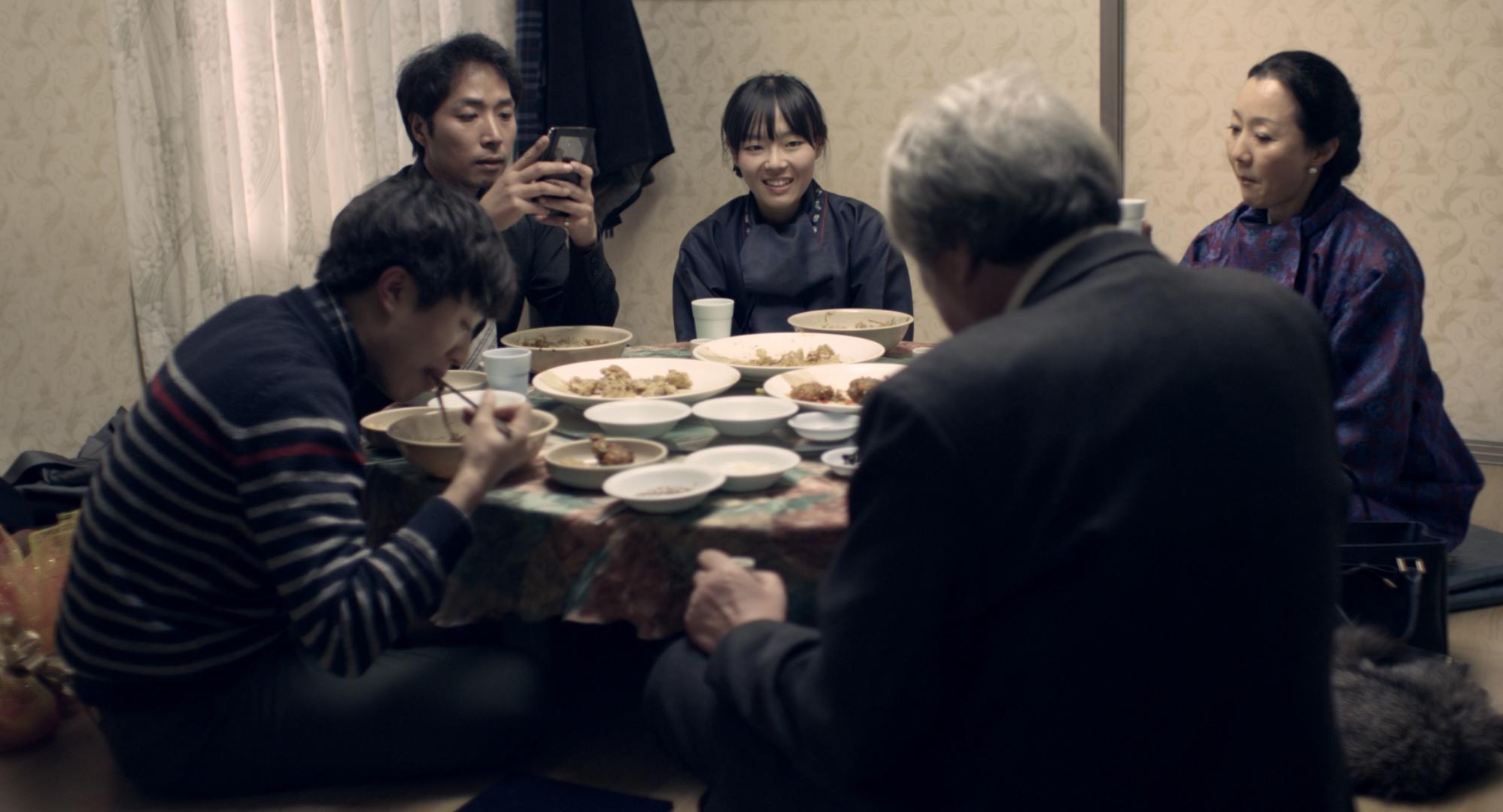
Following the retirement ceremony for the father (Moon Chang-gil (문창길) from his teaching position, he and his family gather together for a meal at a Chinese restaurant. In the presence of his two sons (Kim Min-hyeok (김민혁) (Hur Jaewon (허재원) and daughter-in-law (Lee Sang-hee (이상희), and amid frustrating quarreling, the father shockingly announces that he wishes to divorce from his wife (Lee Yeong-ran (이영란). Stunned, the family struggle with the situation and find comfort in the fact they will soon be traveling back home. Yet as the snowfall becomes heavier and the buses are cancelled, the family members are forced to stay in a small country abode and must confront the issues they have with one another.
The family are in good, yet quarelsome spirits until the father’s shock announcement
Upon its premiere at the 2014 Busan International Film Festival, End of Winter (철원기행) won the prestigious New Currents Award along with Iranian film 13, an accolade that celebrates new Asian film makers of vision. Director Kim Dae-hwan (김대환) certainly has impressive technical prowess as the film’s great strength lies within the composition of the mise-en-scene and cinematography, constructing a dogme 95-esque realism that lends a great deal of sincerity to the proceedings. The manner in which the family members interact with each other similarly evokes such sensibilities, as they are a group of people bound by blood yet who don’t particularly know or understand one another. The awkward conversations and tensions that arise, as well as the issues that each person is hiding yet which gradually come to light, are interesting to watch unfold and are given weight by director Kim’s cinematic realism, as events slowly transpire to reveal the complicated relationships between each person.
That said, End of Winter is an especially slow-moving drama. The protagonists within the film often refuse to speak or give clear answers during conversations which is a huge source of frustration, stunting plot progression as well as character and relationship development, making the viewing experience quite laborious. While it is clear that each character has an interesting motivation and a desire to express it, the withholding of such dilemmas results in a stifling and repetitive story, and one that would certainly be more engaging were more confrontations allowed to occur in addition to the subtleties and allusions to greater issues. Ultimately, Korean audiences are more likely to appreciate and engage with the film more given the nature of the drama, yet even they may find End of Winter somewhat of a chore given their propensity for more typically entertaining generic fare.
In a rare moment, two protagonists engage each other in open conversation
Verdict:
End of Winter is a technically impressive film by director Kim Dae-hwan, whose prowess in regards to mise-en-scene and cinematography evokes potent realism and sincerity. Yet the focus on such cinematic realism, while interesting, results in a family drama that is quite a laborious viewing experience due to the particularly slow pacing of the narrative and the highly restricted dialogue and confrontations.


 The 17th Seoul International Women’s Film Festival (SIWFF) has unveiled the finalists for the Asian Short Film and Video Competition, as well as the ‘I-TEENS’ program.
























 hangukyeonghwa.com