Upcoming London Korean Film Festival to showcase latest blockbusters

The London Korean Film Festival is due to commence November 3rd

The London Korean Film Festival (LKFF) 2011 will host the European premieres of several of this years Korean blockbusters.

Running from November 3rd-17th, LKFF will open with action/adventure film War of the Arrows (최종병기 활) (aka Arrow: The Ultimate Weapon), which stayed at the top of the Korean box office chart for several weeks and has currently grossed over 55,135 million Won. According to Hangul Celluloid, preceding the premiere will be a K-pop concert beginning at 4.30pm.

In addition, sleeper-hit Sunny (써니) which took the prize for Best Director at The Daejong Film Awards, and The Front Line (고지전), winner of Best Picture and official entry to The Academy Awards, will premiere at the event. Furthermore, gritty urban thriller The Yellow Sea (황해), period-comedy Detective K: Secret of the Virtuous Woman (조선명탐정: 각시투구꽃의 비밀), Kim Ki Duk’s critically acclaimed Poongsan (풍산개), and animated tale Leafie: A Hen Into The Wild (마당을 나온 암탉) will all be showcased.

Here’s a trailer showcasing the upcoming screenings of the festival.

LKFF will also be holding a 1 minute short mobile phone competition, to be judged by none other than Old Boy director Park Chan Wook. The winning short will be shown alongside the Mise-en-Scene Shorts, which will include Park Chan Wook’s Night Fishing (파란만장) which was not only shot entirely on an iphone but also won the Golden Bear for Best Short Film at The Berlin Film Festival.

To win free tickets, LKFF has also arranged a competition for fans to post pictures of themselves with a promotional poster.

Special events, including a Korean Cinema Forum and Masterclasses, will be held featuring academics, journalists and Korean film professionals. Most notably, director Ryoo Seung Wan will host a ‘masterclass’ event  while his back-catalogue will be screened as this years ‘Director’s Retrospective.’ His latest film, The Unjust (부당거래), will be the closing film of the festival.

The festival won’t be restricted to London either; the festival will also travel to Sheffield (12-13th, at the Showroom Sheffield), Cambridge (18-20th at the Arts Picturehouse), and Newcastle (20-24th, at the Tyneside Cinema).

You can book tickets to the festival here.

With so many films being showcased, and unselfishly taking the festival to other cities, the upcoming London Korean Film Festival looks certain to impress.
Festival News Festivals 2011

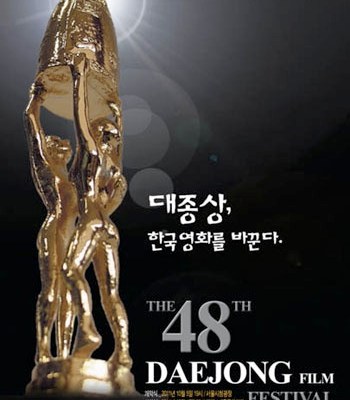
The 48th Daejong Film Awards – 2011

Often referred to as ‘The Korean Oscars’, the 48th Daejong Film Awards were held in at the Sejong Center in Seoul on Monday the 18th.

The 48th Daejong Film Awards

As usual, the red carpet was rolled out for the stars and for their fashionable entrances. Here are pictures of the actors, actresses, and couples that attended.

This year was interesting, as while the films nominated were certainly very good, there was no clear winner that was expected to steal the show. Instead, the awards were spread quite evenly amongst the nominees.

For Best Picture, the award went to Korean war film ‘The Front Line’ (고지전). The film, directed by Kim Ki Duk (김기덕) protege Jang Hoon (장훈), also went on to scoop the awards for Best Production, Best Cinematography, and Best Lighting.

Best Actor went to Park Hae Il (박해일) for his role in action/adventure film ‘Arrow: The Ultimate Weapon/War of the Arrows’ (최종병기 활) (currently with 2 English working titles). The film also scored awards for technical achievement, winning Best Sound and Best Visual Effects. The Best Supporting Actor award was given to Jo Seong-ha (조성하) for his role in gritty action thriller ‘The Yellow Sea(황해).

Kim Ha Neul accepts Best Actress award

Kim Ha Neul (김하늘) won Best Actress for playing a blind woman in crime thriller Blind(블라인드), and accepted her award from ‘You Pet!’ (너는 펫) co-star Jang Geun Seok (장근석) (see here). The award for Best Supporting Actress was scooped by Shim Eun Kyeong (심은경) who appeared in ‘Romantic Heaven’ (로맨틱 헤븐).

The Popularity Award went to The Man From Nowhere (아저씨) star Won Bin, who humbly received his award (here).

Please see here for a full list of the awards, the nominees, and winners from the night.

Festival News Film News

Comedian-turned-director Shim Hyung Rae (심형래) faces bankruptcy

Comedian/director Shim Hyung Rae is in financial difficulty

Shim Hyung Rae (심형래), known throughout Korea for his comedic character Young Gu (영구) and as director on D-War (디 워, 2006) and The Last Godfather (라스트 갓파더, 2010), is facing bankruptcy.

Reporting on August 31st/September 1st 2011, news agencies claimed that the comedian-turned-director had not paid staff at his production company ‘Yonggu Art.’ 43 employees at the company filed a petition for unpaid wages – amounting to 800 million won – which brought to light the financial difficulties Shim was embroiled in. As Shim was unable to pay the outstanding wages, the building in which ‘Yonggu Art’ was located was seized. In addition, Shim Hyung Rae also borrowed heavily from savings banks in order to produce his films, but had been unable to make repayments. In turn, the savings banks have tried to sue him, and the court cases are currently ongoing.

Both D-War and The Last Godfather were critically mauled by the press and word of mouth, yet despite this the hype surroundings his films at the times of their release was immense. However, audience numbers failed to reach expected figures, falling far short of breaking even. The films had been produced with America in mind, hoping to cater to audiences there and therefore increasing audience attendance.

The Korea Times also reported that Shim had a weakness for casinos, and that his gambling addiction was the root of the problem.

As reported hereScott Ross, the co-chairman of inDSP USA and technical director of special effects, claimed that Korean films are:

“very specific to Korean culture, and they’re shot in Korean language with Korean scriptwriters,” and that, “(e)veryone thinks their stories, cultures and movies are global content. But that’s not the case. Hollywood movies are global content.”

Clearly Shim Hyung Rae attempted to follow such advice and break into the American market, yet his failure to do so has ultimately cost him his production company.

Celebrity News Film News
Silenced (The Crucible) (도가니)

‘Silenced’ (도가니), the controversial true-life story, shakes Korea

The release of ‘Silenced (도가니) (aka ‘The Crucible’) has caused an unprecedented level of controversy in Korea.

Poster for Silenced/The Crucible (도가니)

Depicting the true-life story of the shocking sexual abuses that occurred in 2000 at a school for disabled children by the staff – including the principal – Silenced has enraged the public to such a degree that policies and laws are changing. Watch the trailer here.

Released on Sept. 22nd, the film tells of the story of teacher Kang In Ho (강인호) who joins Inhwa school for the hearing impaired in Gwangju. As he begins to learn about the terrible atrocities being committed, he joins Seo Yoo Jin (서유진), a humans rights activist, to help bring the case to the attention of the authorities. Worse still, the six offenders received incredibly lenient sentences; only two received prison sentences, while the other four had suspended sentences or were not punished due to the statute of limitations. The school continued to operate – and some of the accused even returned to the school to teach. It is not known exactly how many victims, or even how many perpetrators, there are as Korean law requires the victims make a complaint.

The outrage surrounding the film has sparked calls for sexual offenders to be prosecuted more severely, and for the statute of limitations to be removed altogether. The public have asked for the case to be reinvestigatedEditorials have been written condemning the leniency given to sexual offenders. Politicians, eager to side with public opinion, also addressed the issue to the point where even President Lee Myung Bak (이명박) stated:

“It is necessary to make legal and institutional supplementations to prevent a similar incident from happening again.”

This in turn has opened an even wider debate on criminal background checks on teachers. The Education Ministry began a consensus asking for details from 189,759 nurseries, schools and private academies. Only 85.2% of teachers submitted details to the Ministry, while 17,891 refused. Currently, foreign teachers must have a criminal background check in order to teach in Korea. Additionally, the punishment sexual offenders has come under review with measures calling for harsher fines, jail terms, and expulsion from the education profession. A list of the measures are reviewed here.

Further still, prosecutors have used this momentum to examine sexual assaults in more depth, such as when, where and who are involved. The ongoing and expanding outrage even led to a report on the issues raised in The Economist.

It’s incredible how Silenced/The Crucible has achieved such notoriety to the point where policies are being examined and laws changed, especially considering it was based on a novel that had been in circulation for years prior. It has remained in the top spot since its release, with current figures suggesting nearly 4 million people have watched it thus far. Initially, director Hwang Dong Hyeok (황동혁) didn’t want to make the film due to the distressing content, however with the triumphant change in policies to protect children across Korea, it’s a very good thing he did.

Film News Uncategorized
Tae-hoon is demoted due to his arrogance and inability to follow orders

Superstar Rain joins the military

Rain prepares for military service (YONHAP)

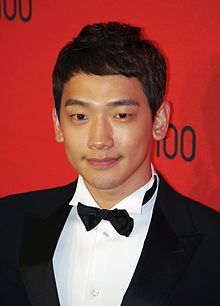
Rain (비), real name Jung Ji Hoon (정지훈), reported for military service on the 11th of October.

All Korean men have mandatory military service for two years, and while celebrities reporting for duty is nothing new, the level of coverage surrounding Rain’s departure has been unprecedented. News outlets from various countries have reported the event, including The Korean Times, the BBC, the Guardian, CBS, TIME, the China Daily, and more.

The Guardian’s Justin McCurry even went as far as to compare Rain to Elvis, stating:

‘More than half a century after the US military draft put Elvis Presley’s career on hold, his modern-day South Korean counterpart bade farewell to tearful fans this week as he prepared for two years’ national service.’

Rain at the TIME 100 gala 2011 (wikipedia)

McCurry certainly has a point. At only 29 years of age, Rain’s career has been impressive and diverse. Primarily known for his

dancing and later his music, Rain has also starred in several Korean TV Dramas including Fugitive: Plan B (도망자 Plan B). He additionally broke into film through his role in the Korean film ‘I’m a Cyborg But That’s OK‘ (싸이보그지만 괜찮아, 2006), and even featured in Hollywood fare in ‘Speed Racer (2008), and as main character Rizo in ‘Ninja Assassin‘ (2009). Rain’s popularity and wealth has also allowed him to create his own entertainment company entitled J Tune Entertainment, and has taken the top spot of TIME’s 100 most influential people poll for 3 years running.

With so many achievements, it will interesting to see how Rain’s military service will impact his career.

Celebrity News

Are Korean films not ‘global’?

In his keynote speech at the 2011 International Digital Content Conference, Scott Ross, the co-chairman of inDSP USA and technical director of special effects, claimed that:

“I’m a big fan of movies by Chan-wook Park and Joon-ho Bong. Unfortunately, no one sees them because Korean movies are made for Korea […] (The) Korean film community and content community clearly create great art. But in the stream of global content, they’ve not been a global player.”

Later, when asked to elaborate, Mr. Ross stated that Korean films were:

“very specific to Korean culture, and they’re shot in Korean language with Korean scriptwriters,” and that, “(e)veryone thinks their stories, cultures and movies are global content. But that’s not the case. Hollywood movies are global content. I’m not saying I like them but that is the case.”

While Mr. Ross is clearly a highly respected man in his field, his comments seem particularly unfair. Aside from the rudeness of his comments, he’s claiming that Korean films are not ‘global’ because they contain Korean culture. According to him, Hollywood movies contain the content required for a film to be successful internationally. While I don’t wish to put words in Mr. Ross’ mouth, it’s quite clear that by ‘Hollywood’ he means ‘American.’ This is an incredibly arrogant assumption considering the vast number of different cultures and languages throughout the world. Certifying his stance even further, Mr. Ross continued:

“From a Korean perspective, Korea has to decide whether they want to be in ‘the show’ or ‘the business’ as in art vs. money. Produce the content in English. And it should have global content sensibility.”

Therefore, according to Mr. Ross, Korean films need to be in the English language and contain ‘global’ (i.e. American) narratives and culture in order to successful.

However, one of the reasons that Korean films are successful is ultimately because they offer something different from typical Hollywood fare. Certainly, Korean films do primarily receive profits from within and the surrounding Asian countries that is true. Yet Korean productions have been regular participants at international film festivals, notably Cannes, such as The Housemaid (하녀) in 2010 which was a competitor for the Palme d’Or. Also, Hollywood often buys the rights to films that originated in Korea, such as Il Mare (시월애, 2000) which was converted into The Lake House (2006), and Oldboy (올드보이) which currently has director Spike Lee and actor Christian Bale attached.

So what do you think? Are Korean films too Korean? Should they be ‘Americanized’? Post your comments below!

Film News

Busan International Film Festival 2011

It would be incredibly appropriate for the first entry into a blog about Korean film would focus on a celebration of the industry – and that’s exactly what we have here, with a report from the Busan International Film Festival  (BIFF) 2011.

Busan, for those unaware, is the second largest city in Korea and has hosted the festival for the last 16 years. During that time it has grown considerably, initially using available cinema screens in the Nampo-dong (남포동) area to later broadening out to the famous tourist destination of Haeundae (해운대).

Running from the 6th to the 14th of October, and showcasing over 300 films, this year also saw a number of ‘firsts.’ The first time the festival was held without founder/coordinator Kim Dong Ho (김동호) since his retirement; the first time ‘Pusan/PIFF’ was changed to ‘Busan/BIFF’ in a long-overdue Romanisation change; and the first unveiling of the exclusive Busan Cinema Centre, that had been under construction since 2008. The centre was also used for the opening red carpet ceremony and opening film ‘Always’ (오직 그대만), tickets for which sold out with 7 seconds.

The founder of BIFF, Kim Dong Ho (김동호)

However BIFF operates a great service for cineastes. While 80% of tickets can be bought online, 20% are available on the day at the ticket office. Also worth mentioning are the price of the tickets; ₩6,000 (£3.28/$5.12) for a regular ticket and ₩8,000 (£4.38/$6.82) for a 3D feature. Compared with the London Film Festival (£6-20/₩11,010-36,703/$9.46-31.52), and the New York Film Festival ($8-50/₩9,316-58,225/£5.07-31.72), the tickets at Busan are a real bargain.

With a few days spare, I visited the area early only to find that the cinema centre was still under construction. But Korean builders are nothing if not diligent, and the centre was (for the most part) completed on time. It’s certainly an impressive building, with 4 indoor screens and 1 outdoor that seats 4000 people. In the basement is the Korean Film Archive, which focuses on Korean film history with the option to buy old films and memorabilia. Designed by Austrian architect Coop Himmelblau, the Cinema Centre cost ₩160 billion ($136 million) and it shows – it really is an astounding and stylish building. It’s also nice to see a country invest and develop the infrastructure of their film industry when others countries – notably England – are withdrawing funding and closing institutions designed to support new productions.

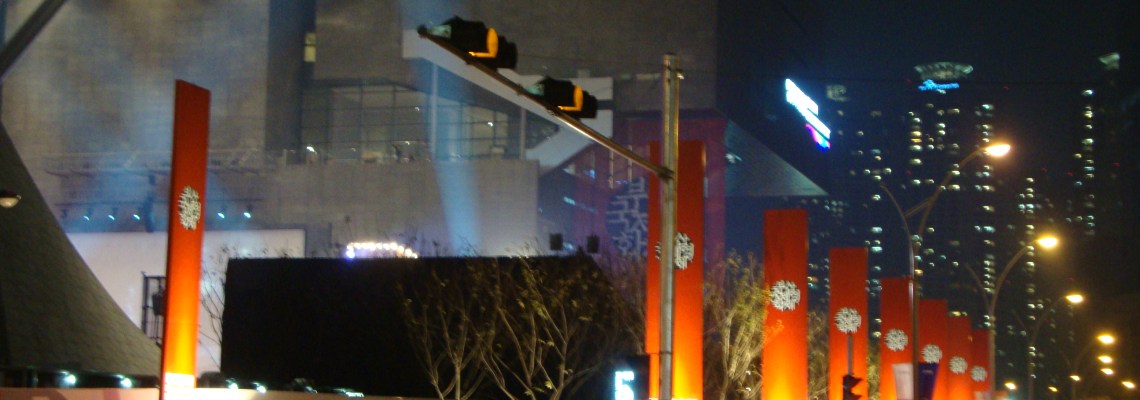
The new Busan Cinema Centre

Before the special red carpet opening of the festival, there was a pre-opening event on Haeundae (해운대) beach. Actors and actresses from different countries were present, fireworks were lit, and prayers of good luck (complete with incense and pig’s head) were conducted. It was a relatively calm and intimate affair, unlike the spectacular ceremony the following day.

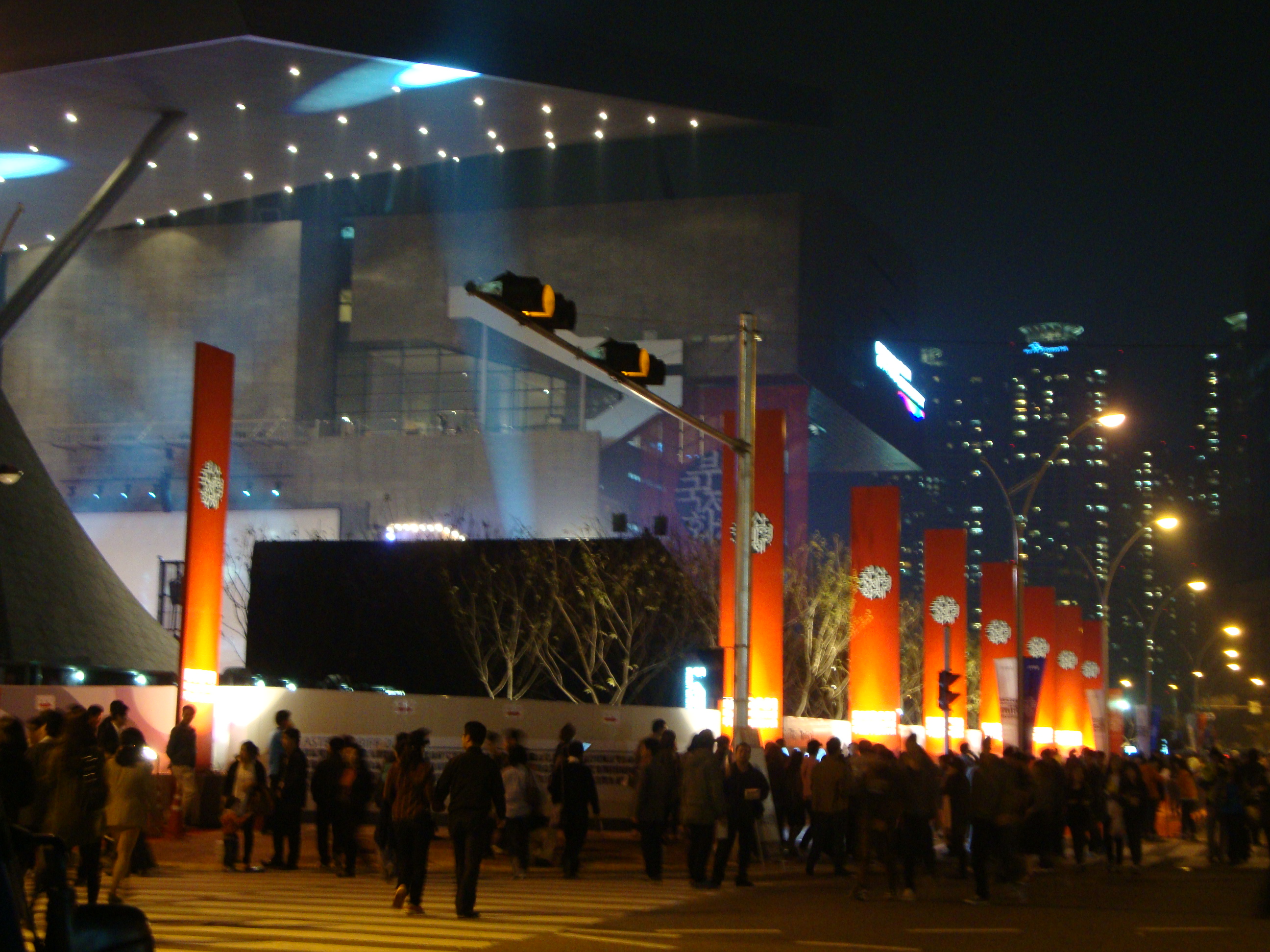
The bright lights of the red carpet opening event

Despite the 8pm opening time, I decided to explore the venue at 1.30pm…which turned out to be too late. Crowds of people were already in lines at the ticket office in an attempt to score last minute invites to the ceremony. Flocks of teenage girls were crammed along the railings next to the red carpet, and their hysteria made it virtually impossible to get a glimpse of the stars as they made their way along the carpet. In spite of this, the event was incredible and lasted hours, followed by the screening of ‘Always’ (오직 그대만), and the entire event was reported by a large number of media outlets.

The pre-opening ‘good luck’ ceremony

Sporting a pre-booked ticket, the next morning I visited the cinema centre once more to watch ‘Hara Kiri: The Death of Samurai’ (3D) by Takeshi Miike. The interior of the building is futuristic in the style of ‘Minority Report’, despite not being entirely finished. Armed with a ticket, a bottle of vitamin water and some peanut butter squid, I ventured into the theater itself, which proved to be a very comfortable viewing experience.

After the film, I intended to explore the rest of the building including the Korean Archive, yet due to the continuing construction work it still hadn’t been finished. Worse still, the Archive didn’t have a kiosk at BIFF Village on the beach, unlike last year. Instead, more commercial firms were present that had little to do with film, which was a shame.

Time constraints meant that unfortunately I couldn’t stay to enjoy the entire festival, yet the opening few days were easily the biggest and most impressive in its 16 year history. It will certainly be interesting to see how the event manages to improve further next year after setting the standard so high.

Festival News Festivals 2011

Greetings from Hanguk Yeonghwa!

Hello everyone! 안녕하세요 여러분!

Welcome to Hanguk Yeonghwa (한국 영화) – or Korean film, if you prefer.

This blog is dedicated to the cinematic endeavors of Korea, where the films are often referred to as an exciting, innovative, and challenging alternative to Hollywood.

Most Korean films that make their way to foreign shores are often labeled as ‘extreme cinema’ due to the violent and/or sexual themes contained within. As such, the majority of audiences are aware of the horrors and thrillers produced, including the likes of Oldboy (올드보이, 2003), Thirst (박쥐, 2009), and the films of Kim Ki Duk (김기덕).

This is unfair, as in addition to the crime and revenge thrillers Korea produces an incredibly large amount of melodramas, comedies, and war films exploring the relationship with their northern cousins. While these films have a slowly increasing level of awareness in Europe and North America, they are extremely widespread throughout the rest of Asia to the point where the immense popularity has been designated as ‘the Korean Wave’ or ‘Hallyu’ (한류). The films, TV dramas and celebrities have an enormous following in Japan, Thailand, The Philippines and beyond, to the point where tour dates are sold out within minutes and actors learn different languages to make appearances on national television. The Korean Wave is expanding into new territories however, thanks to the innovation of those within the entertainment industry, expats, and of course the internet. Today, Korean actors such as Lee Byeong Heon (이병헌), Rain (비/real name 정지훈), and Jeon Ji Hyeon (전지현) are appearing in Hollywood, with director Kim Ji Woon (김지운) at the helm of the upcoming Arnold Swarzenegger film ‘Last Stand’ (2013).

This blog is also riding the wave and will feature film news, festival highlights, and reviews of both past and present, familiar ad unfamiliar. Hopefully, upon reading the reviews you will be curious enough to seek out, or re-watch, some fascinating moments from an ever-changing industry.

But make no mistake, these reviews will not simply be gushing praise simply because of their country of origin. They will be objective, impartial, and compared with counterparts from other countries.

Therefore, if you are interested in Korean film then this is the place to be. There will be no idol gossip about celebrity scandals however; instead, film fans can voice their opinions about the film productions from ‘the land of the rising calm.’ So if you have a few minutes free, sit back and enjoy the posts! (^.^)

Uncategorized