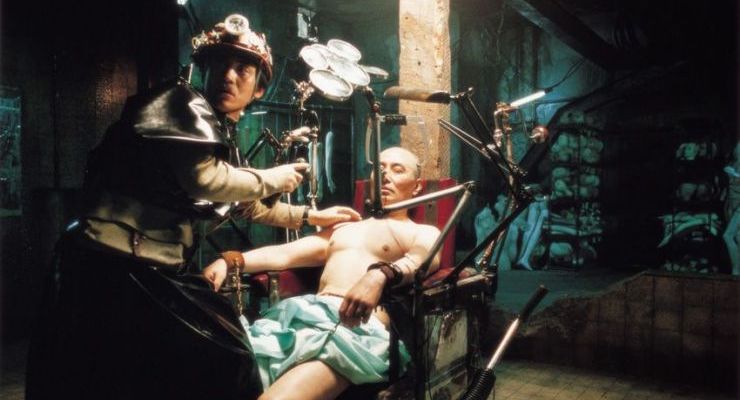
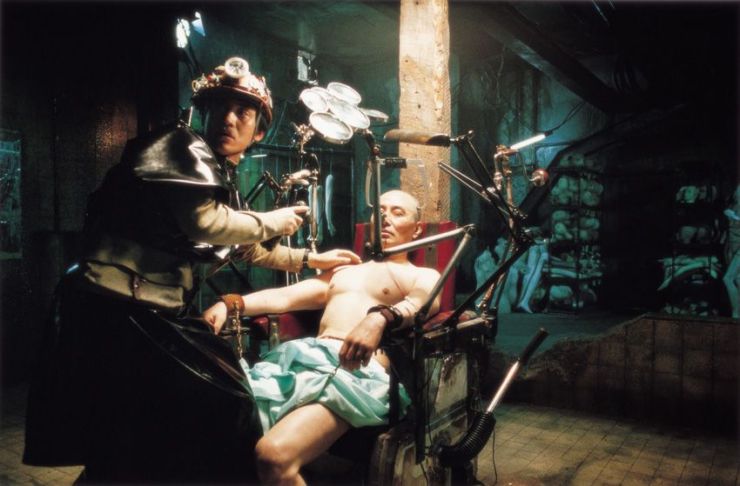
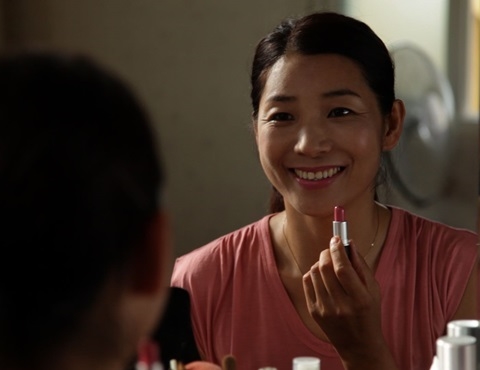
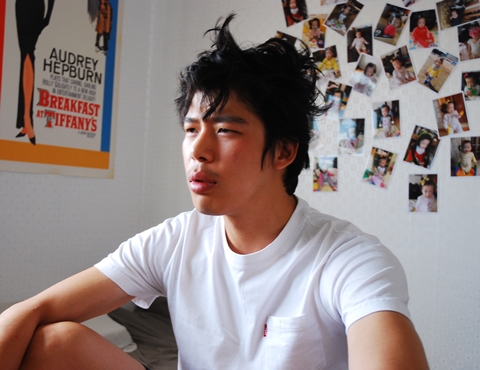
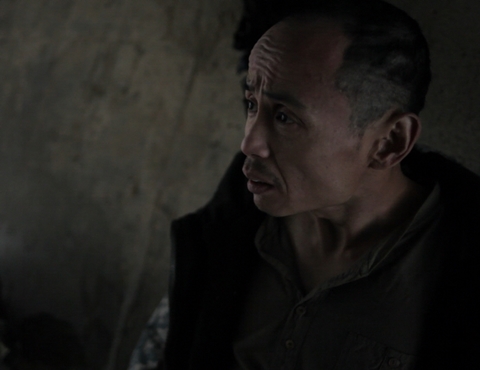
Byeong-gu gets to work interrogating 'alien' Man-shik

Save the Green Planet (지구를 지켜라!) – ★★★★☆

Save the Green Planet (지구를 지켜라!)

Save the Green Planet (지구를 지켜라!)

Cult classic Save the Green Planet (지구를 지켜라!) is perhaps best described as Peppermint Candy (박하사탕) meets Sympathy for Mr. Vengeance (복수는 나의 것) through an amalgamation of dark comedy and disparate genres. While this might sound like an absurd concoction, writer/director Jang Jun-hwan (장준환) merges the assorted features into an incredibly  compelling and entertaining whole, one that moves seamlessly from the madcap to the profound in the creation of a unique celluloid gem. Unfortunately the cult status Save the Green Planet has acquired in foreign territories wasn’t replicated on Korean soil, where it took a nose-dive at the box office. This is a genuine shame as, while not perfect, Save the Green Planet highlights director Jang’s distinctive style and is a highly refreshing departure from other, more formulaic, productions.

Recluse Lee Byeong-gu (Shin Ha-kyun (신하균) becomes obsessed with the notion that Earth is under threat from aliens hailing from Andromeda. To save the green planet, Byeong-gu and his partner Su-ni (Hwang Jeong-min (황정민) kidnap the CEO of a large chemical conglomerate, Kang Man-shik (Baek Yoon-sik (백윤식), believed to be one of the most senior ranking aliens. Torturing the executive for answers, Byeong-gu attempts to discover the clandestine machinations of the race, as well as saving his mother who he also believes to be a victim of alien experimentation. Yet the kidnapping does not go unnoticed by the law, with the police force – as well as a renegade cop – following the trail.

Is Byeong-gu mentally unstable, or does he hold the key to Earth's survival?

Is Byeong-gu mentally unstable, or does he hold the key to Earth’s survival?

‘Madcap’ is a word often used to describe Save the Green Planet and that it is, although not in the haphazard manner the word implies. Director Jang Joon-hwan displays a keen understanding of the array of cinematic traits he employs, competently structuring them in order to provide the best possible use of generic conventions whilst also deriving dark-comedy from the source. Scenes featuring horror, thriller, and dramatic traits flow seamlessly, constructing dramatic tension yet often exhibiting a tongue-in-cheek sensibility as it does so. Torture sequences, for example, feature toe-curling moments but are also incredibly – and darkly – funny, as evil CEO Man-shik has antihistamine rubbed into wounds and is routinely degraded. Similarly, references to accomplished cinematic classics that arise throughout the film are genuine laugh-out-loud moments, and are enjoyable for cinephiles and occasional movie fans alike.

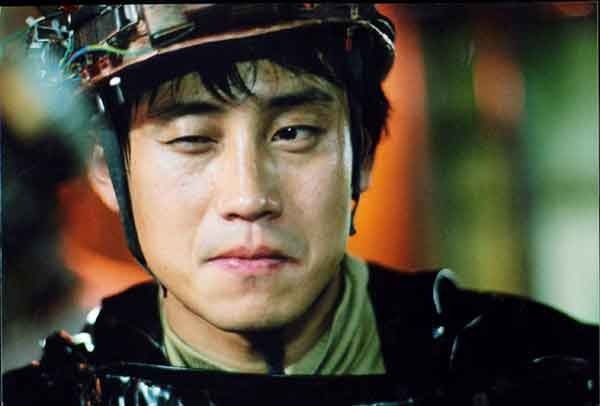
However, humour is just one of the many facets that make Save the Green Planet so entertaining. What truly makes the film so engaging are the underlying themes of the narrative and the psychological disposition of central protagonist Byeong-gu. From the outset, Byeong-gu is conveyed as seriously mentally ill. His theories regarding aliens from Andromeda is the stuff of B-movie science fiction material, while his attire and quirkiness belie the horrors that await in his private torture chamber. Yet his unique perspective on the world is an ironic one, as he uncovers scandals, corruption and amorality in attempting to prove the existence of aliens. Byeong-gu is indeed correct about the Earth being under threat, just not in the manner that his neurosis has constructed. It is in danger through the machinations of the rich and powerful, features which Byeong-gu strips away in order to reveal the ‘truth’ – and potentially atonement – making the unhinged young man something of an anti-hero.

Byeong-gu gets to work interrogating 'alien' Man-shik

Byeong-gu gets to work interrogating ‘alien’ Man-shik

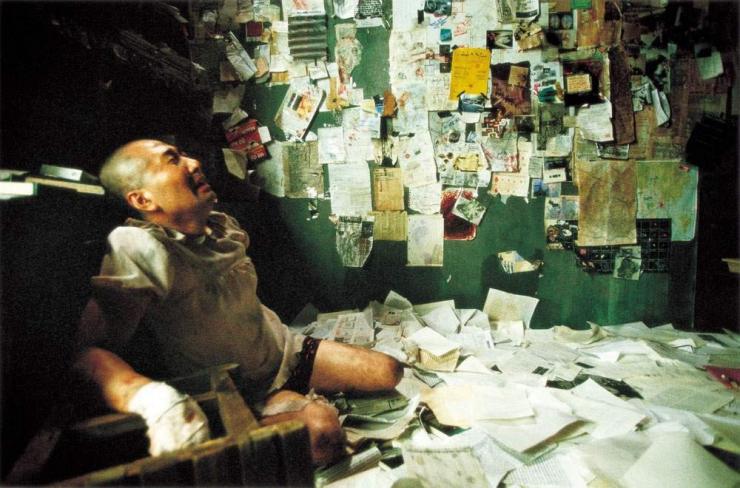
As a result of all his eccentricities the film is a deeply psychological exploration of Byeong-gu’s paranoid mind, one that becomes more and more apparent through multiple viewings. As the unstable protagonist’s history is uncovered, director Jang crafts a biting social commentary regarding contemporary Korea, one that certainly would not be out of place in a Lee Chang-dong film. In doing so Byeong-gu’s cause – and indeed the film itself – is given incredible heartfelt merit, so much so that despite the atrocities he commits his status as an anti-hero is actually heightened. Director Jang intelligently articulates Byeong-gu’s psychosis through the mise-en-scene of the homestead, a multi-tiered countryside abode that features dimly-lit mannequins in the basement and bee hives in the garden, all symbolically linked to is unbalanced mind.

With such a wealth of character material, Shin Ha-kyun doesn’t disappoint. Arguably his career best, Shin is simply excellent in the role with his chameleonic ability to switch between manic highs and solemn lows incredibly impressive and, despite the often comical attributes, sincere. The protagonist could easily be another silly psycho but Shin gives Byeong-gu heart and conviction to make him truly sympathetic, and one of the most memorable characters in contemporary Korean cinema. Such focus unfortunately isn’t bestowed upon other members within the film, notably love interest Su-ni and the assortment of bumbling and renegade cops on the kidnapping trail, ultimately leading to plot threads that are never really mined for their potential. But as Byeong-gu is so charismatic and engaging such shortcomings are easily ignored, as it’s largely due to him that Save the Green Planet is such a compelling genre-bending film.

Battered and bruised, Man-shik attempts to discover Byeong-gu's secrets

Battered and bruised, Man-shik attempts to discover Byeong-gu’s secrets

Verdict:

Save the Green Planet is a thoroughly engaging and fun amalgamation of disparate generic features, all interwoven into a uniquely thrilling whole. Yet in addition to the madcap antics, director Jang Joon-hwan has crafted a biting social satire as well as a highly memorable, psychologically unbalanced anti-hero in the form of Byeong-gu. While the array of characters means that not all get a chance to shine, Byeong-gu’s heartfelt conviction overshadow such shortcomings. Save the Green Planet an incredibly enjoyable, strikingly powerful, and uniquely refreshing film.

★★★★☆

Reviews
JIFF 2013

JIFF 2013: Jeonju Digital Project

JIFF 2013

JIFF 2013

The Jeonju Digital Project (JDP) operates in a similar fashion to the festival’s Short! Short! Short! (숏!숏!숏!) annual event (the profile of which you can see here). Yet while the latter is focused exclusively on Korean film-making talent, the JDP has a more international scope, selecting three directors to produce a 30 minute digital short film each under an umbrella theme, as well as providing 50 million Korean won to help express their unique visions and styles. The JDP therefore is not only concerned with helping to promote talented directors, but also investing in international co-productions that serve to connect the Korean film industry worldwide.

The theme for the 14th JIFF JDP is ‘strangers’, a wonderfully ambiguous word that can be interpreted in vastly different ways yet also places relationships at the center. This year, the three selected directors are all of Asian origin – Japanese, Chinese, and Indonesian.

Director Kobayashi Masahiro, who was a jury member for JIFF’s International Competition at last year’s festival, was one of the few directors to incorporate the tsunami devastation in his feature length film Women on the Edge, which portrayed three sisters who are reunited following the aftermath crisis. The film was invited to Rotterdam, Tokyo, Osaka, and Jeonju film festivals respectively, yet he also has a long history in the film-making industry in the roles of director, screenwriter, and producer. From China, director Zhang Lu also has a history with JIFF as both a film-maker and member of the jury. His first feature, Tang Poetry, was invited to the 2003 edition of the festival, while he on the panel in 2009 for the ‘Korean Films in Competition’. Director Edwin, hailing from Indonesia, is certainly no stranger to the festival circuit with a filmography that has been invited to Cannes, Berlin, Rotterdam, Tribeca, and a staggering number of other festivals internationally. He also has a prior connection with JIFF, having two of his short films invited to the festival in 2008 and 2011, respectively.

Over There (풍경)

Over There (풍경)

Over There (풍경)

Director: Zhang Lu (장률)

Synopsis: The topic of ‘strangers’ has been interpreted into documentary film Over There, in which director Zhang Lu explores the isolation and loneliness of the human experience despite the multitude of people that surround us. It also looks to explore a contrast in cultures. See below for the trailer.

Someone's Wife In The Boat Of Someone's Husband (누군가의 남편의 배에 탄 누군가의 아내)

Someone’s Wife In The Boat Of Someone’s Husband (누군가의 남편의 배에 탄 누군가의 아내)

Someone’s Wife In The Boat Of Someone’s Husband (누군가의 남편의 배에 탄 누군가의 아내)

Director: Edwin (에드윈)

Synopsis: The film follows two people searching for something missing from their lives, and inspired by a romantic legend, journey to the island of Sawai to find it. See the trailer below:

Strangers When We Meet (만날 때는 언제나 타인)

Strangers When We Meet (만날 때는 언제나 타인)

Strangers When We Meet (만날 때는 언제나 타인)

Director: Kobayashi Masahiro (고바야시 마사히로)

Synopsis: Focusing on the social issue of strained relationships amongst the elderly, the film explores the relationship between a couple who haven’t communicated for two years following the death of their son. See the trailer below:

Festival News Jeonju International Film Festival (제14회 전주국제영화제) Korean Festivals 2013
JIFF 2013

JIFF 2013: Short! Short! Short! (숏!숏!숏!)

JIFF 2013

JIFF 2013

Since 2007, the Jeonju International Film Festival has produced the Short! Short! Short! (숏!숏!숏!) series, a collection of 2-3 short films united by a particular theme. Each year, 2-3 talented Korean directors are chosen and given free reign to explore the theme in a manner of their choosing, yet for the 2013 edition each film-maker is connected through the works of novelist Kim Young-ha.

For this years installment of Short! Short! Short!, the directors selected are quite diverse in their respective approaches. Lee Sang-woo (이상우) is arguably the most prolific, responsible for often controversial films including Mother is a Whore (엄마는 창녀다), Father is a Dog (아버지는 개다), and Barbie (바비). Brothers Park Jin-sung (박진성) and Park Jin-seok (박진석) are credited with writing horror films Epitaph (기담) and Evil Spirit: VIY (마녀의 관), the latter of which saw director Park Jin-sung make his debut as a director. Finally, director Lee Jin-woo (이진우), responsible for Sundays in August (팔월의 일요일들) and several other successful short films, rounds out the selection. The film-making talent is quite diverse, and it will be interesting to see how each director takes on the work of Kim Young-ha in their own unique vision.

The Body

The Body

The Body

Directors: Park Jin-sung (박진성), Park Jin-seok (박진석)

Synopsis: The Body looks set to be an interesting interpretation of Kim’s The Last Visitor. The directors have a history in the horror genre and the story, which blurs reality and fantasy between three people on New Year’s Eve, has the potential to be a shocking short film.

Exit (비상구)

Exit (비상구)

Exit (비상구)

Director: Lee Sang-woo (이상우)

Synopsis: No stranger to controversy, particularly in regards to sex and gender, director Lee Sang-woo’s adaptation focuses on a criminal fascinated with a tattoo located on his girlfriend’s genitalia, dubbed ‘the emergency exit’. Lee’s films are often polarizing so it will be interesting to see what he achieves with the material.

Waltzing on Thunder (번개와 춤을)

Waltzing on Thunder (번개와 춤을)

Waltzing on Thunder (번개와 춤을)

Director: Lee Jin-woo (이진우)

Synopsis: Adapting Kim’s The Lightning Rod, director Lee has created a romantic drama involving people who have been struck by lightning, focusing on central protagonist Mi-jung. The film promises to be one of the more quirky offerings in the category.

Festival News Jeonju International Film Festival (제14회 전주국제영화제) Korean Festivals 2013
JIFF 2013

JIFF 2013: Korea Cinemascape

JIFF 2013

JIFF 2013

As part of the build up towards the 2013 installment of the Jeonju International Film Festival, last time here at Hanguk Yeonghwa the ten selected independent films that form the ‘Korean Films in Competition’ were profiled. What they highlight is that JIFF is still continuing to seek out new and fresh film-making talent as the directors are all relatively unknown, raising the possibility for ‘discovering’ quality productions and act as a potential springboard for future festival runs.

Yet JIFF 2013 is also featuring some of the more commercial films to emerge from Korea under the banner of ‘Korea Cinemascape’. In keeping with the festival tradition the themes are quite broad in scope allowing for a range of diverse projects to appear, from star-studded gangster and action epics through to more low-key dramatic pieces. Here are the films announced as part of the ‘Korea Cinemascape’.

Burn, Release, Explode, The Invincible (연소, 석방, 폭발, 대적할 이가 없는)

Burn, Release, Explode, The Invincible (연소, 석방, 폭발, 대적할 이가 없는)

Burn, Release, Explode, The Invincible (연소, 석방, 폭발, 대적할 이가 없는)

Director: Kim Su-hyun  (김수현)

Synopsis: A title that’s almost a story in itself, Burn, Release, Explode, The Invincible charts the life of actor Kim Sang-hyun and the unfolding drama. Described as ‘bohemian and arty’, the 53 minute drama sounds like an interesting exploration of the acting world.

Fist of Legend (전설의 주먹)

Fists of Legend (전설의 주먹)

Fists of Legend (전설의 주먹)

Director: Kang Woo-seok (강우석)

Synopsis: Blockbuster action film Fists of Legend features several A-list stars including Hwang Jeong-min and Yoo Joon-sang, and helmed by the mighty Kang Woo-seok who has been responsible for a string of hits both as producer and director. Word of mouth is positive on this tent-pole actioner, which sees three middle-aged friends reunited in a fighting contest for a large cash prize. As JIFF is mostly concerned with independent features, Fists of Legend will offer a change of pace for those seeking big-budgeted action. Check out the trailer below:

Garibong (가리봉)

Garibong (가리봉)

Garibong (가리봉)

Director: Park Ki Yong (박기용)

Synopsis: This documentary feature by director Park Ki-yong explores the immigrant experience of workers residing in Garibong-dong. Stories involving foreigners and the difficulties of cultural assimilation have become more prominent in recent years, and Garibong could offer a fresh perspective.

Juvenile Offender (범죄소년)

Juvenile Offender (범죄소년)

Juvenile Offender (범죄소년)

Director: Kang Yi-kwan (강이관)

Synopsis: Juvenile Offender made waves upon its release in 2012, with its story of disaffected youth, crime, and familial relationships. The film from director Kang, who previous helmed the Moon So-ri starring Sakwa (사과), premiered in Vancouver and won the coveted Special Jury Award and Best Actor for Seo Young-ju at the Tokyo International Film Festival. With the focus on human rights (indeed, it was partly funded by The National Human Rights Commission of Korea) and timely examination of socio-cultural issues it’s great to see the film get more exposure at JIFF. See below for the trailer:

Mr. Vertigo (축지법과 비행술)

Mr. Vertigo (축지법과 비행술)

Mr. Vertigo (축지법과 비행술)

Director: Lee Kyung-sub (이경섭)

Synopsis: Renowned character actor Oh Dal-su stars in Mr. Vertigo, a story about a man seeking to add excitement and difference to his boring life. At 25 minutes long, the film has the potential to be one of the more off-beat and humourous short stories at the festival.

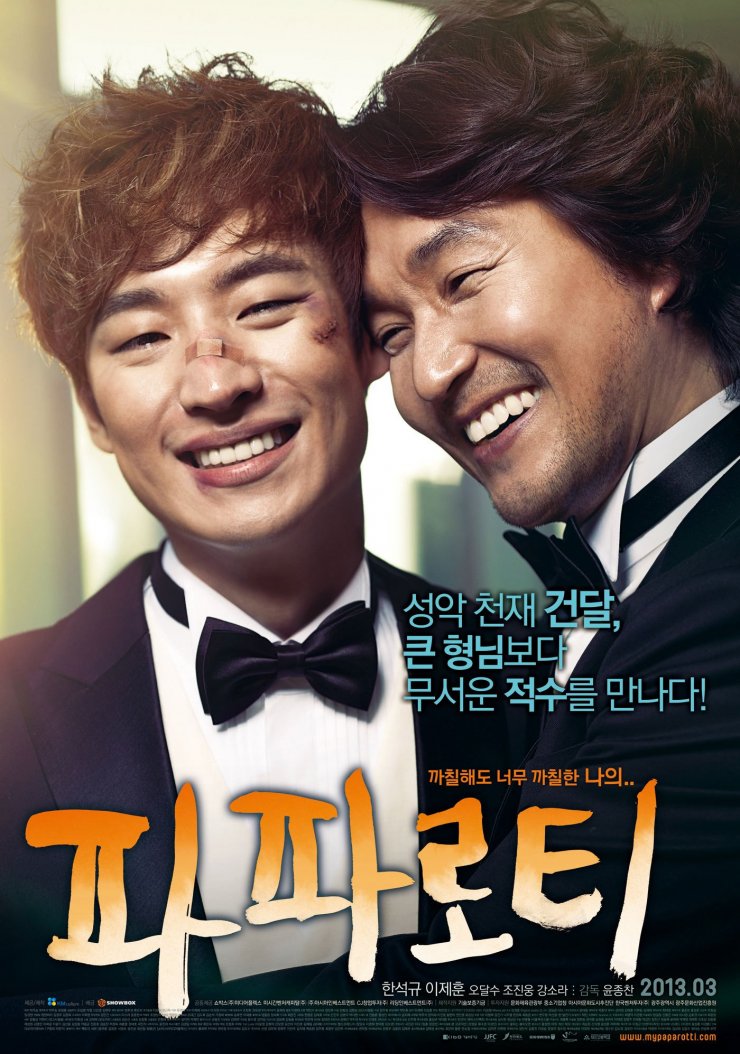
My Paparotti (파파로티)

My Paparotti (파파로티)

My Paparotti (파파로티)

Director: Yoon Jong-chan (윤종찬)

Synopsis: Since its release, My Paparotti has been quite successful earning around 1.45 million admissions (at the time of writing), despite mixed critical reactions. Featuring rising star Lee Je-hoon alongside Han Seok-kyu, the comedy-drama charts the relationship between a washed-up music teacher and  young gangster who sports an exceptional singing voice. See the trailer below:

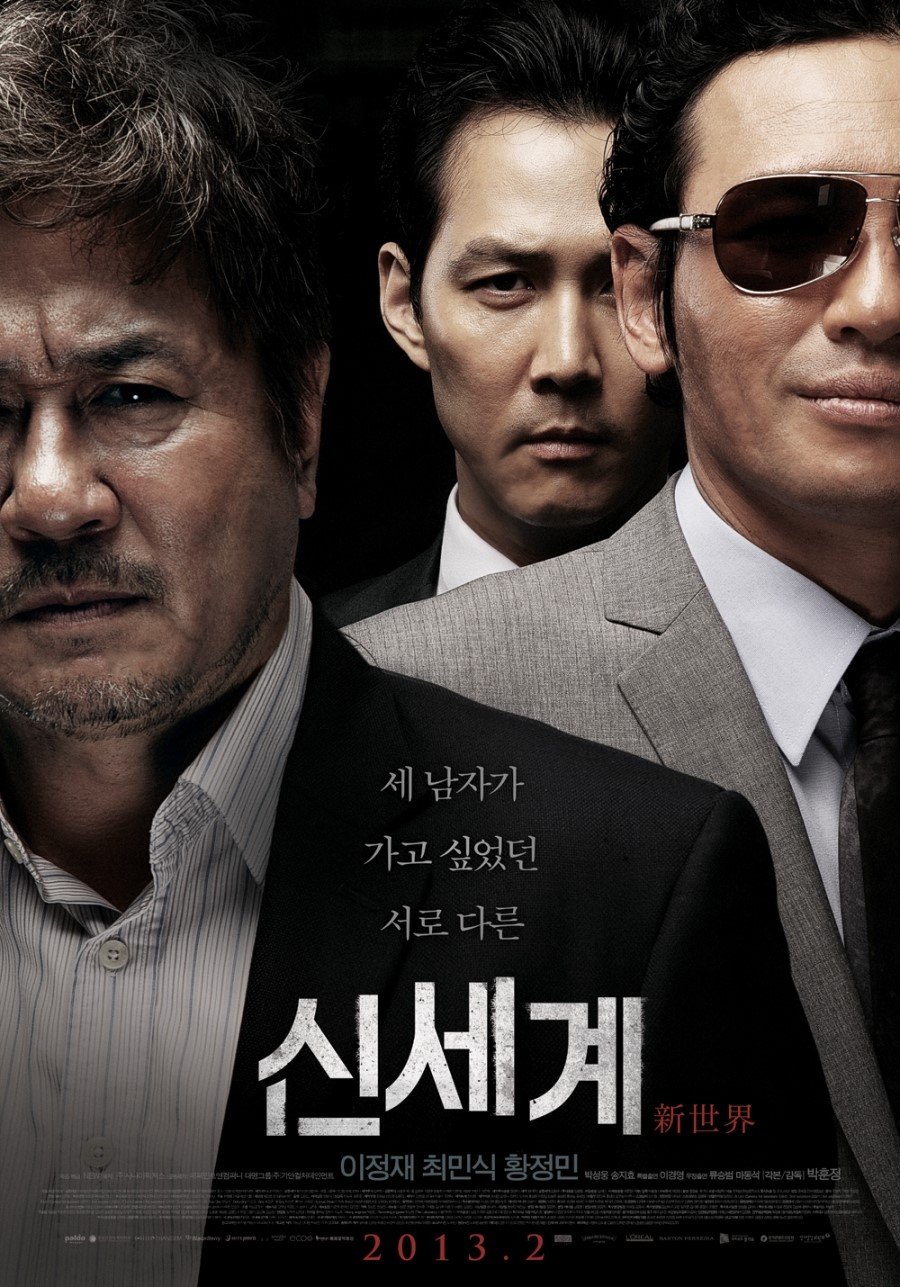
New World (신세계)

New World (신세계)

New World (신세계)

Director: Park Hoon-jung (박훈정)

Synopsis: Gangster epic New World has been incredibly well-received both domestically as well as internationally, selling to multiple territories with its tale of violence and paranoia. Directed by Park Hoon-jung, the writer behind hits I Saw the Devil and The Unjust, the film also features heavyweights Choi Min-shik, Hwang Jeong-min, Lee Jeong-jae and Song Ji-hyo. New World has been likened to Infernal Affairs/The Departed which is high praise indeed. Check out the trailer below:

Project Cheonan Ship (천안함프로젝트)

Project Cheonan Ship (천안함프로젝트)

Project Cheonan Ship (천안함프로젝트)

Director: Baek Seung-woo (백승우)

Synopsis: When he ROKS Cheonan was sunk in 2010, escalating tensions between North and South Korea, several conspiracy theories appeared despite the official verdict that a North Korean submarine fired a torpedo. Documentary Project Cheonan Ship explores the events as well as the reactions by Korean society.

Shibata and Nagao (시바타와 나가오)

Shibata and Nagao (시바타와 나가오)

Shibata and Nagao (시바타와 나가오)

Director: Yang Ik-june (양익준)

Synopsis: The 19 minute Korea/Japanese co-produced drama explores the final moments of a couple as they are about to separate. Director Yang Ik-june is the reason to be excited for this film as his exemplary drama Breathless proved his abilities behind the camera.

Talking Architecture, City:Hall (말하는 건축, 시티:홀)

Talking Architecture, City:Hall (말하는 건축, 시티:홀)

Talking Architecture, City:Hall (말하는 건축, 시티:홀)

Director: Jeong Jae-eun (정재은)

Synopsis: The controversial City Hall project in Seoul has been fraught with difficulty since day one, and this documentary shines a light on the issues that occurred throughout construction. It looks to be an interesting piece, especially in the conflict of old (Japanese) versus new (Korean).

Timing (타이밍)

Timing (타이밍)

Timing (타이밍)

Director: Kim Ji-Yeon (김지연)

Synopsis: Timing looks set to be a sensitive drama, as a woman attempts to resolve loose ends before she moves abroad to study. In doing so she discovers the complex emotions of the sadness of letting go of the past and the fear of starting afresh.

To Be Reborn (환생의 주일)

To Be Reborn (환생의 주일)

To Be Reborn (환생의 주일)

Director: Hwang Qu-doek (황규덕)

Synopsis: To Be Reborn is a documentary that follows the director himself, as he pursues another avenue in life when frustrated with the film industry. The film-making frustrations depicted could resonate well with the independent audiences and prove to be a success.

Total Messed Family (오빠가 돌아왔다)

Total Messed Family (오빠가 돌아왔다)

Total Messed Family (오빠가 돌아왔다)

Director: No Zin-soo (노진수)

Synopsis: The oddly titled Total Messed Family appears to be a more traditional family comedy-drama offering in which a group of mismatched personalities are forced to come together during a crisis. This certainly has the potential to be one of the ‘feel-good’ films at the festival.

The Woman (그 여자)

The Woman (그 여자)

The Woman (그 여자)

Director: Jo Mee-hye (조미혜)

Synopsis: The only film to feature the transsexual experience in the category, The Woman portrays the story of Yoon-hee whose life is thrown into turmoil when her brother informs her of their mother’s illness. It will be very interesting to see how such issues are explored, as Korean culture is still quite conservative.

Festival News Jeonju International Film Festival (제14회 전주국제영화제) Korean Festivals 2013
JIFF 2013

JIFF 2013: Korean Films in Competition

JIFF 2013

JIFF 2013

The 14th Jeonju International Film Festival is almost upon us, kicking off on the 25th of April and running for a week through to the 3rd of May. After the huge controversies surrounding the festival last year, JIFF is reinventing itself with new programmers and staff as well as holding additional events due to take place nearby.

As always JIFF will screen a great variety of film talent focusing specifically on the independent sector. Opening with the joint French/Canadian film Fox Fire (폭스파이어) by director Laurent Cantet, a host of new film-making talent will be on display until closing film Wajida (와즈다), by Saudi Arabian director Haifaa Al Mansour, is screened.

For the full list of films being shown at JIFF 2013 please follow the link provided here, which amongst other things features a wonderful focus on Indian films in a category titled ‘Beyond Bollywood’. Yet as Hanguk Yeonghwa is concerned with Korean films specifically, here’s a rundown of the ten ‘Korean Films in Competition’.

51+

51+

51+

Director: Jung Yong-taek (정용택)

Synopsis: 51+ explores the lives of musicians who perform in the famous Hongdae area of Seoul, a hotspot for indie bands and emerging talent. Yet as the area has become more popular and big businesses have moved in, aspiring musicians are forced out and must take opportunities where they can.

Cheer Up Mr. Lee (힘내세요, 병헌씨)

Cheer Up Mr. Lee (힘내세요, 병헌씨)

Cheer Up Mr. Lee (힘내세요, 병헌씨)

Director: Lee Byeong-hun (이병헌)

Synopsis: The film follows Byeong-heon, a young aspiring film-maker who endures seemingly constant disappointment as he attempts to establish himself. The film purports to be something of an amalgamation of docu- and mockumentary set in the film world.

Dancing Woman (춤추는 여자)

Dancing Woman (춤추는 여자)

Dancing Woman (춤추는 여자)

Directors: Park Sun-il (박선일), Park Jun-hee (박준희), Ryu Jae-mi (유재미), Jo Chi-young (조지영), Choo Kyeong-yeob (추경엽)

Synopsis: Dancing Woman is an omnibus comprised of a variety of different genres and themes. Apparently, the film employs modern dance techniques during each narrative, and looks to be an interesting experimental piece.

Dear Dolphin (환상속의 그대)

Dear Dolphin (환상속의 그대)

Dear Dolphin (환상속의 그대)

Director: Kang Ji-na (강진아)

Synopsis: Employing a mixture of fantasy and reality in exploring love and death, Dear Dolphin looks set to be one of the more surreal offerings from the festival. The trailer can be viewed below:

December (디셈버)

December (디셈버)

December (디셈버)

Director: Park Jeong-hoon (박정훈)

Synopsis: December (디셈버) is an exploration of relationships and how they shift and change over time. At 73 minutes it’s quite short for a feature, yet as one of the few films focusing primarily on relationships it could be one of the more interesting dramatic films at the festival.

Echo of Dragon (용문)

Echo of Dragon (용문)

Echo of Dragon (용문)

Director: Lee Hyun-jung (이현정)

Synopsis: The description of Echo of Dragon is quite ambiguous, even labelled as a ‘peculiar drama’. With it’s off-the-wall themes – including repressed desires – and ‘twisted’ imagery, the film has the potential to be a boundary-pushing wildcard.

Grandma-Cement Garden (할매-시멘트정원)

Grandma-Cement Garden (할매-시멘트정원)

Grandma-Cement Garden (할매-시멘트정원)

Director: Kim Ji-gon (김지곤)

Synopsis: The human rights orientated Grandma-Cement Garden explores the forced relocation of elderly citizens in Busan. Their trials, lifestyles and memories are portrayed until their inevitable move, and as such could be a success with its political scandal/human interest angle.

Groggy Summer (그로기 썸머)

Groggy Summer (그로기 썸머)

Groggy Summer (그로기 썸머)

Director: Yun Su-ik (윤수익)

Synopsis: Groggy Summer is concerned with the pressures of Korean society, and their impact on a creative wannabe poet. The dissection of culture and pressure on Korean youth is an intriguing and timely premise, and could tap into cultural anxieties.

Lebanon Emotion (레바논 감정)

Lebanon Emotion (레바논 감정)

Lebanon Emotion (레바논 감정)

Director: Jung Young-heon (정영헌)

Synopsis: The description of Lebanon Emotion is incredibly vague, but it appears to be an exploration of a variety of human emotions that occur in different situations. Director Jung has helmed several short films during his career, so it will be interesting to see what he achieves with feature length material.

My Place (마이 플레이스)

My Place (마이 플레이스)

My Place (마이 플레이스)

Director: Park Moon-chil (박문칠)

Synopsis: My Place is an interrogation of the differences between contemporary and traditional Korea, focusing on one particular family unit. The ideological differences between generations isn’t particularly original, yet as single-motherhood forms part of the film it could signal a fresh approach on the subject.

Festival News Jeonju International Film Festival (제14회 전주국제영화제) Korean Festivals 2013
Hee-soo confronts ex-boyfriend Byeong-woo about his unpaid debt

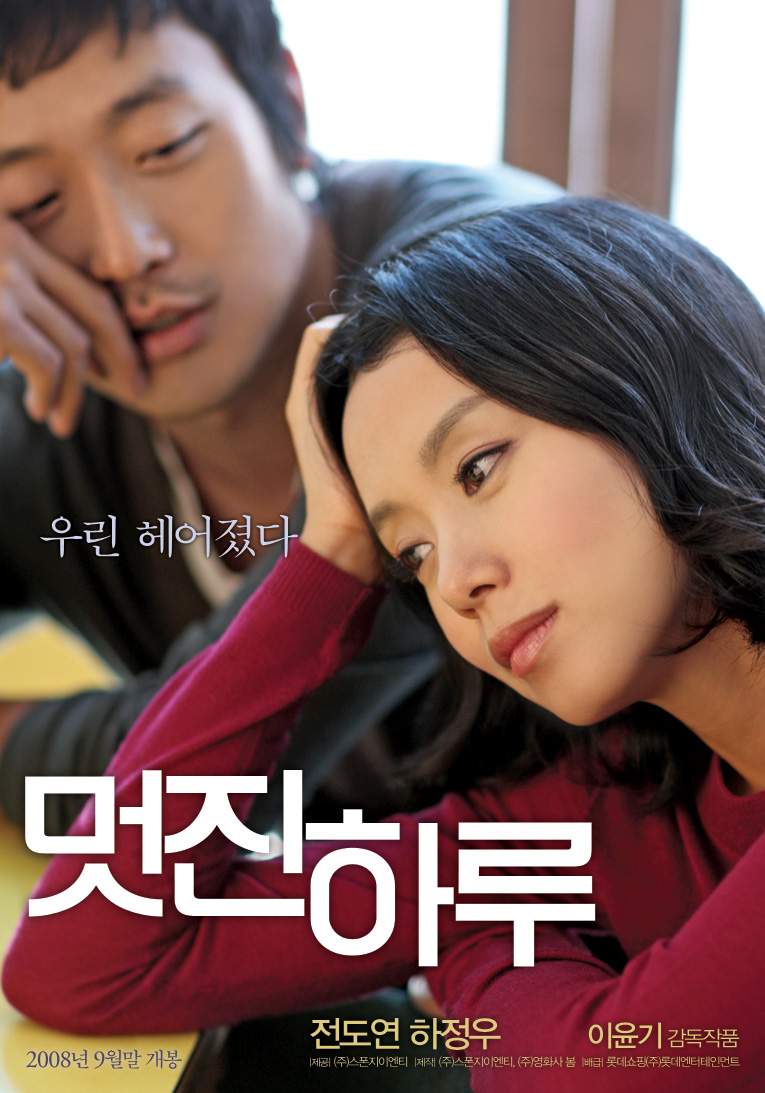
My Dear Enemy (멋진 하루) – ★★★★☆

My Dear Enemy (멋진 하루)

My Dear Enemy (멋진 하루)

With his non-invasive, realism-infused vision, director Lee Yoon-ki’s (이윤기) films are wonderfully character driven as he explores the fragility and complexity of modern relationships. My Dear Enemy (멋진 하루) is very much set within such a framework, as the director subtly peels away the psychological and emotional layers of two ex-lovers who join forces for a day. With his palpable sensitivity and rejection of cliches, director Lee has crafted a poignant examination of the difficulties of early thirty-somethings in contemporary Korea, and their hopes and desires in forming lasting relationships. While the impetus wanes during the final third of the film, My Dear Enemy is an incredibly charming film bolstered by tender and captivating performances by Jeon Do-yeon and Ha Jeong-woo.

 Searching high and low in a betting office, Kim Hee-soo (Jeon Do-yeon (전도연) has almost given up hope of finding ex-boyfriend Jo Byeong-woon (Ha Jeong-woo (하정우). She doesn’t wish to reconcile, however; Hee-soo wants the large sum of money she lent Byeong-woo a year ago and is determined to retrieve it. Finally locating her happy-go-lucky ex, Byeong-woo claims he doesn’t have the money but, with some effort, he can repay her by the end of the day. Afraid he will disappear as before, Hee-soo chaperones Byeong-woo as he collects the money during the course of the day, and as time passes they begin to understand each other more deeply than they thought possible.

Hee-soo confronts ex-boyfriend Byeong-woo about his unpaid debt

Hee-soo confronts ex-boyfriend Byeong-woon about his unpaid debt

Right from the start, director Lee employs his trademark opening long take to absorb the audience into the narrative, following resolute Hee-soo as she traverses a squalid gambling den in search of Byeong-woon. The technique is highly effective in constructing realism as well as provoking curiosity, so that when conflict finally occurs it feels both natural and rewarding. The initial confrontation highlights how wonderfully characterized Hee-soo and Byeong-woon are, with her determination, cynicism and anal retentiveness in stark contrast to his easygoing, considerate, and positive attitude. The differences between them give rise to the question as to why they became a couple in the first place, yet once this minor detail is overlooked what follows are incredibly compelling interactions as the former lovers converse and quarrel, coming to understand each other more clearly than ever before. As Byeong-woon is penniless himself, both he and Hee-soo travel together as he attempts to borrow funds from friends and acquaintances, placing them in a variety of situations that force the duo to re-examine their ideologies and lives. Director Lee uses each opportunity to not only interrogate his protagonists but also contemporary Korean society, and how it has shaped an entire generation now in their thirties. Given the crux of the reunion is debt, financial issues abound in conjunction with marital pressures and gender roles, each explored from an alternative perspective as additional characters are introduced. The subtle sophistication of each encounter is a real delight.

Yet My Dear Enemy is also notable for the captivating performances of A-listers Jeon Do-yeon and Ha Jeong-woo. Director Lee’s distinctive sensitivity and compassion calls for a particular style and quality of acting, and the two gifted stars fulfill their roles with the utmost sincerity. Jeon Do-yeon is wonderfully cynical and stubborn as Hee-soo, exhibiting a frosty and distancing demeanor that initially makes her unlikeable. However through Byeong-woon’s positivity and kindness, as well as a re-examining  of priorities due to their shared experiences, the subtle changes that Hee-soo undergoes are deftly exuded by Jeon as she slowly softens into a more considerate person.

Hee-soo spends time with Byeong-woon's family, learning more about his past

Hee-soo spends time with Byeong-woon’s family, learning more about his past

Of the two, Ha Jeong-woo arguably has the more challenging role in portraying the down-on-his-luck yet affable Byeong-woon. His kindness and generosity convey a palpable positivity, yet it is his natural charisma that makes the character so lovable and draws people closer. The actor superbly sidesteps any potential ‘playboy’ implications by emphasising naivety as a trait which is often scorned by Hee-soo, indicating that while the former lovers are quite different their attributes actually help to make each other stronger.

While the performances and the evolving relationship are a joy to watch, the film begins to falter in the final third. Director Lee seems unsure of how to lead the protagonists through to some form of finale, and a series of missteps detract from the journey they’re on. Just as Hee-soo and Byeong-woon begin to learn from and understand one another, their development is suddenly cut short and while such scenes are occasionally romantic, they could have easily been condensed without interrupting the revelations they discover. Yet luckily the film manages to right itself during the final moments, allowing the couple to convey their fundamental changes while also not taking the easy way out. As such, My Dear Enemy a highly poignant and uplifting film, and in-keeping with the compassionate sensitivity for which director Lee is renowned.

Over the course of the day, Hee-soo's priotrities begin to change

Over the course of the day, Hee-soo’s priotrities begin to change

Verdict:

My Dear Enemy is a charming and moving slice of realism from director Lee Yoon-ki, whose trademark sensitivity and compassion are fully on display. Bolstered by wonderful performances from Jeon Do-yeon and Ha Jeong-woo, the film is a sophisticated yet subtle exploration of the thirty-something generation and their relationships, as well as an interrogation of the role of Korean culture in such matters. As such, the drama is mature and sincere throughout, displaying some the best Korean filmmaking talent at their most sensitive.

★★★★☆

Reviews
The detective discovers Joon's psychometry ability the hard way

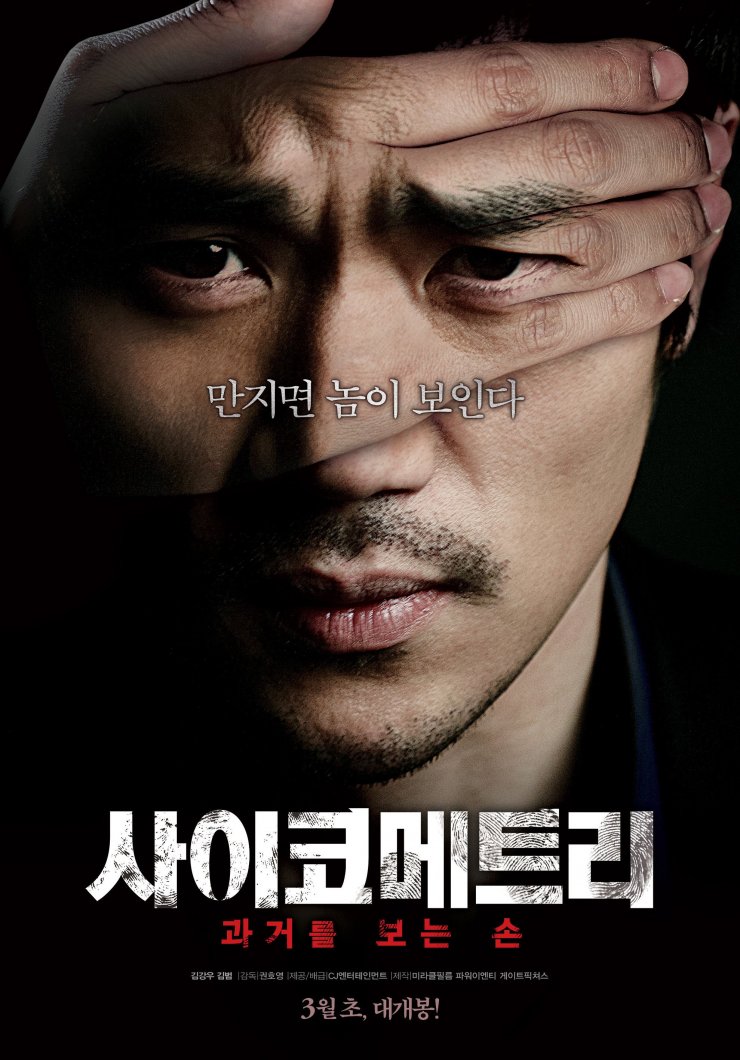
The Gifted Hands (AKA Psychometry) (사이코메트리) – ★☆☆☆☆

The Gifted Hands (사이코메트리)

The Gifted Hands (사이코메트리)

When supernatural elements feature within a thriller film, the production can go one of two ways. The suspense generated from the unknown can heighten the intensity of the events that unfold, adding an original spin to the genre; or, on the other hand, the abilities and powers can appear as cheap gimmicks that add a decidedly silly dimension to the proceedings. The Gifted Hands – aka Psychometry (사이코메트리) – easily falls into the latter category, although between this, the horrendous script, and the appalling acting, it is difficult to know where exactly to fully place the blame for such a ridiculous, vacuous film. Director Kwon Ho-young (권호영) attempts to generate tension amongst his generally competent direction, but it’s not enough to save the frankly awful thriller from being instantly forgettable.

The joke of his precinct, detective Yang Choon-dong (Kim Kang-woo (김강우) regularly causes trouble for his superiors and rarely solves cases. His ineffective style has made him an outsider in the police force, so when a woman reports her daughter as kidnapped he takes the case while the others scoff. When the girl is later found murdered and a scapegoat is required, Choon-dong is blamed and suspended. Distraught, the detective happens upon some graffiti that accurately portrays events of the murder in a startling amount of detail. Tracking down the artist responsible, Choon-dong discovers that the young man named Joon (Kim Beom (김범) has the supernatural ability of psychometry, the power to see events through touch, and the duo set out to catch the murderer before he strikes again.

Detective Choon-dong happens upon artist Joon as he portrays events from the murder

Detective Choon-dong happens upon artist Joon as he portrays events from the murder

The Gifted Hands begins badly, only to become progressively worse. Ignoring the fundamental rule of the thriller genre in hooking the audience within the opening sequence, the scenes of Joon painting the location of the murder are dull yet are also a huge editing faux pas as the scene actually takes place a good twenty minutes later in the movie. Following the opening credits, the film’s ‘true’ beginning takes place during an over-zealous pyramid scheme in which detective Yang is a participant. Immediately the ineffective cop is portrayed as an utter idiot through these attempts at comedy which are not in the least bit funny, as Yang desperately tries to save his dignity and the reputation of the force from his blunder. The detective is clearly an underdog cliche evolving from bumbling fool to responsible cop, which in itself is no bad thing were it not for the awful acting by Kim Kang-woo. The actor performs the ineffective cop as a manic-depressive petulant child, flitting between whining like a teenager to bursts of violence. To be fair to Kim the script also calls for such absurdity in the attempt to provide multiple genres, clearly a cynical move to attract all but ultimately pleasing none, yet the actor certainly doesn’t help himself.

While detective Yang’s story is foregrounded, bizarrely Joon is sidelined. For a film containing supernatural features, Joon’s psychometry abilities appear more like an afterthought rather than the basis for the thriller, so much so that the protagonist infrequently appears throughout. Despite Joon’s cliched emo melancholy – black clothing, hoody, creative talent, misunderstood, etc etc – actor Kim Beom provides an adequate performance, although he is intended to look sullen and attractive for the most part. His psychometry ability is woefully under-utilized within the context of the narrative as well as inherently misunderstood by the writer. During the first of only two times in which Joon uses art to express his gift, it is explained that he was able to do so in such incredible detail, featuring moments from various points throughout the timeline of the murder, because he touched a pigeon who was passing overhead. Seriously.

The detective discovers Joon's psychometry ability the hard way

The detective discovers Joon’s psychometry ability the hard way

Such ridiculous logic continues to arise as the investigation for the killer, and a newly abducted victim, moves forward. For no reason other than detective Yang is in need of a car, he teams up with a petty criminal sidekick who informs the cop that as the first girl was found frozen before she was buried, the killer must be a single man. The reason? All single men freeze their trash before throwing it out. As the graffiti artist depicting the murder, Joon is of course the chief suspect, but as he doesn’t freeze his trash, he is immediately discounted as the criminal. Such instances are incredibly frustrating, as flimsy hunches are employed and conducted with no solid evidence or basis, making it a wonder how any crimes are solved within this particular district. Yet for all of detective Yang’s newfound verve for solving the case, the kidnapping is ironically dropped from the narrative in order to develop the ‘bromance’ between him and Joon – through more comedy and psychologically unbalanced violence. A brief respite appears in the form of potential love interest Seung-gi (승기, Esom (이솜), although as she appears twice and provides nothing of merit the character is wholly unnecessary.

For all of the silliness, director Kwon Ho-young does a competent job at the helm, and attempts to inject the film with tension and suspense whenever the script allows. He does well for the most part, that is until the asinine logic kicks in once more. Locating the murderer is well-staged while the mise-en-scene of the apartment is suitably morbid, yet the compulsion is completely lost when the psychopath begins monologuing about how he simply has no reason or motivation for what he does – only to later explain it anyway. The Gifted Hands is a great example of interesting concept, lazy execution.

Joon must put his abilities to good use to stop the murderer

Joon must put his abilities to good use to stop the murderer

Verdict:

The Gifted Hands spectacularly fails as a supernatural thriller. Featuring an awful script full of holes and bizarre logic, bad acting particularly from the (unintentionally) mentally unbalanced central protagonist, as well as wasting the potential of psychometry itself, the film really is a shambles. Director Kwon Ho-young performs competently at the helm, but it is not enough to save the vacuous thriller from being instantly forgettable.

★☆☆☆☆

Reviews
Going South (남쪽으로 간다)

Going South (남쪽으로 간다) – ★★★☆☆

Going South (남쪽으로 간다)

Going South (남쪽으로 간다)

In exploring the issues of homosexuality within the Korean military, director Lee Song Hee-il’s (이송희일) short film Going South (남쪽으로 간다) is a somewhat culturally sensitive affair on an oft-known, yet seldom discussed topic. Forming part of the director’s 2012 trilogy alongside White Night (백야) and Suddenly, Last Summer (지난여름, 갑자기)Going South also depicts the evolving relationship between two men over the course of several hours, in this instance as they travel through the countryside towards an army barracks. The returning soldier, Gi-tae (Kim Jae-heung (김재흥), is distraught as his lover Jun-yeong (Jeon Sin-hwan (전신환) has ended their relationship following the completion of his mandatory military service. The narrative explores their differing ideology regarding homosexuality within the trauma of separation, emphasizing key socio-cultural issues throughout. Yet the film also struggles with the debate and the increasingly tense relationship, sparingly introducing information about the couple resulting in a somewhat bland, yet very attractive film.

The most striking feature of Going South is undoubtedly the colour palette as director Leesong employs highly effective use of the natural green tones of the countryside. The director’s artistic sensibilities are acutely on display throughout as he captures the vibrant greens of the forests that serve as a backdrop for the protagonists, providing a palpable energy as Gi-tae and Jun-yeong fight and curse at each other during their break-up. Within this realm Gi-tae’s military uniform seamlessly merges with the surrounding environment while Jun-yeong’s city fashion is completely at odds, and director Leesong does well in employing costume to highlight the stark differences between the two protagonists. The contrast with the brown hues that enter the film are also profound, adding potent symbolism for the various stages of their rapidly deteriorating relationship.

Soldier Gi-tae's uniform blends with the green landscapes

Soldier Gi-tae’s uniform blends with the green landscapes

Central to the narrative is the issue of homosexuality within the military, which is wonderfully articulated through Gi-tae and Jun-yeong. For Gi-tae, being gay is part of his identity; for Jun-yeong, it is a phase that men go through during military service. As the two clash over their different ideological perspectives, letters that were exchanged between them when they served together are edited within the film, harking back to their history and the sweet exchanges that took place. Such title screens are quite distracting however, and serve to pull the audience out of the film due to their unnatural insertion. Despite this, Going South quickly becomes an examination of contemporary Korean masculinity, and the role of the military in defining sexuality.

Yet attractive visuals and central theme aside, Going South is a somewhat flat queer film. Much of the running time is preoccupied with driving through the countryside, with more information required to make the protagonists and their ‘journey’ more compelling. The narrative does pick up in the later stages to end on a high note, yet the actors aren’t really stretched into creating the required impetus for these scenes to truly generate the utmost poignancy.

As the relationship deteriorates, symbolic brown tones enter the frame

As the relationship deteriorates, symbolic brown tones enter the frame

Verdict:

Going South is a vibrant, attractive queer film examining homosexuality within the Korean military, and deserves praise merely for broaching the subject. Director Leesong Hee-il employs the colours of the countryside effectively, however the film is a rather flat offering due to the sparse information and lack of powerful performances. Yet Going South offers an interesting perspective in role of the military in defining contemporary Korean masculinity, and as such provides a fresh approach in the exploration of gay relationships.

★★★☆☆

Reviews
Suddenly, Last Summer (지난여름, 갑자기)

Suddenly, Last Summer (지난여름, 갑자기) – ★★★★☆

Suddenly, Last Summer (지난여름, 갑자기)

Suddenly, Last Summer (지난여름, 갑자기)

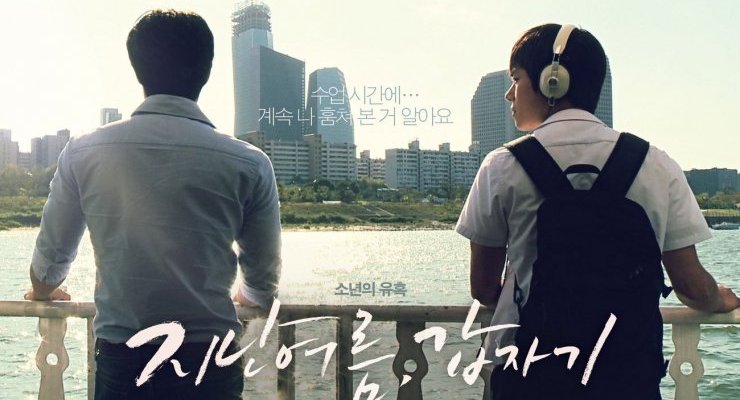
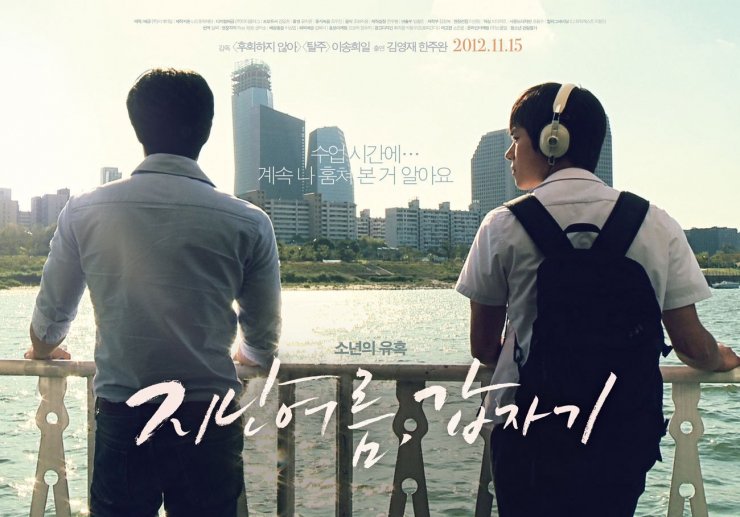
Suddenly, Last Summer (지난여름, 갑자기) is a wonderfully moving and understated short film, and certainly the best of director Lee Song Hee-il’s (이송희일) 2012 trilogy comprised of White Night (백야) and Going South (남쪽으로 간다). In each segment of the trilogy the theme of two men spending a prolonged period of time together in a day is explored, with Suddenly, Last Summer exploring this dynamic between thirty-something high school teacher Kyeong-hoon (경훈, Kim Yeong-jae (김영재) and student Sang-woo (상우, Han Joo-wan (한주완). Typically films that delve into such age and society-related relationships attempt to portray a morality tale of some sort, yet director Leesong eschews melodramatic cliches in order to convey a psychologically complex connection between the protagonists, emerging as a mature and thought-provoking examination on the subject.

Key to the potency of Suddenly, Last Summer is the manner in which director Leesong presents information about the relationship between Kyeong-hoon and Sang-woo, and how such revelations develop their connection. Initially Sang-woo, an attractive young gay student, appears to be infatuated with the teacher, stalking him and making unfair demands. Yet as they engage in various conversations throughout the day, moments from the past are subtly referenced adding layers upon layers of complexity to their relationship, discussing and debating prior actions that may or may not have contained deeper meanings and the inferences generated from them. Director Leesong refuses to either condone or condemn the protagonists, instead opting to examine their internal struggles between desires as gay men and societal responsibilities.

The psychological complexities of he relationship are subtly explored

The psychological complexities of the relationship are subtly explored

Director Leesong’s films always display a keen artistic sensibility, and with Suddenly, Last Summer this most notably appears through the repetition of water imagery. In taking a river cruise in the popular Yeouido area, Kyeong-hoon and Sang-woo open themselves to the tranquil beauty of the water, ebbing and flowing against a romantic-charged soundtrack. The blue tones of the Han River also work well in conjunction with the protagonists’ shirts. The pure white that envelops Sang-woo conveys his purity and innocence, his single-minded approach to life, yet Kyeong-hoon’s blue shirt connotes an older, more mature persona. The actors wonderfully articulate such sensibilities through their performances, with Kim Yeong-jae providing a highly effective and restrained performance as the morally-conflicted teacher, palpably displaying his discontent facially. Meanwhile Han Joo-wan connotes his youthful frustrations well, flitting between moments of maturity and adolescence in expressing his desires.

Despite their differing styles, both men clearly harbour a similar emotional discord which unites them, even though society states it is inappropriate. Their confusion is wonderfully articulated through the labyrinthine landscape of the apartment buildings, with the many twists and turns articulating their own psychological dilemmas. It is this moral and psychological complexity that makes Suddenly, Last Summer such a compelling film, and a welcome entry into Korean queer cinema.

Water imagery and colour play important roles in decoding the relationship

Water imagery and colour play important roles in decoding the relationship

Verdict:

Suddenly, Last Summer is a subtle and moving exploration of the relationship between a high school teacher and student. Director Leesong Hee-il delicately inserts information throughout that continually evolves the connection between them, challenging preconceptions while never adopting a moral position, and as such is the best film in the director’s 2012 trilogy.

★★★★☆

Reviews
Suddenly, Last Summer (지난여름, 갑자기)

Q&A with Director Leesong Hee-il (이송희일) – Part 2

Director Leesong Hee-il (이송희일)

Director Leesong Hee-il (이송희일)

To celebrate renowned queer director Lee Song Hee-il’s (이송희일) 2012 film trilogy, Indieplus cinema in Gangnam held a special screening and Q&A event on the 12th of March. In February, feature length film White Night (백야) was screened – the Q&A of which you can read here – while the March event featured a double-bill of short films Suddenly, Last Summer (지난여름, 갑자기) and Going South (남쪽으로 간다). All three films are connected thematically as each story depicts two gay characters and the events that transpire between them during the course of several hours.

Suddenly, Last Summer is concerned with a relationship between a thirty-something teacher and a high school student. The film is an intelligent and subtle exploration of psychology and morality, as both protagonist have desires yet are constrained by societal position. The performances are wonderfully restrained and poetic, making the film arguably the best of the trilogy.

Going South, meanwhile, explores homosexuality within the military. The short film employs nature and vibrant colours in conveying conflict between the two central characters, one who wishes to continue their relationship and the other who views homosexuality as merely a phase of military service.

Both short films have been well received – and notably invited to the 2013 BFI London Gay and Lesbian Film Festival – and following the screenings director Leesong fielded questions from the audience, kindly translated by independent producer Hwang Hye-rim (황혜림).

Going South (남쪽으로 간다)

Going South (남쪽으로 간다)

Question: Thank you, I really enjoyed both of the films. They are really touching and moving. With Going South, your sense of colour was really strong – the greens and the browns especially. Can you tell us what feelings you were trying to evoke? Why did you choose those two colours in particular?

Director Leesong: When I was thinking of these three films, colour was one of the things that I was really interested in. So I put a lot of focus on that and I tried to make certain differences between the three films in terms of colour. For example, White Night happens at night so I already had limitations, so I tried to put focus on the colour of the protagonists clothes in that film. And I used a 5D Mark II camera to try and make the lighting match and give focus. I tried to give the film a certain kind of colour and tone. And for Suddenly, Last Summer, water is one of the main images so I tried to show the clothes of the main protagonists like the teacher’s shirt or the white shirt of the school uniform which shows more clearly the differences between them. For Going South, the green colour is the most important colour in the film so I tried to find a location where I can show real green images like a lotus field and forest. I visited several forests to find the perfect green [for the film]. There wasn’t exactly a specific reason I chose green, but what I wanted was to go out of Seoul, out of the city and have distance from the city, to show the least [characteristics] of the city such as buildings. Therefore green became important. I shot this film in Yangsuri which is near Seoul, and is well-known by Seoulites, but I tried to shoot it as if it wasn’t Yangsuri, as if it was some other place. So I went deeper into Yangsuri, and tried to find different spots in the area so that it can look different from what people know. I tried quite hard to find these kind of locations and I really wanted to follow the psychological mindscape of the two protagonists, so that’s why I tried to focus more on their journey and their psychology, and to avoid a cityscape. I needed more [natural] landscape. Even the road when one protagonist kidnaps the other, that road is about 300 meters long and other than that it is surrounded by buildings. That specific spot was something I’ve had in my mind for 5 or 6 years and I was always going to use it in a movie one day, and I finally used it. I tried to remove other kinds of colour as I didn’t want to give you too many colourful images but to just focus on the two people, just the colour green and their emotional journey. If you can remember the character of Jun-young from the film, the man from the city who was discharged from military service, he’s wearing a white shirt so I didn’t want to mix too many more different colours. In the end, I only wanted their emotional development to be shown more than other features.
Suddenly, Last Summer (지난여름, 갑자기)

Suddenly, Last Summer (지난여름, 갑자기)

(The following question is quite offensive to the gay community, and is purely the opinion of the audience member. It in no way reflects the liberal attitude within Hanguk Yeonghwa).

Question: I think I can understand more about gay people through these films. I think gay issues are well received in American societies, for example, and economically and politically, and in the film market. But in Korean society, I think there is still, not taboo exactly, but more negative responses to gay issues than other societies. So I’d like to know what you are trying to say through your film to [Korean] society where more negative opinions exist. My second question is I’d say that it’s a personal choice, or sexual preference, if you are gay or not. But also there are worries that after two generations that if more and more people choose to be gay, although it’s personal preferences and choices, it’s probably possible that no-one would exist anymore. So some people consider being gay as a bad influence sometimes, so I’d like to know the director’s opinion on that.

Director Leesong: To answer your first question, there wasn’t a big or high intention. It’s just like if you are asking any non-gay filmmakers, or films with non-gay themes, you never ask them what their intentions were, what did they want to say to non-gay society. You don’t ask that, right? So I say, let’s be fair. But when you are facing a filmmaker who is making a film about sexual minorities then you always ask this kind of question, like what was your message to society. There wasn’t a big intention, just to make a film about love, where the main protagonists are sexual minorities. Let’s be fair, you wouldn’t ask that question to heterosexual filmmakers, so you shouldn’t ask me either. As for the second question, I don’t think it just applies to Korean society, it applies to most societies. Most gay people are raised by non-gay parents but they grew up as a gay person. Even if the parents are a gay couple, and they say to their children, “You should be gay”, they wouldn’t all be gay. If they want to love the other sex, then they will. I don’t think it’s a bad influence. As many of you know, the Mayor of Berlin is gay, and at the city hall there are rainbow flags but that doesn’t mean that Berlin is necessarily the only gay-friendly city. It’s embracing gay culture more, but that doesn’t mean everyone in Berlin is gay. I think that by having more sexual minorities speak out helps to develop a more democratic society, so therefore we need to hear more voices, minority groups should have more voices to make a real democracy possible, and make people embrace other people’s differences and opinions. In those terms I think that Korean society still has that kind of tedious democracy, we are still getting there, to have a more developed democracy.

Suddenly, Last Summer explores the relationship between a teacher and student

Suddenly, Last Summer explores the relationship between a teacher and student

Can we lighten up the atmosphere a little bit? Do you have any lighter questions? I think I will sink into a grave, the atmosphere feels like that.

Question: I’m really curious whether the actors in your films are really gay or not.

Director Leesong: What answer would you like?

Question: Just say it [the truth]!

Director Leesong: They are all not gay in real life. But I have to say I can’t really be happy to answer like that. It’s really hard to find anyone, actor or actress, who has freely come out of the closet and said that they are gay or lesbian. There are almost none who have been open about their sexual identities. So it’s not that I searched hard for non-gay actors, it’s the other way. It’s hard to think of anyone who is as beautiful as the actors who are in the films who are gay, that’s why we were laughing. But I should add that there are differences compared to ten years ago, there are younger generations who have more courage to come for an audition for my films, so that’s a big change.

Question: In Going South it was separated into ‘acts’ with the letters. I was wondering if that is more a stylistic or tonal choice, or did you choose that style for a structural choice in telling the story? Or to separate the different moods of each act?

Going South explores homosexual issues within the military

Going South explores homosexual issues within the military

Director Leesong: Well for Going South we shot for six days, so the whole production was like a short film. It was really difficult to show their past with images, it would have taken me a lot of time to show what they have been through together. So I wanted to show their past history together, not through images, but through their letters. I wanted to reveal their past history as the movie moved on and on, but I didn’t want them to talk about it, so the letters revealed their relationship. I don’t think it was necessarily to make an ‘act’. In Korea, serving in the army is compulsory, it’s an obligation. So if you are old enough, an a man, you must go to the army and serve for two years. It’s been like that for a long time. The things that were depicted in the film are happening quite often in the army, and that’s the basic idea. Nowadays I heard that they are doing several kinds of things such as planning sections differently to ‘prevent’ certain kinds of things – the exact expression is ‘anti-gay’ kinds of things. For example, before all the men used to sleep in one big room, but now they have sections so they are separated from each other. Because before they were all sleeping in the same section, and, well, a lot of things happened there. In those terms, this film Going South is quite a cliche. Whether they are gay or not, the army is a huge group of same sex people, and things happen. I just wanted to show the cliche that people know about, and make a story about it. I should tell a funny story because the atmosphere is so serious. I’m actually quite a funny guy! Having this kind of situation in Korea, and having gay men going to the army, creates two different responses. One is like a man sent to a place full of women, so a lot of gay men have a hard time because of the showers and life is difficult for them. But on the other hand there are gay men who are very happy to go to the army, they use the expression, “I’ll be among the flowers,” “I’m in a flower field.” After their army service they brag about things from the army like sex and lovers, stories they tell to their friends.

(Director Leesong then began to discuss about his next project).

Director Leesong: Night Flight‘ is inspired by a real story that happened about two years ago in a high school. There was a student who confessed his sexual identity to his teacher, which should be discrete. It was during a session with the teacher, and he was having a hard time telling him about what was going on in his mind. But the very next day the teacher broadcasted [the student’s sexuality] throughout the school during a broadcasting program. He just said the boy in class ‘B’, for example, is gay and you shouldn’t choose to be gay. It was a really violent response by a teacher, it shows the reality in Korean education, I think. I was thinking whether I should make a film about it or not, and then we had a person who was the education director for Seoul. Before his election we had an act about student rights which prohibited discrimination against students because of their sexuality and gender. But as soon as this new person got elected as the director of education, he said he was going to exclude and eliminate the article about prohibiting discrimination against gay people. That really pissed me off. It really shows the violent reality in Korean schools these days, Korean schools are showing the violence within Korean society. So I decided to make a film about it, dealing with school violence and also living as a gay [student].

Sincere thanks to director Leesong Hee-il for taking the time to answer the questions, to Producer Hwang for translating and to Manger Kwon Mi-hui and Indieplus Cinema for hosting the event.

Directors Interviews/Q&As