On Thursday, 19th of July the opening ceremony of the Bucheon Fantastic Film Festival (PiFan) got underway in glamorous style.
Luckily the torrential rain held off for the red carpet event, which saw an interesting mixture of up-and-coming stars like PiFan Lady Park Ha-seon, and A-listers, such as Ha Ji-won, Ahn Seong-gi and Ha Jeong-woo. All the stars in attendance looked stunning in their various gowns and suits, making fans squeal with delight. Having been to the film festivals in both Busan and Jeonju, I was unsure of how Bucheon would carve out a unique identity against such heavyweights, and it interestingly seems to occupy somewhat of a middle ground between the two – lavish, but not to the extremes of Busan, and intimate, though not in the independent manner of Jeonju.
PiFan Lady Park Ha-seon (박하선)
Ahn Seong-gi (안성기)
Ha Ji-won (하지원)
Ha Jeong-woo (하정우)
After posing for cameras and conducting brief interviews, the stars all entered the Bucheon Gymnasium for a spectacular show and an awards ceremony, which was then followed by the premiere of Horror Stories (무서운 이야기). The film is highly appropriate given that the festival focuses on genre films, and generally seemed to go down well with the audience. Horror Stories (무서운 이야기) is an interesting take on the horror genre as four different directors have amalgamated their work into a coherent whole, as a young girl must tell horror stories to her kidnapper in a desperate attempt to save her life.
The PiFan awards ceremony and screening of ‘Horror Stories’
After the screening there was a special dinner event for celebrities and press, where I was fortunate enough to (briefly) share a table and some makkoli with director Kim Han-min and Japanese actor Ryohei Otani, who were a delight. Still hot from their success on Arrow, the Ultimate Weapon(최종병기 활), they informed me that their new film, based on famed Admiral Yi-Sun-shin, was due to start filming this winter and will certainly be one to watch out for upon release.
‘Mature animations’ have, rather unfortunately, rarely been a staple in ‘Western’ cinematic culture. ‘Mature’ has often been mistaken for ‘sexualised’ due to marketing ploys attempting to introduce the concept. Yet in ‘Eastern’ cinema mature animations have proved popular for exploring a variety of adult and socio-political themes, ideological explorations which would often require a vast budget in the live-action arena.
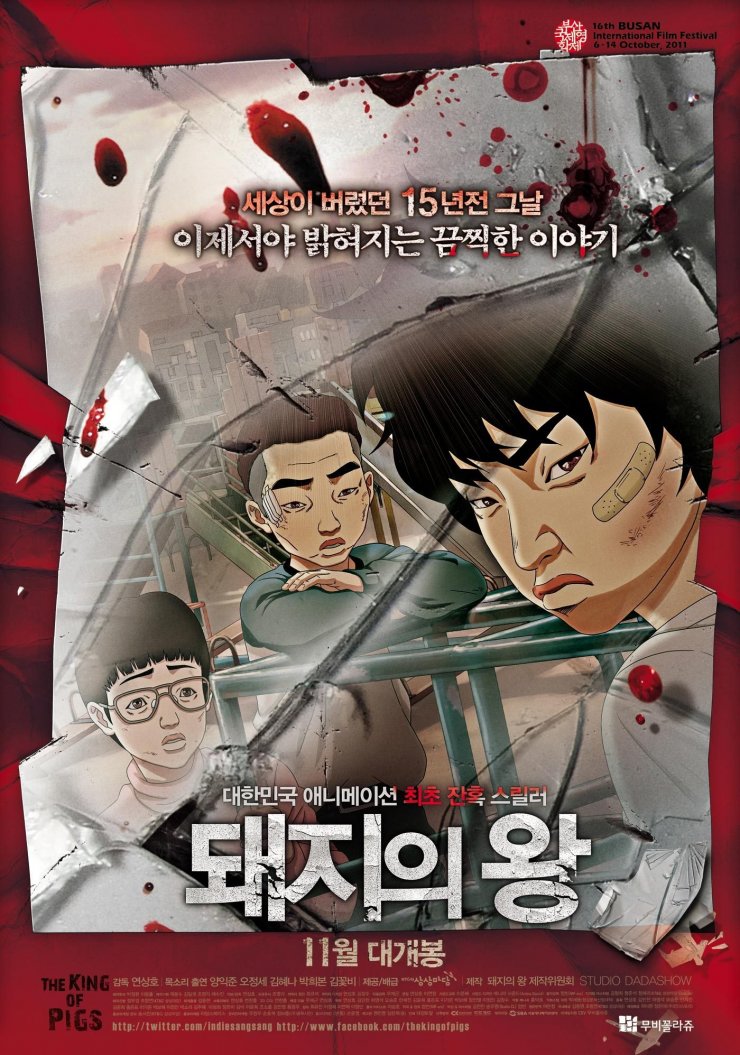
Through his independent feature King of Pigs (돼지의 왕), writer/director Yeon Sang-ho (연상호) has produced an exceptionally powerful social critique of Korean culture. While the limited budget is at times visible and the acting occasionally over-zealous, King of Pigs is a stark and violent examination of patriarchal and hierarchical society, as well as the role of capitalism and corruption in defining one’s existence.
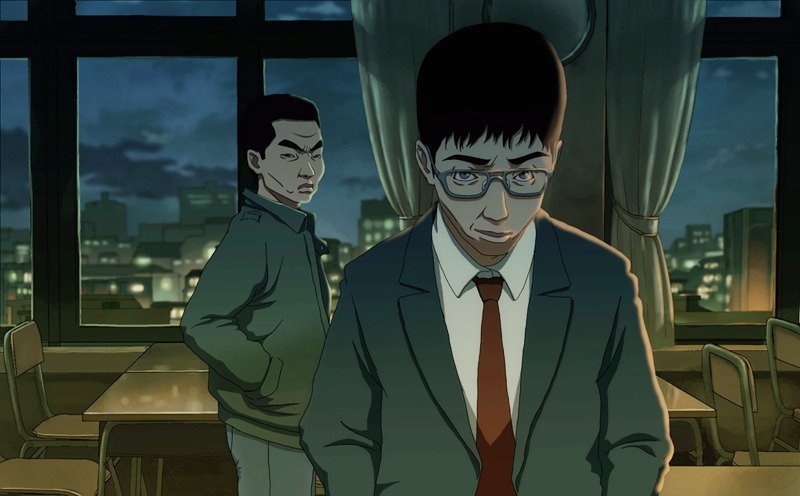
As a struggling writer, Jeong Jong-seok (Yang Ik-joon (양익준) is continually frustrated in his attempts at becoming a published author. Bullied by his boss for daring to give an opinion over a piece of writing, Jong-seok has a violent encounter with his wife as a result. Storming outside to clear his head, Jong-seok receives a call from a childhood friend he hasn’t spoken to in several years, Hwang Kyeong-min (Oh Jeong-se (오정세). Meeting for dinner, the two old friends reminisce about their youth and the difficulties of living and studying in an all boys’ middle school. Yet the conversation takes a darker tone when the topic of their old mutual friend Kim Cheol (Kim Hye-na (김혜나) arises, and secrets long buried are finally revealed.
After 15 years of no contact, Kyeong-min (right) calls Jong-seok for a reunion
King of Pigs is an incredibly gritty, violent examination of the childhood years experienced by contemporary middle aged men, and pulls no punches in emphasizing the Confucian and capitalist value systems as the route of all evil in Korean society. The narrative is one of the most powerful expressions of ‘Han’ cinema in recent years as the social injustice and inequality depicted provide the protagonists with palpable angst and rage, which director Yeon Sang-ho exploits by increasing tension to such an uncomfortable degree that violence is not only a prerequisite but a virtual demand. When it does transpire, the action is beautifully cathartic as the fluid animation and camera movement weaves amongst the kicks and punches as they impact the transgressors, as much a commentary on audience desire as it is on bullying. King of Pigs is a success largely due to such well-structured sequences and the shockingly compelling narrative as it jumps between Jong-seok and Kyeong-min’s childhood years and their adult lives. While the former certainly takes precedence the consequences are conveyed in the present, adding layers of depth as the protagonists’ formative years unfold. Indeed, it is remarkable just how many social discourses are contained within the film. While bullying is rife within all cultures, the tactics employed within this particular school are not only predicated on physicality but also in wealth, age, gender, social relationships and parental influence making King of Pigs a distinctly Korean affair as the hierarchy self-perpetuates due to its Confucian heritage. As Jong-seok, Kyeong-min and Chul have precious little of the necessary attributes they are cast to the lowest ranks of the school pecking order, and the resentment that evolves and festers is startling to behold. Yet the narrative is also concerned with the private lives of the three friends, which allows the conveyance of such concepts on a societal scale as they witness misogyny, crime and corruption as the people around them seek power only to abuse it. As frustration and resentment engulf the trio, they wish desperately to alter their role as merely a ‘pig’ in the hierarchy yet are tragically aware that such a role defines them for life.
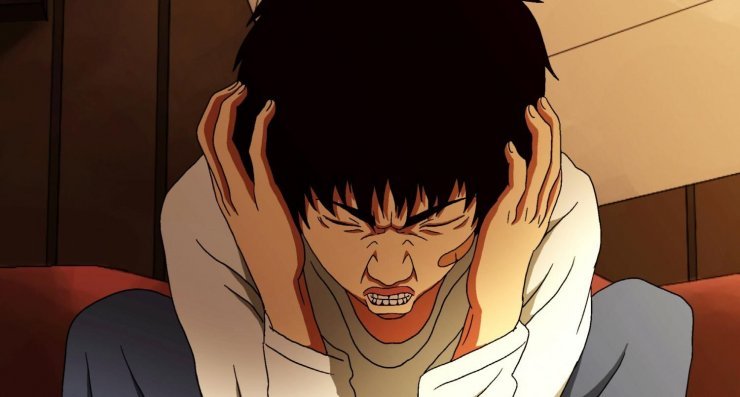
The continuous bullying forces Chul (left) to take a stand against the aggressors
However, while the narrative of King of Pigs is strong and highly symbolic, it is not without problems. While it feels an unfair point to criticize, the limited budget does occasionally appear through the animation as characters move robotically in certain scenes, particularly in sequences where a large number of people enter the frame. This is in stark contrast to the fluidity of action scenes and the difference is quite jarring and somewhat distracting.
The vocal talents of the cast are generally very competent and sincere, particularly by the actors voicing the protagonists as children. Kim Hye-na stands out in this regard as poverty-stricken delinquent Kim Cheol, who performs the array of poignant moments and aggressive events well. As adults the vocal talents have less significant screen time, yet Breathless director Yang Ik-joon conveys the tragic frustrations of Jong-seok especially well. There are moments however when the acting becomes over-zealous, notably with Oh Jeong-se as Kyeong-min who is at times is rather hysterical. Luckily the supporting cast and the strength of the narrative make sure that such moments are short-lived, as the film deftly focuses on the characterization of all the protagonists in both time periods.
The cruelty and injustice of life becomes too much to endure for the friends
Verdict:
King of Pigs is a bold, unflinching animation that portrays an incredible examination of a variety of social discourses in Korean culture. Writer/director Yeon Sang-ho has crafted a well-structured and gripping narrative with incredible depth, where the stylized violence is not only naturalized but, through the build of tension, desired. While budget limitations and over-zealous acting occasionally appear, King of Pigs is a riveting film not only in terms of the animation genre but, due to the uncompromising concept of ‘Han’ throughout, a compelling entry into Korean cinema.
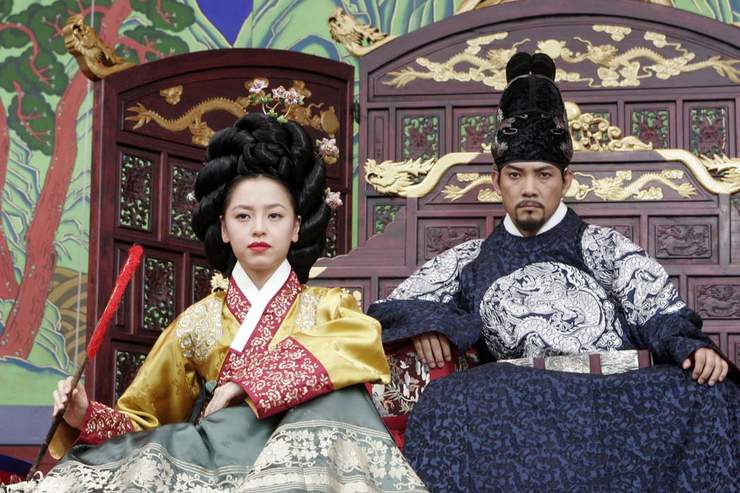
As a breathtaking romantic period-drama set during the Joseon dynasty, The King and the Clown is, perhaps unsurprisingly, one of the highest grossing films in Korean cinema history. However what may be surprising for some is that the romance is homosexual in nature, particularly in a culture where such relationships remain largely taboo. Yet despite such prejudice the film has not only garnered incredible critical praise and commercial success, but has also acted as something of a catalyst for a shift in ignorance largely thanks to androgynous actor Lee Joon-ki.
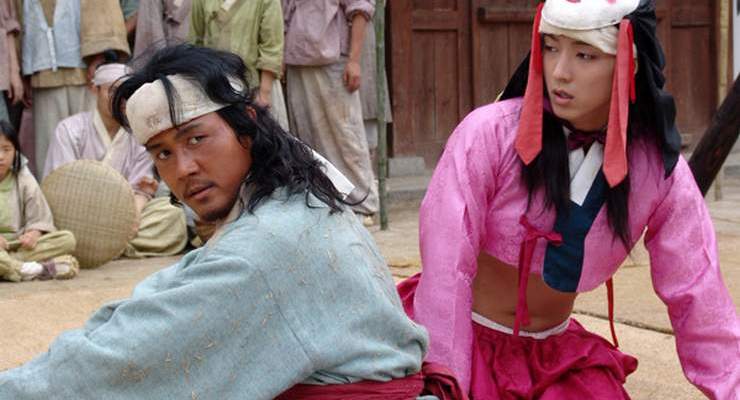
Two talented male minstrels – ruggedly masculine Jang-saeng (Kam Woo-seong (감우성) and delicately feminine Gong-gil (Lee Joon-ki (이준기) – are the leads in an acting troupe that perform for nobility in Joseon dynasty-era Korea. After the performances, Gong-gil is often forced into sexual slavery by their corrupt manager for extra money, sickening his partner. Unable to continue the de-humanising practice, the pair escape and depart for Seoul to earn their fortunes as performance artists and comedians in the capital city. Upon hearing of the cruel absurdities of the current ruler King Yeon-san (Jeong Jin-yeong (정진영), the duo join forces with other street performers to enact a comical tale ridiculing the King with the truths that others are too scared to tell. Their popularity is such that government officials take note, punishing them violently. However they are spared upon one condition – they must perform their mocking routine in front of the King himself, and, should he laugh, Jang-saeng and Gong-gil will be freed.
Jang-saeng and Gong-gil perform their popular routines for unappreciative nobility
The King and the Clown – or more literally translated as ‘The King’s Man’ – is an incredibly poignant and captivating film and a wonderfully colourful historical tale. This is largely due to the partnership between the highly charismatic lead protagonists who never cease to be compelling, and an extremely well-balanced script by Choi Seok-hwan (최석환) who artfully plays with pacing to provide sensitive and thought provoking scenes throughout. Characterization is central to the success of the film, providing fully-rounded roles to individuals who could easily be stereotyped by continually emphasizing their emotional complexity. Jang-saeng is a gifted athlete and performer, with an over-powering compulsion to be truthful and to upset those in power through disrespect; Gong-gil is an equally talented artist who is as adept at acting as he is beautiful, aware that both features are a blessing and a curse; even King Yeon-san, who is often described in the annals of history as the most brutal and selfish ruler in the Joseon era, is portrayed as a psychologically damaged man through childhood torment and the pressures of court. In each case, the narrative allows the protagonists the time to convey their motivations – conscious or otherwise – while the actors that portray them fully inhabit their roles and are utterly convincing whenever they appear on screen.
The concept of truth-through-performance is masterfully conveyed, recalling the likes of Shakespeare’s Hamlet of the ‘play within a play’. As such the film operates as an insightful commentary of the era, depicting the obscurity of truth that is seemingly inherent with power as well as the corruption and tyranny of those in court, through traditional cultural forms. Due to this The King and the Clown expresses a grand, ‘epic’ quality, one which is unfortunately not capitalized on by director Lee Joon-ik. The director is highly competent throughout the film, featuring some wonderful set-pieces and intimate sequences, yet he falters in conveying the grandiose scale of Joseon and the palace in particular, with an establishing shot of Seoul the only notable exception. Despite such shortcomings director Lee Joon-ik is incredibly skilled at conveying intimacy and poignancy as he visualizes the cultural flair and exhibitions with passion and verve, in conjunction with the violence and intense distress that consistently follows. The director’s representation of the homosexual relationships within the film are cautious and understated yet rather than a criticism this actually infers a more innocent and a sweet natured love, although some factions of the audience may take issue with King Yeon-san’s dalliance with Gong-gil as the product of an unresolved Oedipal complex.
The vindictive King Yeon-san and his consort observe the performers
As comic performers Jang-saeng and Gong-gil, Kam Woo-seong and Lee Joon-ki are absolutely enthralling. Kam Woo-seong masterfully conveys the arrogance and audacity of the character, with his unbridled distain for those of a higher societal position palpable. The actor is wonderfully charismatic yet simultaneously tragic, traits that he exemplifies through every mannerism and facial expression with sincerity. Such a description also befits Lee Joon-ki who, as the androgynously beautiful Gong-gil, is a delight. He conveys femininity and elegance with startling conviction, with his resignation to fulfill his sexual role following the performances tender and heartbreaking. His character is as much a commentary about the manipulation of women as it is about homosexuals by those in power, and Lee Joon-ki does not disappoint in emphasizing the sheer injustice of societal inequality.
As the film’s other central protagonist, Jeong Jin-yeong is also frighteningly mesmerizing as King Yeon-san. The actor eloquently conveys the sadistically tragic nature of the ruler as he unpredictably switches emotions on a whim, portraying the leader as an underdeveloped adolescent in one breathe whilst in the next a violent and cruel man. As such Jeong Jin-yeong is fascinating to watch as the long hidden truths are revealed, for his reactions are unpredictably horrifying.
Through their performances Jang-saeng and Gong-gil reveal truths to King Yeon-san, which often incur violence
Verdict:
The King and the Clown is an amazing tale and a wonderful journey through one of the darkest eras of the Joseon dynasty. The narrative and characterization are excellent, as is the acting by all the principal cast who never cease to be enthralling and compelling. While the directing is somewhat lacking in scale the emphasis on intimacy and poignancy makes the film and enduring classic and a testament to the creative qualities of Korean filmmakers.
The divide across the Korean peninsula has provided history with some of the most fascinating and horrifying accounts of human endeavour. Both the North and the South have flip-flopped between moments of sheer brutality against each other yet have also achieved poignant moments of recompense. While terrorist attacks and threats grab headlines, the strong underlying sense of nationality and ‘brother/sisterhood’ has spurred other stories of joint enterprise, family reunification and co-op sporting events that are smaller and more intimate in nature, hinting at the potential future for a united people; they are, after all, Korean.
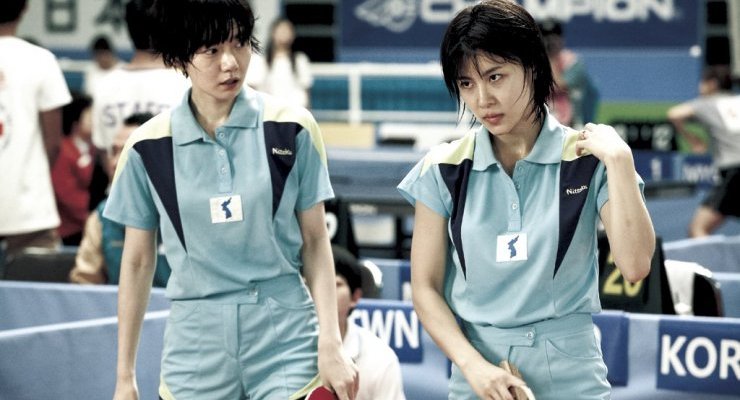
One such tale of triumph over (ideological) adversity was obtained during the 1991 International Table Tennis Championships in Chiba City, Japan, where South Korean and North Korean table tennis players partnered to compete against the rest of the world. Brought to celluloid by director Moon Hyeon-seong (문현성), As One (코리아) flirts dangerously close with being an average TV movie for the majority of its’ running time yet manages to become an engaging and effective sports drama in the final act.
Facing off in the semi-finals during the 1990 Asian games, South Korean table tennis player Hyeon Jeong-hwa (Ha Ji-won 하지원) confronts her Northern rival Lee Boon-hee (Bae Doona 배두나), both determined to win not only for themselves but for the pride of their respective countries. Narrowly defeating her opponent, Jeong-hwa moves on to the finals but is bested by the Chinese champion (Kim Jae-hwa (김재화), nicknamed ‘The Great Wall’. As the teams prepare themselves for the 1991 Championships in Chiba City, the governments of the North and South make a surprising statement – they will combine their athletes to create a ‘Unified Korea’ team. Forced to play alongside each other, Jeong-hwa and Boon-hee must train to overcome the ideological differences between them and defeat their Chinese rivals once and for all.
The champions from the North and South unwillingly join forces
Contemporary Korean films have a reputation for being remarkably even-handed in their representation of Northern protagonists, and As One is no exception. In fact, it’s largely thanks to the balanced approach and ideological banter that the film continues to be compelling during the incredibly lackluster first and second acts. For every quip about human rights comes a retort regarding misogyny; for every representation of stoic obedience is a portrayal of thoughtless misbehaviour. Interestingly it is the Northern athletes, led by Boon-hee, who are the most sympathetic and accommodating protagonists, while those from the South are often rude, aggressive and stubborn, as exemplified by Jeong-hwa. Such a concoction of characters offer predictable pleasures, but are entertaining nonetheless.
However the contrivances of the narrative appear all too frequently and reduce the athletes into one-dimensional caricatures often found in Korean TV dramas – yet without the possibility for development – with only Jeong-hwa and Boon-hee narrowly escaping. A true story such as this means the finale is inevitably predictable, yet the decision to include a supporting cast of stereotypes with stereotypical scenarios is perplexing and detracts from the overall enjoyment. Also halting the engagement of the audience is the soundtrack, which rarely naturally enters the film. With the exception of the final act, the music is continually a distraction and is often disjointed from prior scenes.
Luckily As One manages to redeem itself during the last moments as the final matches of the tournament are thrilling. Director Moon Hyeon-seong (문현성) makes wonderful use of editing and slow-motion techniques to deliver exciting and suspense-filled moments that are riveting and adrenaline-inducing. Strangely he constructs the penultimate match as more thrilling than the final itself, with Yoo Sun-bok’s (Han Ye-ri (한예리) underdog tale an incredibly compelling part of the film, yet also employs enough different filmic techniques to make the final a powerfully emotive viewing experience. The trials faced during the final also allows for the introduction of melodrama which is wonderfully capitalized on as the two teams are forced to part ways. It is here that the acting prowess of the two talented lead actresses finally appears as their parting is both poignantly sincere and heart-wrenching, exhibiting a quality that is a testament to how important the event was for all involved.
Camaraderie initially proves difficult
Much has been reported regarding Ha Ji-won’s table tennis training by the very champion she portrays, and how her skill level potentially rivals world class athletes. Sadly, due to the rapid editing and stylization, the actress’ skill level does not fully translate into film. That said, Ha Ji-won’s passionate, determined and stubborn performance is articulated well throughout As One with her reluctance to accept her long-term rivals as partners convincing. The characterization often gives her little room to manoeuvre, however during the final act Ha Ji-won is utterly enthralling as she bids farewell to her close friend as her evolving level of grief portrays incredible emotional turmoil.
Bae Doo-na shares a similar fate as Boon-hee, who gives a more stoic-yet-understanding performance and as such is the more endearing protagonist. Her weight loss, in attempting to portray the same physique as the real Boon-hee, is quite a shocking visual as her thin frame conveys a frailty and tenderness not ascribed to others. Bae Doo-na’s physical dedication also adds potency to the trials she endures throughout the narrative, while her level-headed and thoughtful acting style present a mature and contemplative counter to Ha Ji-won. Due to Bae Doo-na’s performance the final parting conveys penetrating sincerity, making it virtually impossible not to be moved emotionally.
Out of all the supporting cast only one actress rises above the stereotypical roles bestowed upon them – Han Ye-ri. Her turn as anxious novice Yoo Sun-bok is entertaining and poignant, particularly during the penultimate game. Unfortunately her tale is somewhat faded into the backgrounded as team dynamics and political tension receive focus, yet Han Ye-ri gives a highly capable performance as the underdog achiever.
Jeong-hwa and Boon-hee achieve the unthinkable on and off the court
Verdict:
Thanks to the true story on which it’s based, As One has plenty of potential for an incredible sports drama yet only manages to partially capitalise on the events that unfolded. While the ideological differences are balanced and entertaining, and the final matches are thrilling and exciting, the choice to fill the narrative with one-dimensional stereotypes and scenarios is detrimental to the film overall. That said, the strength of what transpired is moving and will undoubtedly remind audiences of the power of sports in uniting disparate people, and will certainly hold particular resonance for those of Korean descent.
The opportunity to talk in terms of queer theory, ‘camp’, and ‘otherness’ in mainstream Korean cinema is quite rare. While Korean ideology continually changes at an incredible rate, the conservative Confucian ethics still hold immense influence over the attitudes towards the roles of men, women, and sexual relations. Yet cinema is arguably the best medium in which to explore such counter-cultural themes given the creative freedom of expression inherent to the industry, perhaps more so than the structurally rigid television dramas and K-pop. Enter Dasepo Naughty Girls (다세포 소녀).
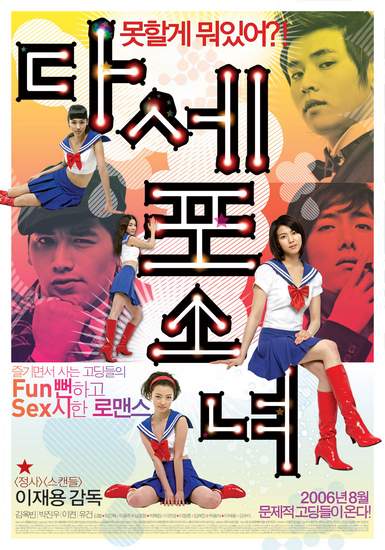
Based on the highly popular web-comic, Dasepo Naughty Girls explores the lives of the students at Useless High School (or No Use High), a school where sexual promiscuity is encouraged and the curriculum is anything but traditional. Director Lee J-young (이재용) wisely exploits the opportunity to employ original and creative vision to a narrative that includes protagonists of every sexual persuasion and circumstance. The result is incredibly mixed, as the directorial flair is certainly unique and celebratory, yet is aligned with an awfully vapid and directionless narrative that not only forces the LGBT and transvestite characters into figures of ridicule, but also pushes the boundaries of perversity as certain scenarios are clearly middle-aged male fantasies.
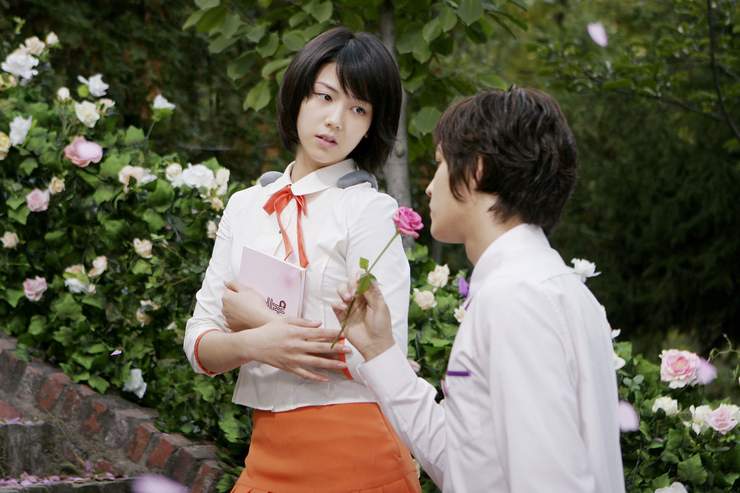
The students at No Use High live rather disparate lives. ‘Poor Girl’ (Kim Ok-bin (김옥빈) lives an extremely humble life due to poverty, literally carrying its’ personification on her back. ‘Rich Boy’ Anthony (Park Jin-woo (박진우) has found love, yet is confused as she is a pre-op transgendered person interestingly named ‘Two Eyes’. Her brother, ‘Cyclops’ (Lee Kyeon (이켠), suffers as the loneliest and only virginal member of the school. As the students’ lives are interwoven, each one must face personal trials to overcome before the final day of graduation. Yet their greatest obstacle is posed by the evil and mysterious principle, who has the power to change bold, individualistic female students into brainwashed geeks. The students must work together to defeat the evil menace in order to continue their lifestyles and graduate unscathed.
The students of No Use High relish in their sexual promiscuity and non-traditional education
Stylistically, Dasepo Naughty Girls is an enjoyable treat with a vibrant colour palette and quirky musical offerings. The opening sees a group of K-pop stylized girls in pink dancing through the school, which is not only fun but sets up the offbeat nature of the film well. Similarly the introduction of musical numbers within the film is entertaining and unique as Korean norae-bang (singing room) culture is wonderfully injected to provide comedy.
Yet aside from a few initial titters, Dasepo Naughty Girls is surprisingly very light on comedy as the scenes intended to provide laughs often result in either immature body jokes or are offensive. While it’s wonderful to see LGBT and transvestite characters receiving screen-time that is more celebratory than depressive, they are quickly ridiculed by a narrative that is desperately attempting to be fun and hip while disguising archaic ideological judgement. For example, ‘Rich Boy’ Anthony’s infatuation with transgendered ‘Double Eyes’ begins humorously during a bathroom error, yet a pornographic video reduces her to a mere body prop from which the character never recovers. ‘Poor Girl’s’ servicing of ‘clients’ also begins well, yet upon meeting transvestite ‘Big Razor Sis’ the duo compete for feminine superiority and acceptance through performance that clearly had only one winner from the start. Racism also appears in the form of an absentee English teacher who not only has sexual liaisons with students but has also infected them with an STD. In these and other scenes it is never the denizens of No Use High that pass judgement but rather the narrative that frequently posits such figures in society as shocking ‘deviants’ to be laughed at and from which comedy can be derived.
Yet ironically the most bizarre – and frankly perverse – plot involves the respected figure of the principal. The mystery involves female students who were previously sexually adventurous, but after visiting the principal’s office become studious nerds with little interest in boys. To achieve this, the principal takes a glob of green material (presumably jade) from his mouth and, using his finger, inserts it into the students’ vagina, for which they are thankful and grateful. As prior to such scenes the principal and his methods were barely a blip on the narrative radar, this tangent conveys not only a ‘tacked on’ sensibility but also a middle-aged male fantasy of intimacy with sexually willing high school girls. The resulting battle, which sees students wafting their genital ‘power’ at the source of the disturbance, is a surreal scenario that seemingly attempts to circumvent prior scenes through oddity, and additionally offers precious little closure on the array of narrative threads that lead to such a juncture.
‘Poor Girl’ meets a transvestite client for teenage frolics
It is particularly difficult to discuss Dasepo Naughty Girls in terms of acting, as the film is intended to be an over-acted and surrealist take on high school life. The extremely limiting screen-time bestowed upon most of the protagonists also hinders proceedings as most characters barely reappear after their initial introduction.
Amongst the handful of characters that recur, it is ‘Poor Girl’ who appears the most and as such carries Dasepo Naughty Girls on her shoulders. This is actually in the films’ favor as the actress is incredibly talented, managing to find the ambiguous fine line between tongue-in-cheek humour, offbeat comedy, and genuine acting. Kim Ok-bin gives the film much needed focus and grounding as well as a heart and soul, and her presence is sorely missed when other protagonists are followed. Her scenes with ‘Big Razor Sis’ are in stark contrast to the poverty inherent in her private life, yet the actress is convincing in each and every scenario.
‘Poor Girl’s’ love for ‘Rich Boy’ Anthony is continually unrequited
Verdict:
Dasepo Naughty Girls is stylized entertainment, one that uses imaginative colour and camera techniques to provide fun and quirky originality within a national cinema that tends to focus on more standardized storytelling. Yet the stylization cannot hide the vacuous nature of the narrative which simultaneously celebrates and derides the protagonists within, and which also fails to merge the various threads into a coherent whole.
One of the most fundamental ideological features of Korean cinema is alienation, yet the topic is almost always at the fringes of the narrative, accepted as a commonplace backdrop against which the protagonists reside. Oh Dae-su was sadistically kidnapped, imprisoned, and isolated for years in Seoul in Oldboy; Mr. Kim attempted suicide due to the stress of city life, and found a private paradise in Castaway on the Moon; and Yang Mi-ja expressed her loneliness and repressed passion through art in Poetry. Yet in each instance it was not their loneliness that drove the narrative forward, despite the central role in which it played in characterization.
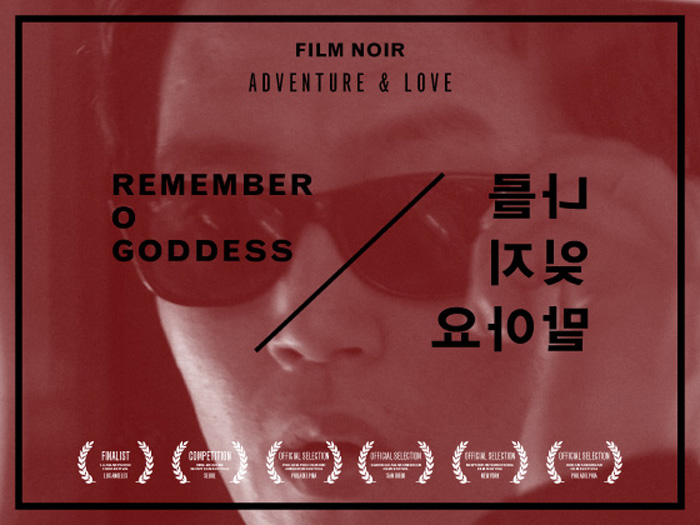
In Remember O Goddess (나를 잊지 말아요) director Lee Yoon-jung explores the concept of alienation in conjunction with identity in contemporary Seoul, constructing a fascinating and enthralling psychological noir that exemplifies the incredible quality of Korean independent cinema. The delicately nuanced scenes, the intellectual-yet-comedic dissection of contemporary identity, as well as an arguably career-best performance by lead actor Kim Jeong-tae (김정태), combine to create a 25 minute short film that easily surpasses the majority of feature length productions.
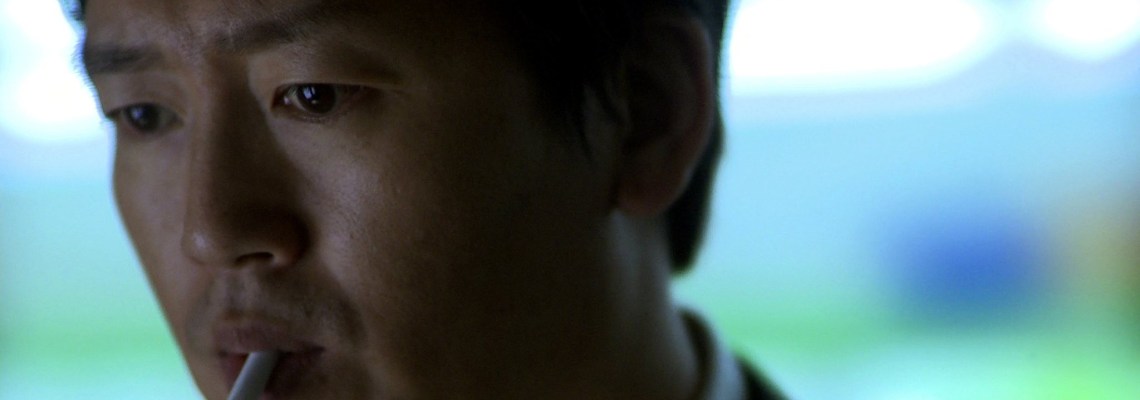
The amesiac man (Kim Jeong-tae (김정태) attempts to (re-)discover his identity
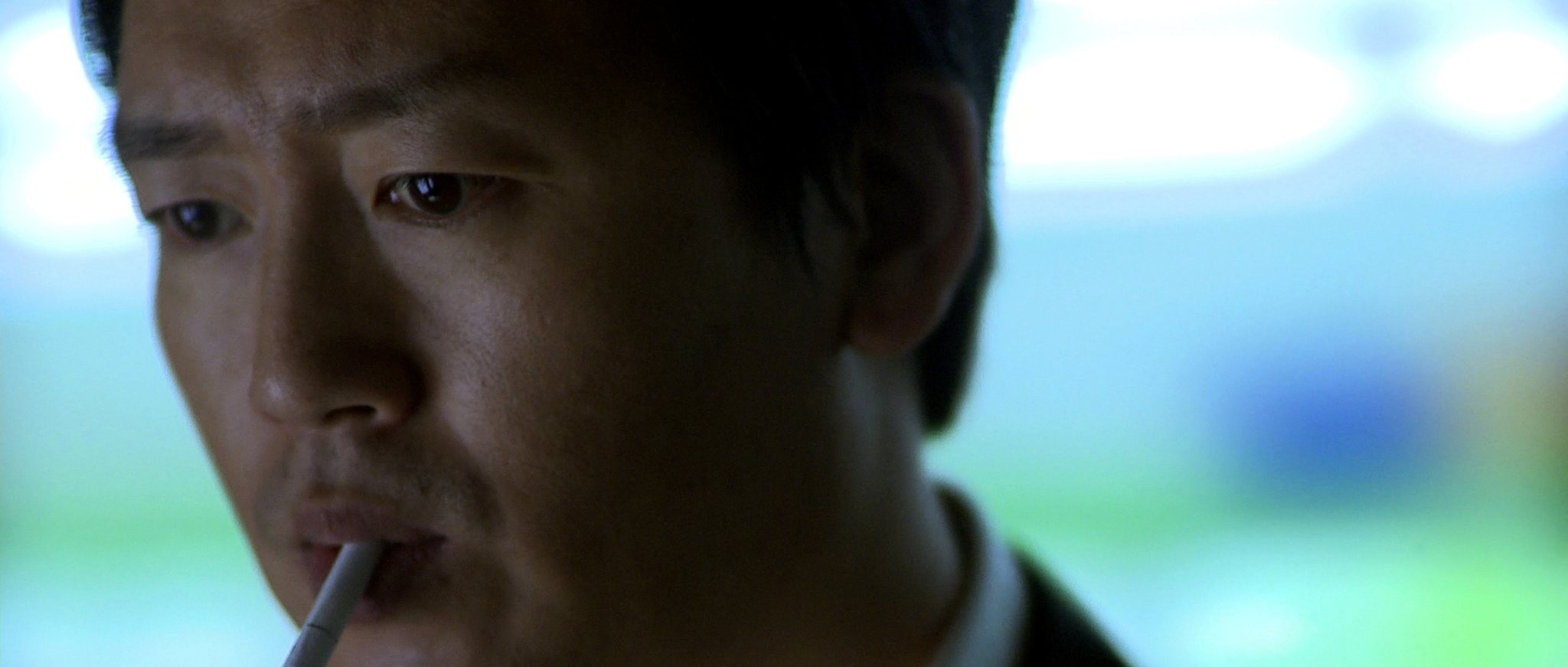
Remember O Goddess is a sophisticatedly crafted, character-driven study of a man searching for his identity. Rather than focus on bombastic or shocking scenes, director Lee Yoon-jung emphasizes the subtleties of the protagonists’ dilemma as he attempts to piece together his fractured self. The manner in which this occurs is part-satire and part-capitalist critique as the man scours his belongings for clues, investigating the most minor details in order to discover what kind of man he truly is. This leads to moments both comedic, as he attempts to (re)discover smoking, and poignant, as he silently stares at the vast and densely populated cityscape before him.
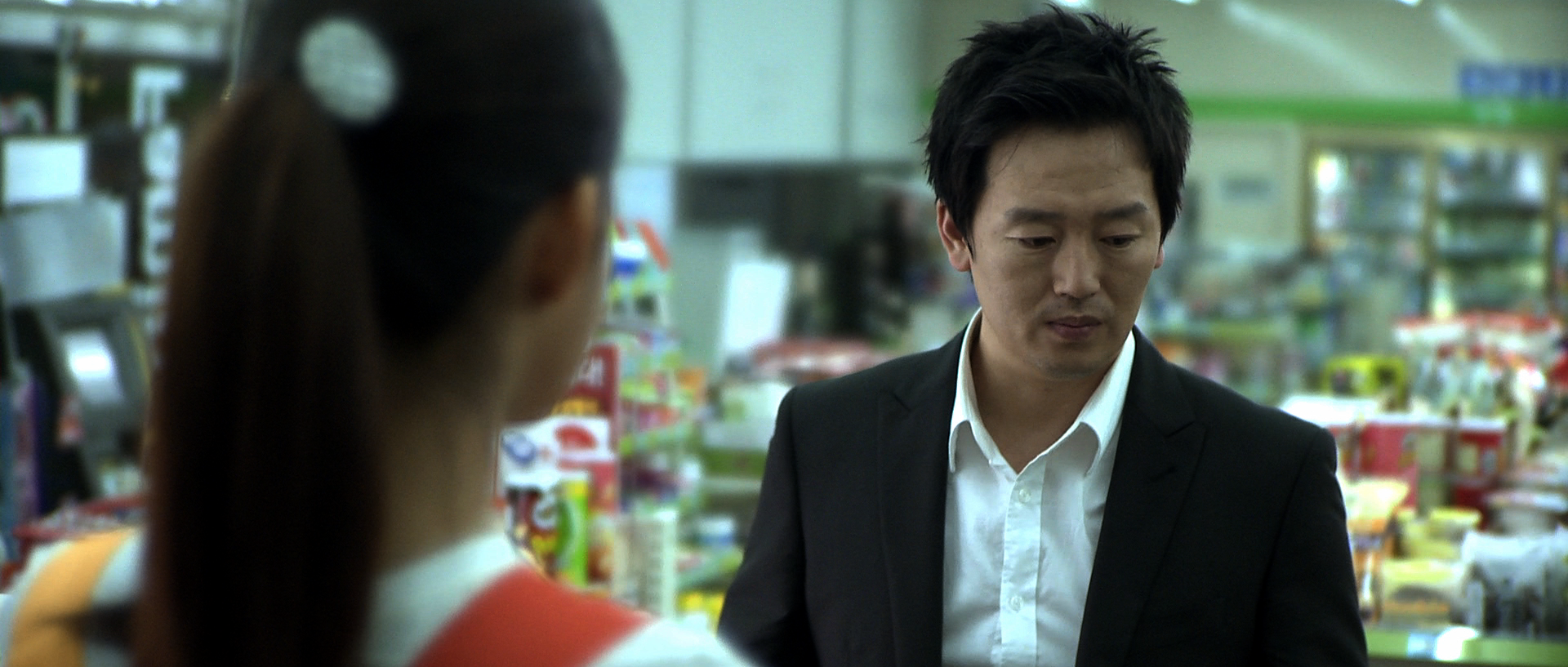
Relationships are also wonderfully deconstructed throughout the film, as the man desperately clings to any form of connection that his circumstances allow. Yet in doing so he highlights the artificiality of contemporary relationships, as well as the (im)personal barriers and the impatience of citizens. Such artifice is eloquently interrogated as those in the service industries are polite yet superficially so, rapidly displaying frustration at the man’s naivety and innocence. Director Lee Yoon-jung showcases her skill during such delicately nuanced scenes – including the relationship with the female store clerk, and a comedically tragic phone call – conveying a plethora of visual and narrative motifs and emotions that define the existence of a contemporary city lifestyle.
The man attempts to forge a relationship with a convenience store worker
It is not an exaggeration to say that in his role as the amnesiac man, Kim Jeong-tae is absolutely sublime. His performance is staggering and conveys an actor fully dedicated to inhabiting the role, as his subtle mannerisms and awkwardness highlight the intense vulnerability of a man pushed to the brink of desperation. Whether the scene involves reporting himself as a missing person or merely attempting to acquire the date, Kim Jeong-tae simultaneously exhibits fragility, curiosity, loneliness and anguish seemingly effortlessly.
The man stares at the vast cityscape in which he inhabits
Despite such high-level praise, Remember O Goddess suffers from one minor issue. This is not related to any of the creative talents involved in producing the film; the reason is, rather superficially, due to the limiting running time. The film is clearly a prelude of a feature film, awash with potential that literally demands further exploration which a greater time limit would allow. As such the film functions as an introductory segment of a promising narrative, a declarative showcase of the talent the conglomeration of individuals are capable of.
This is where you can help. Director Lee Yoon-jung is seeking funding to produce the feature-length version of Remember O Goddess via kickstarter. Please visit the website here to read all the information and to donate to the project. The film is clearly well worth supporting and the cast and crew are fully committed to the production, with all money raised going into the production itself.
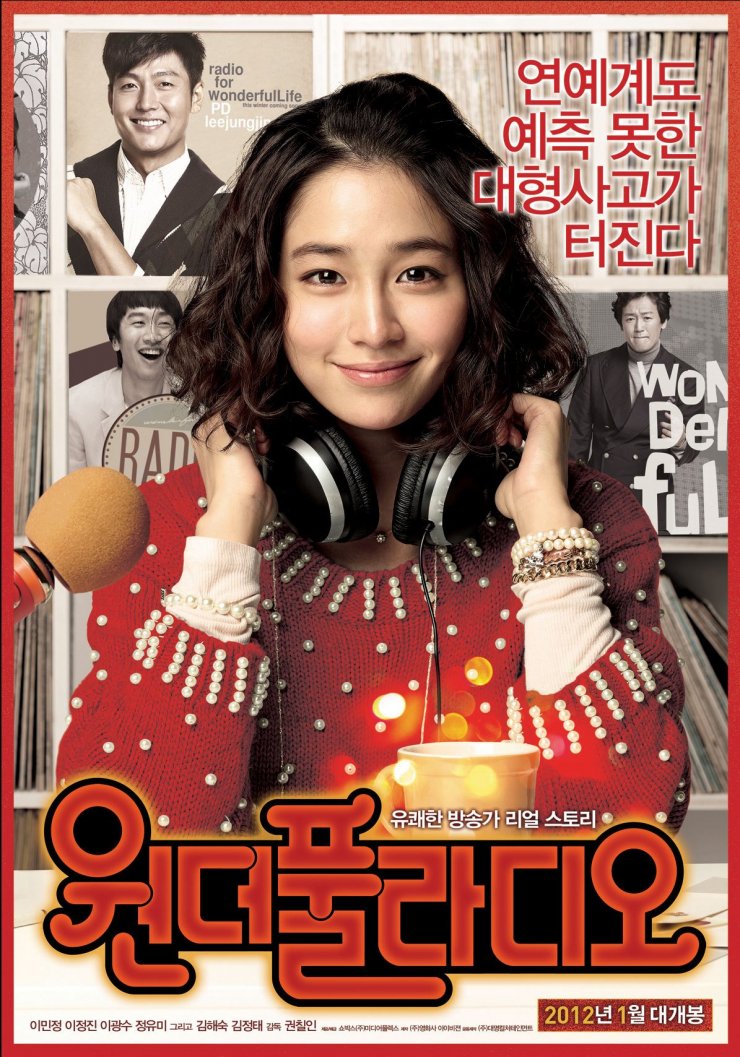
The Korean fascination with K-pop celebrities and the ‘scandals’ that are seemingly inherent within the industry continually appear in a variety of cinematic forms. Comedy 200 Pounds Beautyexplored the concept of beauty and image, while horror White: The Melody of the Cursefocused on the rivalry between the members and the plagiarism that frequently occurs. Interestingly, with romantic-comedy Wonderful Radio (원더풀 라디오), maturity and life following celebrity status are examined.
Wonderful Radio joins You’re My Petas the other big star-driven romantic comedy of 2011; and, as with You’re My Pet, offers little more than a vacuous narrative of two attractive yet contrasting people forging an improbable relationship. Save for an interesting but all-too-brief interrogation of the pretense inherent in K-pop, Wonderful Radio is a mildly entertaining yet instantly forgettable experience.
Jin-ah (Lee Min-jeong (이민정) is the radio DJ for the ailing ‘Wonderful Radio’ segment, a show that is hemorrhaging listeners chiefly through her selfish and rude behavior. Jin-ah desperately longs for her past career as a K-pop icon in girl group ‘Purple’, yet her attempts to rejoin the music industry are continually thwarted as younger stars rise in popularity. In a bid to finally axe the show and Jin-ah’s career, manager In-seok (Kim Jeong-tae (김정태) promotes the notoriously difficult producer Lee Jae-hyeok (Lee Jeong-jin (이정진) to helm the show. Yet against the odds, and despite their constant bickering, Jin-ah and Jae-hyeok may have found a way to save ‘Wonderful Radio’ as well as the start of a blossoming romance.
After a brief stint in K-pop, Jin-ah now hosts the failing ‘Wonderful Radio’
The above comparison between Wonderful Radio and You’re My Pet may seem unfair, yet both films are intended as rather commercially driven efforts to promote the central performers through crowd pleasing romantic tales. Unfortunately for Wonderful Radio, Lee Min-jeong – though a fast rising star – and Lee Jeong-jin do not have the same star power or acting credentials as Kim Ha-neul and Jang Geun-seok, and as such the contrived narrative conveys an even more manufactured sensibility.
As is often noted in any basic film studies and screen-writing course, the opening five-to-ten minutes of any film are crucial in attracting and captivating audience attention; if successful, audiences can forge empathic bonds with the protagonists, with the intensity of the faux-relationship mesmerizing viewers into following the narrative through to its conclusion. Wonderful Radio does not adhere to such a train of thought. The opening act, while admittedly setting up the premise of Jin-ah and her declining show, is utterly directionless with the only driving force being Jin-ah’s intolerable behavior. While she is intended to be something of a ‘princess’ stereotype, full of arrogance and pride, Jin-ah is actually closer to being psychotic as exemplified by her recurring temper tantrums and childish fits. Such scenes may very well be for the sake of comedic entertainment, but when the protagonist becomes quiet and reflective scant moments later it is clear that characterization and narrative structure were something of an afterthought.
Luckily Wonderful Radio finds direction thanks to the timely intervention of a taxi driver – the ever-dependable Jeong Man-sik (정만식) – who adds much needed heart and emotion to the proceedings. With a core theme attached director Kwon Chil-in (권칠인) manages to explore, albeit briefly, the superficial facade of being a K-pop star and promotes ‘authentic’ music, including playing an instrument and removing cheorography, as superior due to the emotional content. While the intriguing topic has incredible potential, it is rapidly jettisoned in favor of returning to the unconvincing love developing between the mismatched lead actors.
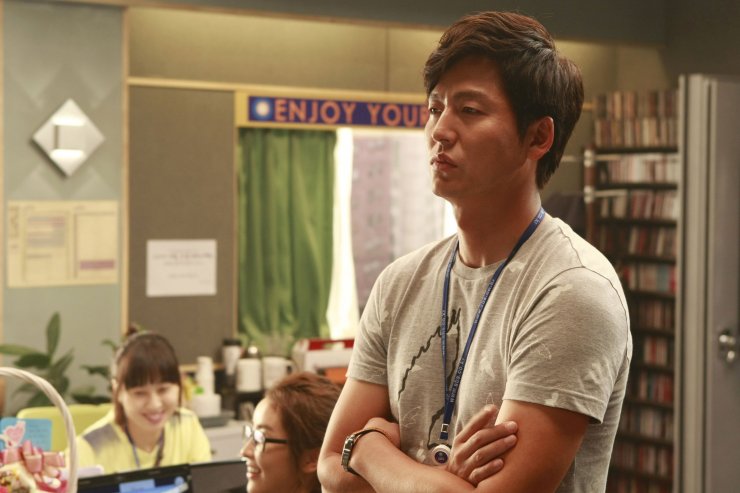
Uncompromising new producer Jae-hyeok attempts to make Wonderful Radio a hit
With such a vapid narrative, the director wisely – or cynically – focuses vast attention on Lee Min-jeong’s undeniable beauty. Indeed, seemingly every few minutes the actress’ face is framed in close up with extreme soft focus, often appearing fragile and on the verge of tears. Lee Min-jeong’s charisma during such moments is palpable and distracting enough to forget the incredible shortcomings of the narrative for an instant, yet disapates almost immediately once her presence is absent. However it is mostly her image that causes such affliction as Lee Min-jeong’s performance is, for the first and second act at least, below par due to the odd behaviorial schizophrenia of her protagonist. The actress is much more comfortable in the final act when her character has calmed, and adequately portrays the character.
The rest of the cast are mostly in supporting roles, with even love interest Lee Jeong-jin as Jae-hyeok something of a secondary character who is woefully underdeveloped and under-represented. The supporting cast enter the narrative seeingly to add people to the scenes and offer very little aside from the occassional moment of comedy. Actor Lee Kwang Soo fares best in this regard as downtrodden Dae-geun, displaying his comedic sensibilities well despite the predicability.
Jin-ah attempts to relaunch herself as a more ‘authentic’ musician – and human being
Verdict:
Wonderful Radio is very much a comercially-driven star vehicle for Lee Min-jeong, which would certainly be no bad thing were it not for the directionless, bland and predictable narrative, and the incredibly underdeveloped characterisation. The film does attempt to correct the issues with the introduction of emotional content and an interesting perspective on the world of K-pop, yet these measures are brought in far too late and appear all too briefly to make an impact. As such, Wonderful Radio is a lacklustre romantic-comedy that is instantly forgettable.
If you’ve ever wanted to be involved in Korean film production, or in independent film production in general, this is an opportunity you certainly won’t want to miss.
Remember O Goddess, an incredible noir 25 minute short film by director Yoon Jung Lee, is making waves and has been invited to several prominent festivals including the 2011 LA Asian Pacific Film Festival, in which it was a Finalist for the Golden Reel Jury Award for Short Film, in Los Angeles, USA; the 2011 Urban Suburban Film Festival, Philadelphia, USA; and the 2011 New York International Film Festival, NYC, USA amongst others.
In order to extend the film into a feature-length production, Yoon Jung Lee is seeking additional funding – which is where we can help.
Actor Kim Jeong-tae (김정태) takes the lead role as an amnesiac in a noirish world
By visiting this site at kickstarter, you can donate to help keep momentum on the project moving. You can also read the in-depth profile of all the talent involved, and the history of the production which highlights the incredible efforts of the team. Whether it’s $10 or $1,000, every little helps and will be appreciated. Depending on the level of your donation you could receive your name in the credits, a signed DVD and poster, or even a guided tour. Please see the website for more details, and let’s work together to help director Yoon Jung Lee and Remember O Goddess develop the potential so clearly displayed in the short film.
Korean cinema has something of a love affair with partnering a mad-cap group of disparate individuals, who are given the unenviable task of bringing the corrupt elite to justice. The repetition of such a narrative framework is undoubtedly ideologically founded, yet the translation of the sense of ‘Han’ within the team dynamic is often hit-and-miss. For every The Host (괴물) is a Once Upon a Time (원스 어폰 어 타임); for every Take Off (국가대표) is a Sector 7 (7광구).
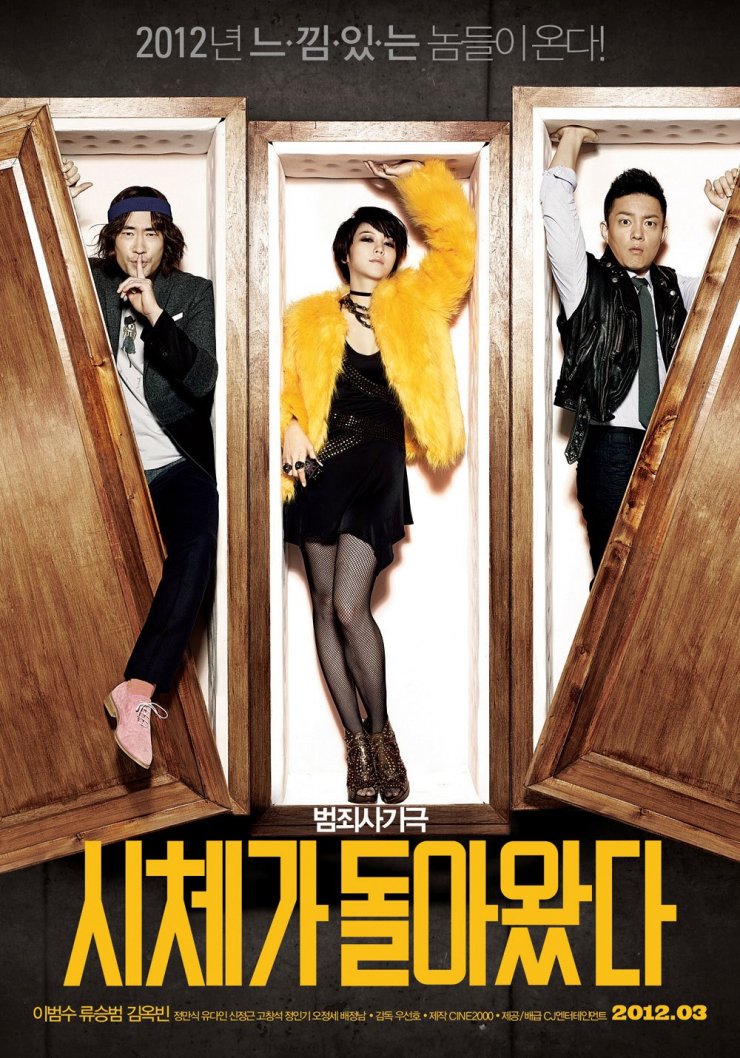
Writer/director Wu Seon-ho’s (우선호) foray into the arena is more comically-macabre in nature as an exploited group of individuals attempt to ransom a corpse. As such Over My Dead Body (시체가 돌아왔다) provides a distinctly fresh approach to the concept yet never manages to fully capitialise on the premise, instead falling back on the tried-and-tested format – and cliches – of its forebearers. Luckily the addition of Ryoo Seung-beom (류승범), who is a charismatic delight throughout, singlehandedly elevates Over My Dead Body out of mediocrity.
Protesting against the unscrupulous CEO of a technology firm, engineer Baek Hyeon-cheol (Lee Beom-soo (이범수) and his mentor throw eggs and chant slogans in the belief that the specialist microchip they have developed is being sold abroad. They are indeed correct, as the CEO has been faking an illness and has implanted the microchip within himself in a bid to smuggle the technology into America for a large profit. Yet through their persistance Hyeon-cheol and his senior reveal the fraud to the country, and in retaliation the mentor is brutally inured. Swearing revenge for the crimes against her father, Han Dong-hwa (Kim Ok-bin (김옥빈) enlists the help of ever-reluctant Hyeon-cheol. However, with the shocking news of the CEO’s death the duo hatch a plan to steal the corpse and hold it to ransom – unwittingly stealing the microchip in the process. Yet when the corpse suddenly awakens to reveal conman Ahn Jin-oh (Ryoo Seung-beom (류승범), the trio must begrudgingly combine their skills in order to walk away with the money – and their lives.
Hyeon-cheol and Dong-hwa pledge to bring the corrupt to justice
Over My Dead Body begins in a fun but rather odd science-fiction fashion as Hyeon-cheol chases down a corrupt CEO who deals with advanced microchips and lasers. The premise of the film is then quickly set up, as Dong-hwa and Hyeon-cheol – who transforms from science-nerd to attractive middle-aged man in a matter of minutes – go about planning to steal the titular corpse. The duo’s theft is humorous and entertaining, as they fumble their way through security measures and unforeseen circumstances in a bid to complete their mission. The resulting getaway is also highly enjoyable, with Jin-oh’s awakening corpse routine a real highlight of the film.
It’s at this stage that Over My Dead Body seemingly runs out of ideas as a slew of underdeveloped characters are introduced that do little to continue the promising momentum of the first act. These stock characters are all stereotypical in nature, including the unintelligent gangster duo, bumbling National Intelligence Agency officers, and a host of security personal led by a nefarious kingpin. The narrative desperately attempts to juggle everyone and give them adequate relevance, but there are far too many and the story becomes bogged down as the central protagonists move from one set piece to the next. The decision to include such stereotypes also opens up a variety of cliched and predictable scenarios, some of which are humorous while others tend to fall flat, making the narrative lack compulsion with yet another case of mistaken identity and/or betrayal. By including so many narrative threads the central cast suffer from lack of development, particularly Kim Ok-bin (김옥빈) whose talents are vastly under-utilized as she exists merely as ‘the sexy punk girl/love interest.’
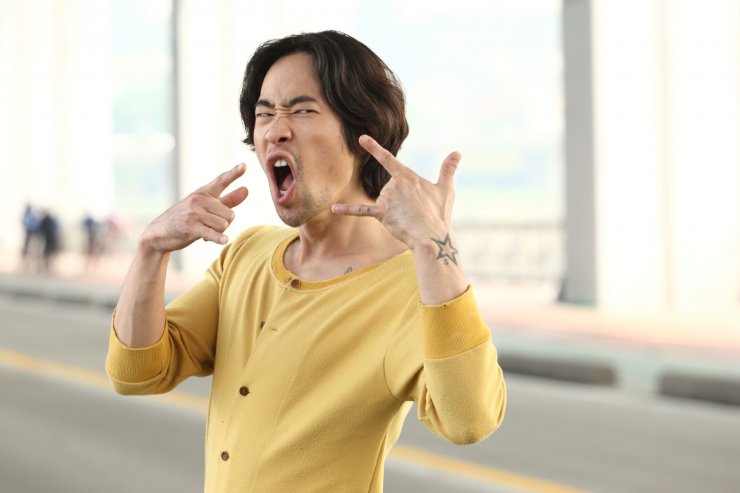
Luckily Over My Dead Body is consistently rejuvenated whenever Jin-oh (Ryoo Seung-beom (류승범) appears, as his mixture of whacky antics, deviousness and over-acting are highly comical and drag the narrative out of any slumps that occur. Thanks to his wise inclusion the film never sinks into blandness, and makes the narrative much more compelling to see through to its conclusion.
Joined by charismatic/psychotic con-man Jin-oh, the trio continue their quest
Lee Beom-soo is an interesting choice as science nerd Hyeon-cheol, and delivers a competent and likable performance. While he – as with his compatriots – suffers from lack of character development, Lee Beom-soo conducts himself as an intelligent ‘every-man’ well. The director’s decisions in regards to costume make it difficult to convey the character, as he strangely moves from geek to office worker to university student, a feature which is also reflected in his personality as it undergoes dramatic shifts from shy to intelligent to aggressive.
Kim Ok-bin is generally employed as a sexy love interest in playing Dong-hwa, and aside from inspiring the heist is incredibly undervalued. The actress plays the role of the strong, stubborn punk well yet there are few scenes in which her character is allowed to convey more, with her pink hair and cell phone charms the only indicators to greater depth. An effort is made to connect her with her sick father, yet such sparse time is dedicated it barely registers.
Ryoo Seung-beom is seemingly the only actor who understands the tongue-in-cheek farcical nature of the narrative, and over-acts in each scene with wonderful charisma. Yet throughout his performance he also keeps the audience guessing as to whether Jin-oh is a hyper-intelligent fraudster or genuinely mentally unstable, making him a comical and entertaining protagonist within each scene. Again, little depth is ascribed to Jin-oh yet his presence and hyperactivity circumvents criticism in this regard as the film is elevated largely due to him.
Jin-oh’s wacky antics continually entertain
Verdict:
Over My Dead Body offers an interesting and comically-macabre spin on the crime heist sub-genre, and often succeeds in being entertaining throughout due to the premise. Yet the film largely falls into cliche and predictability following the first act due to the reliance upon an array of stock characters and a lack of inventiveness. However Ryoo Seung-beom’s presence consistently raises the film, and fans of the actor will not be disappointed as Over My Dead Body is an enjoyable film largely thanks to him.
Religiously-infused films often walk an incredibly precarious line; should the narrative either condone or condemn the ideology being portrayed, the risk of alienating – or worse, offending – factions of the audience is great. And yet seemingly any cinematic foray into the subject inescapably stokes controversy as the predicaments, decisions and actions taken through faith, whether situated within historical or contemporary contexts, generate enormous debate amongst the religious and non-religious alike.
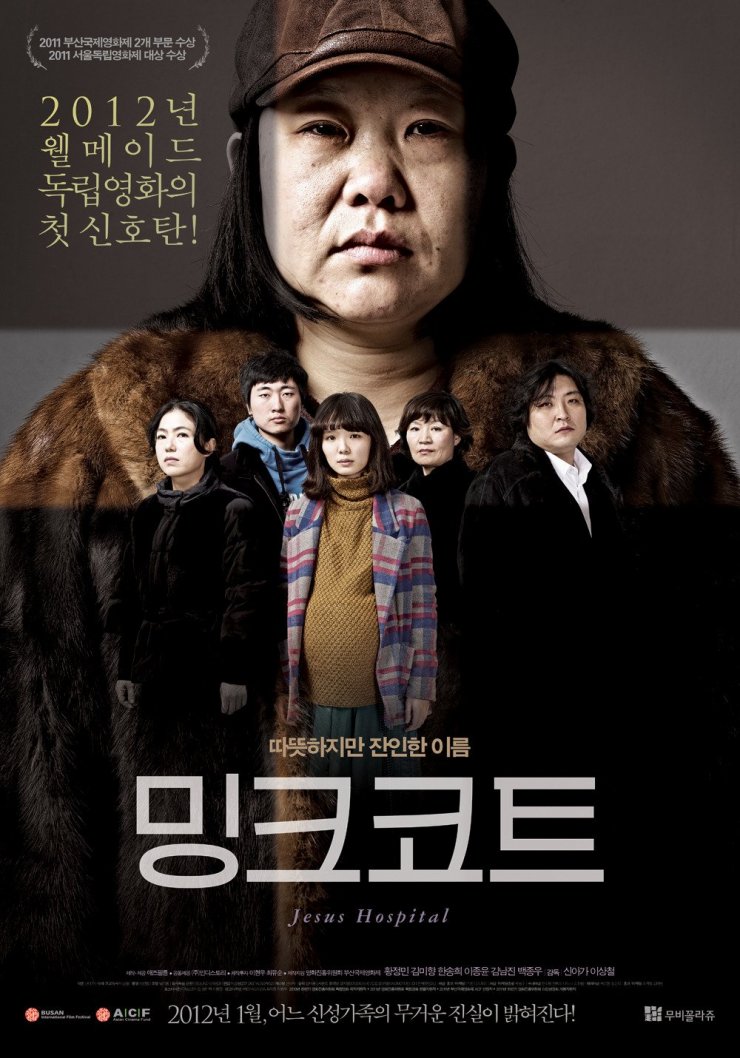
With a title such as Jesus Hospital (밍크코트), audiences could understandably be forgiven for preconceiving that the film features overtly biased, pro-Christian debates. Yet Jesus Hospital does no such thing, instead focusing on a family tragedy while the emotionally fraught relatives struggle to make sense of their situations through their own interpretations of religious texts. The film is incredibly successful in portraying a balanced, mediative approach, and aside from a rather bland second act, is an interesting and thought provoking independent drama.
Despite her humble life, Hyeon-soon (Hwang Jeong-min (황정민) is relatively happy. However she hides a secret from the rest of her devoutly Christian family, as Hyeon-soon’s beliefs are more akin to the Old Testament and she frequently worships in such a manner. When her mother becomes gravely ill, Hyeon-soon and the rest of her estranged family must reach an agreement – should they end the life support keeping their mother alive, or wait in the hope that she will one day awaken? As each member of the family wrestles with the ethical dilemma and their religious beliefs, the introduction of Hyeon-soon’s pregnant daughter Soo-jin (수진) shakes the familial ties to their very foundations and forces them to acknowledge factors they have long sought to keep hidden.
Hyeon-soon leads a humble, yet satisfactory lifestyle
The title Jesus Hospital isa bizarre, religiously-infused differentiation from the original ‘Mink Coat’, and is also something of a disservice as the film is much more concerned with familial relationships and ethical dilemmas than in foregrounding Christian ideology. Religious beliefs are however wonderfully interrogated throughout the domestic strife in Hyeon-soon’s family, as each member applies rhetoric to suit to their own desires yet appear wholly ignorant of their selective manipulation. Yet co-directors Lee Sang-cheol (이상철) and Shin A-ga (신아가) are incredibly balanced in their portrayal of Christian beliefs, neither reinforcing nor detracting from the ideology and instead allow each protagonist to convey their religious position throughout the drama. As such the narrative is – as with each protagonist’s relationship with the bible – open to ambiguity and interpretation, forming a mature and insightful foundation within which events transpire and decisions are made. Such a highly symbolic nature again emphasises the importance of the original title, as Mink Coat alludes to the themes expressed within the film with acute poignancy.
Jesus Hospital begins promisingly, as Hyeon-soon’s poverty-stricken life is revealed through a series of rapid extreme close-ups that starkly convey her hardships, from her aging skin through to the dilapated locations within which she monotonously delivers milk. Her dreary existence is wonderfully constructed and conveyed, as the directors have drained all colour from the mise-en-scene and emphasise Hyeon-soon’s boisterous character through confrontations with the public. Most notably, however are the conflicts with her family which are simultaneously humorous yet uncomfortably tense as the members trade quips with each other within seemingly intrusive camerawork. When Hyeon-soon’s mother is placed on life-support several months later, each family member’s Christian values – and deviation thereof – are employed to argue whether to end the life of the kind old woman, or to preserve it. With such an interesting premise it’s therefore surprising that the rest of the second act is a rather muted and bland affair, as the co-directors and the actors themselves fail to capitalize on the urgency of the situation, or the deviousness of those involved. Thankfully Jesus Hospital regains momentum with the introduction of Hyeon-soon’s estranged daughter Soo-jin, whose turn as a outspoken mediator makes the final act incredibly compelling.
The introduction of pregnant daughter Soo-jin increases the familial tension
As central protagonist Hyeon-soon (현순), Hwang Jeong-min (황정민) is wonderfully convincing as a poverty-stricken woman who dearly loves her mother and who seeks solace from her existence in Old Testament-esque worship. While her boisterous character is skillfully conveyed, her religious fortitude is often expressed through wide-eyed glares and wringing of hands which somewhat detracts from the zealous fundamentalism which is so often hinted. Nonetheless, Hwang Jeong-min portrays a fascinating character and continually alludes to the humor, loneliness, and anger of a woman striving to make sense of her life.
Despite her supporting role status, Han Song-hee (한송희) is incredibly compelling and likable as pregnant daughter Soo-jin (수진). Her ambivalence and indifference to family matters is performed convincingly, as is her radical change of stance upon learning the role of the mink coat within the family. It is largely due to her presence that the film recaptures the momentum contained within earlier scenes, and the actress brings a palpable sense of urgency and morality to the proceedings which had been absent.
The rest of the supporting cast all perform competently. In the role of Hyeon-soon’s older sister, Kim Mi-hyang (김미향), and of brother and sister-in-law Kim Nam-jin (김남진) and Baek Jong-woo (백종우), all three perform well as a devious trio each with their own agenda. However the actors generally fail to fully convey the complexity of their roles and the haste in which they wish action to be taken. Despite this, they perform well and their interactions with Hwang Jeong-min are humorously-uncomfortable highlights.
Hyeon-soon seeks advice from the heavens
Verdict:
Misleading title notwithstanding, Jesus Hospital is an insightful and compelling independent drama that examines morality with a family during a period of crises. Writer Shin A-ga has constructed a well-balanced and incredibly mature exploration of the selective application of faith, which she skillfully co-directs with Lee Sang-cheol in conveying the complex relationships and ethical dilemmas. While duo somewhat fail to capitalize on the intriguing premise during the second act, Jesus Hospital is an engaging film and a significant contribution to Korean independent cinema.





























 hangukyeonghwa.com