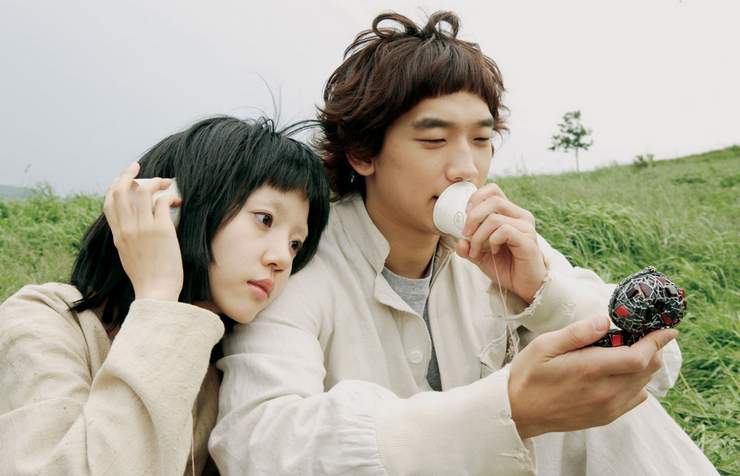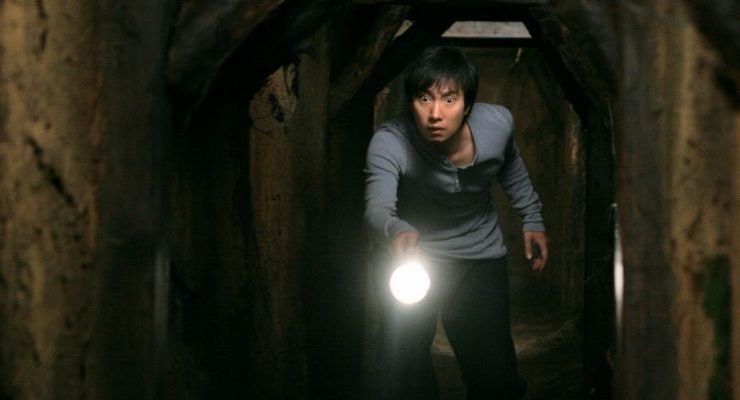
Searching for the killer leads all the detectives into a moral vacuum

Memories of Murder (살인의 추억) – ★★★★★

Memories of Murder (살인의 추억)

Memories of Murder (살인의 추억)

Truth is, as the saying goes, stranger than fiction. Perhaps the cliche is best served when applied to the criminal classes, as events that would seemingly belong in the pages of Sir Arthur Conan Doyle or the films of Martin Scorcese are violently brought into ‘the real’, adding an incomparable shock value with the knowledge that criminal empires were actually built, and that victims genuinely suffered. More specifically, the notion of the serial killer has endeared itself amongst fans of the crime genre for the thrilling cat-and-mouse games played by the detective and murderer, but more so in attempting to piece together the depraved psychosis of the unhinged individual before another innocent succumbs to such unbalanced desires.

Memories of Murder (살인의 추억), director Bong Joon-ho’s (봉준호) incredible second film, is based on the true story of Korea’s first known serial killer who raped and murdered ten women between 1986 and 1991 – a case that is still unresolved. Memories of Murder is one of the most successful and prolific films to emerge from Korea and rightfully so, with superb direction from one of the country’s leading auteurs and an exceptional performance from lead actor Song Kang-ho (송강호).

In a small rural town surrounded by farmland, the naked and bound body of a young woman is found in an irrigation tunnel. Detective Park Doo-man (Song Kang-ho) is called to the scene, but all traces of evidence have been destroyed by the locals. Shortly thereafter, the body of another young woman is found, raped and murdered in the same fashion. With no leads, Doo-man and his aggressive partner Detective Cho Yong-koo (Kim Roi-ha (김뢰하) are tasked with finding the culprit, beating and torturing any suspects who visually conform to their idea of a serial killer. Their theories and methods of interrogation are rejected by intellectual Seoulite Detective Seo Tae-Yoon (Kim Sang-kyeong (김상경) who joins the search, but as the three detectives squabble and desperately cling to the loosest of hunches, and with the government too busy quelling the various uprisings throughout the country, the number of murdered young women continues to rise.

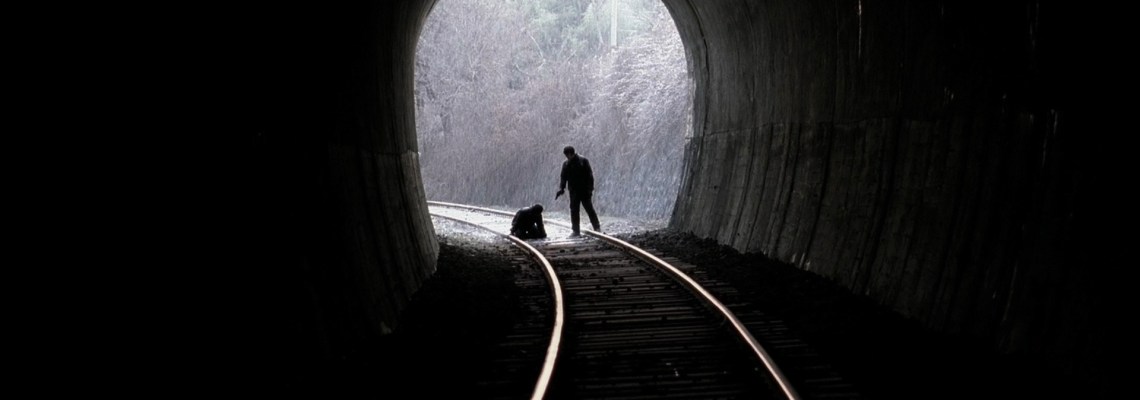
Detective Park Doo-man discovers the first victim

Detective Park Doo-man discovers the first victim

There is a tendency with crime-thrillers to reveal the bloodied and mutilated corpses of the victims for shock value, a tendency from which Bong Joon-ho wisely refrains and instead allows the horrifying true story to be at the forefront of the film. His vision in presenting the narrative is enthralling as he simultaneously conveys beauty and the macabre seamlessly – when Detective Park Doo-man visits the broad, expansive golden farmland in the initial establishing shot, mere moments later he is confronted with a corpse in a darkened, claustrophobic tunnel. The interplay between such oppositions, which have marked Bong Joon-ho as an auteur, continually explore the duality of the situation as light conflicts with darkness, the truth struggles against the veneer, and the lines between morality and immorality are blurred. As such, Memories of Murder contains some incredibly dark humour, such as the ramifications in fabricating evidence and the bizarre perversity that is unlocked in certain members of the populace when news of the murders spreads, adding a comedic edge that stops the film from becoming bleak but also conveys the turmoil and frustrations in attempting to catch a serial killer.

In addition to his interest in duality, Bong Joon-ho’s recurrent social exploration is rather blatantly laid bare and few are portrayed positively. The military government is too busy extinguishing public protests to provide resources; the public are too ignorant to understand they are destroying evidence; media outlets compound the situation further; and men are chauvinistic and sexist. By far the most damning indictments are reserved for the police force, as corruption and violence are commonplace. Detectives Park Doo-man and Cho Yong-koo have received very little education and their logic-defying hunches are simultaneously comedic yet disturbing, as Doo-man rehearses confessional speeches with suspects after Yong-koo has tortured them into submission. Both men humiliate the police force and make them a national embarrassment with their actions, as Bong Joon-ho initially portrays them as simpletons in need of a scapegoat. Intellectual detective Seo Tae-yoon fairs much better having received an education and training in Seoul, yet even he succumbs to the moral abyss due to the frustration with his peers and the lack of resources at his disposal. Bong Joon-ho creates a powerfully damning portrait of the era, yet the dark humour and the often unbelievably surreal events that transpire make the protagonists somehow likable as they themselves are attempt to create order within a society in chaos.

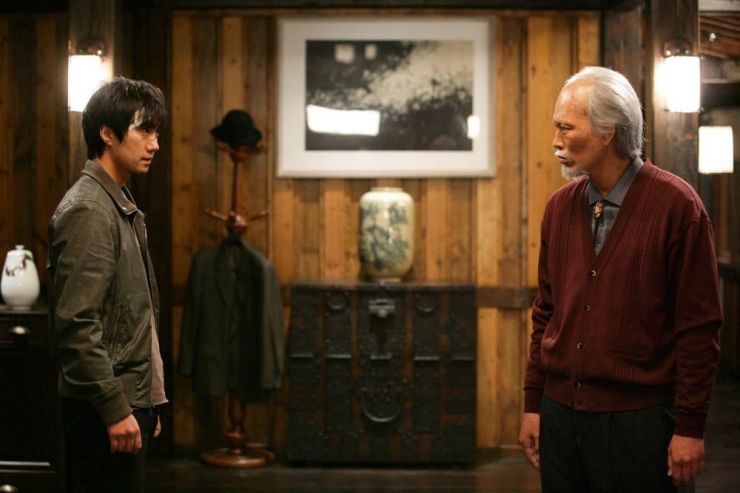
The detectives target anyone who fits their idea of a serial killer

The detectives target anyone who fits their idea of a serial killer

Song Kang-ho, as Detective Park Doo-man, is superb and utterly deserving of his Grand Bell Best Actor Award for the role. Park Doo-man is a bullying fraudster, a corrupt tyrant, yet amazingly is a compelling and charismatic protagonist. His rudimentary upbringing and attitude convey him as an underdog who routinely makes mistakes, and as such resorts to fabricating evidence regardless. Yet when his actions bring the police into disrepute, Doo-man’s evolution is incredible as he begins to emulate Detective Seo-Tae-yoon and commit to serious police work, making Memories of Murder as much about his maturation as about finding the serial killer.

Detective Cho Yong-koo is ultimately a proletariat figure with a penchant for violence, and Kim Roi-ha performs the role well. Bong Joon-ho uses the protagonist of Yong-koo to express the base dissatisfaction with the institution, and as such is more akin to a criminal as he abuses suspects, drinks alcohol, fights with locals, and more importantly sexually assaults a girl in a karaoke room – right next to his oblivious fellow officers.

Kim Sang-kyeong also conveys a highly competent performance as pretentious Seoulite Detective Seo Tae-yoon. As his modern style of police work inspires Park Doo-man, the corruption conversely leads to the devolution of Tae-yoon as his frustrations engulf his sense of reason. Yet while Doo-man’s character arc is compelling, Tae-yoon’s is less so due to his reserved and conceited portrayal.

Searching for the killer leads all the detectives down a dark path

Searching for the killer leads all the detectives into a moral vacuum

Verdict:

Memories of Murder is a fantastic example of a crime-thriller that does not rely on gore in producing an enthralling film about serial murders. While artistic license has undoubtedly been applied in certain areas, the fact it is based on a real-life unresolved case provides authenticity and a mixture of genuine fascination and horror that such events could transpire in recent history. As such it justifiably deserves its status as being not only one of the most prolific films to originate from Korea, but also in cementing Bong Joon-ho’s reputation as a respected auteur, making Memories of Murder one of the most noteworthy examples of the genre.

★★★★★
Reviews
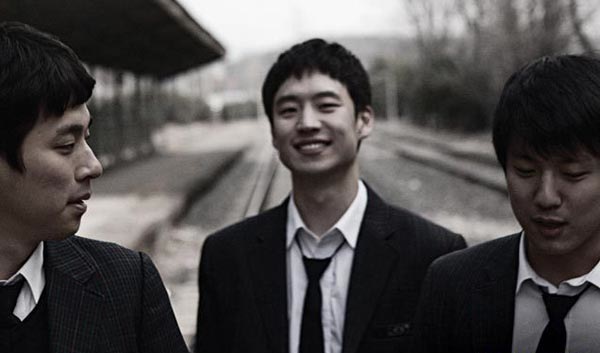
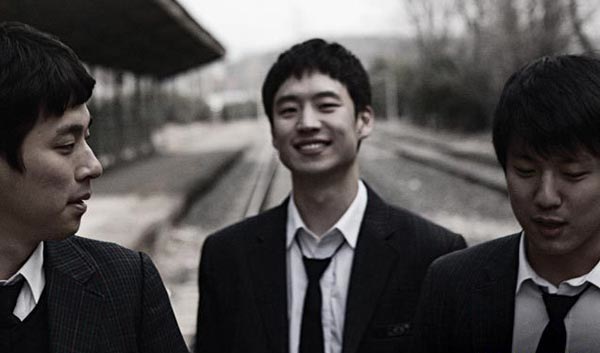
Hee-joon, Gi-tae, and Dong-yoon hang out at the abandoned rail track

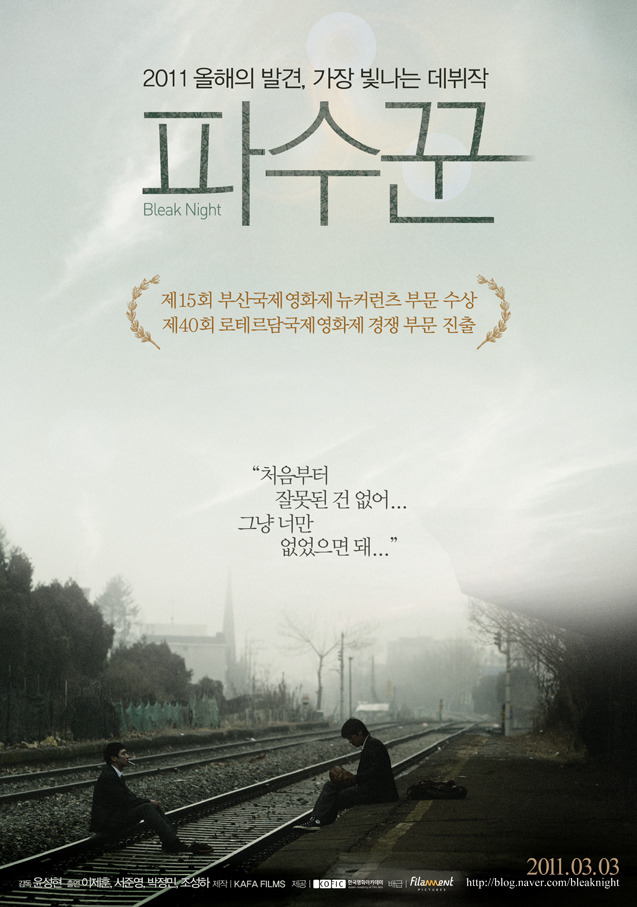
Bleak Night (파수꾼) – ★★★★★

Bleak Night (파수꾼)

Bleak Night (파수꾼)

The younger generations, and their lifestyles, are generally not represented well in cinema. For every La Haine (1995) is an American Pie franchise; for every Kidulthood (2006) a season of 90210. Actors in their 20s and 30s portraying the formative teenage years in the bourgeoisie do well financially, due in no small part through the over-emphasis of sex, alcohol, drugs, and more sex. Despite the blatant lack of realism, the anxieties that so concern the younger generations are routinely dismissed in favor of cinematic hedonism.

Not so in Bleak Night (파수꾼), which depicts the trials and tribulations of three high school friends in a raw, independent manner that highlights their tumultuous lifestyles, and is without a doubt one of the best films of 2011. Even more astounding is that the film is the directorial debut of Yoon Sung-hyun (윤성현), fresh from film school and with his keen eye for realism and drama is clearly a filmmaker to watch.

Gi-tae (Lee Je-hoon (이제훈), Dong-yoon (Seo Joon-yeong (서준영) and Hee-joon (Park Jeong-min (박정민) are inseparable friends; when not together in high school, they can be found playing baseball on the abandoned rail tracks nearby, joking, swearing and occasionally smoking. In an effort to pair each other with a girlfriend, they arrange a trip to Wolmido amusement park with three girls, yet Hee-joon’s crush is unrequited as she likes Gi-tae instead. This simple jealous misunderstanding becomes the catalyst for disharmony amongst the group, escalating into bullying, fighting and the disintegration of friendship.

Hee-joon, Gi-tae, and Dong-yoon hang out at the abandoned rail track

Hee-joon, Gi-tae, and Dong-yoon hang out at the abandoned rail track

Bleak Night is a staggering achievement from first-time writer/director Yoon Sung-hyun, who conveys his protagonists and their environment with visionary skill. As the title suggests, the film is indeed bleak not only in a narrative sense but also technically as filters block any colour from entering the lives of the characters. Combined with the visual repetition of the high-rise apartment blocks and abandoned rail station, the bland and drab surroundings are more akin to a dystopian landscape than contemporary Seoul, forming a prison from which there is seemingly no escape.  The only time colour enters the film is during the group date at Wolmido amusement park, when Hee-joon’s hopes are dashed and the catalytic event that engulfs the friendship originates; when colour and passion are allowed to enter their lives, conveys the director, is the time when their vulnerabilities are revealed. The protagonists raw and uncontrollable emotion is wonderfully articulated through the camerawork, with the non-static hand-held prowess and close-ups conveying the uncomfortably intense situations that arise.

Yoon Sung-hyun also deserves praise for his editing skills, which are reminiscent of auteur Christopher Nolan in taking a fairly uncomplicated narrative and creating a non-linear, compelling viewing experience. The time displacement, while initially somewhat jarring, is edited extraordinarily well and makes somewhat predictable scenes enthralling as audiences are forced to wait for the ramifications – or the prelude – of dramatic encounters. For example, the reason for Hee-joon’s lack of interest in playing games with the class is unknown, as is the over-zealous insistence of Gi-tae for him to join; yet through the carefully edited framework, the events originating Hee-joon’s reluctance are portrayed, while later still is the resultant battle he must fight due to his lack of co-operation. The edited sequences are structured as if they were memories, as the friends recount the events that alienated them from each other; just as their memories are fragmented and non-linear, so too are the events portrayed.

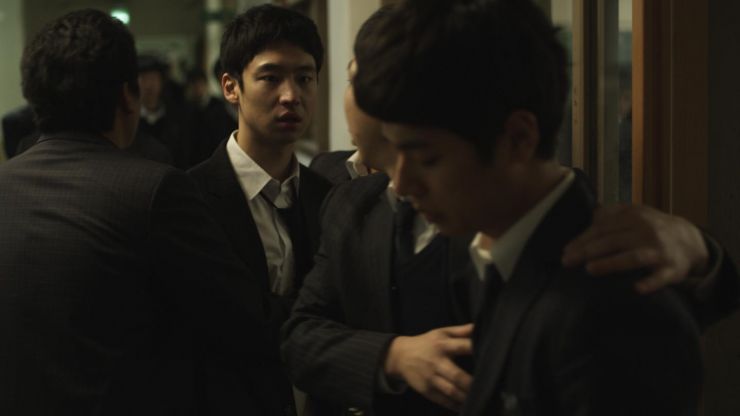
Bullying and fighting develop between the friends

Bullying and fighting develop between the friends

Lee Je-hoon won the 2011 32nd Blue Dragon Award for Best New Actor in his portrayal as Gi-tae, and it’s quite clear why. The young actor portrays the conflicted protagonist with incredible skill, with the ability to switch from happy and playful to intense and violent at will. His actions are motivated by his obsessive desire for attention and friendship, and his aggression when either fails is palpable. Lee Je-hoon’s eyes are perhaps his most his most vital asset, conveying sheer joy when playing games or sheer ferocity when being ignored. As Dong-yoon, Seo Joon-yeong was also nominated for the award of Best New Actor. Slightly relegated to the second and final acts, Seo Joon-yeong nevertheless gives a wonderful dramatic display as a student unable to halt the self-destruction of his friends. His turmoil when confronted with relationship problems with his friends and girlfriend are conveyed like a seasoned actor, forging empathy from audiences with his subtle and indecisive mannerisms. Park Jeong-min fairs less well, although that’s a rather unfair criticism given that his role is largely limited to the first act in which he must be aloof and ignorant as Hee-joon. Park Jeong-min expresses the immature jealousy of Hee-joon very well, refusing to acknowledge his emotions and instead projecting his anguish into pretentious defiance, furthering the ire of his counterparts.

Dong-yoon must attempt to explain the disintegration of the group

Dong-yoon must attempt to explain the disintegration of the group

Verdict:

Bleak Night would be considered an incredible achievement for a seasoned director, but for first-time writer/director/editor Yoon Sung-hyun it is a monumental and career forging film. His creative and technical prowess, combined with three young and talented actors, have earned Bleak Night the Best New Director and Best New Actor awards domestically, while the film has been invited to several high profile international festivals. Bleak Night is proof that an enormous budget and renowned stars are not necessary in creating a compelling and thought-provoking drama, and is highly, highly, recommended.

★★★★★
Reviews
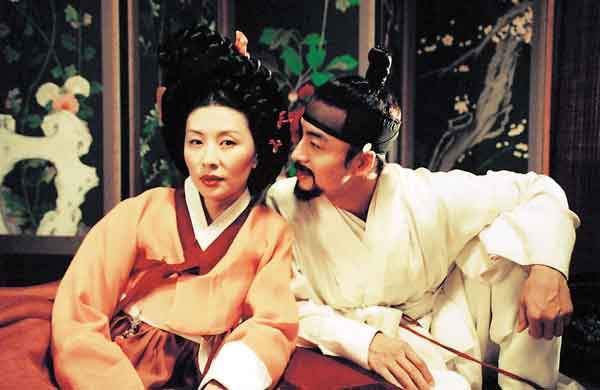
16 year old concubine So-ok must be impregnated for Sir Jo to win the gambit

Untold Scandal (스캔들 – 조선남녀상열지사) – ★★★★☆

Untold Scandal (스캔들 - 조선남녀상열지사)

Untold Scandal (스캔들 – 조선남녀상열지사)

The French classic Les Liaisons Dangereuses has been adapted for the screen several times, including the critically acclaimed Dangerous Liaisons (1988) which employed a traditionalist approach, as well as a successful contemporary teenage variation with Cruel Intentions (1999).

Untold Scandal relocates the infamous text to 18th century Korea during the Joseon Dynasty, an era of strict Confucianism and the emergence of then-illegal Catholicism, a time when men were allowed multiple wives and concubines and women had precious few rights. As such, the French literature so concerned with scandal is transplanted astonishingly well, and aside from rather uninspiring direction, is an entertaining tale in old Korea.

Sir Jo-won (Bae Yong-joon (배용준) is the most famous lothario in the land, a man of ill-repute who passes his days bedding the local women and painting images of his conquests. His cousin and rival Lady Jo (Lee Mi-sook (이미숙), is a manipulative and vindictive woman of aristocracy who, upon learning of her husband’s desire for 16 year old concubine So-ok (Lee So-yeon (이소연), forges a gambit with her sexually predatory cousin; take the virtue of the concubine and impregnate her, and in exchange Sir Jo-won can have the prize he’s always coveted – a night with Lady Jo. Should he fail however, Sir Jo must spend the rest of his days as a monk. Considering the bet to be unchallenging, Sir Jo raises the stakes by including bedding the most virtuous widow in the land, Lady Jung (Jeon Do-yeon (전도연), and sets out to fulfill the task and receive the conquest he has always desired.

Lady Jo and Sir Jo-won create the scandalous bet

Lady Jo and Sir Jo-won create the scandalous bet

18th century Korea is wonderfully realized in Untold Scandal, and the costume and set designers deserve praise for their painstaking attention to detail throughout the film. The costumes in particular form a major proponent of the mise-en-scene, as the style and colour schemes of the traditional hanboks worn are indicative of the personality of the wearer; the seductive yet dangerous reds worn by Lady Jo are in stark contrast to the calm and natural blues worn by Lady Jung, and as such protagonists convey a wealth of emotion and anticipation through their appearance alone. Director Lee J-yong captures the world of Untold Scandal competently and with sincerity, yet his style is often bland and uninspiring, framing the action as if it were on stage rather than celluloid. Furthermore, the director’s apparent preference for mid-shots tends to detract from establishing the beauty of the era with long-shots or, crucially, the intense seduction between the protagonists with close-ups. However, the performances of the cast more than redress these shortcomings as their provocative and flirtatious encounters with each other are palpable.

The narrative is, as expected from the source material, a captivating and enthralling tale and the inclusion of features inherently Korean serve to enhance the story in a varied and interesting fashion. The strict Confucian ideology of the era serves to make Sir Jo-won’s bet more difficult to achieve, as Lady Jung initially will only communicate through a proxy for fear of sullying her reputation as a virtuous woman. As was commonplace in the Joseon Dynasty, men were within their rights to have a wife as well as several concubines, roles which Lady Jo and So-ok embody quite naturally and serve to give an alternative perspective on their troublesome relationship. Rather than letters or a diary, Sir Jo-won paints his conquests in the style of Joseon painters adding authenticity as well as a unique spin on the evidence of his philandering. Combined, these organic features establish Untold Scandal as unmistakably Korean, with the contrasting approach conveying the seductions and betrayals as markedly different from other adaptations.

Sir Jo-won must seduce the most virtuous woman in the land, Lady Jung

Sir Jo-won must seduce the most virtuous woman in the land, Lady Jung

As is often the case, Jeon Do-yeon is incredible in her portrayal of Lady Jung and outshines the rest of the cast. Her performance evolves from icy to humble with deft skill, although the jump from humble to loving requires further suspension of disbelief. Such criticism is also applicable to Bae Yong-joon as Sir Jo-won, who is never convincing in his declarations of love for Lady Jung. As a casanova, Bae Yong-joon performs well despite lacking the charisma and subtlety expected of the role, raising doubts as to how he is able to seduce so many woman. For example the night in which he beds concubine So-ok is not achieved through mastery of seduction or language, but through force. The scene is conveyed as rape rather than alluring temptation, and undermines Sir Jo-won’s character enormously. Despite her limited role, Lee So-yeon (이소연) portrays the naivety of So-ok wonderfully, and it’s a shame more dramatic scenes, such as the ramifications of her actions, were not produced to convey the shattering of her innocence. So-ok’s mentor Lady Jo is captivatingly performed by Lee Mi-sook (이미숙), who seemingly seethes with vengeance and pride. Lee Mi-sook not only wonderfully conveys, but clearly also relishes, every ounce of tension, manipulation and seduction she creates in every scene. Her character is somewhat limited however in that there are scant few scenes of her actually displaying her enticing prowess, which serves to make her threatening demeanor slightly shallow.

16 year old concubine So-ok must be impregnated for Sir Jo to win the gambit

16 year old concubine So-ok must be impregnated for Sir Jo to win the gambit

Verdict:

Untold Scandal is a delightfully scandalous and entertaining film about seduction and betrayal in 18th century Korea, with beautiful costume design that adds elegance and authenticity to the mise-en-scene. The adaptation works incredibly well and offers an interestingly unique perspective on the source material. However the direction by Lee J-young is often bland and uninspiring due to a general lack of technical variation, failing to fully capitalise on the lustful charisma between the protagonists, which are joyous performances despite their occasional limitations. Untold Scandal is highly engaging and enjoyable, and a fascinating take on an old classic.

 ★★★★☆

Reviews
In-ho constantly breaks the rules, and requires punishment

You’re My Pet (너는 펫) – ★★☆☆☆

You're My Pet (너는 펫)

You’re My Pet (너는 펫)

The reversal of gender roles can prove to be a simultaneously comedic as well as enlightening viewing experience. For every humorous moment of mistaken identity, cross dressing and so forth, the gender inequalities within society are expressed and critiqued. From Kramer vs. Kramer to Devil Wears Prada, from Mrs. Doubtfire to Disney’s Tangled, each production highlights the ‘active’ and passive’ roles which men and women employ in articulating their (cultural) identities, identities which are comically subverted to reveal their fragile and ultimately hollow nature.

You’re My Pet (너는 펫), the latest adaptation from the manga series, also uses gender differences for comical effect, attracting controversy in the process as a men’s association filed a legal petition due to what they claim was an emasculating portrayal of men. Ironically this attracted an even greater audience, although it’s quite undeserved as You’re My Pet is unfortunately little more than a vacuous rom-com vehicle for stars Jang Geun-seok and Kim Ha-neul.

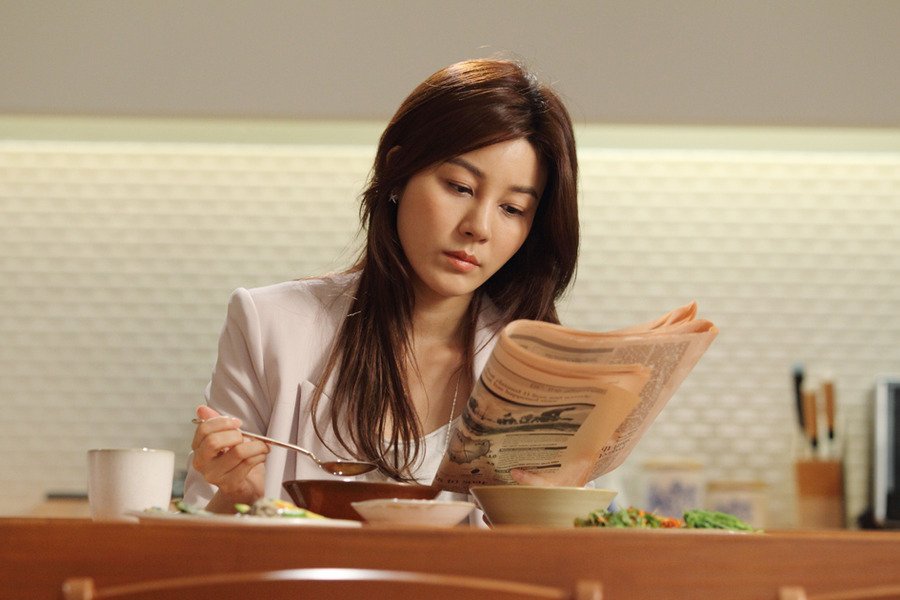
As a successful 30-something career woman, Ji Eun-i (Kim Ha-neul (김하늘) has a very comfortable life with her high-ranking job at a fashion magazine and spending time with close friends. Kang In-ho (Jang Geun-seok (장근석), on the other hand, is homeless and penniless despite his past fame as a ballet dancer. Their paths intertwine however when In-ho begs to live at his friend’s apartment – a friend who happens to live with his older sister Eun-i, who is less than pleased with the new arrangement. Eun-i’s displeasure grows further when her brother is forced to leave, meaning she and stranger In-ho must live together alone. The two strike a deal – Eun-i is the master while In-ho will take the role of a pet, who will be fed and taken care of in exchange for performing errands. As the two spend more time together they become closer, yet complicating matters is the arrival of Eun-i’s first love, Cha Woo-seong (Yoo Tae-joon (류태준).

Eun-i is a successful and indepdendent 30-something woman

Eun-i is a successful and indepdendent 30-something woman

Kim Byeong-gon (김병곤) competently – although blandly – directs the film. Often You’re My Pet lacks the technical dynamics and polish of a feature film, instead displaying conventions more akin to televisual productions. While such faults are the responsibility of the director, he cannot be held accountable for the uninspiring and dull script that squandered the potential that appeared so promisingly in the synopsis. For example, the reversal of gendered roles should provide insight and amusement, but is largely the opposite. Eun-i is a successful woman, yet the film rarely focuses on her achievements preferring to highlight her unhappiness as a singleton and the constant frustrations she must endure in the workplace from her colleagues. Additionally, Eun-i is never conveyed as the ‘master’ in her relationship with In-ho, and is in fact more a maternal figure as she cooks him meals, washes his hair, and punishes him for naughty behaviour. The (forced) appearance of her first love Woo-seong does nothing to promote her independent status as she then ultimately becomes the prize in a love triangle.

Despite his poverty stricken status, In-ho’s representation fairs so much better that at time it becomes cringeworthy. Women continually comment about his handsome features and his prowess as a professional dancer. Ironically this is the only tangible result of the reversal of gender roles, as actor Jang Geun-seok is routinely discussed in terms of image, and as such You’re My Pet is reduced to a fairly average vehicle for the star’s promotion.

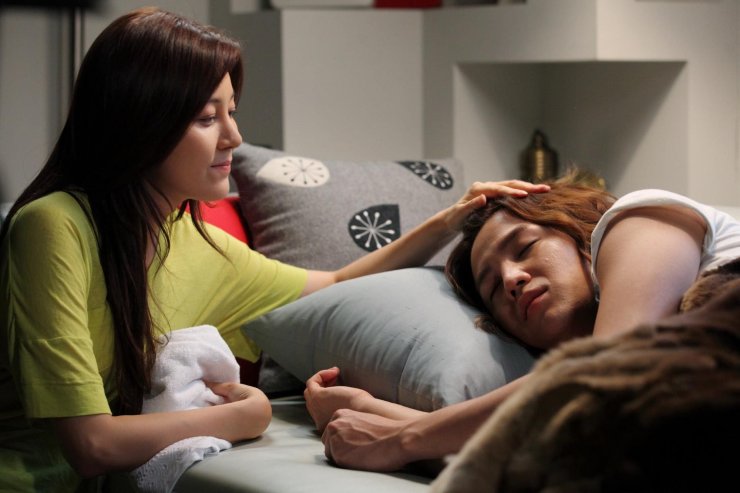
The relationship between Eun-i and In-ho, absurd origin notwithstanding, is occasionally quite endearing as the two struggle to live with each other and adhere to the rules of the arrangement. As such the relationship develops in an organic and natural fashion akin to newlyweds, yet due to the ‘master and pet’ dichotomy in which Eun-i ultimately becomes a maternal figure,  the ‘love’ feels somewhat implausible and forced in order for a romantic finale.

In-ho constantly breaks the rules, and requires punishment

In-ho constantly breaks the rules, and requires punishment

With regards to acting, both leads are rather average and have few scenes in which to display their craft. Kim Ha-neul gives the best performance by far, although she never fully conveys the decisive and no-nonsense sensibilities that a woman dedicated to her career would inhabit. Due to this she is routinely chastised by her subordinates (a feature seriously lacking in realism particularly in Korean culture) and allows In-ho’s immature behaviour with little protest. As for Jang Geun-seok, he conveys the ‘man-child’ characteristics of In-ho well yet lacks the charisma to make In-ho endearing, relying on his physical features to perform that function. In-ho is often irritating due to this as scenes in which he strives for attention, such as throwing tantrums and having his hair washed, are conveyed as the petty contrivances of a child rather than a charming-but-poor man attempting to woe his love interest.

Eun-i and In-ho become closer

Eun-i and In-ho become closer

Verdict:

You’re My Pet is unfortunately a rather shallow romantic-comedy, which fails at both being romantic or comedic. The premise is a fine one, although the potential is never fully realised as the archaic constructions of gender identity overwhelm it, as does Jang Geun-seok who uses the film as little more than a self-promoting device. Kim Ha-neul does add charm to You’re My Pet with her performance, but it is not enough to elevate the film above its mediocre status.

★★☆☆☆

Reviews
Young-goon works in a radio factory, hearing broadcasts about her cyborg nature

I’m a Cyborg, But That’s OK (싸이보그지만 괜찮아) – ★★★★☆

I'm a Cyborg, But That's OK (싸이보그지만 괜찮아)

I’m a Cyborg, But That’s OK (싸이보그지만 괜찮아)

I’m a Cyborg, But That’s OK (싸이보그지만 괜찮아) is perhaps best described as One Flew Over The Cuckoo’s Nest (1975) meets Amelie (2001) due to the whimsical portrayal of romance set within the confines of a mental institution. While these two features may initially seem an unnatural pairing, the abstract representation of the tenderness and innocence of love makes I’m a Cyborg an incredible inventive and poignant addition to the romance genre.

The film also marks a rather remarkable thematic departure for director Park Chan-wook (박찬욱) whose previous works have tended to focus on the nature of violence and revenge, yet his fundamental creative flair and ingenuity portray the magical nature of love of those with an alternative perception of reality.

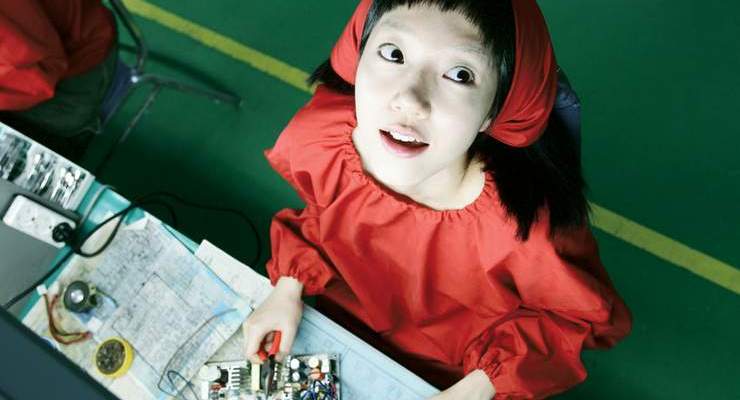
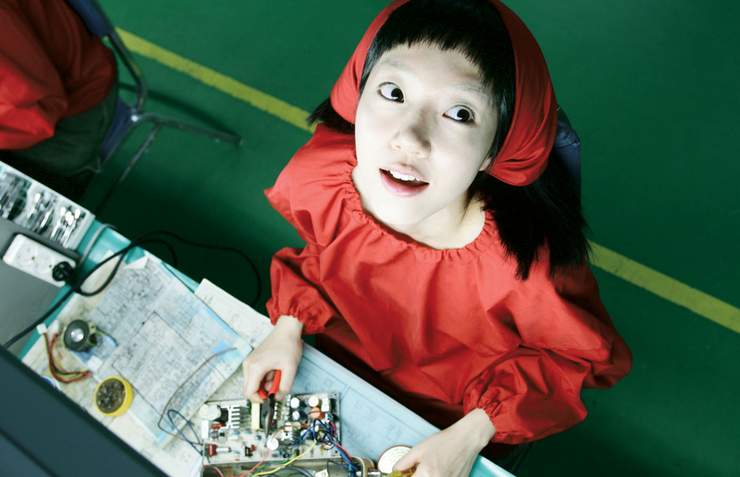
Cha Young-goon (Im Soo-jeong (임수정) believes herself to be a cyborg, so much so that she attempts to recharge herself at her factory workplace by slitting her wrist and inserting electronic wiring within the wound. Mistaken for a suicide attempt, Young-goon is taken to a mental institution to receive treatment and meets a variety of eclectic and comical characters including Park Il-soon (Jung Ji-hoon/Rain (정지훈/비). Il-soon believes he has the ability to steal personal attributes of his fellow patients, and his perceived lack of identity leads him to wear a rabbit mask before ultimately fading into nothingness. Upon learning of Il-soon’s abilities, Young-goon begs him to steal her ‘sympathy’ so that she can exact revenge on ‘the white coats’ who forcibly took her Grandmother away. Il-soon becomes fascinated with Young-goon and her psychoses, and the two form an unlikely bond that help each other more deeply than any psychiatrist could ever hope for.

Young-goon works in a radio factory, hearing broadcasts about her cyborg nature

Young-goon works in a radio factory, hearing broadcasts about her cyborg nature

I’m a Cyborg, But That’s OK is a wonderfully compelling romantic story with incredible visual flair from co-writer/director Park Chan-wook. The composition and colour within each frame is often majestic, such as the greens and reds within the radio factory in which Young-goon is employed that clearly contribute to her belief she’s a cyborg. Contrasted with the stark white within the institution and the ‘dome’ in which patients attempt to verbalise their symptoms, I’m a Cyborg continually conveys whimsy and poignancy in equal measure. This also applies to the character-driven script co-written with Jeong Seo-kyeong (정서경), which foregoes representing mentally ill patients as silly entertainment and instead endeavours to provide each character with history, depth, and empathy. This seemingly rare feature of cinema constructs an environment in which the central protagonists are not conveyed as beyond help, but as members of a social group in which their tragedy and comedy are shared with each other and forges relationships. Young-goon, for example, is from a family with a history of mental illness which included her Grandmother who believed she was a mouse and only ate radishes. When her Grandmother is forcibly sectioned, Young-goon desperately holds on to her memory by wearing her dentures and swearing revenge with her cyborg body. This mixture of empathy and comedy makes I’m a Cyborg one of the most unique, interesting and romantic character studies in many years.

Il-soon hides his identity with a rabbit mask, stealing personal attributes from patients

Il-soon hides his identity with a rabbit mask, stealing personal attributes from patients

At the heart of I’m a Cyborg is the relationships between Young-goon and Il-soon, and the development of their love is represented organically and with passion. Im Soo-jeong is convincing and sympathetic as girl-turned-cyborg Young-goon, conveying her detachment from reality with skill and conviction, and is by far the most engaging protagonist within the film. Similarly Jung Ji-hoon/Rain is charismatic as love interest Il-soon, and while he often does not convey his anti-social behaviour he still functions well as a charming rogue whose interest in Young-goon blossoms with time. The supporting characters also offer interesting interludes that add to the central concept, as Il-soon ‘steals’ personality traits that help bring him closer to Young-goon and provide him with an identity. However, neither leading actor is given a ‘defining moment’ in which their acting prowess can be revealed – such as can be found within One Flew Over the Cuckoo’s Nest, Girl, Interrupted and Amelie – which ultimately limits their performance and the character depth which is continually alluded to is never fully realised. As such, the gentle narrative flow is never disrupted to a degree whereby drama ensues and hurdles must be overcome, leaving I’m a Cyborg as a pleasantly mellow offering, without much conflict or resolution.

The unlikely duo form a romantic bond that helps overcome their psychoses

The unlikely duo form a romantic bond that helps overcome their psychoses

Verdict:

I’m a Cyborg, But That’s OK is a rare and unique treat, portraying mentally ill patients not as figures of ridicule but of poignancy, comedy, and of love. Director Park Chan-wook employs a whimsical and creative style that is engaging and entertaining, emphasizing his ability produce tender and heartfelt romance within the context of fantasy. While the narrative shies away from dramatic character defining events, the gently-paced and thoughtful character construction, accompanied with the surrealism of their perception of reality, is both charming and heartwarming.

★★★★☆

Reviews
Ha-cheon is a sultry, charismatic con-woman who easily manipulates men

Countdown (카운트다운) – ★★★☆☆

Countdown (카운트다운)

Countdown (카운트다운)

The partnership of Steven Soderbergh and George Clooney brought back the ‘cool’ of the con-man in their remake of the classic ratpack film Ocean’s Eleven (2001). With Soderbergh’s vision for capturing the flamboyance and decadence of Las Vegas and Clooney’s uncanny knack for emanating panache and suavity, the duo made the con-man someone to root for again as the intelligent, just-one-step-ahead, underdog. Yet the machismo comes with a tongue-in-cheek sensibility, as Clooney and his cohorts are constantly bamboozled by the feminine wiles of their love interests who are equally as intelligent, cunning, and charismatic. The chemistry between them, and the cat and mouse games they play, add to the appeal of the thrilling con-man lifestyle as to who will outsmart the other and emerge victorious, walking away with a small fortune.

Countdown (카운트다운) endeavours to re-create such chemistry, as two highly charismatic actors – Jeon Do-yeon (전도연) and Jeong Jae-yeong (정재영) – must compete against each other while attempting to outwit other con-artists in parting with their money. It’s a competent venture for the most part, although suffers from a lack of direction in the third act and the awful misogynistic representations throughout.

Tae Geon-ho (Jeong Jae-yeong) is a tough debt collector, a man not afraid of breaking a few bones in order to obtain the money owed. His self-destructive approach has made him the top collector, but upon discovering he has only a couple of weeks left to live due to liver cancer, Geon-ho quits and seeks out potential donors. As none exist, his only option is to find people who received transplants  from the organs of his deceased son. Only one of these can provide him with a new liver, the enigmatic con-woman Cha Ha-yeon (Jeon Do-yeon) who ripped off several high-profile gangsters before a betrayal landed her in jail. Shortly to be released, Ha-yeon makes Geon-ho a deal – help her to get revenge on those that framed her, and she’ll willingly undergo the procedure. With time counting down on Geon-ho’s life, he and his co-hort play cat-and-mouse games with each other and criminal organisations in the hope that, when everything is settled, Ha-yeon will have her revenge and Geon-ho will have a new liver.

Geon-ho is a tough debt collector, who failing liver means his life is in countdown

Geon-ho is a tough debt collector, who failing liver means his life is in countdown

Countdown incorporates an interesting mix of visual styles thanks to director Heo Jong-ho (허종호), who blends the dark tones of the criminal underworld with the bright lights of deceiving the rich with skill. In the former is Geon-ho, and the director portrays his world of shadows, violence, and debt collecting as a mixture of horror and action that threatens to engulf his central protagonist. In building the character of Geon-ho, Heo Jong-ho takes time to examine an alpha male with nothing to live for, a self-destructive selfish man, who bizarrely decides to fight for his life when faced with his own mortality. Jeong Jae-yeong portrays the stoic role well, delivering dialogue with intensity and menace while despising his place in the world. In later scenes, which take a more dramatic turn, Jeong Jae-yeong gives a stellar performance proving why he is currently one of the best actors in contemporary Korean cinema, with highly emotionally charged scenes that convey deep empathy and poignancy.

Contrasting completely with this world is Ha-cheon, as her frivolous life of consumerism and con-artistry  is depicted as luxurious, glamourous and fun. The wealthy lifestyle she targets/acquires is emphasised through the portrayal of boats, fancy restaurants, and designer clothes that reveal her incredible sex appeal and charisma. However, it is also offensively misogynistic as Ha-cheon is conveyed merely as a lying high-class prostitute rather than an intelligent and manipulative woman. References are continually made to her ‘technique’ of providing pleasure in the bedroom, and even undergoing vaginoplasty, in order to get what she wants – money and designer clothes. Ha-cheon’s history, as a mother who abandoned her daughter, serves to cement her role as a deceitful whore with no redeeming qualities, not so much femme fatale as femme devil. Furthermore, she always fails in her cons and needs rescuing by the alpha male partner she continually abandons, connoting a lack of intelligence, strength and functioning as a damsel in distress. Quite why an actress of Jeon Do-yeon’s outstanding calibre was selected for such a role is indeed puzzling, as the one-dimensional pro/antagonist offers her – and the representation of women in general – nothing of merit.

Ha-cheon is a sultry, charismatic con-woman who easily manipulates men

Ha-cheon is a sultry, charismatic con-woman who easily manipulates men

In terms of the narrative, which was co-written by director Heo Jong-ho and Lee Hyung-suk, Countdown is thrilling in the first and second acts, before becoming a mundane drama in the third. Korean cinema is wonderful for its innovative use of amalgamating genre techniques to create something original and/or veering into an unexpected territory. With Countdown this is something of a hinderance, as the initial premise is engaging and the mismatch of such distinct characters and the games they play is highly enjoyable. Particularly of note is a scene in a department store, where Ha-cheon outwits Geon-ho as well as a cadre of gangsters with style and elegance, escaping with a bag full of money…only to be captured by a different organization. The rapid editing and camera movement create a thrilling chase, and serve to heighten expectations for a similarly natured finale that never materializes. The true villain of the film, gangster boss Jo Myeong-seok (Lee Kyeong-yeong (이경영) is delightfully vindictive although it’s a long time before he is introduced into the narrative, which impedes the potency of the threat he presents. Despite this, on the few occasions Myeong-seok is portrayed, his violent and unforgiving style is gripping.

The final act however is disjointed in that, after the glamourous con-artistry and action scenes, kitchen sink melodrama is unnecessarily shoe-horned into the narrative. Ha-cheon’s 17 year old abandoned daughter Hyeon-ji (Lee Min-yeong (이민영) adds absolutely nothing to the proceedings except to give Geon-ho another female to save. Additionally, Geon-ho’s missing memory returns yet as his amnesia had not been a serious and impeding – or even recurring – feature, the impact is minimal despite the strong performance given by Jeong Jae-yeong.

Myeong-seok is the ruthless boss of a criminal empire

Myeong-seok is the ruthless boss of a criminal empire

Verdict:

As an attempt at creating romantic chemistry through deceitful but fun con-artistry, Countdown somewhat succeeds. As always, Jeon Do-yeon and Jeong Jae-yeong give wonderful performances, and director Heo Jong-ho conveys the two opposing worlds his protagonists inhabit with skill. However, the potency of Countdown is greatly reduced through the offensively misogynistic representation of its lead female, and with a final act that holds little relation with what came before. Despite this, Countdown is an enjoyable, albeit stunted, take on inept gangsters and the glamorous world of con-artists.

★★★☆☆

Reviews
Gi-soo and Choon-sim are forced to work together or the helmet-bomb will detonate

Quick (퀵) – ★★☆☆☆

Quick (퀵)

Quick (퀵)

The action-comedy sub-genre can be a gleefully entertaining experience, eschewing the penetrative socio-cultural material conveyed through critically acclaimed work and focusing primarily on exhilarating stunts and battles, charismatic lead actors, and downright silly fun. The amazing Jackie Chan has built a career through action-comedies with his incredibly unique vision for fight sequences and stunt work that made insurance companies weak at the knees. Similarly, Jason Statham’s The Transporter and Crank genre vehicles helped cement his role as action hero, while The Fast and The Furious has such popularity with its fast cars and overt machismo that a seventh sequel is currently planned.

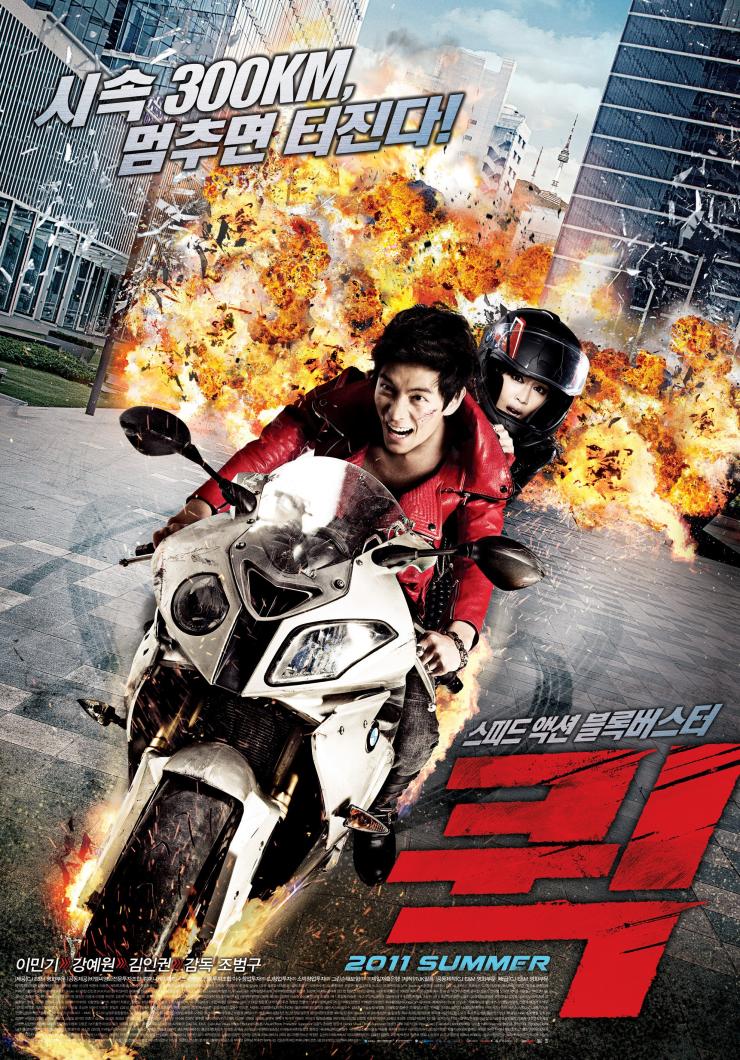
Quick (퀵) aims to emulate such successes, featuring racing motorcycles, rogue police officers, and a race against time to stop the Machiavellian ne’er-do-well from exploding yet another building. However, the striking lack of originality, lack of charismatic leads, and general lack of comedy make Quick a forgettable viewing experience.

Han Gi-soo (Lee Min-ki (이민기) is a legendary biker gang leader, always in trouble with the law yet despite this dates the studious Choon-sim (Kang Ye-won (강예원). Caught kissing another girl, Gi-soo simply rides away but is pursued by Choon-sim who demands answers for his betrayal. During the chaos, the bikers cause several traffic accidents resulting in the destruction of a number of cars and lives lost. A few years later, Gi-soo works as a bike courier renowned for delivering packages in ultra-fast time. One afternoon Gi-soo is instructed to transport a person to a studio, which turns out to be Choon-sim who has re-invented herself as Ah-rom (아롬), a member of a Kpop girl group. Yet when she puts on her helmet, a bomb is triggered and a mysterious voice on a cell phone claims he will detonate if Gi-soo refuses to deliver packages to various recipients. In addition, Gi-soo is also tagged with a bracelet linked to Choon-sim’s helmet – if they are more than 10 meters away from each other, the bomb will also detonate. Gi-soo and Choon-sim are forced to work together to deliver all the packages in time and escape with their lives, as well as discovering why they were chosen for the task.

Gi-soo and Choon-sim are forced to work together or the helmet-bomb will detonate

Gi-soo and Choon-sim are forced to work together or the helmet-bomb will detonate

Director Jo Beom-goo (조범구) competently constructs and frames the action, filming multiple car pile-ups and explosions with confidence. The motorcycle stunts, despite the suspension of disbelief required, are thrilling and entertaining to watch as Gi-soo and Choon-sim jump over ramps, rooftops, and even over streets into nearby buildings as they avoid the fleet of police officers hunting them down and the fiery infernos that are left in their wake. To this end the editing must also be acknowledged as the rapid style adds excitement and conveys the speed of the race-against-time scenario. The same cannot be said for Park Su-jin’s (박수진) script which is overly convoluted featuring corporate espionage, gang warfare, and an ineffective police force. Overburdened with so many narrative tangents, and so many protagonists inaugurated to achieve those ends, the core plot of Quick quickly becomes submerged which detracts from the enjoyment of the over-the-top action spectacles. Quick (퀵) also blatantly ‘borrows’ gimmicky ideas and themes from other films of the genre, most notably The Transporter and The Fast and The Furious franchises, in a less-than-subtle attempt to become Hollywood fare. The reason such devices worked in prior films was due to their originality and the charisma of the actors involved, who clearly understood the tongue-in-cheek nature of  their role. Quick unfortunately has neither.

Gi-soo and Choon-sim find themselves in an array of dangerous situations

Gi-soo and Choon-sim find themselves in an array of dangerous situations

While lead actor Lee Min-ki and actress Kang Ye-won are incredibly attractive, their performances leave little to be desired. The roles themselves are extremely limiting as they function as devices simply to move from one set piece to the next, but even so, Lee Min-ki is not convincing as an action star. His lack of physical prowess notwithstanding, the tough-guy street-savvy attitude and intimidating personality are noticeably absent with the singular – and unimpressive – fight scene doing very little to remedy the matter. Similarly Kang Ye-won’s role, in which she miraculously changes from teenage bookworm to Kpop superstar, is merely to complain, whine and scream throughout the narrative. But by far the most irritating protagonist is biker-turned-traffic cop Kim Myeong-sik, played by Kim In-kwon. While initially humourous, Myeong-sik quickly becomes aggravating due to recurring gags and his constant yelling for his unrequited love interest. It’s also puzzling as to why so many protagonists are deemed necessary, as the abundance of police officers, gangsters, and corrupt office workers severely impede the character development of the lead roles.

The couple must take to the pedestrian-filled streets to escape the police

The couple must take to the pedestrian-filled streets to escape the police

Verdict:

Quick is an enjoyable, albeit mediocre, action comedy. With some entertaining stunt work and fun set-pieces, Quick is a fast paced and – thanks to the lead actors – an attractive viewing experience. However the film is weighed down by excessive narrative tangents and protagonists, and the resulting lack of character development detracts from creating empathy with the leads and portraying the intensity of their situation. Despite these shortcomings, there are enough car and motorbike crashes, highway chases and explosions to keep fans of the genre happy.

★★☆☆☆

Reviews
Digger 'terrorist' Shua is confronted by Jay, an Ecoban soldier

Wonderful Days (Sky Blue) (원더풀 데이즈) – ★★☆☆☆

Wonderful Days (원더풀 데이즈)

Wonderful Days (원더풀 데이즈)

Dystopian visions of the future offer a fantastical perspective from which to examine socio-cultural anxiety of the era. From Fritz Lang’s 1927 masterpiece Metropolis and Katsuhiro Otomo’s classic Akira (1988), to more contemporary fare such as The Day After Tomorrow (2004), District 9 (2009) and Star Trek (2009), the dystopian realm is a place to dissect humanity’s overly ambitious use of technology and the class divisions that were of such incredible concern for Karl Marx.

Wonderful Days (원더풀 데이즈) also addresses such themes within its science-fiction narrative, yet despite the sumptuous animation unfortunately offers precious little originality due to a woefully bland narrative.

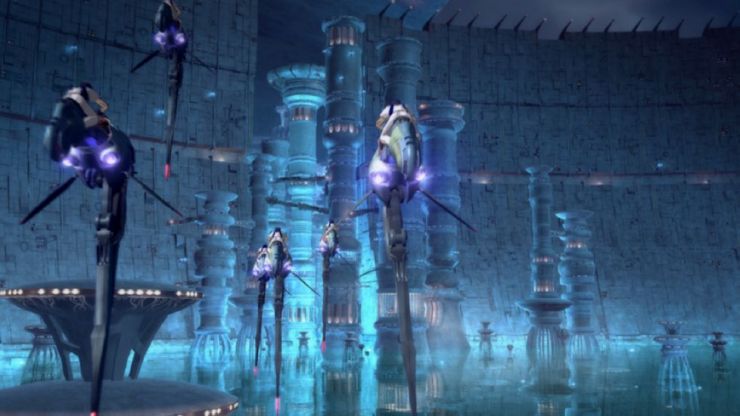
In the year 2142, humankind is almost extinct due to global warming and continuous acid rain storms that have fallen for 100 years. Foreseeing the impending catastrophe, scientists built a ‘living’ city called Ecoban for future generations to inhabit, yet after the events that reduced the population by billions the remaining survivors were denied sanctuary. Instead, the ‘Diggers’ were forced into the wasteland to mine for carbonite, the fuel source that Ecoban and its denizens rely upon. As the various revolutions come to nothing, a young man named Shua (수아) decides to sabotage Ecoban’s fuel tanks once and for all, but standing in his path are female soldier Jay (즈아) and her commander Cade (크아드).

The beautiful city of Ecoban, exclusive only to a small percentage of the population

The beautiful city of Ecoban, exclusive only to a small percentage of the population

Wonderful Days is visually impressive, employing 3D textures for landscapes and vehicles amalgamated with 2D animation for the protagonists that use them. Shortly after the opening scenes, the ‘terrorist’ Shua enters Ecoban through a mask dance festival in order to sabotage the generators within, leading to an action sequence that displays the keen prowess of the animators involved. However, such impressive visuals are one of the few scant positives in Wonderful Days as the narrative itself is incredibly dull and uninspired, with enormous plot holes that in certain instances render the events as ridiculous. At approximately 86 minutes long it is also frustratingly short as there is ample time to further explore the potential that Wonderful Days alludes to. The fundamental societal issues – the devastation of Earth and the class divide – are barely explored despite their importance within the narrative. Considering neighbouring Japan has produced arguably the seminal animated films relating to such anxieties in the form of Princess Mononoke (1997), Castle in the Sky (1986) and Akira to name a few, it’s all the more baffling that writer/director Kim Moon-saeng (김문생) didn’t seek inspiration for an alternative interpretation of a dystopian nightmare.

Digger 'terrorist' Shua is confronted by Jay, an Ecoban soldier

Digger ‘terrorist’ Shua is confronted by Jay, an Ecoban soldier

Instead, a rather bizarre and remotely explained romantic triangle tends to dominant the proceedings, as well as an array of 2 dimensional characters that flit in and out of the narrative that offer little other than irritation. The romance is incredibly contrived and forced as the center-point of the plot, attempting to be akin to Romeo and Juliet as lovers from different backgrounds, but it ultimately fails due to the lack of character depth and defining moments, as well as the staggering leap of disbelief required.

The class struggle is interesting as descension spreads and riots break out, but again the lack of exploration into the world inhabited by the Diggers fails to convey the intensity and anger felt by the underprivileged. The characters that feature within the wastelands occupied by the working classes are generic stereotypes that do nothing to portray or promote their cause as just, and are so unlikeable and downright stupid that it almost becomes difficult to distinguish which side should emerge victorious.

Shua must sabotage Ecoban if he is to save the Diggers

Shua must sabotage Ecoban if he is to save the Diggers

Verdict:

Despite the attractive visuals, Wonderful Days is a hollow film that is devoid of any depth. This is perplexing as there is a wealth of potential in the exploration of dystopian futures, technological abominations and class warfare, but in attempting to force a contrived romantic story as its center-piece Wonderful Days fails to entertain or enlighten.

★★☆☆☆

Reviews
Hae-gook must traverse a literal tunnel of deceit

Moss (이끼) – ★★★★☆

Moss (이끼)

Moss (이끼)

The corruption of the ruling elite is certainly nothing new in Korean cinema. After years of military dictatorships and scandalous corporate backhanders, it’s clearly understandable why such themes are continuously prevalent. However these narratives often approach from a reactionary perspective, highlighting the suffering of those victimized by injustices. Little explored are the foundations of a community, the roles and interplay of law, religion, power, crime and punishment in the creation of a society. Such Shakespearean motifs are traditionally reserved for period dramas, yet Kang Woo-seok’s (강우석) Moss (이끼) wonderfully examines the labyrinthine networks of power in a contemporary village in Gangwon province. Based on the incredibly popular internet comic, Moss is an exhilarating and fresh addition to the thriller genre.

While struggling against a law suit, Ryoo Hae-gook (Park Hae-il (박해일) receives news that his estranged father, Yoo Mok-hyeong (Heo Joon-ho (허준호), has died. Visiting the estate, Hae-gook is surprised to learn of his late father’s role as one of the elder statesmen of the village, yet merely wishes to resolve  any outstanding affairs and return to his life in Seoul. However Hae-gook’s curiosity is piqued when his father’s partner, the powerful village foreman Cheon Yong-deok (Jeong Jae-yeong (정재영) and his three right-hand men – Kim Deok-cheon (Yoo Hae-jin (유해진), Jeon Seok-man (Kim Sang-ho (김상호), and Ha Seong-gyoo (Kim Joon-bae (김준배) – continually attempt to persuade him to leave.  As Hae-gook digs deeper into the mystery of his father’s death and the strange behaviour of the residents, he must confront the disturbing truth about the village and its inhabitants.

The residents of the village are not all they seem

The residents of the village are not all they seem

Screenwriter Jeong Ji-woo (정지우) has translated the web-comic to film with incredible skill, lacing each protagonist with depth and nuance – as well as fully realised character arcs – that makes each confrontation compelling viewing. This is remarkable as the 163 minute running time may seem excessive, but the narrative is so fueled with suspense and the protagonists so fascinating that the time is hardly noticeable. The plot is the epitome of labyrinthine, carefully taking time to construct the scenario through flashbacks and the creation (and breakdown) of relationships through subtle character defining events. Director Kang Woo-seok is impressive in visualizing such dense material, from the intimidating fortress overlooking the village to the claustrophobic subterranean tunnels. Praise should also be bestowed upon the set design, lighting and editing departments, who display ingenuity in creating the tension-filled world of Moss.

The actors are also wonderful in bringing the community of Moss alive. Park Hae-il is excellent as the idealistic Hae-gook who is continually involved in events beyond his understanding, while his nemeses – Yoo Hae-jin, Kim Sang-ho and Kim Joon-bae – are incredibly unnerving and intense in portraying the criminal classes/extensions of power. However, the most exceptional performance belongs to Jeong Jae-yeong, who is loud, violent and ambitious as a young man, but silently commands respect as an elder. The sheer intensity conveyed through his expressions is amazingly sinister, demanding obedience with merely a glance. The weakest link is Yoo Seon as store owner Lee Yeong-ji through no fault on her part, as her role is virtually forgotten until the third act when her presence is suddenly elevated into a lead protagonist.

Hae-gook must traverse a literal tunnel of deceit

Hae-gook must traverse a literal tunnel of deceit

Thematically, Moss is also a triumph. The portrayal of corruption seemingly endemic with the ruling elite is hardly original, but Moss strives to explore all areas in the creation of a society, notably the role of religion. As such, the village in Moss acts as a microcosm for society, and how the younger generation must fight against the greed of their elders. Yong-deok, the village foreman, was a corrupt police officer in his youth but his ambition for power was continually unfulfilled. That is, until he met Mok-hyeong, a man with a violent past that had apparently found redemption through religion who was quickly amassing followers. The jealousy for power and influence ultimately fuels their relationship, yet both are keenly aware that alone they can achieve little. In joining forces to create a community both men have similar intentions but are ideologically opposed, as they wish to exert dominance over others but through different means. Each man is clearly representative of the ideological vie for power in society, and the process in which they become increasingly more corrupt is as organic as it is alarming. There is rather blatant bias however, as Mok-hyeong’s Christian ideology is constantly  represented as inherently ‘good’ which diminishes the exploration somewhat.

In discovering the sinister origins of the village, Hae-gook is representative of the younger generation that must reveal and persecute such greed. Hae-gook studies old books and documents, finds subterranean tunnels, and must even join forces with an enemy in the pursuit of his father’s murderer. As a young divorcee, Hae-gook embodies the change in society as the shift away from tradition becomes ever more apparent. His naivety and idealism is endearing but simultaneously foolhardy, as he continually fails to understand the larger events at hand.

The young and idealistic Hae-gook must face the old and corrupt Yong-deok

The young and idealistic Hae-gook must face the old and corrupt Yong-deok

Verdict:

Moss is a incredibly well executed thriller that delves into Shakespearean themes of the vie for power amongst the ruling classes. The interplay of different features of society, from religion to the criminal classes, constructs a dense tale of suspense that highlights the unfairness, and the generational differences, within a culture and emphasizes the importance of prosecuting the corrupt. The bias nature in representing Christianity, and the under-developed female role slightly detract from the viewing experience, but despite this Moss is a highly entertaining and compelling foray into corruption in contemporary Korea.

★★★★☆

Reviews
One by one, the group begin to display odd behaviour

White: The Melody of the Curse (화이트: 저주의 멜로디) – ★★☆☆☆

White: The Melody of the Curse (화이트: 저주의 멜로디)

White: The Melody of the Curse (화이트: 저주의 멜로디)

The glamourous world of Kpop has two faces. The glitz, lifestyle, fame and legions of fans displayed in front of the cameras has a much darker side once the cameras are switched off. The performers are forced to endure working long hours, as well as the spiteful behaviour of fellow singers ambitious to make it to the top, the constant need to reinvent through concepts to stay fresh and modern, and the ‘sex for sponsorship’ culture seemingly inherent in the industry, all of which constitute just a fraction of the intense pressure undertaken by those seeking celebrity status.

Such complex material is fertile ground for the creation of a tense psychological drama – or in the case of White: The Melody of the Curse (화이트: 저주의 멜로디), a horror. Yet rather than explore such ripe narrative devices in a detailed suspense-driven manner, screenwriters/directors Kim Gok (김곡) and Kim Sun (김선) opt for superficial, rapidly-edited scares that leave little lasting impression.

Appearing in multiple talent shows, ‘Pink Dolls’ continually fail to attract the media attention they crave in order to become the next big girl group sensation. As the slightly older leader of the group,  Eun-joo (Ham Eun-jeong (함은정) has difficulty controlling the spiteful and devious natures of other members Sin-ji (Maydoni (메이다니), Ah-rang (Choi Ah-ra (최아라) and Je-ni (Jin Se-yeon (진세연). Following their latest disastrous appearance, the group move into a new studio where Eun-joo discovers a 15 year old video tape labelled ‘white’ which contains a catchy song. With no owner, Pink Dolls steal the song and re-launch themselves on television, propelling them into stardom and becoming overnight sensations. Yet with their new-found celebrity status, the relationships between the group members become even more strained and are compounded further by the mysterious activity that seems to be occurring in their new studio.

The Pink Dolls consistently fail, until they appropriate an unclaimed song

The Pink Dolls consistently fail, until they appropriate an unclaimed song

Writers/directors Kim Gok and Kim Sun deserve credit for highlighting the plight of young artists struggling to achieve success as Kpop idols, despite their rather shallow attempts at representation. The underhanded tactics of the members of Pink Dolls is interesting as they attempt to sabotage each other by poisoning cosmetics and uploading pictures on the internet. However very little tension is generated through these narrative devices which is a missed opportunity, as the potential for suspense as well as social commentary is incredibly high. Additionally, an array of important headline issues faced by Kpop idols are included in the same fashion. The Pink Dolls plagiarize a song from a prior group, yet there are no legal ramifications; Eun-joo is coerced – by her (female) manager no less – into sexual intercourse for money/sponsorship, yet there is no exploration into the psychological fallout; the intense pressure on the members to appear in media productions is present, yet their exhaustion and stress are not. Rather, those who commit such amoral deeds are ‘punished’ by the spirit that haunts the studio, but without depth applied to such narrative devices the ghost is conveyed as malevolent instead of motivated. The ‘punishment’/horror also fails as the results are temporary. Foregoing suspense-driven intensity for rapidly-edited thrills, the scenes of horror – including hanging by the neck from microphone wire, falling head-first from a platform, and being crushed by camera equipment – all leave their victims alive which diffuses any sense of finality to the proceedings.

Tension escalates between the members as they vie to be lead singer

Tension escalates between the members as they vie to be lead singer

In terms of narrative ingenuity and cinematic techniques, White: The Melody of the Curse offers nothing new but is generally competently crafted. The performances however are incredibly over-exaggerated, especially by the members of the band. Only Ham Eun-jeong – from girl band T-ara – manages a more restrained style, but the lack of character depth gives her (and her compatriots) little room in which to display her acting prowess. Ham Eun-jeong’s character is aligned with the ghost as they both have experienced similar situations, but differences appear seemingly at the whim of moving the narrative forward. White: The Melody of the Curse also suffers from the cliche of portraying the entire history of the spirit during the finale, rather than organically including it throughout the film making the backstory feel forced and (almost) unnecessary.

One by one, the group begin to display odd behaviour

One by one, the group begin to display odd behaviour

Verdict:

White: The Melody of the Curse certainly deserves credit for attempting to emphasize some of the hardships endured by those in the world of celebrity. However, the superficial portrayal of such prime material, and the decision to employ quick thrills as opposed to suspense-fueled psychoanalytic horror, results in a shallow viewing experience.

★★☆☆☆

Reviews