In-ho constantly breaks the rules, and requires punishment

Jang Geun-seok (장근석) defends emasculating role in You Pet (너는 펫)

Jang Geun-seok (장근석) defends his latest movie

Jang Geun-seok (장근석) defends his latest movie

The release of Jang Geun-seok (장근석) and Kim Ha-neul‘s (김하늘) new film You Pet/You’re My Pet (너는 펫) has prompted an outcry and a legal petition from a Korean men’s association. According to the Chosun Ilbo, the association filed the petition as they were offended by the emasculating role played by Jang Geun-seok as he takes on traditional female tasks and acts like a dog for his ‘master’, the intelligent and successful Kim Ha-neul. The men’s association stated that that the portrayal was, “an insult to men’s dignity as human beings.”

The enormously popular Hallyu star was quick to defend his role in the film, positing, “Why wouldn’t you be able to be like a pet if the woman is older, more capable, and the whole dinner menu changes when you please her?” He continued that men shouldn’t feel threatened or that their masculine pride has been damaged, as it’s not a charming quality.

While this news may seem lacking in controversy for ‘western’ audiences, it highlights a growing shift in the deconstruction of gender roles in conservative Korea. As a very patriarchal society, the release of You Pet/You’re My Pet would undoubtedly be deemed as antagonistic by those that consider gender roles to be ‘fixed’. It is wonderful to see that the younger generation of film stars and film makers are challenging such archaic sensibilities, particularly someone as popular as Jang Geun-seok, as while the film may be a romantic comedy it will also serve to raise awareness of gendered stereotyping and the limitations thereof.

UPDATE

The legal petition submitted by the men’s association was rejected by Seoul Central District Court. The injunction had attempted to ban the film completely, but was dismissed in open court. As is often the case, the petition has actually served to increase interest in You Pet/You’re My Pet (너는 펫), which Hancinema claims is riding high at the box office.

You Pet/You’re My Pet is currently in cinemas in Korea, and the trailer is below.
Celebrity News Film News

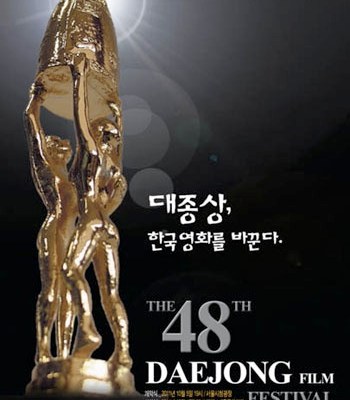
The 48th Daejong Film Awards – 2011

Often referred to as ‘The Korean Oscars’, the 48th Daejong Film Awards were held in at the Sejong Center in Seoul on Monday the 18th.

The 48th Daejong Film Awards

As usual, the red carpet was rolled out for the stars and for their fashionable entrances. Here are pictures of the actors, actresses, and couples that attended.

This year was interesting, as while the films nominated were certainly very good, there was no clear winner that was expected to steal the show. Instead, the awards were spread quite evenly amongst the nominees.

For Best Picture, the award went to Korean war film ‘The Front Line’ (고지전). The film, directed by Kim Ki Duk (김기덕) protege Jang Hoon (장훈), also went on to scoop the awards for Best Production, Best Cinematography, and Best Lighting.

Best Actor went to Park Hae Il (박해일) for his role in action/adventure film ‘Arrow: The Ultimate Weapon/War of the Arrows’ (최종병기 활) (currently with 2 English working titles). The film also scored awards for technical achievement, winning Best Sound and Best Visual Effects. The Best Supporting Actor award was given to Jo Seong-ha (조성하) for his role in gritty action thriller ‘The Yellow Sea(황해).

Kim Ha Neul accepts Best Actress award

Kim Ha Neul (김하늘) won Best Actress for playing a blind woman in crime thriller Blind(블라인드), and accepted her award from ‘You Pet!’ (너는 펫) co-star Jang Geun Seok (장근석) (see here). The award for Best Supporting Actress was scooped by Shim Eun Kyeong (심은경) who appeared in ‘Romantic Heaven’ (로맨틱 헤븐).

The Popularity Award went to The Man From Nowhere (아저씨) star Won Bin, who humbly received his award (here).

Please see here for a full list of the awards, the nominees, and winners from the night.

Festival News Film News

Comedian-turned-director Shim Hyung Rae (심형래) faces bankruptcy

Comedian/director Shim Hyung Rae is in financial difficulty

Shim Hyung Rae (심형래), known throughout Korea for his comedic character Young Gu (영구) and as director on D-War (디 워, 2006) and The Last Godfather (라스트 갓파더, 2010), is facing bankruptcy.

Reporting on August 31st/September 1st 2011, news agencies claimed that the comedian-turned-director had not paid staff at his production company ‘Yonggu Art.’ 43 employees at the company filed a petition for unpaid wages – amounting to 800 million won – which brought to light the financial difficulties Shim was embroiled in. As Shim was unable to pay the outstanding wages, the building in which ‘Yonggu Art’ was located was seized. In addition, Shim Hyung Rae also borrowed heavily from savings banks in order to produce his films, but had been unable to make repayments. In turn, the savings banks have tried to sue him, and the court cases are currently ongoing.

Both D-War and The Last Godfather were critically mauled by the press and word of mouth, yet despite this the hype surroundings his films at the times of their release was immense. However, audience numbers failed to reach expected figures, falling far short of breaking even. The films had been produced with America in mind, hoping to cater to audiences there and therefore increasing audience attendance.

The Korea Times also reported that Shim had a weakness for casinos, and that his gambling addiction was the root of the problem.

As reported hereScott Ross, the co-chairman of inDSP USA and technical director of special effects, claimed that Korean films are:

“very specific to Korean culture, and they’re shot in Korean language with Korean scriptwriters,” and that, “(e)veryone thinks their stories, cultures and movies are global content. But that’s not the case. Hollywood movies are global content.”

Clearly Shim Hyung Rae attempted to follow such advice and break into the American market, yet his failure to do so has ultimately cost him his production company.

Celebrity News Film News
Silenced (The Crucible) (도가니)

‘Silenced’ (도가니), the controversial true-life story, shakes Korea

The release of ‘Silenced (도가니) (aka ‘The Crucible’) has caused an unprecedented level of controversy in Korea.

Poster for Silenced/The Crucible (도가니)

Depicting the true-life story of the shocking sexual abuses that occurred in 2000 at a school for disabled children by the staff – including the principal – Silenced has enraged the public to such a degree that policies and laws are changing. Watch the trailer here.

Released on Sept. 22nd, the film tells of the story of teacher Kang In Ho (강인호) who joins Inhwa school for the hearing impaired in Gwangju. As he begins to learn about the terrible atrocities being committed, he joins Seo Yoo Jin (서유진), a humans rights activist, to help bring the case to the attention of the authorities. Worse still, the six offenders received incredibly lenient sentences; only two received prison sentences, while the other four had suspended sentences or were not punished due to the statute of limitations. The school continued to operate – and some of the accused even returned to the school to teach. It is not known exactly how many victims, or even how many perpetrators, there are as Korean law requires the victims make a complaint.

The outrage surrounding the film has sparked calls for sexual offenders to be prosecuted more severely, and for the statute of limitations to be removed altogether. The public have asked for the case to be reinvestigatedEditorials have been written condemning the leniency given to sexual offenders. Politicians, eager to side with public opinion, also addressed the issue to the point where even President Lee Myung Bak (이명박) stated:

“It is necessary to make legal and institutional supplementations to prevent a similar incident from happening again.”

This in turn has opened an even wider debate on criminal background checks on teachers. The Education Ministry began a consensus asking for details from 189,759 nurseries, schools and private academies. Only 85.2% of teachers submitted details to the Ministry, while 17,891 refused. Currently, foreign teachers must have a criminal background check in order to teach in Korea. Additionally, the punishment sexual offenders has come under review with measures calling for harsher fines, jail terms, and expulsion from the education profession. A list of the measures are reviewed here.

Further still, prosecutors have used this momentum to examine sexual assaults in more depth, such as when, where and who are involved. The ongoing and expanding outrage even led to a report on the issues raised in The Economist.

It’s incredible how Silenced/The Crucible has achieved such notoriety to the point where policies are being examined and laws changed, especially considering it was based on a novel that had been in circulation for years prior. It has remained in the top spot since its release, with current figures suggesting nearly 4 million people have watched it thus far. Initially, director Hwang Dong Hyeok (황동혁) didn’t want to make the film due to the distressing content, however with the triumphant change in policies to protect children across Korea, it’s a very good thing he did.

Film News Uncategorized

Are Korean films not ‘global’?

In his keynote speech at the 2011 International Digital Content Conference, Scott Ross, the co-chairman of inDSP USA and technical director of special effects, claimed that:

“I’m a big fan of movies by Chan-wook Park and Joon-ho Bong. Unfortunately, no one sees them because Korean movies are made for Korea […] (The) Korean film community and content community clearly create great art. But in the stream of global content, they’ve not been a global player.”

Later, when asked to elaborate, Mr. Ross stated that Korean films were:

“very specific to Korean culture, and they’re shot in Korean language with Korean scriptwriters,” and that, “(e)veryone thinks their stories, cultures and movies are global content. But that’s not the case. Hollywood movies are global content. I’m not saying I like them but that is the case.”

While Mr. Ross is clearly a highly respected man in his field, his comments seem particularly unfair. Aside from the rudeness of his comments, he’s claiming that Korean films are not ‘global’ because they contain Korean culture. According to him, Hollywood movies contain the content required for a film to be successful internationally. While I don’t wish to put words in Mr. Ross’ mouth, it’s quite clear that by ‘Hollywood’ he means ‘American.’ This is an incredibly arrogant assumption considering the vast number of different cultures and languages throughout the world. Certifying his stance even further, Mr. Ross continued:

“From a Korean perspective, Korea has to decide whether they want to be in ‘the show’ or ‘the business’ as in art vs. money. Produce the content in English. And it should have global content sensibility.”

Therefore, according to Mr. Ross, Korean films need to be in the English language and contain ‘global’ (i.e. American) narratives and culture in order to successful.

However, one of the reasons that Korean films are successful is ultimately because they offer something different from typical Hollywood fare. Certainly, Korean films do primarily receive profits from within and the surrounding Asian countries that is true. Yet Korean productions have been regular participants at international film festivals, notably Cannes, such as The Housemaid (하녀) in 2010 which was a competitor for the Palme d’Or. Also, Hollywood often buys the rights to films that originated in Korea, such as Il Mare (시월애, 2000) which was converted into The Lake House (2006), and Oldboy (올드보이) which currently has director Spike Lee and actor Christian Bale attached.

So what do you think? Are Korean films too Korean? Should they be ‘Americanized’? Post your comments below!

Film News