SHINee to perform at the London Korean Film Festival 2011

Kpop sensations SHINee (샤이니) , whose hits include ‘Ring Ding Dong’ and ‘Lucifer‘,

SHINee at LKFF 2011

will perform the first concert to open the London Korean Film Festival. According to the official LKFF facebook page, SHINee will perform at the Odeon West End in Leceister Square, in screen 2 on November 3rd at 4.30pm. Tickets will go on sale soon and will be £20-30, and can be bought at the official Odeon website here.

You can visit the Hanguk Yeonghwa page on the upcoming festival here, and visit the official LKFF page here.

As a taster of things to come, here’s the music video for (arguably) their greatest hit, ‘Ring Ding Dong.’

Celebrity News Festival News Festivals 2011

Upcoming London Korean Film Festival to showcase latest blockbusters

The London Korean Film Festival is due to commence November 3rd

The London Korean Film Festival (LKFF) 2011 will host the European premieres of several of this years Korean blockbusters.

Running from November 3rd-17th, LKFF will open with action/adventure film War of the Arrows (최종병기 활) (aka Arrow: The Ultimate Weapon), which stayed at the top of the Korean box office chart for several weeks and has currently grossed over 55,135 million Won. According to Hangul Celluloid, preceding the premiere will be a K-pop concert beginning at 4.30pm.

In addition, sleeper-hit Sunny (써니) which took the prize for Best Director at The Daejong Film Awards, and The Front Line (고지전), winner of Best Picture and official entry to The Academy Awards, will premiere at the event. Furthermore, gritty urban thriller The Yellow Sea (황해), period-comedy Detective K: Secret of the Virtuous Woman (조선명탐정: 각시투구꽃의 비밀), Kim Ki Duk’s critically acclaimed Poongsan (풍산개), and animated tale Leafie: A Hen Into The Wild (마당을 나온 암탉) will all be showcased.

Here’s a trailer showcasing the upcoming screenings of the festival.

LKFF will also be holding a 1 minute short mobile phone competition, to be judged by none other than Old Boy director Park Chan Wook. The winning short will be shown alongside the Mise-en-Scene Shorts, which will include Park Chan Wook’s Night Fishing (파란만장) which was not only shot entirely on an iphone but also won the Golden Bear for Best Short Film at The Berlin Film Festival.

To win free tickets, LKFF has also arranged a competition for fans to post pictures of themselves with a promotional poster.

Special events, including a Korean Cinema Forum and Masterclasses, will be held featuring academics, journalists and Korean film professionals. Most notably, director Ryoo Seung Wan will host a ‘masterclass’ event  while his back-catalogue will be screened as this years ‘Director’s Retrospective.’ His latest film, The Unjust (부당거래), will be the closing film of the festival.

The festival won’t be restricted to London either; the festival will also travel to Sheffield (12-13th, at the Showroom Sheffield), Cambridge (18-20th at the Arts Picturehouse), and Newcastle (20-24th, at the Tyneside Cinema).

You can book tickets to the festival here.

With so many films being showcased, and unselfishly taking the festival to other cities, the upcoming London Korean Film Festival looks certain to impress.

Festival News Festivals 2011

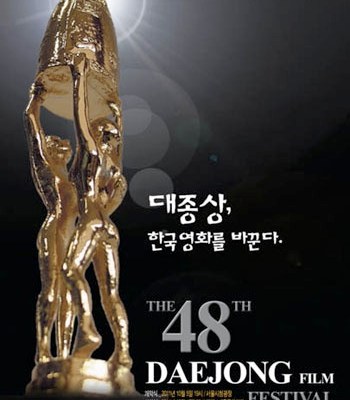
The 48th Daejong Film Awards – 2011

Often referred to as ‘The Korean Oscars’, the 48th Daejong Film Awards were held in at the Sejong Center in Seoul on Monday the 18th.

The 48th Daejong Film Awards

As usual, the red carpet was rolled out for the stars and for their fashionable entrances. Here are pictures of the actors, actresses, and couples that attended.

This year was interesting, as while the films nominated were certainly very good, there was no clear winner that was expected to steal the show. Instead, the awards were spread quite evenly amongst the nominees.

For Best Picture, the award went to Korean war film ‘The Front Line’ (고지전). The film, directed by Kim Ki Duk (김기덕) protege Jang Hoon (장훈), also went on to scoop the awards for Best Production, Best Cinematography, and Best Lighting.

Best Actor went to Park Hae Il (박해일) for his role in action/adventure film ‘Arrow: The Ultimate Weapon/War of the Arrows’ (최종병기 활) (currently with 2 English working titles). The film also scored awards for technical achievement, winning Best Sound and Best Visual Effects. The Best Supporting Actor award was given to Jo Seong-ha (조성하) for his role in gritty action thriller ‘The Yellow Sea(황해).

Kim Ha Neul accepts Best Actress award

Kim Ha Neul (김하늘) won Best Actress for playing a blind woman in crime thriller Blind(블라인드), and accepted her award from ‘You Pet!’ (너는 펫) co-star Jang Geun Seok (장근석) (see here). The award for Best Supporting Actress was scooped by Shim Eun Kyeong (심은경) who appeared in ‘Romantic Heaven’ (로맨틱 헤븐).

The Popularity Award went to The Man From Nowhere (아저씨) star Won Bin, who humbly received his award (here).

Please see here for a full list of the awards, the nominees, and winners from the night.

Festival News Film News

Busan International Film Festival 2011

It would be incredibly appropriate for the first entry into a blog about Korean film would focus on a celebration of the industry – and that’s exactly what we have here, with a report from the Busan International Film Festival  (BIFF) 2011.

Busan, for those unaware, is the second largest city in Korea and has hosted the festival for the last 16 years. During that time it has grown considerably, initially using available cinema screens in the Nampo-dong (남포동) area to later broadening out to the famous tourist destination of Haeundae (해운대).

Running from the 6th to the 14th of October, and showcasing over 300 films, this year also saw a number of ‘firsts.’ The first time the festival was held without founder/coordinator Kim Dong Ho (김동호) since his retirement; the first time ‘Pusan/PIFF’ was changed to ‘Busan/BIFF’ in a long-overdue Romanisation change; and the first unveiling of the exclusive Busan Cinema Centre, that had been under construction since 2008. The centre was also used for the opening red carpet ceremony and opening film ‘Always’ (오직 그대만), tickets for which sold out with 7 seconds.

The founder of BIFF, Kim Dong Ho (김동호)

However BIFF operates a great service for cineastes. While 80% of tickets can be bought online, 20% are available on the day at the ticket office. Also worth mentioning are the price of the tickets; ₩6,000 (£3.28/$5.12) for a regular ticket and ₩8,000 (£4.38/$6.82) for a 3D feature. Compared with the London Film Festival (£6-20/₩11,010-36,703/$9.46-31.52), and the New York Film Festival ($8-50/₩9,316-58,225/£5.07-31.72), the tickets at Busan are a real bargain.

With a few days spare, I visited the area early only to find that the cinema centre was still under construction. But Korean builders are nothing if not diligent, and the centre was (for the most part) completed on time. It’s certainly an impressive building, with 4 indoor screens and 1 outdoor that seats 4000 people. In the basement is the Korean Film Archive, which focuses on Korean film history with the option to buy old films and memorabilia. Designed by Austrian architect Coop Himmelblau, the Cinema Centre cost ₩160 billion ($136 million) and it shows – it really is an astounding and stylish building. It’s also nice to see a country invest and develop the infrastructure of their film industry when others countries – notably England – are withdrawing funding and closing institutions designed to support new productions.
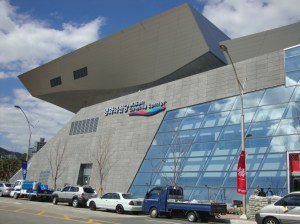
The new Busan Cinema Centre

Before the special red carpet opening of the festival, there was a pre-opening event on Haeundae (해운대) beach. Actors and actresses from different countries were present, fireworks were lit, and prayers of good luck (complete with incense and pig’s head) were conducted. It was a relatively calm and intimate affair, unlike the spectacular ceremony the following day.
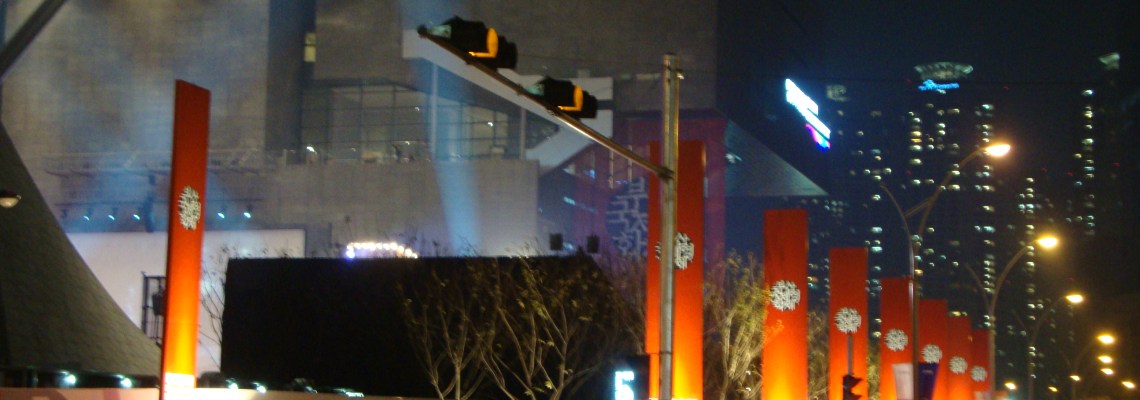
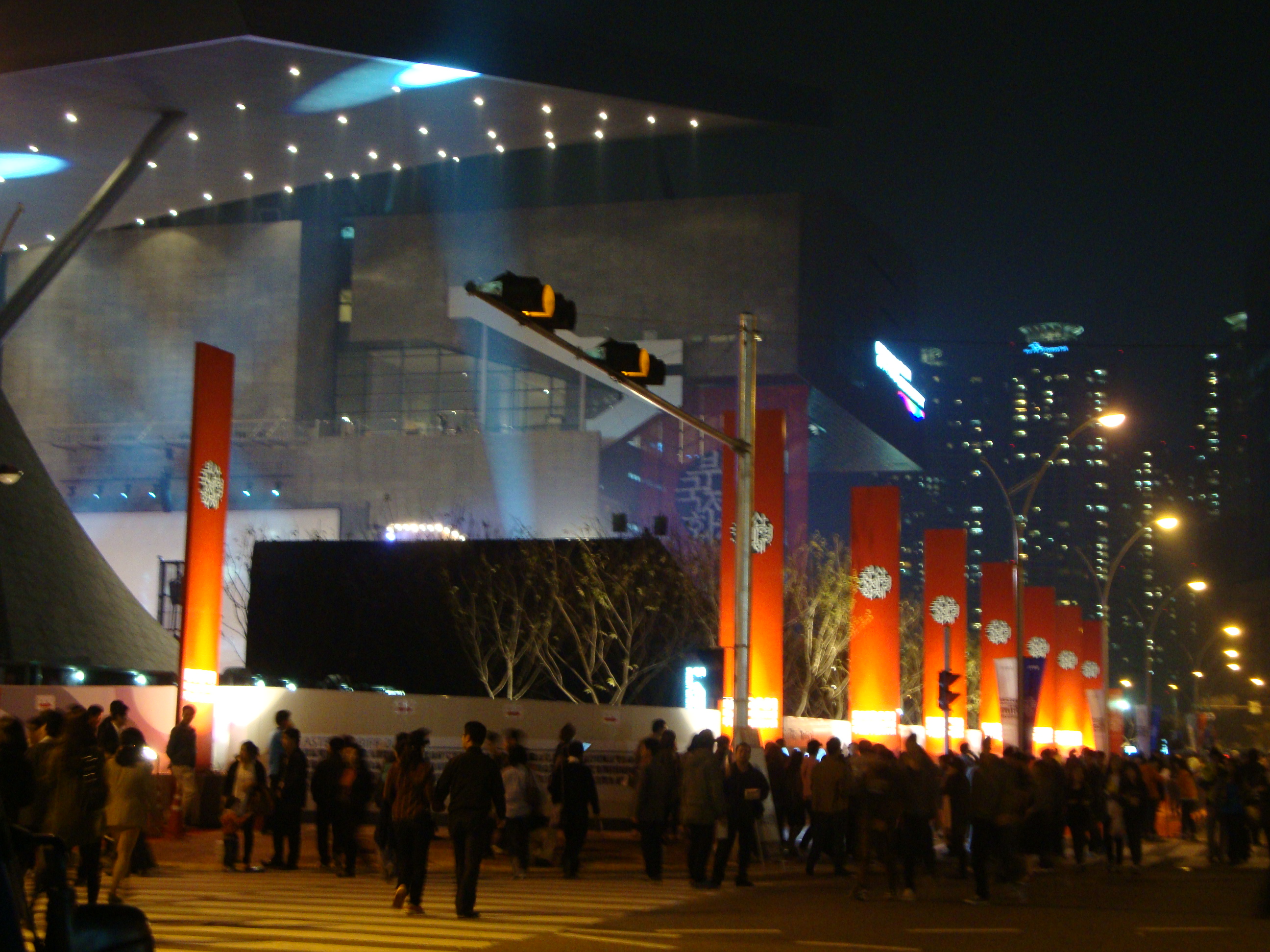
The bright lights of the red carpet opening event

Despite the 8pm opening time, I decided to explore the venue at 1.30pm…which turned out to be too late. Crowds of people were already in lines at the ticket office in an attempt to score last minute invites to the ceremony. Flocks of teenage girls were crammed along the railings next to the red carpet, and their hysteria made it virtually impossible to get a glimpse of the stars as they made their way along the carpet. In spite of this, the event was incredible and lasted hours, followed by the screening of ‘Always’ (오직 그대만), and the entire event was reported by a large number of media outlets.

The pre-opening ‘good luck’ ceremony

Sporting a pre-booked ticket, the next morning I visited the cinema centre once more to watch ‘Hara Kiri: The Death of Samurai’ (3D) by Takeshi Miike. The interior of the building is futuristic in the style of ‘Minority Report’, despite not being entirely finished. Armed with a ticket, a bottle of vitamin water and some peanut butter squid, I ventured into the theater itself, which proved to be a very comfortable viewing experience.

After the film, I intended to explore the rest of the building including the Korean Archive, yet due to the continuing construction work it still hadn’t been finished. Worse still, the Archive didn’t have a kiosk at BIFF Village on the beach, unlike last year. Instead, more commercial firms were present that had little to do with film, which was a shame.

Time constraints meant that unfortunately I couldn’t stay to enjoy the entire festival, yet the opening few days were easily the biggest and most impressive in its 16 year history. It will certainly be interesting to see how the event manages to improve further next year after setting the standard so high.

Festival News Festivals 2011