Are Korean films not ‘global’?

In his keynote speech at the 2011 International Digital Content Conference, Scott Ross, the co-chairman of inDSP USA and technical director of special effects, claimed that:

“I’m a big fan of movies by Chan-wook Park and Joon-ho Bong. Unfortunately, no one sees them because Korean movies are made for Korea […] (The) Korean film community and content community clearly create great art. But in the stream of global content, they’ve not been a global player.”

Later, when asked to elaborate, Mr. Ross stated that Korean films were:

“very specific to Korean culture, and they’re shot in Korean language with Korean scriptwriters,” and that, “(e)veryone thinks their stories, cultures and movies are global content. But that’s not the case. Hollywood movies are global content. I’m not saying I like them but that is the case.”

While Mr. Ross is clearly a highly respected man in his field, his comments seem particularly unfair. Aside from the rudeness of his comments, he’s claiming that Korean films are not ‘global’ because they contain Korean culture. According to him, Hollywood movies contain the content required for a film to be successful internationally. While I don’t wish to put words in Mr. Ross’ mouth, it’s quite clear that by ‘Hollywood’ he means ‘American.’ This is an incredibly arrogant assumption considering the vast number of different cultures and languages throughout the world. Certifying his stance even further, Mr. Ross continued:

“From a Korean perspective, Korea has to decide whether they want to be in ‘the show’ or ‘the business’ as in art vs. money. Produce the content in English. And it should have global content sensibility.”

Therefore, according to Mr. Ross, Korean films need to be in the English language and contain ‘global’ (i.e. American) narratives and culture in order to successful.

However, one of the reasons that Korean films are successful is ultimately because they offer something different from typical Hollywood fare. Certainly, Korean films do primarily receive profits from within and the surrounding Asian countries that is true. Yet Korean productions have been regular participants at international film festivals, notably Cannes, such as The Housemaid (하녀) in 2010 which was a competitor for the Palme d’Or. Also, Hollywood often buys the rights to films that originated in Korea, such as Il Mare (시월애, 2000) which was converted into The Lake House (2006), and Oldboy (올드보이) which currently has director Spike Lee and actor Christian Bale attached.

So what do you think? Are Korean films too Korean? Should they be ‘Americanized’? Post your comments below!
Film News

Busan International Film Festival 2011

It would be incredibly appropriate for the first entry into a blog about Korean film would focus on a celebration of the industry – and that’s exactly what we have here, with a report from the Busan International Film Festival  (BIFF) 2011.

Busan, for those unaware, is the second largest city in Korea and has hosted the festival for the last 16 years. During that time it has grown considerably, initially using available cinema screens in the Nampo-dong (남포동) area to later broadening out to the famous tourist destination of Haeundae (해운대).

Running from the 6th to the 14th of October, and showcasing over 300 films, this year also saw a number of ‘firsts.’ The first time the festival was held without founder/coordinator Kim Dong Ho (김동호) since his retirement; the first time ‘Pusan/PIFF’ was changed to ‘Busan/BIFF’ in a long-overdue Romanisation change; and the first unveiling of the exclusive Busan Cinema Centre, that had been under construction since 2008. The centre was also used for the opening red carpet ceremony and opening film ‘Always’ (오직 그대만), tickets for which sold out with 7 seconds.

The founder of BIFF, Kim Dong Ho (김동호)

However BIFF operates a great service for cineastes. While 80% of tickets can be bought online, 20% are available on the day at the ticket office. Also worth mentioning are the price of the tickets; ₩6,000 (£3.28/$5.12) for a regular ticket and ₩8,000 (£4.38/$6.82) for a 3D feature. Compared with the London Film Festival (£6-20/₩11,010-36,703/$9.46-31.52), and the New York Film Festival ($8-50/₩9,316-58,225/£5.07-31.72), the tickets at Busan are a real bargain.

With a few days spare, I visited the area early only to find that the cinema centre was still under construction. But Korean builders are nothing if not diligent, and the centre was (for the most part) completed on time. It’s certainly an impressive building, with 4 indoor screens and 1 outdoor that seats 4000 people. In the basement is the Korean Film Archive, which focuses on Korean film history with the option to buy old films and memorabilia. Designed by Austrian architect Coop Himmelblau, the Cinema Centre cost ₩160 billion ($136 million) and it shows – it really is an astounding and stylish building. It’s also nice to see a country invest and develop the infrastructure of their film industry when others countries – notably England – are withdrawing funding and closing institutions designed to support new productions.

The new Busan Cinema Centre

Before the special red carpet opening of the festival, there was a pre-opening event on Haeundae (해운대) beach. Actors and actresses from different countries were present, fireworks were lit, and prayers of good luck (complete with incense and pig’s head) were conducted. It was a relatively calm and intimate affair, unlike the spectacular ceremony the following day.

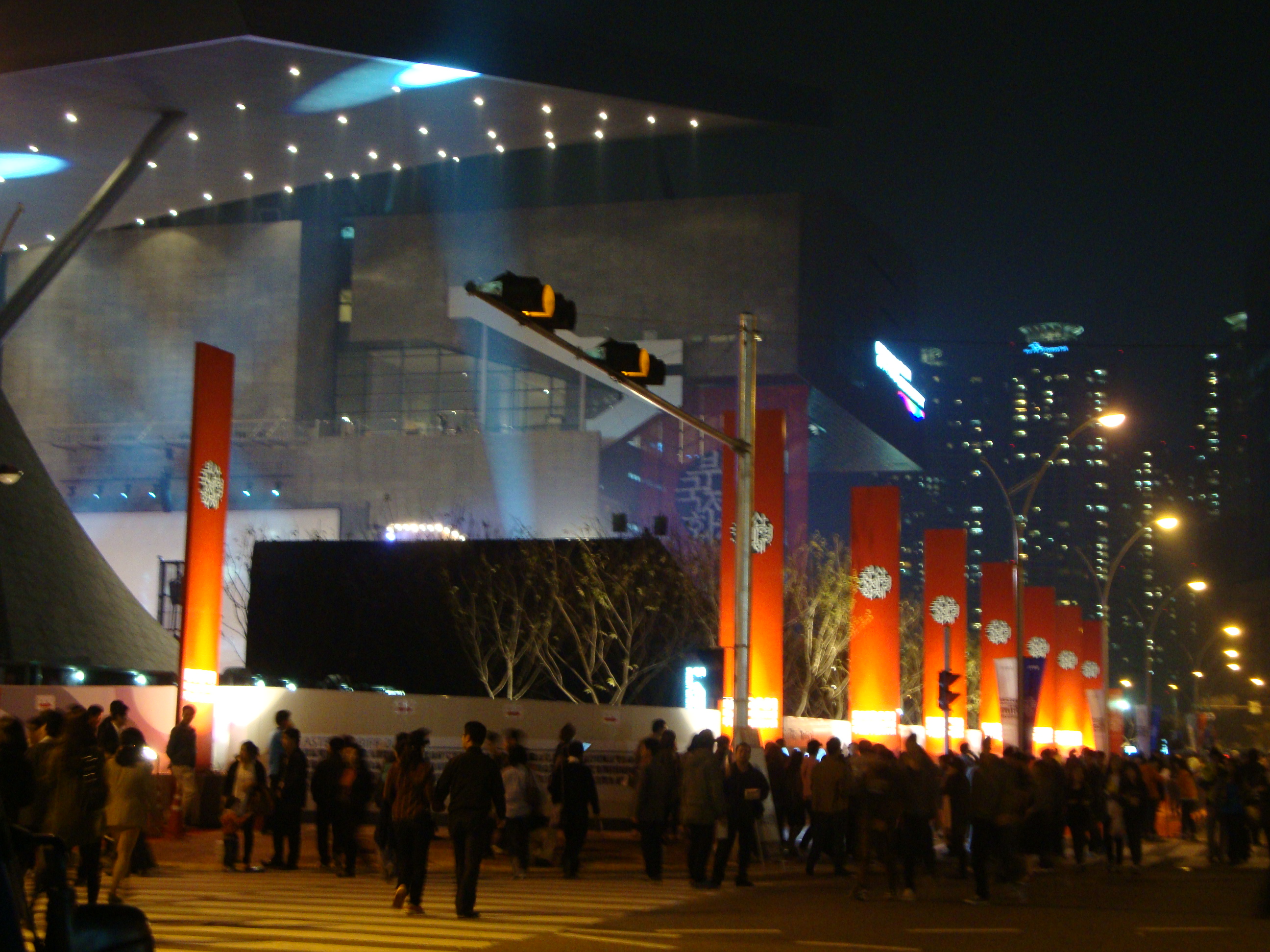
The bright lights of the red carpet opening event

Despite the 8pm opening time, I decided to explore the venue at 1.30pm…which turned out to be too late. Crowds of people were already in lines at the ticket office in an attempt to score last minute invites to the ceremony. Flocks of teenage girls were crammed along the railings next to the red carpet, and their hysteria made it virtually impossible to get a glimpse of the stars as they made their way along the carpet. In spite of this, the event was incredible and lasted hours, followed by the screening of ‘Always’ (오직 그대만), and the entire event was reported by a large number of media outlets.

The pre-opening ‘good luck’ ceremony

Sporting a pre-booked ticket, the next morning I visited the cinema centre once more to watch ‘Hara Kiri: The Death of Samurai’ (3D) by Takeshi Miike. The interior of the building is futuristic in the style of ‘Minority Report’, despite not being entirely finished. Armed with a ticket, a bottle of vitamin water and some peanut butter squid, I ventured into the theater itself, which proved to be a very comfortable viewing experience.

After the film, I intended to explore the rest of the building including the Korean Archive, yet due to the continuing construction work it still hadn’t been finished. Worse still, the Archive didn’t have a kiosk at BIFF Village on the beach, unlike last year. Instead, more commercial firms were present that had little to do with film, which was a shame.

Time constraints meant that unfortunately I couldn’t stay to enjoy the entire festival, yet the opening few days were easily the biggest and most impressive in its 16 year history. It will certainly be interesting to see how the event manages to improve further next year after setting the standard so high.

Festival News Festivals 2011

Greetings from Hanguk Yeonghwa!

Hello everyone! 안녕하세요 여러분!

Welcome to Hanguk Yeonghwa (한국 영화) – or Korean film, if you prefer.

This blog is dedicated to the cinematic endeavors of Korea, where the films are often referred to as an exciting, innovative, and challenging alternative to Hollywood.

Most Korean films that make their way to foreign shores are often labeled as ‘extreme cinema’ due to the violent and/or sexual themes contained within. As such, the majority of audiences are aware of the horrors and thrillers produced, including the likes of Oldboy (올드보이, 2003), Thirst (박쥐, 2009), and the films of Kim Ki Duk (김기덕).

This is unfair, as in addition to the crime and revenge thrillers Korea produces an incredibly large amount of melodramas, comedies, and war films exploring the relationship with their northern cousins. While these films have a slowly increasing level of awareness in Europe and North America, they are extremely widespread throughout the rest of Asia to the point where the immense popularity has been designated as ‘the Korean Wave’ or ‘Hallyu’ (한류). The films, TV dramas and celebrities have an enormous following in Japan, Thailand, The Philippines and beyond, to the point where tour dates are sold out within minutes and actors learn different languages to make appearances on national television. The Korean Wave is expanding into new territories however, thanks to the innovation of those within the entertainment industry, expats, and of course the internet. Today, Korean actors such as Lee Byeong Heon (이병헌), Rain (비/real name 정지훈), and Jeon Ji Hyeon (전지현) are appearing in Hollywood, with director Kim Ji Woon (김지운) at the helm of the upcoming Arnold Swarzenegger film ‘Last Stand’ (2013).

This blog is also riding the wave and will feature film news, festival highlights, and reviews of both past and present, familiar ad unfamiliar. Hopefully, upon reading the reviews you will be curious enough to seek out, or re-watch, some fascinating moments from an ever-changing industry.

But make no mistake, these reviews will not simply be gushing praise simply because of their country of origin. They will be objective, impartial, and compared with counterparts from other countries.

Therefore, if you are interested in Korean film then this is the place to be. There will be no idol gossip about celebrity scandals however; instead, film fans can voice their opinions about the film productions from ‘the land of the rising calm.’ So if you have a few minutes free, sit back and enjoy the posts! (^.^)

Uncategorized