The intimacy is created through honest action, rather than empty promises

Poongsan (풍산개) – ★★★☆☆

Poongsan (풍산개)

Poongsan (풍산개)

There has been a noticeable ideological shift in the representation between North and South Korea in recent cinematic productions. While the late ’90s inaugurated a period where the differences between the people were rendered moot (as exemplified by Shiri (쉬리)JSA – Joint Security Area (공동경비구역 JSA)  and Taegukgi (태극기 휘날리며), the past few years have appropriated a nihilistic approach that represents both sides as equally corrupt. The Front Line (고지전)Dance Town (댄스 타운) and even insanely popular TV drama City Hunter (시티헌터) have all subscribed to such representations, depicting government and military officials, and even citizens, as either equally underhanded or worse than their northern counterparts. Poongsan (풍산개) joins this trend, examining the lives of those caught between the ideological conflict in an interesting, albeit haphazard, style.

Poongsan tells the story of an unnamed man who regularly risks his life by crossing the De-Militarized Zone at the request of families on either side. He becomes know as ‘Poongsan’ (Yoon Kye-sang (윤계상) after the brand of cigarettes he smokes, and passes letters, videos, trinkets, and in special cases, people. Concurrently South Korean agents are pressuring a high ranking North Korean defector (Kim Jong-soo (김종수) for information, which he claims he cannot provide without his girlfriend In-ok (Kim Gyoo-ri (김규리) who still lives in The People’s Republic. The agents charge the DMZ runner with finding and retrieving the woman, yet on their dangerous return an unshakeable bond forms between them. On their arrival in the South,the double-crossing South Korean agents and North Korean spies vie for control over the lives of the defector, his girlfriend and the runner, leading to a deadly showdown.

Poongsan and In-ok cross the DMZ to the South

Poongsan and In-ok cross the DMZ to the South

While directed by his protege Juhn Jai-hong (전재홍), Kim Ki-duk’s (김기덕) indelible stamp is firmly cemented in Poongsan due to his dual role as writer/producer. The nameless DMZ runner, who never utters a word of dialogue during the entire course of the film, has more than a little in common with the lead in prior film 3-Iron (빈집). ‘Poongsan’ never talks, rather allowing his actions to convey his personality and pure intentions. If there is an ‘enemy’ in the film it would be ‘words’. The spies within the film continually offer empty promises and the rhetoric they spout is interchangeable. Worse still is that once the rhetoric has finished, both sides engage in horrific barbarous torture methods that reveal a twisted sadism within the agents. Even the past times of the agents are the same; the southern agents visit a hostess bar for the northern prostitutes, and the northern agents frequent a bar for southern working girls. The high ranking North Korean defector is portrayed similarly, initially conveying love and adoration for his girlfriend which later reveals itself as passive-aggressive misogyny. His vital report is also of note, as the defector understands the nature of his situation – once his document is submitted, his own life will be forfeit despite the security insisting otherwise. Only the silent ‘Poongsan’ and In-ok are represented as innocent and genuine, the true victims of the ideological warfare that continues to divide the populace.
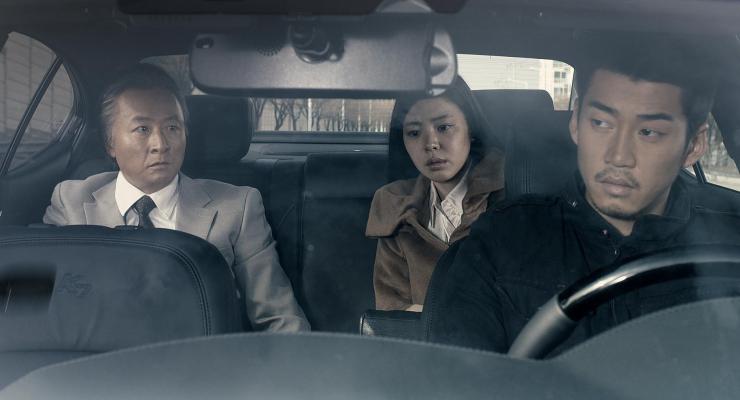
Poongsan, In-ok, and the defector are caught between agents from both countries

Poongsan, In-ok, and the defector are caught between agents from both countries

As is often Kim Ki-duk’s style, the narrative veers in different directions unexpectedly yet still serves to emphasise the underlying socio-cultural critique. A wide array of alternating generic features are employed to this end, however they tend to distract from the deconstruction of the north/south opposition rather than enhance it. In addition, leaps are taken with suspension of disbelief in several areas. For example, the romance between ‘Poongsan’ and In-ok begins organically enough yet somehow jumps into a timeless intimate love; similarly, ‘Poongsan’ is a veritable one-man army who seemingly recovers from grave wounds with ease. The final showdown involves the highly idealised event of locking both factions of agents in a room to settle the dispute once and for all, which is an interesting premise yet merely serves to highlight their cowardice and lacks intensity. As the chief protagonist, Yoon Kye-sang (윤계상) gives a competent performance as ‘Poongsan’, a difficult task given the inherent stoicism. Unfortunately ‘Poongsan’ is, in the latter half of the film, relegated to being a supporting actor as the political themes take precedence.
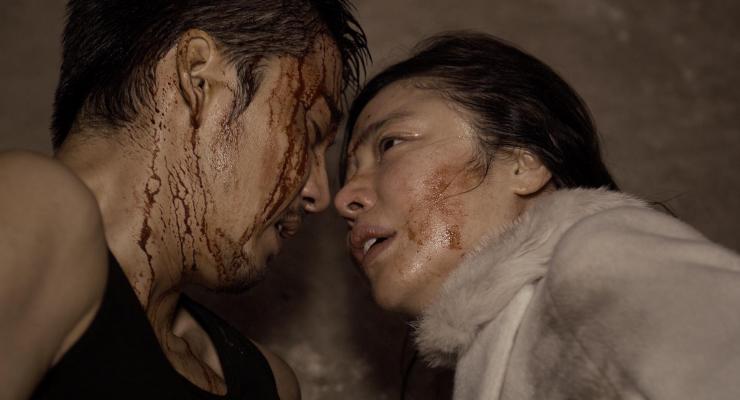
The intimacy is created through honest action, rather than empty promises

The intimacy is created through honest action, rather than empty promises

Verdict:

Poongsan is a very interesting nihilistic examination of the north/south divide, one that embraces wholeheartedly the similarities between both sides in an incredibly pessimistic context. The deconstruction of the agencies of both countries, and the use of language as a tool/enemy is wonderfully executed and brings a new dimension to the political debate within the cinematic realm. The lead protagonists however lack the depth required for them to be believable and fully attract empathy, and in addition to other frivolous/whimsical uses of generic conventions and audience disbelief, detract from the construction of this statement. Poongsan will no doubt be hailed in future discussions of Korean cinema as a film that brought a new dimension to an old debate and is an entertaining, though occasionally disjointed, film.

★★★☆☆

Reviews
Sun-woo's arrogance leads to his downfall

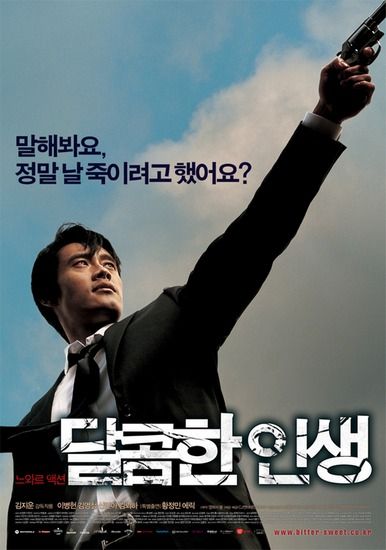
A Bittersweet Life (달콤한 인생) – ★★★★★

A Bittersweet Life (달콤한 인생)

A Bittersweet Life (달콤한 인생)

Contemporary action heroes are markedly different from their forebearers. Fragments of the stoic hard-boiled masculinity of the noir 1930s, the rebellious ‘anti-hero’ escapades of the ’60s, and the hyper-masculinity of the ’80s amongst others still exist yet are characterised by more psychologically flawed and vulnerable protagonists. The psychosis of the contemporary action hero is propagated further by his/her unfettered arrogance which often serves to be the source of their appeal; they may be murderous unhinged individuals, but they conduct violence with such swagger and confidence that popularity is undoubtedly assured. The most recent incarnation of James Bond, played by Daniel Craig, is a prime example of such characterisation and differs incredibly from previous actors rendition of the spy. Such traits are of fundamental significance in Kim Ji-woon’s (김지운) A Bittersweet Life (달콤한 인생), an amazingly stylised action noir thriller that boasts an incredible performance from leading man Lee Byeong-Heon (이병헌).

Kim Sun-woo (Lee Byeong-Heon) is an enforcer for ruthless gangster and hotel owner Mr. Kang (Kim Young-cheol (김영철). Sun-woo is the epitome of diligence and loyalty, protecting his boss’ interests above all else including beating lower-tier gangsters that visit the establishment to cause trouble. Before a business trip to Shanghai, Mr. Kang orders Sun-woo to watch his young girlfriend Hee-soo (Sin Min-ah (신민아) for fear she is meeting another, younger, man. If Sun-woo confirms his suspicions, he must ‘take care’ of the situation. Yet when Sun-woo meets Hee-soo he is captivated by her, and cannot fulfill his obligations when her affair is discovered. Enraged, Mr. Kang orders his men to punish Sun-woo, setting in motion a series of events that tests both men to their limits.

Sun-woo is an arrogant, lethal enforcer for Mr. Kang

Sun-woo is an arrogant, lethal enforcer for Mr. Kang

As expected from auteur  Kim Ji-woon, A Bittersweet Life is technically fantastic with wonderful framing and composition, and superb use of mise-en-scene. The writer/director combines a multitude of different generic features seamlessly. The elegant gangster inspired ‘La Dolce Vita’ restaurant is exquisitely constructed, with a title that becomes a recurring subliminal pun throughout the film. The ultra-violent action sequences are brutal and shocking in their presentation, often accompanied by noir-esque shadows and suspense. The inclusion of romantic motifs are subtle yet moving as close up shots of minor mannerisms effect Sun-woo, that ultimately lead to his downfall. Sun-woo’s loneliness is consistently emphasised by framing devices that convey his isolation, as do the angled shots that portray the trajectory of his devolution down the gangster hierarchy. Kim Ji-woon’s renowned use of colour is on full display, from the bright white corridors that lead to the deep red and black interior of ‘La Dolce Vita’ to the continued use of bright lights surrounding love-interest Hee-soo. This subtly ties into Sun-woo’s almost obsessive compulsive disorder for switching lamps on and off several times before sleeping, as Hee-soo is constantly surrounded by light and has a penchant for lamps of all varieties.

Sun-woo escorts Hee-soo, whose subtle charms impair his judgment

Sun-woo escorts Hee-soo, whose subtle charms impair his judgment

Sun-woo is an incredibly arrogant and prideful protagonist, wonderfully portrayed by Lee Byeong-Heon. The intensity and conflict from his previous roles serves him well as Sun-woo’s narrative journey takes him from the upper echelons of the gang to crawling on his knees. And yet Sun-woo still refuses to acknowledge his feelings or to apologise, just as Mr. Kang refuses to change his stance to spare his dignity. They are mirrors of each other not just in personality and career but also in their affection for Hee-soo, and it’s ultimately that jealousy that destroys them all including the organisation. The final images of Sun-woo shadow boxing with his own reflection in ‘La Dolce Vita’ are tragically revealing, as his narcissistic spirit is forever locked in an internal love/hate battle with himself and his organisation. The other actors all convey great performances, although they are somewhat underdeveloped. Sin Min-ah conveys innocence and naivety as Hee-soo, and immeasurable sadness when her affair is brought to light. Kim Young-cheol is wonderfully sadistic as Mr. Kang and the mirror of Sun-woo, conveying real internal conflict when giving orders against his protege. As jealous second lieutenant Mun-suk, Kim Roi-ha is delightfully vindictive despite his limited character.

Sun-woo's arrogance leads to his downfall

Sun-woo’s arrogance leads to his downfall

Verdict:

A Bittersweet Life is an incredibly stylised action/gangster/noir thriller that is head-and-shoulders above other recent examples of the genre. As always, director Kim Ji-woon doesn’t disappoint, employing a variety of generic motifs to wonderful effect that keeps the film moving at a brisk pace without detracting from lead character Sun-woo’s development. Lee Byeong-Heon gives a wonderful performance as the flawed anti-hero, and despite his violent tendencies and arrogance is one of the most compelling action protagonists in recent memory. A Bittersweet Life is a premier example of the innovation of Korean cinema, and a more than worthy addition to the genre.

★★★★★

Reviews
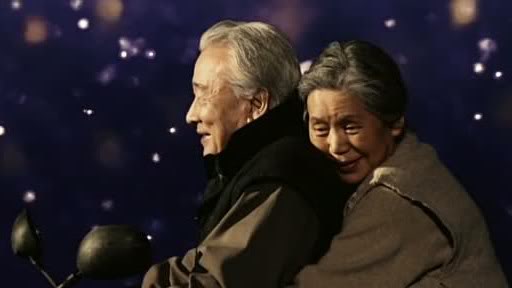
Man-seok and Song enjoy driving in the snow

Late Blossom (그대를 사랑합니다) – ★★★★☆

Late Blossom (그대를 사랑합니다)

Late Blossom (그대를 사랑합니다)

Love is, if celluloid is to be believed, the realm of young star-crossed lovers and those on the cusp of mid-life crises. The representation of youthful love is often accompanied by the intense passion of the first love, and the parental figures with whom they will undoubtedly clash. Middle-aged representations of love are acutely different incorporating a unique undercurrent of pessimism, the desire to end an elongated period loneliness and be married before the dreaded 40. But what of the eldest generation? By and large they tend to be ignored in the romance genre. Choo Chang-min‘s (추창민) Late Blossom (그대를 사랑합니다) helps to remedy the imbalance, offering deeply poignant and deeply romantic narratives featuring senior citizens.

Kim Man-seok (Lee Soon-jae (이순재) is a foul-tempered and foul-mouthed milk courier who traverses the narrow alleyways of his neighbourhood on  his trusty moped. One winter Man-seok passes Song I-ppoon (Yoon So-jeong (윤소정), a poor woman of a similar age struggling to make ends meet by collecting cardboard and plastic. In spite of his ill-tempered disposition, Man-seok attempts to help her in the difficult icy conditions. Though annoyed, he finds himself drawn to Song and every morning waits to help her and his temperament gradually dissipates. In the same neighbourhood are another elderly couple, Jang Goon-bong (Song Jae-ho (송재호) and his wife (Kim Soo-mi (김수미). Goon-bong works all hours at the local parking lot while his Alzheimer’s suffering spouse stays home. That is, until one day Goon-bong forgets to lock the gate and she escapes, later bumping into Man-seok at the local park which sets off a chain of events that will bring the unlikely quartet together and in the process rediscover themselves.

Man-seok and Song enjoy driving in the snow

Man-seok and Song enjoy driving in the snow

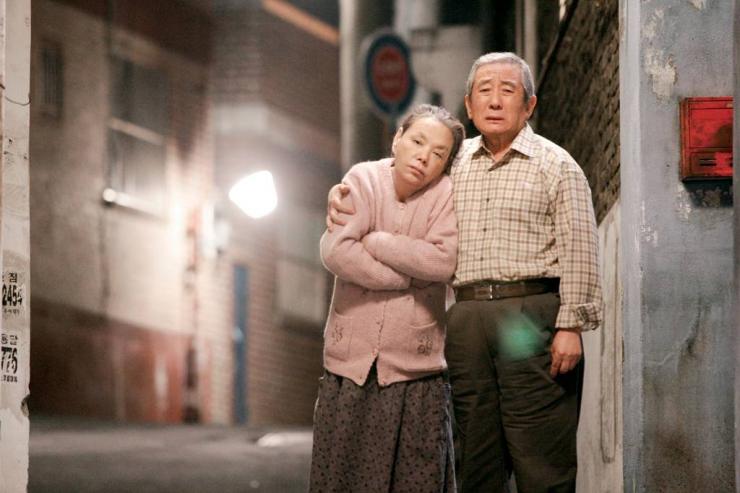
Late Blossom is a delicately crafted, wonderfully poignant romantic tale. Screenwriters Choo Chang-min, Kim Sang-soo, Kim Yong-deok, and Lee Man-hee have carefully constructed an emotionally charged and heartwarming narrative that never feels forced. The way the relationships develop are subtle and organic, employing psychoanalytic depth to each protagonist amid the issues faced by senior citizens. Additionally, the mise-en-scene is sublime. Director Choo Chang-min uses the landscape to great effect, capturing the claustrophobic environment of the run-down old houses and the narrow labyrinthine streets. The town itself is situated on a mountain slope allowing for a variety of angled shots that highlight the change in power status between the central protagonists and the other inhabitants. The framing is also incredibly impressive serving to be both social-realist during the more bleak moments, and whimsically romantic in the melodramatic segments.

Goon-bong and his wife appear with dignity in the high-angled shot

Goon-bong and his wife appear with dignity in the low-angled shot

Just as Late Blossom is technically impressive, the acting is also very effective. While all the performances are competent, Lee Soon-jae and Kim Soo-mi are remarkable. As an Alzheimer’s patient, Kim Soo-mi evokes a multitude of emotions which earned her the Best Supporting Actress award at the 32nd Blue Dragon Awards. She conveys empathy, humour, mental illness and in rare moments of translucency, deeply moving sentiment. Lee Soon-jae is also wonderful as ill-tempered Man-seok, who gradually evolves due to his belated encounter with love. The narrative is mostly concerned with his evolution of character, which is a shame considering the additional talent involved, but Lee Soon-jae’s performance is so poignant that the narrative is consistently entertaining. Yoon So-jeong is restrained and subtle as illiterate Song I-ppoon, whose poverty-stricken life has beaten her into despair. Similarly, Song Jae-ho is wonderful as caring husband Goon-bong. His unselfish motivations are perhaps the most romantic within Late Blossom, convey adoration and heartache for his wife.

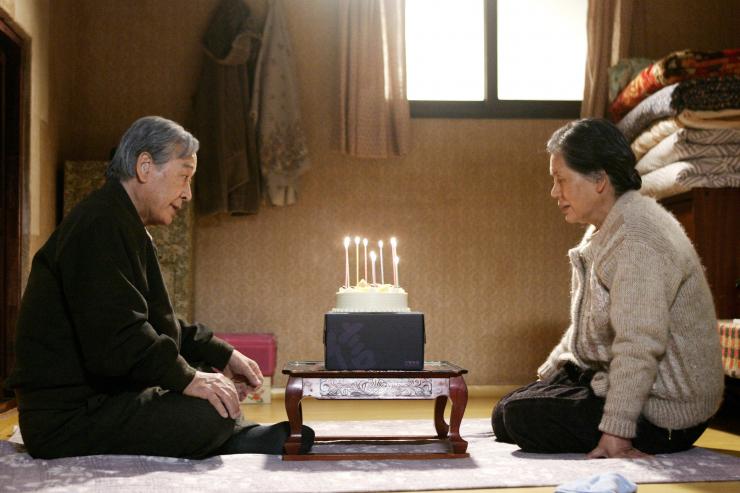
Man-seok and Song have a birthday celebration

Man-seok and Song have a birthday celebration

Verdict:

Late Blossom is a wonderfully moving film, conveying romance and dilemmas for an often under-represented generation. It is thought-provoking and poignant, eschewing the cliches often ascribed to more generic examples that are arguably naive in their representations of love. That said, the narrative is not equally shared amongst the quartet of protagonists which is a shame, as the character development is somewhat stifled for certain members. However, Late Blossom  is not only an incredible example of the genre, but amongst the best in representing romance for senior members of society.

★★★★☆

Reviews
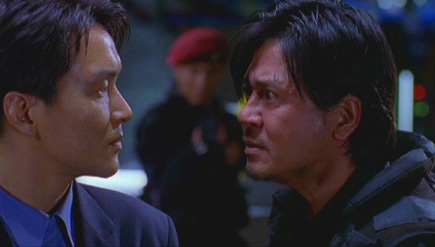
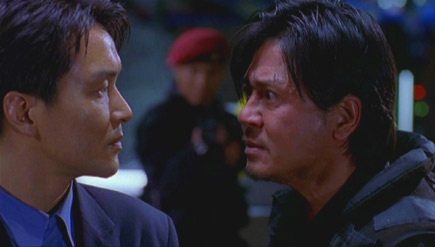
Agent Yu and Northern commando Mu-Young are mirrors of each other

Shiri (쉬리) – ★★★★☆

Shiri (쉬리)

Shiri (쉬리)

There are select few films that can claim they were part of a movement that changed the course of national cinema. Shiri (쉬리) is such a film. With the change from a military to democratic government in the early 1990’s, and the resulting relaxation of censorship, Shiri proved to be one of the first films to tackle the relationship with North Korea that wasn’t represented wholly negatively. The film also proved that Korea had highly capable directors and actors, employing stylised and kinetic action sequences that had been the staple of 1990’s Hong Kong films and utilising them to express Korean socio-cultural anxieties. As such, Shiri became the biggest box office hit of 1999. Furthermore, the film gained international recognition promoting Korea as a country – and a film industry – to watch.

Agents Yu Jong-won (Han Seok-Kyu (한석규) and Lee Jang-gil (Song Kang-ho (송강호) work for the South Korean intelligence agency. Widely respected as the best in the agency, they ultimately fail to protect an arms dealer assigned to their care. The precision and perfection of the assassination leads to only one suspect – North Korean sniper Lee Bang-hee (Kim Yoon-jin (김윤진). Her return is a surprise as Hee has not been active for years after she assassinated a number of high profile government officials. Complicating matters further, a small band of renegade Northern commandos led by Park Mu-young (Choi Min-sik (최민식)  are en-route to the South, amid the backdrop of a football (soccer) game aimed at promoting ties between both people. Agents Yu and Lee are charged with finding and stopping Bang-hee and her compatriots, and uncovering why they have emerged to reek havoc once more.

Agent Ryu (류) must track down elusive North Korean sniper Hee (희)

Agent Yu must track down elusive North Korean sniper Bang-hee

Director Kang Je-gyu (강제규), who also co-wrote the screenplay with Jeon Yoon-soo (전윤수), continually deconstructs the notions of ‘north’ and ‘south’ as oppositional (themes which he would later expand on in the seminal Taegukgi (태극기 휘날리며). Indeed, the title of the film ‘Shiri’ is the name of a fish that swims in the waters between the two countries, completely unaware of the political situation yet living in harmony. The film opens with the brutal military training regime Bang-hee must endure in the North, which are equally horrifying and dehumanising. Rather than representing the assassin purely as a monster, Kang Je-gyu also constructs empathy as she is forced to comply with barbaric demands. After she has infiltrated the South, empathy is invoked further as Bang-hee is a recovering alcoholic with social relationships, even managing her own business, conveying that precious little separates her from those in the South. Her fiancee is the unaware Agent Yu, and their union represents the reunification of both countries more succinctly than any treaty possibly could. Agent Yu must locate Northern terrorist Mu-young, who serve as mirrors of each other in their desire for reunification, albeit under different banners. During one of their confrontations Mu-young reveals his unbridled rage with the South, yet his reasons are not based on political rhetoric – rather, his jealousy of the high standard of living and the decadence within the country fuels his hatred, and in doing so conveys empathy towards his misguided violent attempts at reuniting the regions. While the politicians try to spur reunification through sport, it is ironically the ‘hero’ Agent Yu who destroys the only real way in which the countries can be unified, emphasising that neither side is inherently ‘good’ or ‘bad’ but misguided.

Agent Yu and Northern commando Mu-Young are mirrors of each other

Agent Yu and Northern commando Mu-Young are mirrors of each other

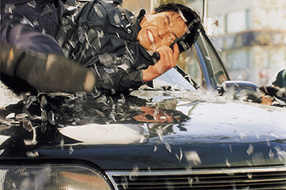
The actors all give good performances despite the tendency of ’90s action films for 2-dimensional characters. Such character development is generally limited in order for north/south relations to be at the forefront of the narrative, however the representation of the romance between Agent Yu and Bang-hee is touching and reinforces that the divide can be overcome with love. Choi Min-sik is by far the most talented and intense actor in the film, and acutely conveys the anger and frustration of those living in the North. His unrepentant attitude towards violence drives the narrative forward at a rapid pace and provides the thrills that lead to the ultimate showdown. The action sequences are kinetic and enjoyable, although they are far removed from the balletic slow-motion action of John Woo. Similarly, the introduction of new water-based super-weapon CTX is somewhat silly, yet it reinforces the notion of the adaptability and free-flowing nature of water in which the Shiri fish inhabit.

The kinetic action sequences are reminiscent of Hong Kong productions

The kinetic action sequences are reminiscent of Hong Kong productions

Verdict:

It is important not to understate the importance and influence of Shiri in Korean cinematic history. While it may not be a ‘perfect’ action film, it helped to insure not only that the national cinema had serious potential but also that a country that had struggled for years following the Korean War could be recognised for its cinematic output. The impact is still present to this day exemplified by the sensational 2009 TV drama IRIS which employed similar themes and motifs. Shiri proved that, while borrowing generic features from Hollywood and Hong Kong, a national cinema featuring national socio-cultural concerns was indeed possible and helped to form the foundation of a cinematic movement.

★★★★☆

Reviews
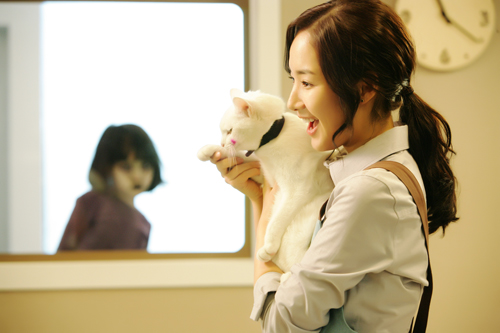
So-yeon (소연) is stalked by the ghost of a young girl

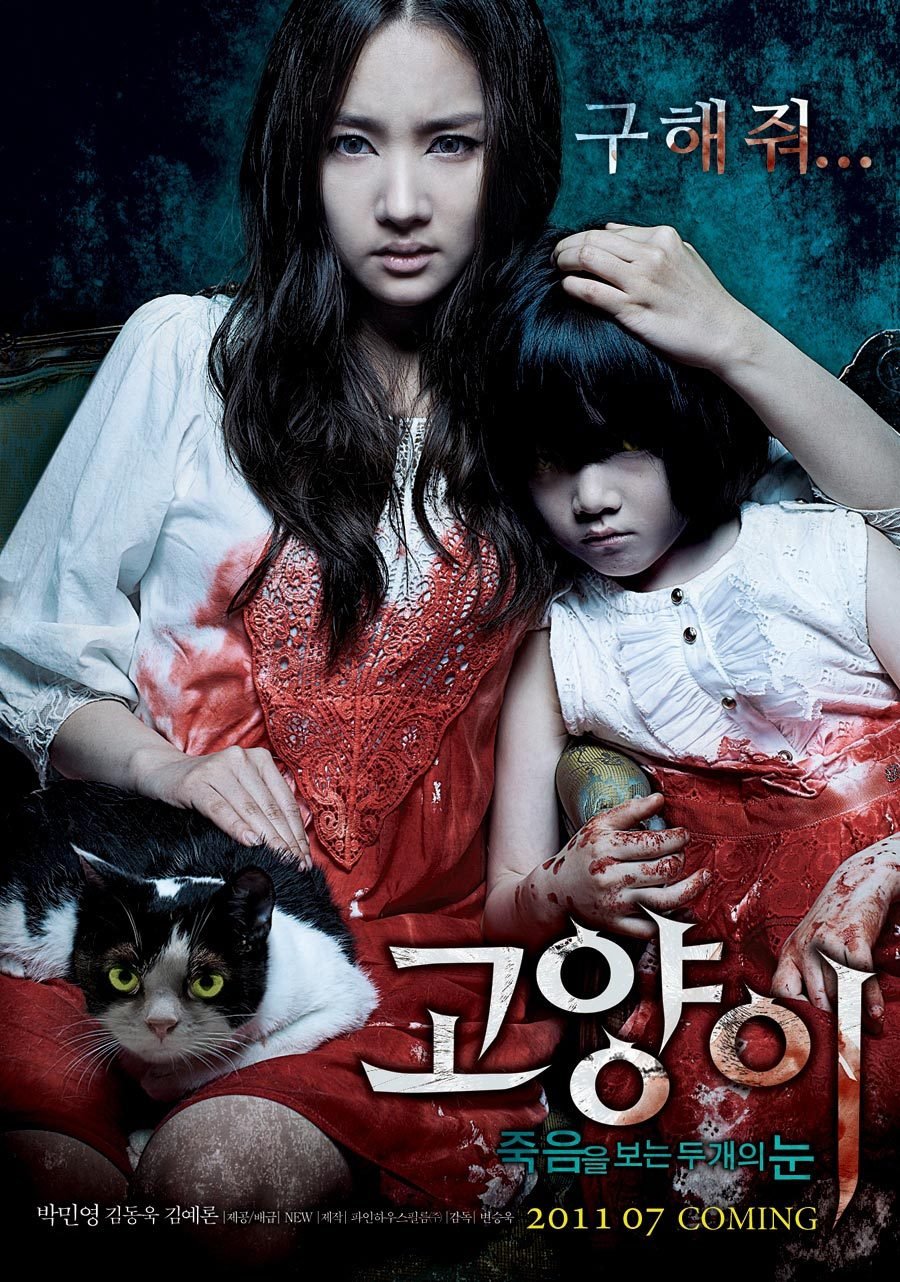
The Cat (고양이: 죽음을 보는 두 개의 눈) – ★★★☆☆

The Cat (고양이: 죽음을 보는 두 개의 눈)

The Cat (고양이: 죽음을 보는 두 개의 눈)

Certain visual motifs have always been prevalent in Asian horror films. It was arguably Hideo Nakata’s incredible Ring (1998) that introduced the majority of ‘Western’ audiences to such themes, most notably the ‘gwishin’ or girl spirit with long black hair and wearing a white nightdress. Additionally, water (particularly in Japan), the deconstruction of family ethics, the motif of the circle, technological advancements, and the supernatural are all features that continually recur. As the title suggests, The Cat (고양이: 죽음을 보는 두 개의 눈) uses felines as the conduits of horror in conjunction with other common motifs, and while entertaining, offers little in the way of originality or suspense.

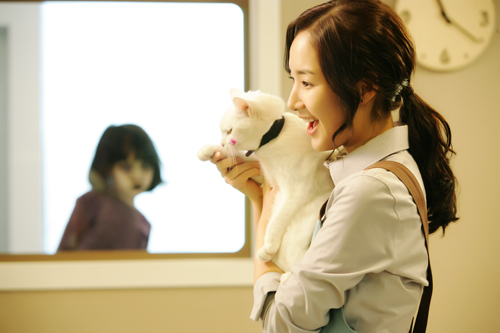
So-yeon (Park Min-yeong (박민영) works at a pet store grooming animals, supervised by the sinister flamboyant manager (Lee Han-wi (이한위). So-yeon suffers from claustrophobia due to an undisclosed childhood accident, visiting a psychiatrist and taking anxiety medicine, and as such has an acute fear of elevators and closed doors. After grooming cat ‘Silky’, the owner mysteriously dies forcing police officer Joon-seok (Kim Dong-wuk, 김동욱) to ask So-yeon to take care of the feline. But on taking Silky home, it becomes clear that something else has followed them – the apparition of a young girl called Hee-jin (Kim Ye-ron, 김예론) with cat-like eyes.

So-yeon (소연) is stalked by the ghost of a young girl

So-yeon (소연) is stalked by the ghost of a young girl

The trend to incorporate ‘western’ style scare tactics through rapid editing, rather than elongated atmospheric scenes, features heavily in The Cat. This is a shame, as the effects of such a style wear off as quickly as they are introduced and do little to perpetuate suspense and terror throughout the film. However director Byeon Seung-wook (변승욱) competently creates these scenes of horror, employing filters that seemingly drain colour from the mise-en-scene in anticipation of an upcoming shock. Unfortunately, the impact of the shocks are fleeting, and the lack of originality is painfully obvious. This is heightened due to the unwise decision of including scenes reminiscent of other superior horror classics, which detracts from the overall enjoyment. Attempts are made to make The Cat into more of a psychological horror due to So-yeon’s psychosis, with ghost Hee-jin as a mirror/conduit for her childhood trauma. Hee-jin – who bares more than a passing resemblance to So-yeon in her youth – stalks So-yeon yet does not harm her; only those who are unkind to cats feel her wrath. Yet the victims are also people that So-yeon dislikes or bears a grudge towards, and in this capacity Hee-jin becomes a supernatural tool implementing So-yeon’s subconscious will. Further supporting this argument is the fact that all the murders are conducted in confined spaces, an area that petrifies So-yeon yet is the source of her neurological condition. While there is certainly a mystery to be solved, the identity of the killer is ambiguous.

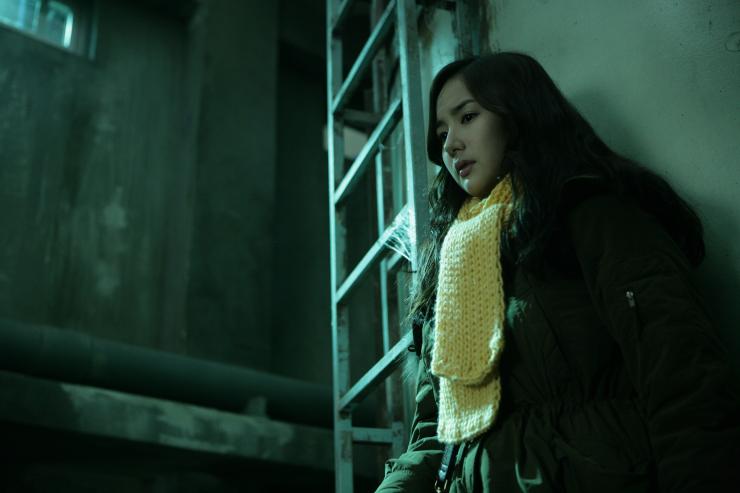
So-yeon attempts to solve the mystery

So-yeon attempts to solve the mystery

Park Min-yeong gives a solid performance as pet-groomer So-yeon, yet the role mostly requires her to look scared and doesn’t allow for a more penetrative exploration of her psychological condition or the foundation thereof. As such, the evolution of So-yeon as a protagonist is rather flat. Police officer and potential love interest Joon-seok is pitifully underdeveloped and adds little to the narrative, and as such Kim Dong-wuk’s performance is muted. Perhaps the most entertaining protagonist is the camp pet store owner, played by Lee Han-wi (이한위), who seems to relish portraying the flamboyantly vicious entrepreneur. The standard of acting is generally mediocre as director Byeon Seung-wook is more concerned with quickly moving from one horror set piece to the next, and the lack of character development clearly limits the performances provided.

Death visits those close to So-yeon

Death visits those close to So-yeon

Verdict:

While competently made, The Cat does not belong with premier examples of the genre. Attempts have clearly been made to construct depth through the inclusion of a leading protagonist with neurosis, yet the lack of development and the consistent references to other, more superior, horror films detracts from the overall experience. That’s not to say that The Cat isn’t enjoyable – far from it. While the unease of horror is unlikely to linger after the credits, the fast-paced quick thrills make the film an entertaining experience.

★★★☆☆

Reviews
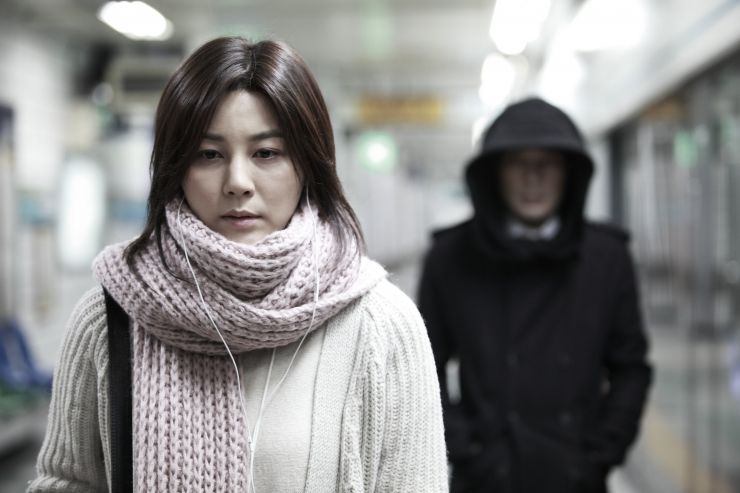
Soo-ah must escape the labyrinthine subway station

Blind (블라인드) – ★★★☆☆

Blind (블라인드)

Blind (블라인드)

The impairment of a leading protagonist in a film can often allow an actor or actress to stretch themselves into new territory and offer startling performances (and, more cynically, guarantee some silverware). Daniel Day-Lewis’ turn as an artist with cerebral palsy in My Left Foot (1989) is perhaps the most significant, but other actors including Russell Crowe (A Beautiful Mind, 2001), Denzel Washington (The Bone Collector, 1999) John Hurt (The Elephant Man, 1980) and Colin Firth (The King’s Speech, 2010) amongst many, many others have all conveyed the difficulties that impaired people face. With Blind (블라인드), Kim Ha-neul (김하늘) takes on the role of a visually impaired woman and in doing so has won the 2011 ‘Best Actress’ award at both The Daejong Awards and The Blue Dragon Awards. Quite how is something of a mystery, as Kim Ha-neul’s performance, as well the film itself, rarely rises above mediocre.

Blind tells the story of promising police cadet Min Soo-ah (Kim Ha-neul) who, through an accident partly of her own making, loses her sight. Life becomes a struggle for Soo-ah as the fast-paced world around her is seemingly intolerant of her impairment. Whilst attempting to find her way home one evening, Soo-ah becomes a witness in an abduction case and must use her training and heightened senses to help find the killer. Complicating matters further is the second witness, Kwon Gi-seob (Yoo Seung-ho (유승호), who gives a contradictory testimony of events. Joined by Detective Jo (Jo Hee-bong (조희봉), Soo-ah and Gi-seob must solve the mystery together, before the killer finds them first.

Min Soo-ah (민수아, Kim Ha-neul 김하늘) and her faithful guide dog

Min Soo-ah (Kim Ha-neul) and her faithful guide dog

Films representing impairment tend to focus on the adversity that is endured and finally, over the course of the narrative, overcome. With Blind, director Ahn Sang-hoon (안상훈) makes minimal effort to convey the hardships Soo-ah faces, representing rather obvious and fleeting problems such as crossing the road, which seem redundant as she walks with her guide dog. Ironically the colour is drained in the exterior sequences through utilising filters, in an attempt to emphasise the cold and harsh outside world. Such devices do little to create empathy however, due to not only the lack of innovation but also Soo-ah’s stubborn nature that places herself in precarious situations. That said, other sequences such as a subway chase where Soo-ah must use floor tiles to find an exit as quickly as possible, are filmed and edited in a thrilling fashion and offer a refreshing take on the genre. One of the fundamental issues of Blind is that Ahn Sang-hoon and screenwriter Choi Min-seok fail to make any of the protagonists compelling enough to forge empathy with, and thus when the 2-dimensional characters are in peril the lack of engagement equates to flat, rather than thrilling, scenes.

Soo-ah must escape the labyrinthine subway station

Soo-ah must escape the labyrinthine subway station

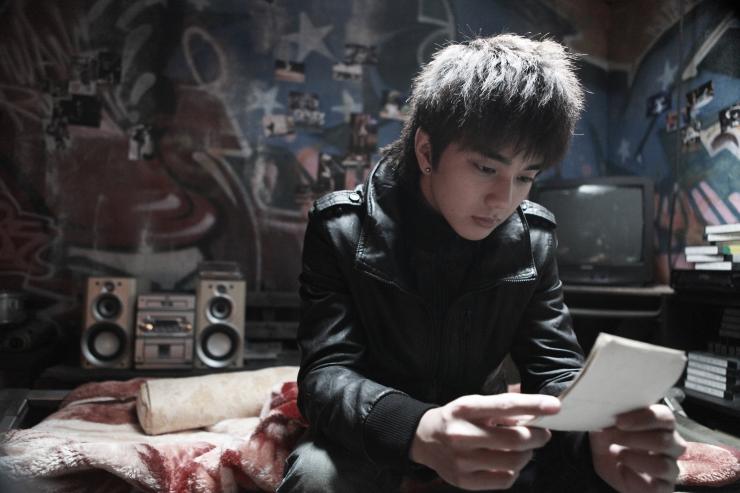
The actors generally give competent performances despite this. Kim Ha-neul is certainly prominent in this regard as a visually impaired woman, with occasional sequences that are convincing as she struggles with daily activities. Yoo Seung-ho is adequate as rebellious teen Gi-seob, as is Jo Hee-bong as foolhardy Detective Jo, yet they are never given the opportunity to display more than their supporting statuses will allow. Unfortunately the worst offender is Yang Yeong-jo as gynecologist-turned-serial-killer Myeong-jin. Again, this is not entirely his fault as the role itself is so woefully underdeveloped that Yeong-jo is merely present to appear menacing and snarl and cackle occasionally.

as rebellious teen

Yoo Seung-ho as rebellious teen Kwon Gi-seob

Verdict:

Blind certainly had the potential to be an interesting and creative take on the thriller genre, but unfortunately due to the lack of character development and innovation it is a rather bland and mediocre offering. The actors involved all provide competent performances despite the limitations imposed on them, while Kim Ha-neul is somewhat convincing as a visually impaired witness. Blind does contain a select few sequences that provide enjoyable thrills, and while certainly no masterpiece, it offers enough entertainment to be an interesting viewing experience.

★★★☆☆

Reviews
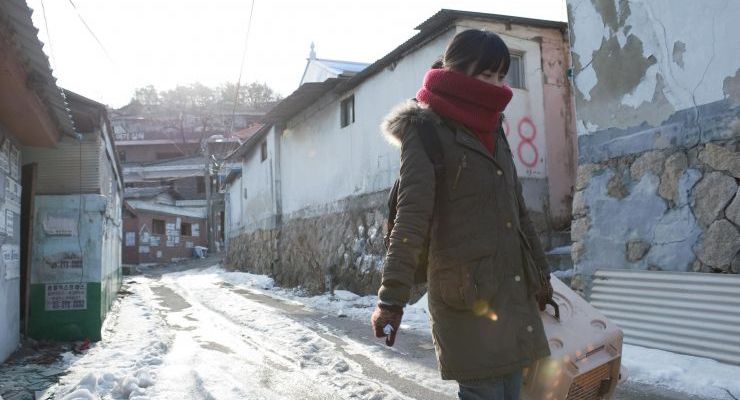
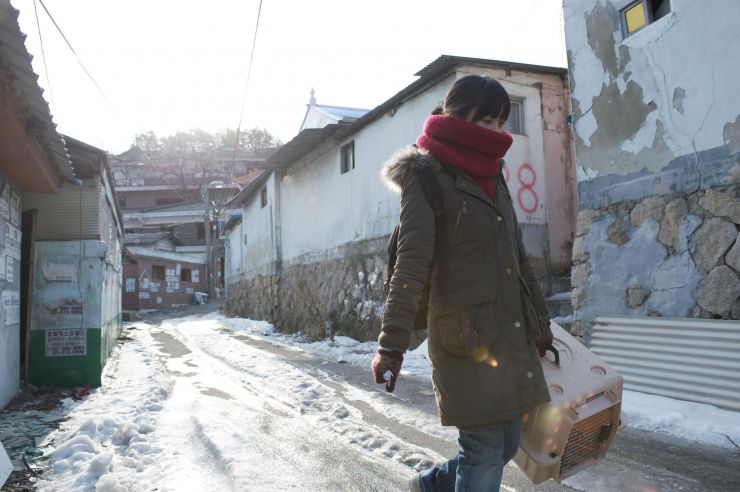
Hye-hwa helps stay dogs in the barren landscape

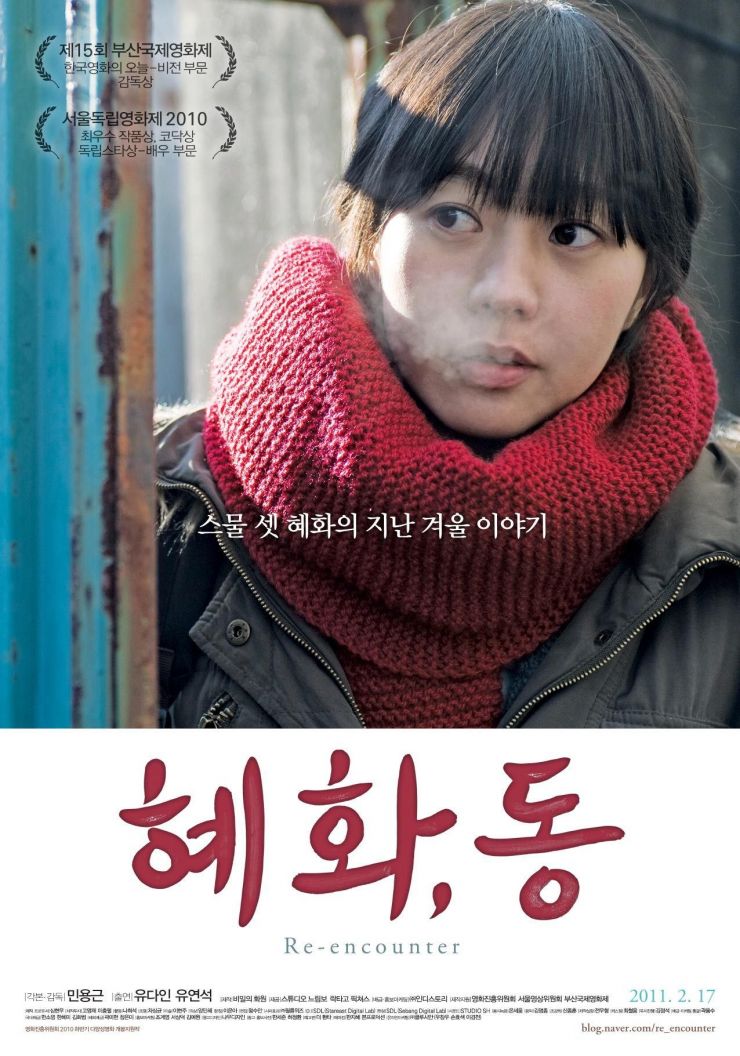
Re-encounter (혜화,동) – ★★★★☆

Re-encounter (혜화,동)

Re-encounter (혜화,동)

For any independent film maker, getting the project off the ground is a daunting task. While the freedom from studios is enviable, the production costs have the potential to escalate due to an incredible variety of external factors. Having a established actor/actress is therefore something of a coup, often guaranteeing both finance and audience revenue. Interesting then, that writer/director Min Yong-geun (민용근) intentionally chose not to cast any renowned stars in his second feature length film Re-encounter (혜화,동), rather allowing for the narrative to be the centerpiece.

Hye-hwa (Yoo Da-in (유다인) works for a canine veterinary surgery in a small rustic town. During the day she often visits the abandoned and dilapidated area on the outskirts of town where feral dogs roam, in a bid to save and treat them before they are caught by a cruel dog-napper. That is, until she surprisingly re-encounters ex-boyfriend Han-soo (Yoo Yeon-seok (유연석). Han-soo informs Hye-hwa that the child they had together years earlier, and believed to be dead, is actually alive and has been adopted. Forced to face the pain of her past, Hye-hwa’s life becomes increasingly fraught with the stress of who she is, and who she feels she ought to be.

Hye-hwa helps stay dogs in the barren landscape

Hye-hwa (혜화) helps stray dogs in the barren landscape

Director Min Yong-geun (민용근) has constructed a a very delicately paced drama, and wonderfully conveys Hye-hwa’s life as lonely and fragile. As she walks through the desolate landscape of abandoned buildings and feral animals, Hye-hwa is actually allegorically exploring the fragments of her consciousness which has never healed following the traumatic loss of her baby. Similarly, her passionate desire to find and treat the sick dogs in the area are the result of Hye-hwa’s inability to cope with her loss, chasing the helpless inside her psychosis as she desperately tries to exert control over the one thing she can never rectify. If all this sounds like an enormous burden, it is; the large red muffler that Hye-hwa wears is symbolic of the enormous strain she ‘wears’ day after day that weighs her down and threatens to engulf her.

Min Yong-geun also interrogates the root of Hye-hwa’s neurosis, highlighting the archaic notion of ‘the family unit’ in Korean culture as the cause of disruption. As Hye-hwa and Han-soo were only (unmarried) teenagers at the time of pregnancy, the families of both intervened and removed the decision process from the parents-to-be. Spiraling out this domineering attitude are two psychologically and emotionally scarred young people, and the director expertly conveys their trauma through the subtle use of the mise-en-scene and slow pacing.

The trauma of the young couple is expertly conveyed through the mise-en-scene

The trauma of the young couple is expertly conveyed through the mise-en-scene

The decision to use non-prolific actors is an interesting one and serves the narrative well, adding a shade more realism than more renowned counterparts. Yoo Da-in gives an incredibly restrained and subtle performance, and fully deserves her nomination for ‘Best Actress’ at the 32nd Blue Dragon Film Awards. Her expression of conflict as she cannot part with her cut nails is poignant and moving, as is her inability to recognise her underlying neurosis but determination to continue a ‘normal’ life. Yoo Yeon-seok fares less well, and while his performance is competent it fails to attract the same level of empathy as his love interest. This is perhaps unfair as this is also due to the significantly less screen-time he is provided, as the narrative belongs to the emotional turmoil of Hye-hwa.

Yoo Da-in (유다인) gives a subtle and poignant performance

Yoo Da-in (유다인) gives a subtle and poignant performance

Verdict:

Re-encounter is a thought provoking and restrained exploration of how trauma becomes a part of a person’s character when not confronted. It is incredibly slow-paced as director Min Yong-geun establishes his protagonists through imagery, which is something of a double-edged sword; while the mise-en-scene is expertly crafted, the characterization suffers slightly through the lack of interaction with others. But then, in highlighting their loneliness, Min Yong-geun emphasizes that such reconciliation is the fundamental way in which to begin healing trauma, and has crafted a touching humanist story in making such a statement.

★★★★☆

Reviews
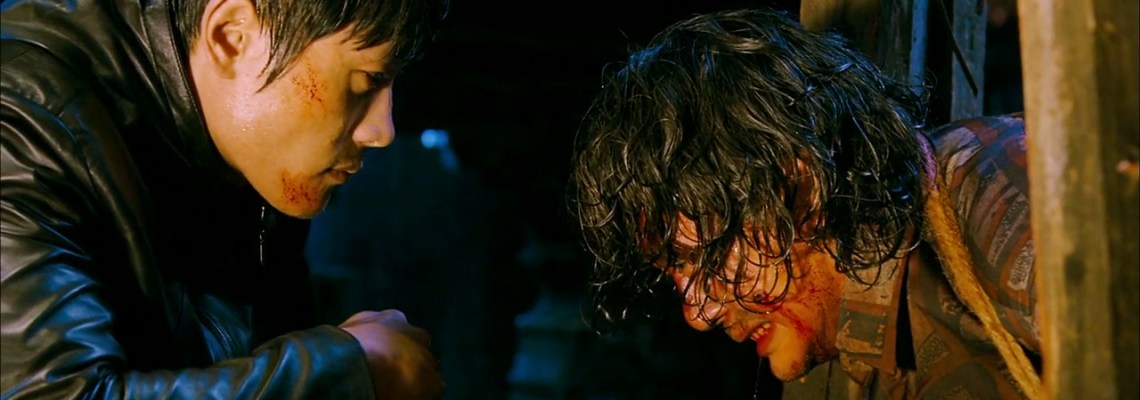
Mirror image - who is the monster?

I Saw the Devil (악마를 보았다) – ★★★★☆

I Saw the Devil (악마를 보았다)

I Saw the Devil (악마를 보았다)

Director Kim Ji-woon (김지운) is renowned for his genre-play, which perhaps makes it surprising that he waited so long to tackle Korea’s most popular genre – the thriller. As his 8th film, I Saw the Devil (악마를 보았다) is not only a refreshing take on an over-saturated genre but also extends beyond the celluloid in a similar fashion to Michael Haneke’s Funny Games (1997, 2008). Kim Ji-woon understands the genre and its relationship with the audience immensely; that audiences see thrillers to be thrilled. To this end, the auteur not only repeatedly creates incredibly suspenseful scenarios but also indirectly holds audiences accountable for the cruelty and violence that ensues.

I Saw the Devil depicts the story of intelligence agent Kim Soo-hyeon (Lee Byeong-Heon (이병헌), whose fiance is brutally murdered by serial killer Jang Keyong-cheol (Choi Min-sik (최민식). Not content with simply finding his finance’s murderer, Soo-hyeon plans to torture Keyong-cheol in the worst way possible – by striking just as the psycho’s bloodlust is about to be fulfilled, severely punishing him, and then setting him free. In this way Keyong-chul’s punishment, and Soo-hyeon’s vengeance, will be never-ending…but in doing so, Soo-hyeon must walk the dangerous line between man and monster.

Jang Keyong-cheol (장경철, Choi Min-sik (최민식) deals with his latest victim

Jang Keyong-cheol (Choi Min-sik) deals with his latest victim

Choi Min-sik and Lee Byeong-Heon are, as one would expect from such acting powerhouses, fantastic in their roles as serial killer and intelligence agent. While the roles don’t exactly stretch the actors into new territory, they convey incredible intensity throughout their cat-and-mouse games. Choi Min-sik in particular appears to relish his turn as sadistic serial killer Jang Keyong-cheol as he snarls and cackles without remorse as his victims suffer atrocities. His sheer intensity during such perverse sequences makes for uncomfortable but compelling viewing, and even provides some darkly comedic sensibilities in the horrific and ironic situations that arise. Lee Byeong-Heon is also terrific as he searches for revenge. The evolution of his character from agent to monster is riveting, as his moral code dissipates and allows further crimes to be committed in his selfish and arrogant desire for extreme vengeance.

The audience derives pleasure from the killers twisted games

The audience derives pleasure from the killers twisted games

Kim Ji-woon has achieved ‘auteur’ status for a very good reason, and actually manages to extend himself further through incorporating audience ‘pleasures’ and accountability. When the film begins, the camera is within a van driving along rustic country lanes in the snow. Either side of the rear-view mirror are florescent blue ‘wings’ that connote eyes; audiences are thus placed within the mind of a ‘monster’ as it prowls the countryside for its next victim. This is a recurring feature, as Kim Ji-woon aligns audiences with the villain making them responsible for their own voyeuristic desires of violence and mayhem. Yet once intelligence agent Soo-hyeon has caught the monster, the auteur splits alignment between the excitement of Keyong-cheol as he obtains his next victim, and the thrills of Soo-hyeon as he violently halts the killer. Kim Ji-woon understands his audience intimately and makes the cat and mouse game, in a sense, the audience chasing themselves as they simultaneously enjoy the murderous thrill of catching the prey and the (violent) catharsis of the saviour-figure that stops the perversity before the degradation has gone beyond acceptable limitations. He then punishes the audience for their desires within the narrative structure, forcing them to face their own notions of ‘pleasure’ within the cinema.

Mirror image - who is the monster?

Mirror image – who is the monster?

Verdict:

I Saw the Devil is a wonderful addition to an over-saturated genre, and offers a fresh and interesting take on the notions of revenge by implicating audiences within the frantically-paced violence that transpires. As such, the protagonists lack depth and the events that transpire do little to provide evolution, but the film is not intended as a character study. Rather, it’s about the nature of violence and retribution, its escalation, and the accountability of the audience in their desires for such cruelty.

★★★★☆

Reviews
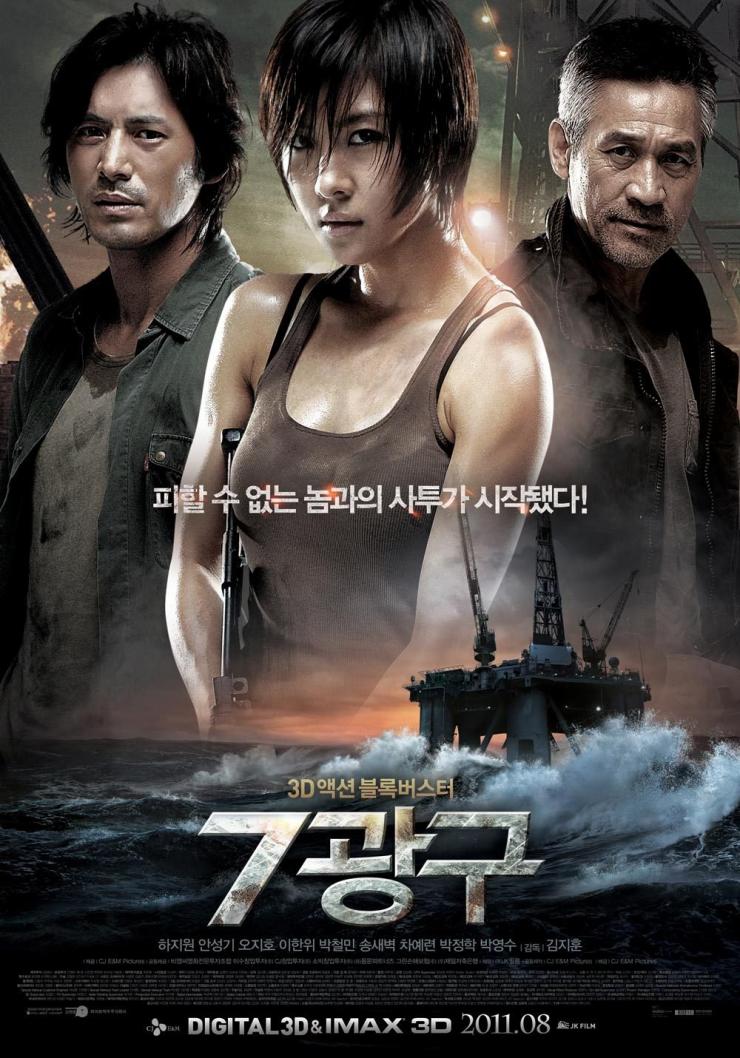
Cha Hae-joon (차해준) faces off against the monster

Sector 7 (7광구) – ★☆☆☆☆

Sector 7 (7광구)

Sector 7 (7광구)

When Sector 7 (7광구) was announced, it came with a wave of anticipation. It had a blockbuster story that resembled Hollywood fare, guaranteeing a foreign market; it had assembled some of the most popular actors in the country, including hot property Ha Ji-won (하지원) also known as ‘the Korean Angelina Jolie’; and it was to be filmed in 3D, insinuating the high level of confidence film executives had in the project.

The story, about workers on an oil rig that come face to face with a monster, had more than a few similarities with Ridley Scott’s classic Alien (1979) and had cinephiles wondering if it could compete in Hollywood and reignite international attention in Korean cinema. To be fair, the expectations were so ridiculously high that any film would have fallen short. But no-one was prepared for just how far short, and how awful, Sector 7 truly is.

On an isolated oil rig off the coast of Jeju Island, the crew are experiencing difficulties as there is no oil to be found. The supervisor (Park Jeong-hak (박정학), wants to abandon the search but is repeatedly challenged by team member Cha Hae-joon (Ha Ji-won (하지원) for his cowardice. That is, until senior official Jeong-man (Ahn Seong-gi (안성기) returns to the rig and demands the search continues until an oil well is found; yet once their objective has been achieved, members of the crew are found dead. As the crew attempt to find the murderer, the come face-to-face with a monster from the depths of the ocean.

Cha Hae-joon (차해준, Ha Ji-won (하지원) searches for the unseen killer

Cha Hae-joon (Ha Ji-won) searches for the unseen killer

The narrative itself is not an inherently bad premise, yet director Kim Ji-hoon (김지훈) continually pushes audiences’ suspension of disbelief well beyond their limits. For example, motorcycle drag racing on an oil rig appears to be a commonplace activity on this particular rig, as does the bizarre mixture of futuristic and archaic technology within it. The absurdity is not helped by the use of terrible CGI and green screen that seriously detracts an sense of logic to the proceedings. The worst is saved for the monster itself, an unbelievably poor creation that appears like a reject from a Final Fantasy video game. The monster has supposedly been forcefully evolved from a smaller creature yet bares no resemblance to it whatsoever, and exhibits an entirely different set of abilities. Luckily most scenes involving the creature are at night and in shadows, yet even then the lackluster design, movement, skin texture and so on are obviously apparent. This is all the more baffling when considering Bong Joon-ho‘s incredible monster film The Host was made 5 years earlier.

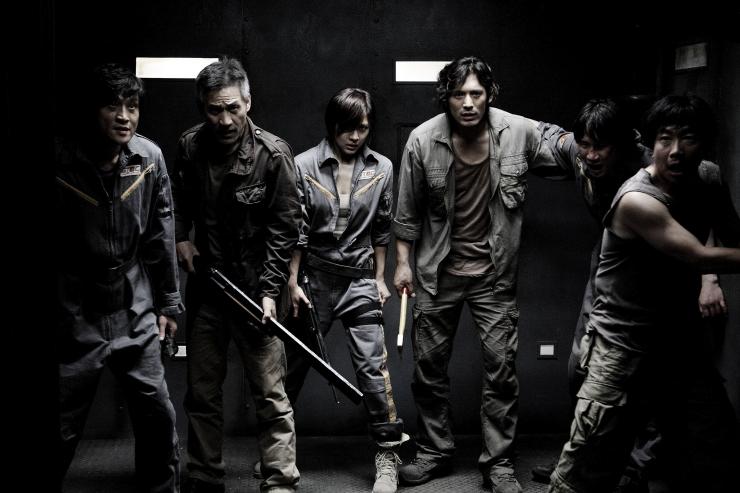
The crew must fight to survive the new menace

The crew must fight to survive the new menace

The actors portraying the tyrannized protagonists are also unimpressive, although they cannot be held fully accountable as the dialogue is woeful. Ha Ji-won is usually an actress that guarantees quality, yet even she provides an under-par performance as she schizophrenically flits from cute airhead to hardened independent woman. Her love interest played by Oh Ji-ho (as Kim Dong-soo (김동수) is so under-represented that he hardly warrants being in the film, let alone providing adequate interest as the source of her affections. Duo Park Cheol-min (박철민) and Song Sae-byeok (송새벽) are intended to add comedy to the mix however become so irritating that it’s something of a relief when they meet their demise. Park Cheol-min in particular shouts his way through his dialogue, while his compatriot merely whines. The less said about Park Yeong-soo’s (박영수) mentally ill crew member Jang Chi-soon the better. Only Ahn Seong-gi as senior crew member Jeong-man conveys credibility through his quiet-albeit-authoritative tones, yet he too succumbs to the oddities in the narrative when his supposedly true nature is revealed.

Cha Hae-joon (차해준) faces off against the monster

Cha Hae-joon faces off against the monster

Verdict:

Sector 7 is not a complete disaster, as director Kim Ji-hoon competently composes scenes and keeps the action moving at a swift pace. Apart from the awful CGI it’s clear that Sector 7 has a large budget which has been well spent on creating the mise-en-scene of an oil rig. It’s a shame that so many negative features outweigh the few scant positives, rendering a potential blockbuster into a substandard film well below the talents of all involved.

★☆☆☆☆
Reviews
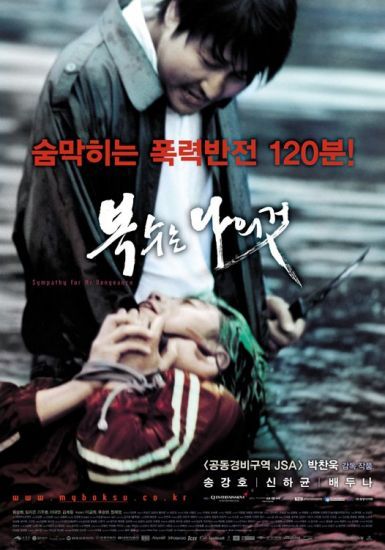
Ryu (류) wakes up to find his money, and his kidney, have been stolen

Sympathy for Mr. Vengeance (복수는 나의 것) – ★★★★☆

Sympathy for Mr. Vengeance (복수는 나의 것)

Sympathy for Mr. Vengeance (복수는 나의 것)

Anyone even remotely aware of Korean cinema understands that the theme of revenge is commonplace. There are, of course, a great number of socio-cultural reasons as to why vengeance is prevalent. Historically, Japan has brutally colonised Korea several times over the past few centuries. Following the Second World War, the then-military government oppressed the people until an uprising forced change. Then, after a democratic capitalist government took power, the race to catch up with ‘Western’ countries divided the rich and poor to an even greater degree, with traditional values altered and livelihoods destroyed in order to create infrastructure. The theme of revenge is dominant as it undoubtedly provides catharsis for a nation of people whose identity has been in a constant state of instability due to external factors beyond their control.

Director Park Chan-wook (박찬욱) explores such notions of revenge in his infamous ‘Vengeance Trilogy’ beginning with Sympathy for Mr. Vengeance (복수는 나의 것), and followed by Old Boy (올드보이) and  Lady Vengeance (친절한 금자씨) respectively.

Sympathy for Mr. Vengeance is concerned not only with revenge but the very basis and cyclical nature which it evolves into. Ryu (Sin Ha-gyoon (신하균) is deaf and mute, and lives a meager existence working in a factory. His sister (Lim Ji-eun 임지은) suffers from kidney disease and is in urgent need of a transplant. Fired from his job and distressed that his sister may die, Ryu turns to the black market and strikes a deal – he will give all his money and donate his own kidney, and in exchange he will receive a healthy kidney for his sister. Yet, when Ryu wakes up after the operation, he finds his kidney, and his money, have been stolen. Worse still, thanks to a miraculous donation a kidney is now available at the hospital, but without his savings the operation cannot commence.

Ryu (류) wakes up to find his money, and his kidney, have been stolen

Ryu wakes up to find his money, and his kidney, have been stolen

Desperate, Ryu and his anarchist girlfriend Cha Yeong-mi (Bae Doona (배두나) scheme to kidnap the daughter of his former boss Park Dong-jin (Song Kang-ho (송강호) for ransom. With the transplant money secure, the duo plan to release the girl and restore the equilibrium; yet when Ryu’s sister discovers the plot she cannot take the shame and burden, and commits suicide. Ryu and the boss’s daughter bury her body by a riverbank, but the youngster falls into the water and drowns. Sympathy for Mr. Vengeance then evolves into two separate narratives of revenge; Ryu’s quest to hunt down the black market organ dealers, and Dong-jin’s desire for vengeance over his dead daughter. Each man has lost someone special, someone who helped to define their identity and give them purpose and subsequently, as each man follows his agenda, their humanity becomes lost amid their barbarous acts of vengeance. Both Ryu and Dong-jin are good men, but are transformed into murderers due to external economic and medical forces, adding sympathy and poignancy as they lose their identity with each act of violence. The evolution of the protagonists are superbly conveyed by Sin Ha-gyoon and Song Kang-ho (송강호), the latter in particular giving a towering performance transforming from emotional businessman to hardened killer. Neither man understands the futility of their vengeance nor that the escalation of violence produces more victims that demand justice.

Dong-jin (박덩진) transforms from father to murderer

Dong-jin transforms from father to murderer

The evolution of the protagonists is masterfully constructed by director Park Chan-wook, who expertly composes each shot to reinforce the sympathy, and the insanity, of their actions. The cinematography is incredible in places, particularly in the recurrence of aerial shots that emphasize the loneliness of the men and the fragility of their humanity. Additionally, the utilisation of space and depth of field highlights their terrible position, both literally and figuratively, in horrific environments and circumstances. Ryu’s world is conveyed effectively and dramatically due to his inability to hear, as alternating POV shots establish how silent and disadvantaged his world is compared to those around him adding yet another layer of compassion to his predicament. Park Chan-wook’s presentation of violence is thoughtful and initially restrained, gradually building tension in order for graphic scenes to have the utmost impact.

Director Park Chan-wook's recurrent use of aerial shots emphasize loneliness and futility

Director Park Chan-wook’s recurrent use of aerial shots emphasize loneliness and futility

Verdict:

Sympathy for Mr. Vengeance is a fascinating exploration into the nature of revenge and violence, highlighting how two seemingly ‘good’ men can evolve into psychotic killers when they are bereaved. However, further exploration of the socio-economic problems that created the black market organ trade and the lay-offs at the factory, could have enhanced the poignancy of their predicaments further, as would have additional characterization before the crises developed. Yet despite this, Sympathy for Mr. Vengeance is a riveting and emotionally charged debate on the escalation and futility of vengeance, and how the loss of a loved one can become poison when the path of revenge is taken.

★★★★☆

Reviews