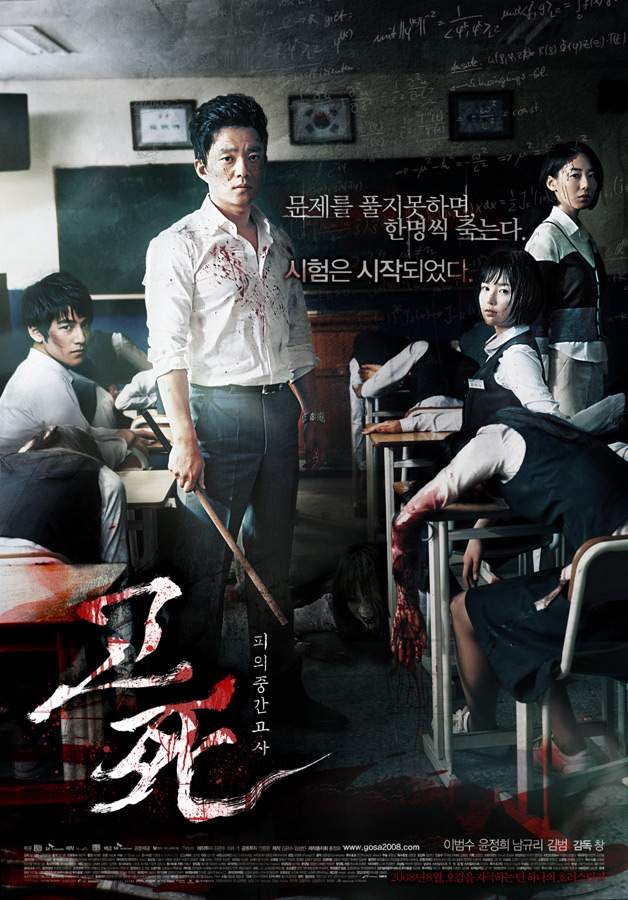
Are the corridors of the school haunted by a ghost?

Death Bell (고死: 피의 중간고사) – ★☆☆☆☆

Death Bell (고死: 피의 중간고사)

Death Bell (고死: 피의 중간고사)

The Korean education system is a brutal, arduous regime for students; in addition to the standard school hours they must attend, students also frequent numerous private academies of various subjects during the evening, slotting in further educational events whenever spare time allows. Understandably the stress and pressure imposed by the education culture – and more specifically, parents – often leads to depression and ill health, at best. Escalating matters further are the tales of corruption as parents attempt to secure the future of their offspring through bribery and ‘favors’ of teachers and officials.

Death Bell (고死: 피의 중간고사) attempts to take the grueling education system as the basis for horror, as a mysterious killer/ghost slowly murders the students of a special class. While the social commentary underpinning the film is an interesting cultural examination, director Chang (real name Yoon Hong-seung (윤홍승) has crafted a vapid, uninspiring horror film that appeals to the lowest common denominator through its ‘torture’ porn aesthetic and hyper-editing over genuine chills.

During the exam season, the students are frantically studying in an attempt to be the best in the school and secure a place in a good university. The pressure is intense and students begin to crack under the strain, yet kind teacher Hwang Chang-wook (Lee Beom-soo (이범수) tries to reassure his students; in his rival class, however, strict teacher Choi So-yeong (Yoon Jeong-hee 윤정희) pushes for the best. At the end of the exam season the relieved students prepare for vacation, yet the news of a ‘special class’ with a rival school forces the elite students to stay behind for further studies. However just as the session is due to begin, a missing student appears on TV in a death trap. The killer gives instructions that the students need to complete a series of challenges if they are to survive, and so begins a battle of wits as the students attempt to solve riddles and find the murderer before they are all killed.
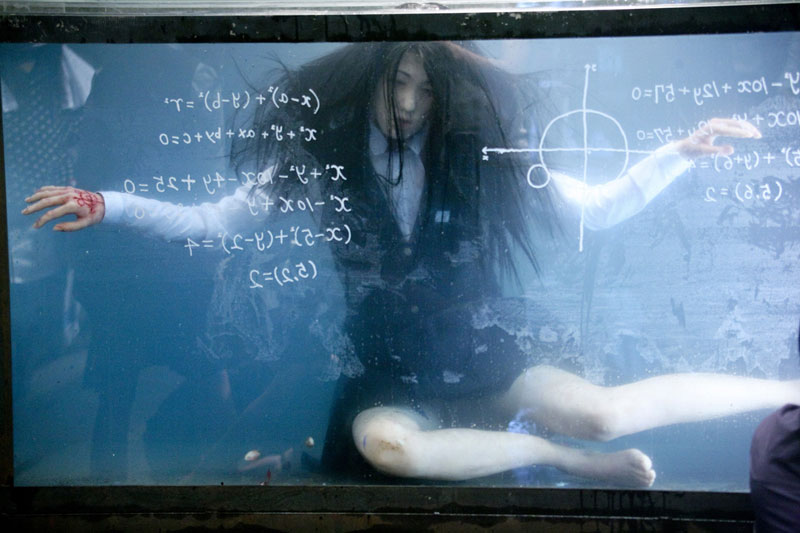
The students must solve riddles to save their classmates

The students must solve riddles to save their classmates

While a large number of horror films require the audience to suspend their disbelief in logic, Death Bell ranks amongst the worst examples of the genre for pushing it to the limits. When murdered bodies appear, no-one looks in the direction it arrived; when voices and images are broadcast, no-one thinks to look for the source; in the search for the killer, teachers regularly leave students alone to fend for themselves. Additionally, in the attempt to be ‘Saw in a high school’, Death Bell features puzzles for students to solve in a bid to save their companions yet they and their solutions are generally pointless. The writers endeavour to add meaning to the riddles and to apply a time limit to create tension, but the execution is flat and the answers are quite ridiculous, especially as student I-na (Nam Gyoo-ri (남규리) almost immediately knows who the murders are related to.

Yet horror films aimed at a teenage audience often place chilling scenes above narrative logic, and in this regard Death Bell is also limp. Bizarrely the film features ‘torture porn’ scenes such as dripping hot candle wax on a victim, and in the oddly superfluous – and unsubtly symbolic – opening sequence featuring zombified students, horror and menstrual blood are misogynistically conveyed as one and the same. In one scene, a female student is hoisted by one leg exposing her panties for no particular reason before receiving a death not in-keeping with the other murders. The female students are routinely ‘punished’ for being intelligent and, as with American horrors from the 1970s/80s, for being curious about the opposite gender. In all cases, director Chang never builds tension effectively and instead relies on rapid camera movement and editing to provide thrills, yet as it is often difficult to see anything on screen the results are generally less than impressive.

Death Bell does become interesting in the final act however, as social commentary involving the Korean education system and the roles of parents and teachers are inserted and portrayed. This late but welcome addition depicts the extent to which high grades play in Korean culture, and the lengths to which all involved will go to secure them in the highly competitive system. Unfortunately as such themes are introduced so late the potential is never truly expanded, yet it does provide some much needed impetus to events as well as tying up narrative loose ends.

Teacher Hwang Chang-wook desperately tries to protect his students

Teacher Hwang Chang-wook desperately tries to protect his students

As teacher Hwang Chang-wook, Lee Beom-soo is the central protagonist of the film and does well to keep the pace of the film moving and involving. His role is highly limited due to awfully vapid narrative, forcing him to be a reactionary figure in moments that lack logic, yet the actor performs competently and genuinely works hard to make the the premise and his situation believable. He ultimately fails due to the nonsensical script, but his effort is commendable.

The films other two lead roles fall to Yoon Jeong-hee as strict teacher Choi So-yeong and Nam Gyoo-ri student I-na. Both roles are woefully underdeveloped and leave the actresses with little to do save to convey the stereotypes they are constructed as – Choi So-yeong as a stoic disciplinarian and I-na as a vulnerable schoolgirl interested in boys. Both roles add precious little to the narrative, but the actresses competently act the stereotypes ascribed to them.

Are the corridors of the school haunted by a ghost?

Are the corridors of the school haunted by a ghost?

Verdict:

Death Bell is a dull, vacuous horror film that attempts to be ‘Saw in a high school’ but is ultimately a bland excuse to depict torture porn on teenagers. Hindering the scares further are the kinetic camera movements and editing that continually frustrate. While Lee Beom-soo attempts to make the film compelling, and the late introduction of key cultural themes try to elevate the film, Death Bell is a hollow, soulless example of the genre and is for enthusiasts only.

★☆☆☆☆

Reviews
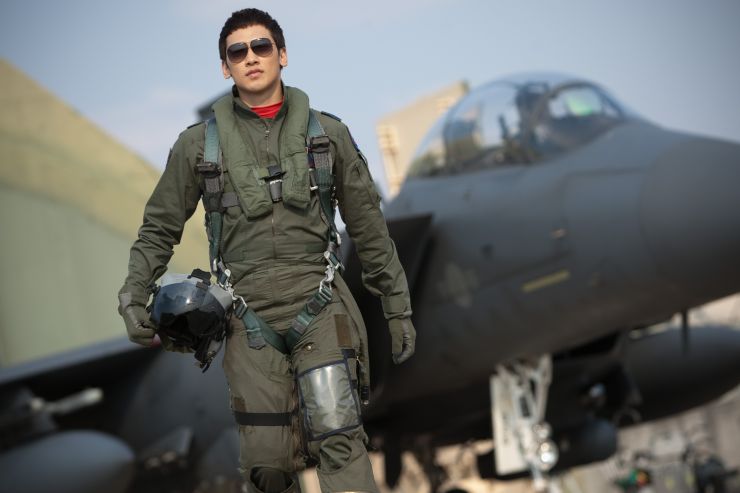
The aerial dogfights are thrilling as pilots battle over Seoul

R2B: Return to Base (R2B: 리턴투베이스) – ★★☆☆☆

R2B: Return to Base (R2B: 리턴투베이스)

R2B: Return to Base (R2B: 리턴투베이스)

When Top Gun was released in 1986, Tom Cruise and company presented aerial combat in thrilling fashion alongside a bombastic soundtrack. Despite the shallow story, the rapid high-octane action sequences, muscular homoerotic camaraderie, and zealous nationalism succinctly tapped in to the ’80s zeitgeist, resulting in an unprecedented level of applications for the American Air Force and rocketing sales of aviator sunglasses.

R2B: Return to Base (R2B: 리턴투베이스) has been marketed as ‘the Korean Top Gun‘ and rightly so as the film borders on plagiarism with scenes, characters and events almost directly ‘lifted’ from Tony Scott’s effort. Yet R2B: Return to Base has precious little of the charm of the original, only earning the title of ‘action movie’ in the final 20 minutes largely due to a reliance on TV drama-esque stereotypes and stock conflicts for much of the film. That said, the aerial sequences are indeed thrilling regardless of the logic – and physics – defying feats.

Cocky pilot Jeong Tae-hoon (Rain/Jung Ji-oon (비/정지훈) is unceremoniously kicked out of his squadron for performing dangerous aerial techniques in front of the public. Demoted into military ranks, Tae-hoon meets beautiful mechanic Yoo Se-yeong (Sin Se-kyeong (신세경) and new recruit Ji Seok-hyeon (Lee Jung-seok (이종석), as well as forming a rivalry with stoic Lee Cheol-hee (Yu Joon-sang (유준상). As friendships and camaraderie builds on base, a new threat presents itself in North Korea where a coup threatens to destabilize the peace between the nations. With tensions escalating, it’s up to Tae-hoon and Cheol-hee to set aside their grudges and work together to save South Korea from the machinations of a power-hungry Northern General and his pilots.

Tae-hoon is demoted due to his arrogance and inability to follow orders

Tae-hoon is demoted due to his arrogance and inability to follow orders

Surprisingly, for a film marketed on its action sequences, R2B: Return to Base features few sequences that excite. Aside from a fun opening that introduces hot-shot pilot Tae-hoon, the real action takes place only during the last 20 minutes during an exhilarating sequence where a rogue North Korean pilot descends on the Yeouido district in central Seoul and an aerial assault on a Northern base. Director Kim Dong-weon (김동원) clearly used the majority of the budget on such high-octane events, conveying the speed and danger of the dogfights convincingly and effectively. The aerial battle above Seoul is the genuine highlight of the film as bullets fly and windows shatter on iconic landmarks in wonderful use of slow-motion, producing an entertainingly horrifying attack on the capital city.

However for the vast majority of its running time  R2B: Return to Base plays out akin to a low-grade TV drama. All the stereotypes are present with frustrating clarity. The hero Tae-hoon has obviously been modeled on Tom Cruise’s Maverick, yet Rain/Jung Ji-hoon doesn’t have the same charisma to make the protagonist likable. Maverick’s arrogance and swagger fits perfectly with American cultural values; Tae-hoon is generally an insolent, selfish fool that defies orders for the sake of it. His love interest, in the form of Se-yeong, fares worse as she is reduced to yet another beautiful-yet-damaged female role, a woman in need of rescuing from herself despite her talents. Outside of the main two protagonists are an array of supporting cast members, so much so that precious little time is given to establish them as worthy of inclusion. Cheol-hee arguably receives the most screen-time as the rival, although his character development is stunted which dilutes the antagonism with Tae-hoon. Novice Seok-hyeon is present mainly for comedy value as he screams and faints during flights, providing entertainment. Comedy is also present in the form of two workmen fulfilling military service, but after featuring in a handful of quips they unceremoniously disappear altogether. Other co-pilots feature in the film such as Oh Yoo-jin (Lee Ha-na (이하나) and partner Jo Tae-bong (Jeong Kyung-ho (정경호), but again their inclusion is a limited attempt to add melodrama to the proceedings. All the of the characters are involved in stock narrative events that help to establish relationships but do little to propel the plot, which is conveyed as an afterthought.

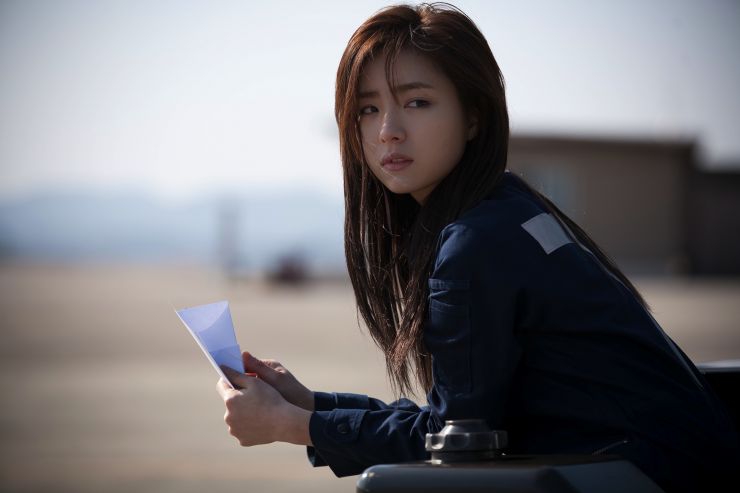
Feisty Yoo Se-yeong is the most talented mechanic on the base

Feisty Yu Se-yeong is the most talented mechanic on the base

One of the amazing features of Korean cinema is the continual representation of North Korean adversaries in three-dimensional, semi-sympathetic roles. R2B: Return to Base opts for the American approach of ‘good vs. evil’, barely giving the Northern enemies faces let alone impetus. This would perhaps not be as bad – it was a feature of Top Gun – if not for their last minute inclusion within the narrative, as suddenly a rogue Northern general launches an unprovoked attack on Seoul seemingly from out of nowhere. The assault does allow for the inclusion of Korean nationalism and masculine bravado however as the American military attempts to dominate the retaliation to embarrassing effect, as well as providing Tae-hoon and Cheol-hee with something to do other than bicker.

In terms of performance, Sin Se-kyeong is arguably the most prominent as mechanic Se-yeong. The actress has little room to extend herself given the highly stereotyped nature of the role, yet she performs well. The chemistry between her and co-star Rain/Jung Ji-hoon however is entirely absent. Rain/Jung Ji-hoon competently performs the role of arrogant pilot Tae-hoon but unfortunately he is also hindered but the script which portrays him as an immature fool rather than overly confident, a feature which his charisma tries and fails to overcome.

The aerial dogfights are thrilling as pilots battle over Seoul

The aerial dogfights are thrilling as pilots battle over Seoul

Verdict:

R2B: Return to Base desperately wants to be ‘the Korean Top Gun‘, and succeeds in as much as containing some highly thrilling and entertaining aerial sequences that convey the speed and danger of aerial dogfights. Yet such sparse combat scenes cannot hide the vacuous, TV drama-esque narrative and stereotypes that dominate most of the running time, as well as the lack of threat featured by the caricatured North Korean adversaries. With the last minute inclusion of masculine bravado and nationalism, R2B: Return to Base rises out of its quagmire yet still fails to obtain its full potential.

★★☆☆☆

Reviews
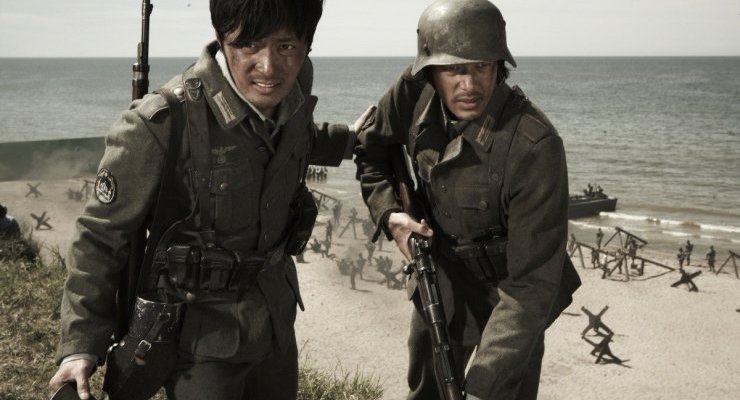
On the beaches of Normandy, Joon-sik and Tatsuo do all they can to survive

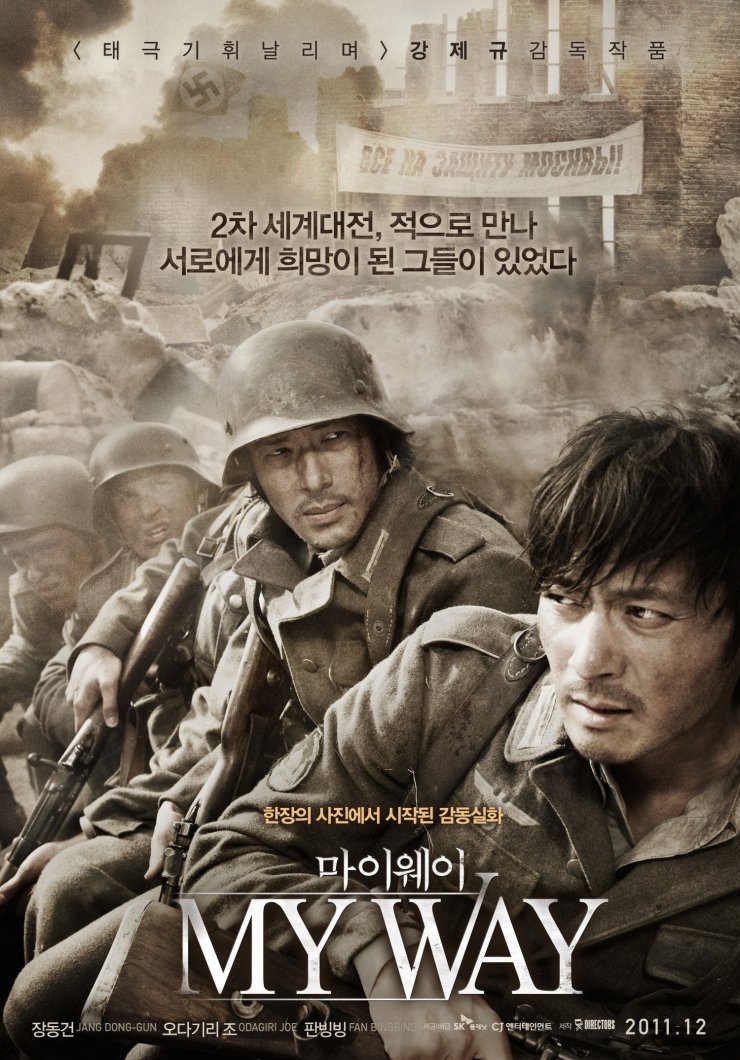
My Way (마이 웨이) – ★★★☆☆

My Way (마이 웨이)

My Way (마이 웨이)

Expectations were always going to be impossibly high for director Kang Je-gyu’s (강제규) follow up to Taegukgi. The 2004 film was revolutionary at the time, combining kinetic war scenes, an orchestral score, and strong nationalistic sentiment through the (somewhat allegorical) story of two brothers divided by civil war. Yet after a seven year hiatus the director chose to return to the war genre, bolstered by an enormous 28 billion won budget and the return of Jang Dong-gun (장동건) alongside a cast of international stars. Furthermore, his project was to be based on the mysteriously true story of the discovery of a Korean soldier during the D-Day landings in Normandy, an event still unexplained to this day. Curiosity, and expectations, naturally increased.

My Way (마이 웨이) continues the themes that have become a staple of the genre, including the notion of brotherhood and the brutality of war, albeit this time on an international scale. The grand scope and focus on historical events results in a lack of character development for the entire cast, and as such became a disappointment at the box office in Korea. However My Way boasts some of the most gloriously horrifying war sequences from Kang Je-gyu, whose vision and stylization have notably evolved from his prior films. Yet despite the spectacle, the lack of characterization and emphasis on more personal, intimate conflicts amounts to an attractive but somewhat hollow war film.

During the occupation of Korea by Japanese forces in the 1920s and ’30s, tensions are high on both sides with riots and assassinations commonplace. Despite the crackdown on the freedom of native Koreans, a rivalry emerges between two talented marathon athletes; a poor Korean rickshaw driver named Joon-sik, and rich Japanese student Tatsuo (Joe Odagiri). After Joon-sik wins a competition intended to prove the superiority of the Japanese, a corrupt ruling disqualifies the Korean athlete and rioting ensues. For their crimes, all involved in the riot are forced to become conscripts in the Japanese military. Sent to the frontline, Joon-sik and Tatsuo experience the sheer brutality of war on a variety of continents and through numerous armies, allaying their rivalry and instead forging the bonds of brotherhood.

Following a riot after a corrupt marathon decision, Joon-sik and his friends are forced to become conscripts in the Japanese army

Following a riot after a corrupt marathon decision, Joon-sik and his friends are forced to become conscripts in the Japanese army

My Way is a stunningly realized film, recreating the landscape of 1930s Korea as well as Asian and European battlegrounds with incredible realism. The mise-en-scene is wondrous throughout the film and deeply absorbing, from scenes such as Joon-sik racing throughout the streets of Korea with a rickshaw, to a grueling winter imprisoned in a Russian concentration camp, to being caught in a crossfire involving the Nazis. The variety of events and landscapes are genuine highlights of My Way as Kang Je-gyu showcases his talent in recreating historical scenes with superb attention to detail, moving from one location to the next with impetus. The camerawork and frenetic action sequences are exquisitely brutal, genuinely conveying the horrific incidents soldiers were forced to endure and as the landscape and military units continually change such sequences never become tiresome or dull. Yet therein also lies the greatest difficulty of the film, as while great emphasis is placed on moving the protagonists from Korea to Normandy the characterization is an afterthought, making the harsh war scenes stunning but without an emotional core. Joon-sik is very much the centre of the film, and while likable, has little-to-no reason to want to return home other than to continue running competitively. His journey is thus undermined, although his Korean compatriots suffer far worse as they are barely given an introduction before they are ruthlessly dispatched by the enemy in trying to create dramatic tension. The narrative does deserve credit for broaching the subject of brotherhood between Korea and Japan through Joon-sik and Tetsuo, attempting to convey a form of reconciliation and alleviating tensions between the two nations. But again, the pace of the narrative allows precious little space for their brotherhood to develop, which is of acute importance given their mutual hatred at the start of the film. As such the intimacy between Joon-sik and Tetsuo is (quite romantically) melodramatic and uplifting, yet also contrived.

The narrative does however explore the interchangeability of bloodthirsty inhumanity during the course of the film, and the corruption that power seemingly inevitably brings. Given the tumultuous history between Korea, Japan and China, depicting scenes of Japanese brutality are certainly nothing new; however Kang Je-gyu portrays the forces not only as barbaric but downright fanatical as soldiers are ordered on suicide missions for the glory of the empire or shot upon retreat. What may seem like the stirring of Korean nationalistic sentiment is allayed by the contrasts with Russian and German troops, all of whom convey the same ideological stance during battles. My Way blurs the boundaries of nationality in conveying the merciless nature of warfare, portraying all parties as equally accountable. The representation of German troops is quite perplexing however, as the kind, relaxed and joyous soldiers stands in stark contrast to the annals of history.

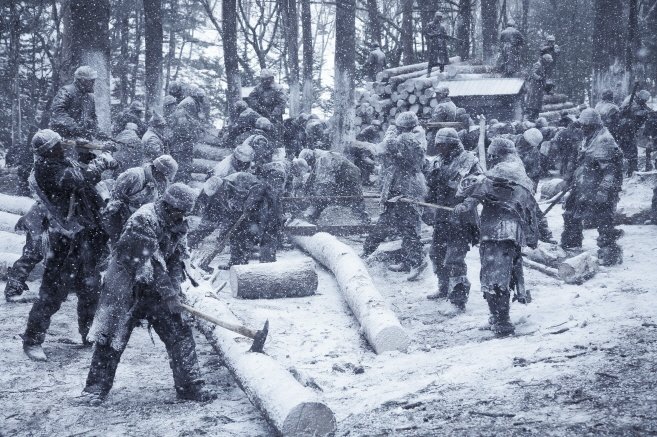
Joon-sik and Tatsuo find themselves working in a Russian concentration camp

Joon-sik and Tatsuo find themselves working in a Russian concentration camp

As Korean marathon runner Joon-sik, Jang Dong-gun (장동건) gives a highly capable performance although he is never stretched in the role. The actor conveys all the necessary emotions during the horrors of war and attempts to provide a heart to the film despite the limitations of the script. He is highly likable and attempts to shine a light of humanity during scenes of war as the narrative intends, but Jang Dong-gun’s presence is generally to give focus to the impressive battle sequences that rage around him. While battles commence on land, sea and air in spectacular fashion, the actor is usually running through the middle of the conflict giving scale and someone to root for as he takes the audience into the midst of war.

Interestingly it is Japanese actor Joe Odagiri as student/marathon runner Tatsuo that has the greatest character arc in My Way. From angry student to fanatically patriotic military officer to brother, the actor gives a competent performance throughout although as with his co-star Joe Odagiri is not stretched in the role. The film is very much his story due to his character evolution, and provides an interesting counter-balance to those featuring Jang Dong-gun.

As for famed Chinese actress Fan Bing-bing, it is a wonder why she choose to be part of the film at all given her incredibly short time on camera as Chinese sniper Sirai. She performs admirably, although she is ultimately just a device to spur the narrative forward.

On the beaches of Normandy, Joon-sik and Tatsup do all they can to survive

On the beaches of Normandy, Joon-sik and Tatsuo do all they can to survive

Verdict:

My Way is an incredible spectacle of a war film, with continually stunning sequences of war and featuring breathtaking cinematography in a variety of landscapes. Director Kang Je-gyu has clearly used the enormous budget to produce some of the most effective scenes of battle in recent memory, with the scope and scale allowing his vision to evolve tremendously. That said, the focus on visuals results in a lack of characterization making the depiction of war rather deprived of an emotional core, and audience interest by extension. My Way is a visually impressive, although somewhat hollow, tour de force and a notable entry in the war genre.

★★★☆☆

Reviews
Ik-hyeon settles into his 'gangster' role with ease

Nameless Gangster (범죄와의 전쟁: 나쁜놈들 전성시대) – ★★★☆☆

Nameless Gangster (범죄와의 전쟁: 나쁜놈들 전성시대)

Nameless Gangster (범죄와의 전쟁: 나쁜놈들 전성시대)

Gangster ‘epics’ are not films that merely present bad men doing bad things; on the contrary, the ‘epicness’ of the films are due to the ways in which producers tell the story within the wider context of the socio-cultural period, conveying a national uniqueness alongside the themes of brotherhood, betrayal, and the escalation of violence. While there are numerous contemporary directors such as Guy Ritchie, Francis Ford Coppola and Michael Mann that fit this paradigm, the most notable figure in this regard is the legendary Martin Scorsese who besets his conflicted protagonists with problems from all sides, masterfully building tension to a poignant crescendo.

With Nameless Gangster (범죄와의 전쟁: 나쁜놈들 전성시대) writer/director Yoon Jong-bin (윤종빈) seemingly attempts to emulate Scorsese, featuring a similar rags-to-riches and fall-from-grace narrative structure. Yet there the comparisons end as while the story is distinctly Korean and multi-layered, and the directing competent, the lack of flair, tension and an over-abundance of secondary characters halt Nameless Gangster from achieving excellence. However, alongside the sumptuous costume and set design the film sports a fascinating perspective on the evolution of crime in Korea, and the struggle to combat corruption in contemporary society.

In the month of October, 1990, President Roh Tae-woo launches a crackdown on corruption and crime in South Korea, giving the police and prosecutors special powers to arrest those involved in the criminal underworld. For the port city of Busan this presents an acute problem, and as gangsters are forced to lie low the incarceration of infamous Choi Ik-hyeon (Choi Min-sik (최민식) is an enormous victory for prosecutor Jo Beom-seok (Kwak Byeong-gyoo (곽병규). Yet the criminal simply refuses to admit any wrongdoing despite overwhelming evidence to the contrary. In order to fully uncover the truth, the journey must begin back in 1982 when Ik-hyeon was a mere corrupt customs official, exploring the relationships that were forged – particularly with notorious criminal Choi Hyeong-bae (Ha Jeong-woo (하정우) – during the golden age of the gangster lifestyle in Korea.

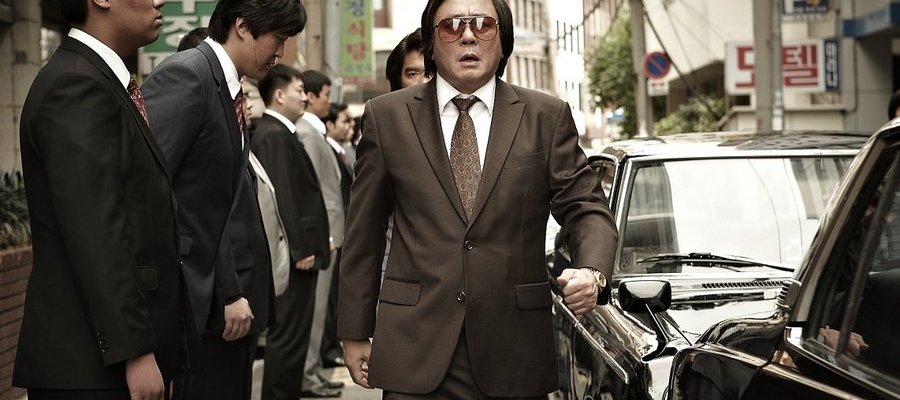
Ik-hyeon settles into his 'gangster' role with ease

Ik-hyeon settles into his ‘gangster’ role with ease

Nameless Gangster is surprisingly less a film about gangsters and more a film about the evolution of corruption in Korean society, personified through smarmy central protagonist Ik-hyeon. Originating as a corrupt customs official, Ik-hyeon – and the entire customs department – are directly in the firing line of the government crackdown on crime, the penalty for which is placed squarely on Ik-hyeon’s shoulders. Yet despite being a dishonest and unscrupulous reprobate, Ik-hyeon is quite a charismatic and lovable rogue due to the performance of acting legend Choi Min-sik. Bizarrely Choi Min-sik exaggerates and overacts the character throughout the film but incredibly manages to convey this as part of Ik-hyeon’s personality, an appealingly silly man who constantly oversteps his boundaries to the chagrin of all involved. The subtly seductive performance blurs the lines between the gangster and comedy genres as Ik-hyeon simultaneously charms and smites those around him, juxtaposing laugh-out-loud moments with brutality, reminiscent of scenes within Scorsese’s Goodfellas from which the film borrows heavily. However these moments never quite achieve the shocking impact they should. Writer/director Yoon Jong-bin (윤종빈) writes the scenes incredibly well and has highly competent vision, yet somehow fails to capture the tension that such scenes demand, with the slow build of suspense and apprehension curiously absent. Violence, too, is also problematic within Nameless Gangster through the lack of escalation. While it would be absurd to expect Americanized gun crime within such a distinctly Korean gangster film the repetitive nature of the clashes, commonly involving baseball bats and glass bottles, quickly becomes bland and lessens the severity such confrontations should convey.

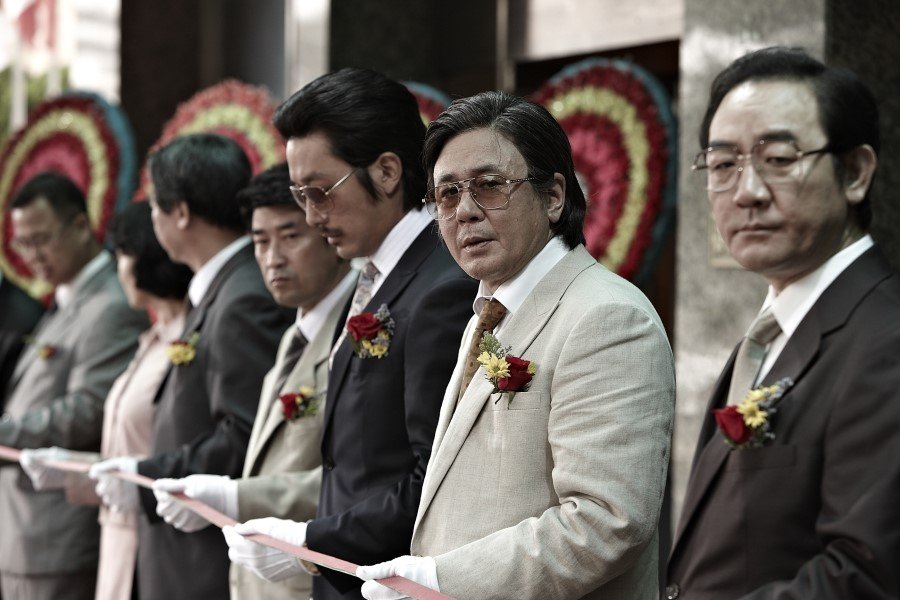
Violence enters the narrative through the introduction of Choi Hyeong-bae, a lifelong gangster with whom Ik-hyeon shares common ancestry. It is through their relationship that Nameless Gangster truly shines, as the bumbling Ik-hyeon forges ties with an incredible variety of powerful strangers due to mutual heritage – and seniority – in order to create a criminal empire, constructing a fascinating insight into the multifaceted nature of corruption in Korea. Director Yoon Jong-bin’s narrative strength lies in the comically awe-inspiring Ik-hyeon as he weasels his way into the good graces of politicians, law-makers and international crime syndicates, resulting in a meteoric rise from crooked customs official to one of the most dangerous gangsters in Busan. While Ik-hyeon provides the connections it is Hyeong-bae, wonderfully performed by Ha Jeong-woo, who commands the muscle. Hyeong-bae is stoic, authoritative and deadly, conveying restrained violence and potential danger with every movement and gesture, the true gangster of the partnership. The stark contrast between the two, as well as Ik-hyeon’s unerring manner for overstepping boundaries, provides the catalyst for the introduction of a third party in the form of rival gangster Kim Pan-ho (Jo Jin-woong (조진웅). In another nod to past gangster epics in the form of Scorsese-esque triumvirates, Pan-ho ultimately fails to be a convincing protagonist due to serious underdevelopment, undermining him as a credible threat both within the narrative and to consummate gangster Hyeong-bae.

Hyeong-bae is the consummate gangster - stoic, powerful, and deadly

Hyeong-bae is the consummate gangster – stoic, powerful, and deadly

With a strong narrative and competent direction, Nameless Gangster also benefits from having sumptuous costume and set design. The world of 1980s Busan is eloquently portrayed and wonderfully realized, absorbing the audience within the chic decor and lifestyle from humble homesteads to bars to casinos.

In terms of performance both Choi Min-sik and Ha Jeong-woo play off each other well, with the latter giving the stand-out portrayal as hard-boiled gangster Hyeong-bae. The stoicism of the character coupled with the restrained threat of violence is an absolute joy and contributes greatly in conveying tension, which is sadly underutilized within the narrative and direction. Choi Min-sik, on the other hand, is highly charismatic as Ik-hyeon despite being a tad overzealous throughout. The actor conveys the foolish nature of the man incredibly well, yet the scenes in which Ik-hyeon demands power and authority unbecoming to him that are the most revealing, conveying a man desperate for control in a universe which resolutely refuses him.

The rest of the cast are used in supportive roles and are either generally underdeveloped, such as gangster Pan-ho and prosecutor Jo Beom-seok, or simply redundant, such as club Manager Yeo (Kim Hye-eun (김혜은) or brother-in-law Seo-bang Kim  (Ma Dong-seok (마동석). This is unfortunate, as had the roles been greater (or jettisoned) the web of threat and deception would undoubtedly be much stronger as in Ryoo Seung-wan‘s The Unjust; as it stands, they are rather limp additions in an otherwise well-written screenplay about societal corruption.

Through creating links and contacts, Ik-hyeon helps expand the criminal empire

Through creating links and contacts, Ik-hyeon helps expand the criminal empire

Verdict:

Nameless Gangster is a compelling and fascinating film about the nature, and evolution, of crime and corruption in Korea. With an absorbing narrative, wonderful set and costume design, and entertaining performances, the film is generally let down by the lack of tension and suspense, as well as underdeveloped characters. That said, Nameless Gangster is an enjoyable yarn of power and social relationships in a country still struggling to shake off the ramifications of the war on crime.

★★★☆☆

Reviews
17 year old Eun-gyo is a naturally charismatic young woman

A Muse (은교) – ★★★☆☆

A Muse (은교)

A Muse (은교)

An age gap between lovers can make for incredible drama as the couple step outside preconceived notions of what is deemed socially acceptable in a relationship. The seminal film The Graduate (1967) is the most prominent in this regard which, while comical, also conveyed the ideological differences between generations. In Korea such themes have also played out, most notably in Kim Ki-young’s exemplary 1960 classic The Housemaid (하녀), while more contemporary offerings have arrived in the form of Kim Ki-duk’s The Bow (활) and Yang Ik-joon’s Breathless (똥파리). While each film approaches the subject differently they all exhibit the conflict that arises between youth and maturity, attraction and repulsion, desire versus social acceptance.

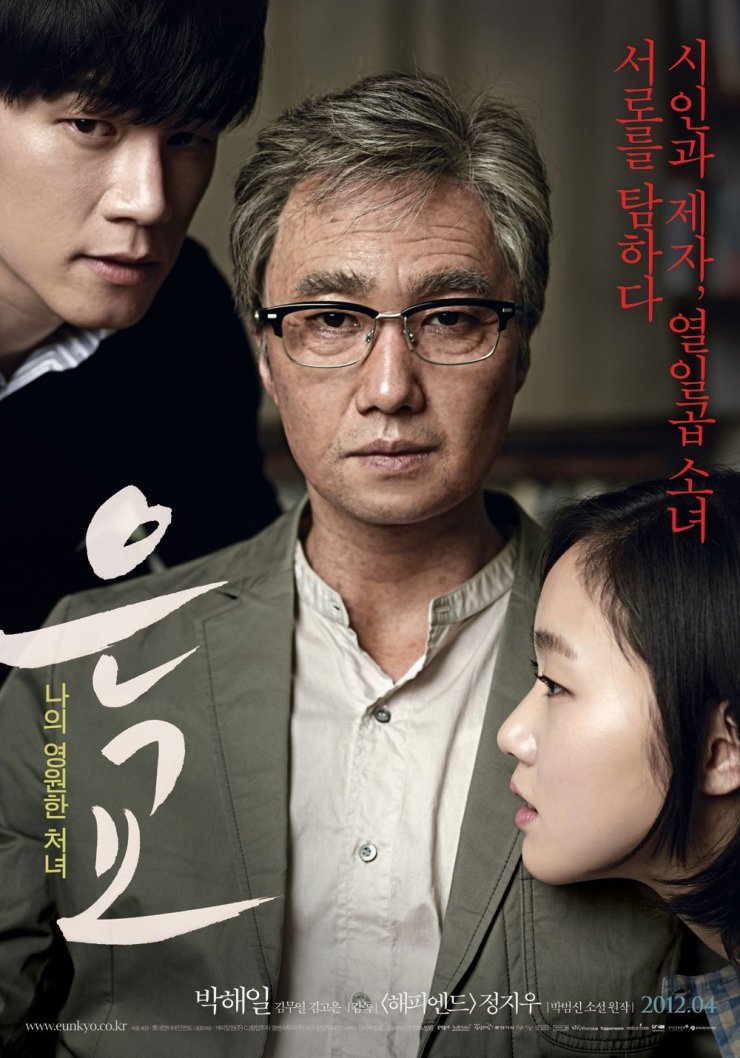
A Muse (은교), directed by Jeong Ji-woo (정지우), provides a gently poetic, emotionally fraught, and symbolic take on the romantic theme, in keeping with his back-catalogue. The exploration of the relationship between the three central protagonists contains poignant depth, bolstered through an interrogation regarding the nature of age and talent. However, the film is also somewhat hampered by the casting of Park Hae-il as an old man, while the constant fetishization of Eun-gyo’s body – rather than her mind and spirit – undermines the purity of their relationship.

As a poet and national icon, elderly Lee Jeok-yo (Park Hae-il (박해일) has enjoyed incredible success, even preparing for a museum to be constructed in his honor. Yet now is the time for his young apprentice Seo Ji-woo (Kim Moo-yeol (김무열) to shine as his new novel becomes an incredibly popular and rapid bestseller. However their lives, and their relationships, are drastically altered when a young girl named Han Eun-gyo (Kim Go-eun (김고은) visits their home, charming them both with her youthful vitality and curiosity.

17 year old Eun-gyo is a naturally charismatic young woman

17 year old Eun-gyo is a naturally charismatic young woman

While A Muse takes quite some time in establishing the life of poet Jeok-yo and that of his student Ji-woo, the inception of Eun-gyo – also the name of the original Korean title – distinctly elevates the film and gives it direction and purpose. Director Jeong Ji-woo does an incredible job of constructing Eun-gyo as an intoxicating protagonist, a young woman whose youth, energy and curiosity are infectious and spellbinding. However, the most prominent form in conveying such devotion is through the fetishization of her body, featuring close-ups of her skin and various body parts, sexualizing Eun-gyo to the point of worship. With the knowledge that Park Hae-il portrays the elderly poet, such scenes are (despite the misogyny) tender and romantically sexual, yet had an actor of the correct age performed the role perversity would undoubtedly enter critical debate. Luckily Jeong Ji-woo also emphasizes the emotional and spiritual connections between the two, and that Jeok-yo desires Eun-gyo’s youth, purity and innocence as much as her physique, as she is in turn attracted to his depth of character and devotion. Age may suggest otherwise but they are kindred spirits, and sequences in which they strengthen their bond are heartwarming and endearing, particularly during the soft-focus scenes where Jeok-yo imagines himself as a young man. Their relationship is in stark contrast to those involved with Ji-woo, who worships Jeok-yo as a respected surrogate father and idolizes Eun-gyo due to their similar ages and as someone who can heal his loneliness. The director is highly intelligent in constructing each relationship as distinctly different entities, evolving each subtly and with realism as jealousy and desire intermingle with love and affection. However as Ji-woo is certainly the less developed of the three he perhaps unfairly falls into a villainous category, rather than a conflicted young man.

Romance and personal connections inform the exploration of age within A Muse, which is arguably the central concern of the narrative. The depth, symbolism and subtlety are eloquently conveyed as each protagonist gradually reveals their shortcomings seemingly ascribed through age. Jeok-yo, having lost his youth, uses Ji-woo and Eun-gyo as agencies through which to live again, contrasted with Ji-woo’s competitive masculine nature  and Eun-gyo’s innocence and curiosity. What is fascinating throughout the narrative are the ways in which each protagonist views things differently and the ways in which they display emotion and respect, allowing audiences to genuinely understand them and their motivations. As such, when the film ends, the tragic fallacies and the impact of events linger and resonate long, long after the final credits.

Jeok-gyo and Eun-gyo share intimate moments

Jeok-yo and Eun-gyo share intimate moments

Kim Go-eun gives the stand out performance within A Muse as high schooler Eun-gyo and is enthralling. The actress inhabits the role completely, conveying innocence, curiosity and vitality with genuine charisma forcing audiences to adore her as much as the protagonists do. Kim Go-eun’s charismatic performance is such that it is easy to forget her age and occupation, drawing spectators in with her enthusiasm and smile whilst also sympathizing with her as the unwitting catalyst in a love triangle. Passionate scenes are also sincere, and while the constant fetishization of her body occasionally undermines her character Kim Go-eun utilizes her physicality to convey a range of emotions depending on who she is with.

As always Park Hae-il gives a highly competent performance as elderly poet Jeok-yo. His casting is odd but understandable given the sexual scenes and fetishization of his love interest’s body, but it is difficult not to think that an older actor would have lent more credibility to the role. There are certainly a lot of actors of this age group in Korea that are incredibly talented, as Lee Chang-dong’s sublime Poetry, and Choo Chang-min’s Late Blossom, highlighted. In any case, Park Hae-il portrays the stoicism and loneliness of Jeok-yo well, conveying the evolution of the character subtly and organically. However there are several occasions where the actor is clearly trying to act like a senior citizen to the detriment of the scene, distractions in an otherwise competent display.

Kim Moo-yeol, despite receiving the least amount of screen time, portrays the role of jealous young author Ji-woo competently. The driven and arrogant nature of the character is performed well, as is his complete lack of understanding in regards to the depth of both Jeok-yo and Eun-gyo. Ji-woo’s love/hate relationship with them both is also interesting to watch unfold and is never contrived, resulting in a slow build of tension just waiting to erupt.

Eun-gyo also attracts the attention of prodigy Ji-woo

Eun-gyo also attracts the attention of prodigy Ji-woo

Verdict:

A film of great depth and symbolism, A Muse is an eloquent exploration of the nature of age, love, and relationships. While the fetishization of Eun-gyo’s body tends to undermine the spiritual connection between her and Jeok-yo, with Park Hae-il’s casting simultaneously helping to alleviate the sexualization as well as being an oddity, the film succeeds on the strengths of a wonderfully character driven narrative  and a superb debut by actress Kim Go-eun. With the subtle, organic and romantic performances and directorial style, the themes explored within A Muse will undoubtedly resonate with audiences long after the finale.

★★★☆☆

Reviews