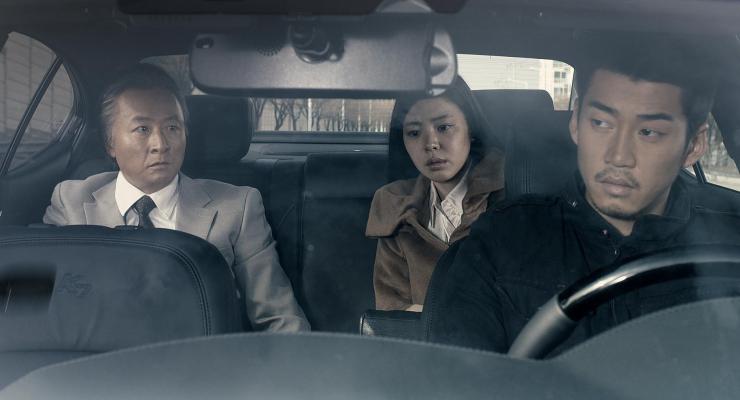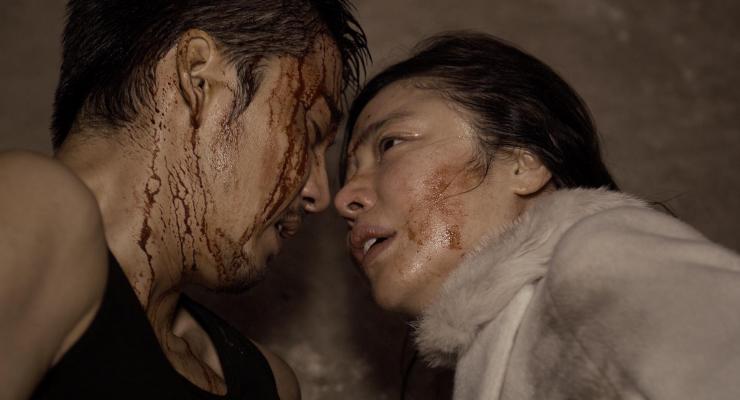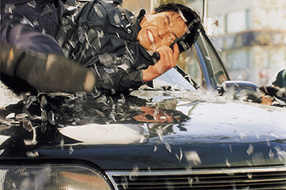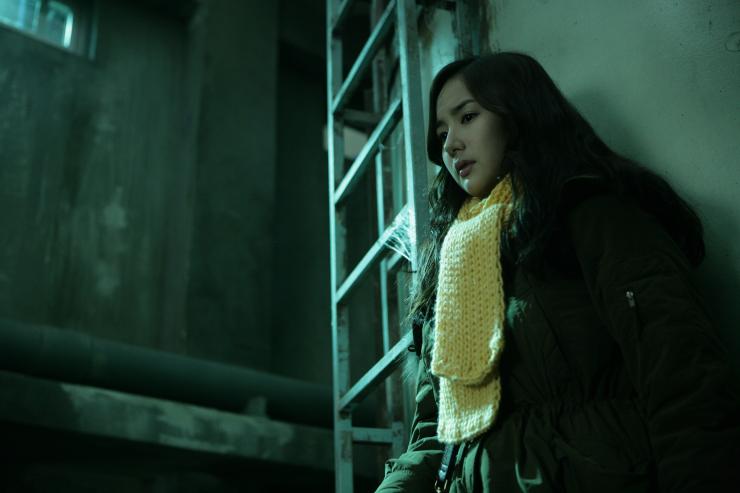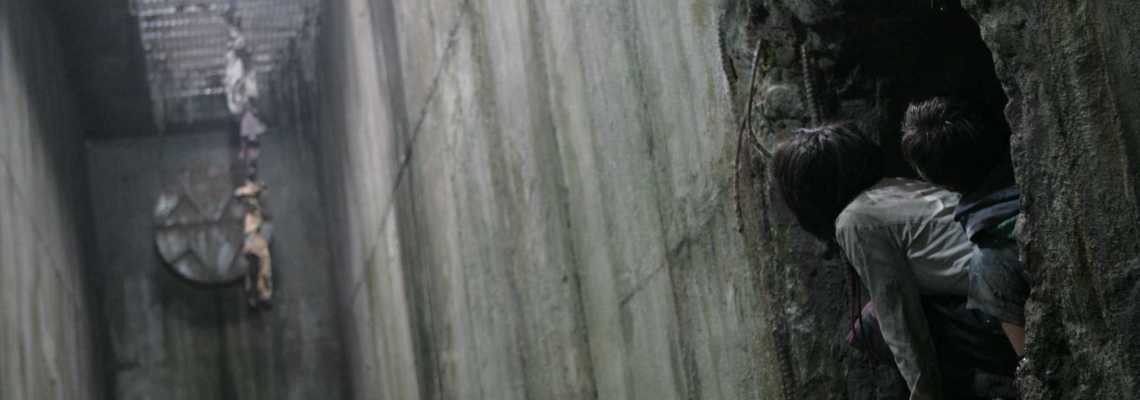
Hyeon-seo is taken to the monster's lair

The Host (괴물) – ★★★★★

The Host (괴물)

The Host (괴물)

The introduction of Godzilla in 1954 was a masterstroke. The monster directly tapped into the fears and anxieties of the Japanese populace following the American atomic bomb attacks on Hiroshima and Nagasaki, and the potential ramifications of the nuclear fallout. The popularity of the iconic character was instant, while the enduring legacy of Godzilla has remained due to the still underlying apprehension surrounding nuclear technology.

Ironically, a similar fate was to occur with neighbouring South Korea. In 2000, the American military dumped 20 gallons of formaldehyde into drains which flowed directly into the Han River, the source of drinking water for the entire population of Seoul. The enormity of the public outcry was such that the U.S. military gave it’s first public apology since the Korean War, yet it did little to assuage public opinion. Enter The Host (괴물), a film that – similar to Godzilla – uses the true story as a basis for a narrative which introduces a monster into the midst of Seoul, amalgamating the fears, angers and anxieties of the society into the monstrous beast. ‘괴물’ is translated as ‘monster’, the source of the horror. However, far more interesting (and multi-layered) is the English title ‘The Host’. ‘The Host’ refers to the Han River which harbours the monster, but is also symbolic of Korea for ‘hosting’ the U.S. military (arguably another source of ‘horror’ due to creating the monster and perceived imperialism). The multi-layered title is reflected within the narrative, and it is such complexity that makes The Host one of the best science-fiction films of all time.
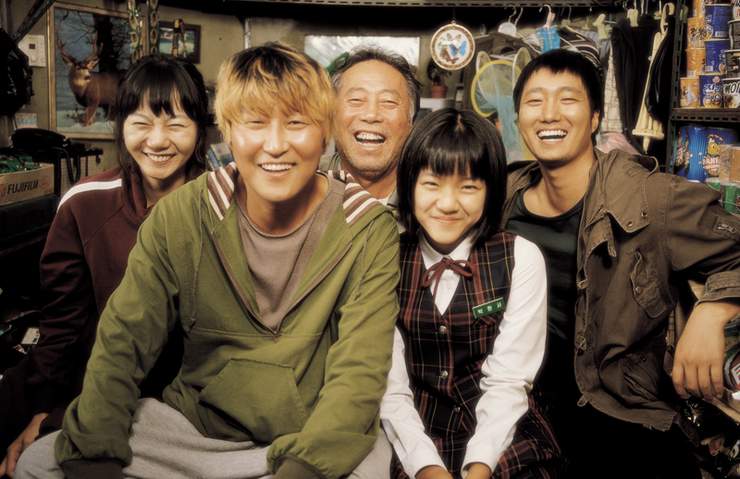
The 'average' Seoulite family

The ‘average’ Seoulite family

The Host depicts the dysfunctional Park family, who are more a collection of individuals due to their differing personalities and interests. The slacker of the family, Gang-du (Song Kang-ho (송강호) works at a convenience store with his diligent father Hee-bong (Byeon Hee-bong (변희봉) on the banks of the Han River. Living with them is Gang-du’s daughter Hyun-seo (Ko Ah-seong (고아성) a middle school student who dislikes her father’s laid-back attitude. One day whilst serving customers, a mutated amphibious fish monster emerges from the river wreaking havoc. Gang-du and an American soldier bravely try to stop the monster from eating people, but during the struggle the soldier is gravely injured as the monster tries to consume him. Wounded by Gang-du, the monster runs back to the safety of the Han River and snatches the unaware Hyun-seo on the way. With Hyun-seo believed dead, the Gang-du is joined by his salaryman brother Nam-il (Park Hae-il (박해일) and archer sister Nam-joo (Bae Doona (배두나) in mourning. However, the American soldier is reported in the media as having a new strain of disease due to contact with the monster, and the military immediately incarcerate and quarantine the entire Park family against their will. That night, Gang-du receives a phone call from Hyeon-seo who is trapped in the monster’s sewer lair, and as the military refuse to help, the Park family resolve to escape their imprisonment and find Hyeon-seo before it’s too late.

Gang-du and Hyeon-seo run from the monster

Gang-du and Hyeon-seo run from the monster

Director Bong Joon-ho (봉준호),  who also co-wrote the film with Ha Joon-won (하준원), Joo-byeol (주별) and Baek Cheol-hyeon (백철현), has crafted a magnificent and multi-layered film that examines an incredible array of socio-cultural anxieties within Korean society. The Park family are a microcosm for the disparate identities and labour forces within Korea. Grandfather Hee-bong represents the hard-working older generation; Gang-du exemplifies the manual labour force; Nam-il constitutes the university-students-turned-office workers; Nam-ju represents women in Korea, hesitant to display their power and talent; and Hyeon-seo embodies the innocence of the younger generations. As such the family unit is allegorical of Korea itself, emphasising that for the family/Korea to succeed in killing the monster and saving their daughter/youth, they must forgo their differences, come together and work as one. The ‘monster’ the family must defeat is somewhat ambiguous. The mutated animal is the most obvious example, yet the media is equally as monstrous in inspiring panic throughout the citizens of Seoul, reports which are ultimately lies. Behind those lies are the American government and military who use the panic to their advantage, expanding American influence/imperialism and releasing ‘Agent Yellow’ (a not-so-subtle reference to toxic Agent Orange) into the atmosphere, which does little except to add further poison to the atmosphere. Korean society is also interrogated by depicting bribery and the traitorous actions of office workers due to their escalating debt. Director Bong Joon-ho (봉준호) continually references the multitudinous ‘monsters’ the family confront through a variety of representational devices, serving to add astonishing political and socio-cultural depth within the narrative.

Hyeon-seo is taken to the monster's lair

Hyeon-seo is taken to the monster’s lair

The blending, and subversion, of genres is seamless. Most science-fiction films tend to refrain from fully revealing their antagonist until the final acts, surrounded by darkness to both convey suspense and hide the limitations of CGI. Not so in The Host, which has one of the most staggering introduction sequences ever constructed for a monster, all during the bright daylight hours. The rampage is truly astounding, and Bong Joon-ho employs a variety of techniques in capturing the the monster’s behaviour and the panic of the crowd. The actors are, as one would expect from such highly talented individuals, perfect in capturing the essence of their respective protagonists, conveying powerful performances that virtually command attention and empathy. With so many narrative devices included, it’s astonishing how each protagonist also manages to evolve throughout the film, leading to a socialist-esque finale in which they all overcome their flaws to fight as one with the proletariat landing the final blow.

Gang-du squares off against the monster

Gang-du squares off against the monster

Verdict:

The Host is an incredible film, and highlights the sheer talent and innovation of all involved. While it is unashamedly mainstream, the film never falls into cliche or parody as is often the case in the genre. Instead, The Host employs layers upon layers of political and socio-cultural subtext that adds phenomenal depth to an already highly entertaining premise, and cannot be recommended highly enough.

★★★★★

Reviews
The intimacy is created through honest action, rather than empty promises

Poongsan (풍산개) – ★★★☆☆

Poongsan (풍산개)

Poongsan (풍산개)

There has been a noticeable ideological shift in the representation between North and South Korea in recent cinematic productions. While the late ’90s inaugurated a period where the differences between the people were rendered moot (as exemplified by Shiri (쉬리)JSA – Joint Security Area (공동경비구역 JSA)  and Taegukgi (태극기 휘날리며), the past few years have appropriated a nihilistic approach that represents both sides as equally corrupt. The Front Line (고지전)Dance Town (댄스 타운) and even insanely popular TV drama City Hunter (시티헌터) have all subscribed to such representations, depicting government and military officials, and even citizens, as either equally underhanded or worse than their northern counterparts. Poongsan (풍산개) joins this trend, examining the lives of those caught between the ideological conflict in an interesting, albeit haphazard, style.

Poongsan tells the story of an unnamed man who regularly risks his life by crossing the De-Militarized Zone at the request of families on either side. He becomes know as ‘Poongsan’ (Yoon Kye-sang (윤계상) after the brand of cigarettes he smokes, and passes letters, videos, trinkets, and in special cases, people. Concurrently South Korean agents are pressuring a high ranking North Korean defector (Kim Jong-soo (김종수) for information, which he claims he cannot provide without his girlfriend In-ok (Kim Gyoo-ri (김규리) who still lives in The People’s Republic. The agents charge the DMZ runner with finding and retrieving the woman, yet on their dangerous return an unshakeable bond forms between them. On their arrival in the South,the double-crossing South Korean agents and North Korean spies vie for control over the lives of the defector, his girlfriend and the runner, leading to a deadly showdown.

Poongsan and In-ok cross the DMZ to the South

Poongsan and In-ok cross the DMZ to the South

While directed by his protege Juhn Jai-hong (전재홍), Kim Ki-duk’s (김기덕) indelible stamp is firmly cemented in Poongsan due to his dual role as writer/producer. The nameless DMZ runner, who never utters a word of dialogue during the entire course of the film, has more than a little in common with the lead in prior film 3-Iron (빈집). ‘Poongsan’ never talks, rather allowing his actions to convey his personality and pure intentions. If there is an ‘enemy’ in the film it would be ‘words’. The spies within the film continually offer empty promises and the rhetoric they spout is interchangeable. Worse still is that once the rhetoric has finished, both sides engage in horrific barbarous torture methods that reveal a twisted sadism within the agents. Even the past times of the agents are the same; the southern agents visit a hostess bar for the northern prostitutes, and the northern agents frequent a bar for southern working girls. The high ranking North Korean defector is portrayed similarly, initially conveying love and adoration for his girlfriend which later reveals itself as passive-aggressive misogyny. His vital report is also of note, as the defector understands the nature of his situation – once his document is submitted, his own life will be forfeit despite the security insisting otherwise. Only the silent ‘Poongsan’ and In-ok are represented as innocent and genuine, the true victims of the ideological warfare that continues to divide the populace.

Poongsan, In-ok, and the defector are caught between agents from both countries

Poongsan, In-ok, and the defector are caught between agents from both countries

As is often Kim Ki-duk’s style, the narrative veers in different directions unexpectedly yet still serves to emphasise the underlying socio-cultural critique. A wide array of alternating generic features are employed to this end, however they tend to distract from the deconstruction of the north/south opposition rather than enhance it. In addition, leaps are taken with suspension of disbelief in several areas. For example, the romance between ‘Poongsan’ and In-ok begins organically enough yet somehow jumps into a timeless intimate love; similarly, ‘Poongsan’ is a veritable one-man army who seemingly recovers from grave wounds with ease. The final showdown involves the highly idealised event of locking both factions of agents in a room to settle the dispute once and for all, which is an interesting premise yet merely serves to highlight their cowardice and lacks intensity. As the chief protagonist, Yoon Kye-sang (윤계상) gives a competent performance as ‘Poongsan’, a difficult task given the inherent stoicism. Unfortunately ‘Poongsan’ is, in the latter half of the film, relegated to being a supporting actor as the political themes take precedence.

The intimacy is created through honest action, rather than empty promises

The intimacy is created through honest action, rather than empty promises

Verdict:

Poongsan is a very interesting nihilistic examination of the north/south divide, one that embraces wholeheartedly the similarities between both sides in an incredibly pessimistic context. The deconstruction of the agencies of both countries, and the use of language as a tool/enemy is wonderfully executed and brings a new dimension to the political debate within the cinematic realm. The lead protagonists however lack the depth required for them to be believable and fully attract empathy, and in addition to other frivolous/whimsical uses of generic conventions and audience disbelief, detract from the construction of this statement. Poongsan will no doubt be hailed in future discussions of Korean cinema as a film that brought a new dimension to an old debate and is an entertaining, though occasionally disjointed, film.

★★★☆☆

Reviews
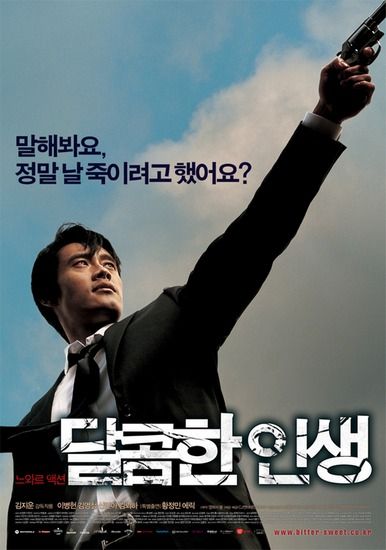
Sun-woo's arrogance leads to his downfall

A Bittersweet Life (달콤한 인생) – ★★★★★

A Bittersweet Life (달콤한 인생)

A Bittersweet Life (달콤한 인생)

Contemporary action heroes are markedly different from their forebearers. Fragments of the stoic hard-boiled masculinity of the noir 1930s, the rebellious ‘anti-hero’ escapades of the ’60s, and the hyper-masculinity of the ’80s amongst others still exist yet are characterised by more psychologically flawed and vulnerable protagonists. The psychosis of the contemporary action hero is propagated further by his/her unfettered arrogance which often serves to be the source of their appeal; they may be murderous unhinged individuals, but they conduct violence with such swagger and confidence that popularity is undoubtedly assured. The most recent incarnation of James Bond, played by Daniel Craig, is a prime example of such characterisation and differs incredibly from previous actors rendition of the spy. Such traits are of fundamental significance in Kim Ji-woon’s (김지운) A Bittersweet Life (달콤한 인생), an amazingly stylised action noir thriller that boasts an incredible performance from leading man Lee Byeong-Heon (이병헌).

Kim Sun-woo (Lee Byeong-Heon) is an enforcer for ruthless gangster and hotel owner Mr. Kang (Kim Young-cheol (김영철). Sun-woo is the epitome of diligence and loyalty, protecting his boss’ interests above all else including beating lower-tier gangsters that visit the establishment to cause trouble. Before a business trip to Shanghai, Mr. Kang orders Sun-woo to watch his young girlfriend Hee-soo (Sin Min-ah (신민아) for fear she is meeting another, younger, man. If Sun-woo confirms his suspicions, he must ‘take care’ of the situation. Yet when Sun-woo meets Hee-soo he is captivated by her, and cannot fulfill his obligations when her affair is discovered. Enraged, Mr. Kang orders his men to punish Sun-woo, setting in motion a series of events that tests both men to their limits.

Sun-woo is an arrogant, lethal enforcer for Mr. Kang

Sun-woo is an arrogant, lethal enforcer for Mr. Kang

As expected from auteur  Kim Ji-woon, A Bittersweet Life is technically fantastic with wonderful framing and composition, and superb use of mise-en-scene. The writer/director combines a multitude of different generic features seamlessly. The elegant gangster inspired ‘La Dolce Vita’ restaurant is exquisitely constructed, with a title that becomes a recurring subliminal pun throughout the film. The ultra-violent action sequences are brutal and shocking in their presentation, often accompanied by noir-esque shadows and suspense. The inclusion of romantic motifs are subtle yet moving as close up shots of minor mannerisms effect Sun-woo, that ultimately lead to his downfall. Sun-woo’s loneliness is consistently emphasised by framing devices that convey his isolation, as do the angled shots that portray the trajectory of his devolution down the gangster hierarchy. Kim Ji-woon’s renowned use of colour is on full display, from the bright white corridors that lead to the deep red and black interior of ‘La Dolce Vita’ to the continued use of bright lights surrounding love-interest Hee-soo. This subtly ties into Sun-woo’s almost obsessive compulsive disorder for switching lamps on and off several times before sleeping, as Hee-soo is constantly surrounded by light and has a penchant for lamps of all varieties.

Sun-woo escorts Hee-soo, whose subtle charms impair his judgment

Sun-woo escorts Hee-soo, whose subtle charms impair his judgment

Sun-woo is an incredibly arrogant and prideful protagonist, wonderfully portrayed by Lee Byeong-Heon. The intensity and conflict from his previous roles serves him well as Sun-woo’s narrative journey takes him from the upper echelons of the gang to crawling on his knees. And yet Sun-woo still refuses to acknowledge his feelings or to apologise, just as Mr. Kang refuses to change his stance to spare his dignity. They are mirrors of each other not just in personality and career but also in their affection for Hee-soo, and it’s ultimately that jealousy that destroys them all including the organisation. The final images of Sun-woo shadow boxing with his own reflection in ‘La Dolce Vita’ are tragically revealing, as his narcissistic spirit is forever locked in an internal love/hate battle with himself and his organisation. The other actors all convey great performances, although they are somewhat underdeveloped. Sin Min-ah conveys innocence and naivety as Hee-soo, and immeasurable sadness when her affair is brought to light. Kim Young-cheol is wonderfully sadistic as Mr. Kang and the mirror of Sun-woo, conveying real internal conflict when giving orders against his protege. As jealous second lieutenant Mun-suk, Kim Roi-ha is delightfully vindictive despite his limited character.

Sun-woo's arrogance leads to his downfall

Sun-woo’s arrogance leads to his downfall

Verdict:

A Bittersweet Life is an incredibly stylised action/gangster/noir thriller that is head-and-shoulders above other recent examples of the genre. As always, director Kim Ji-woon doesn’t disappoint, employing a variety of generic motifs to wonderful effect that keeps the film moving at a brisk pace without detracting from lead character Sun-woo’s development. Lee Byeong-Heon gives a wonderful performance as the flawed anti-hero, and despite his violent tendencies and arrogance is one of the most compelling action protagonists in recent memory. A Bittersweet Life is a premier example of the innovation of Korean cinema, and a more than worthy addition to the genre.

★★★★★

Reviews
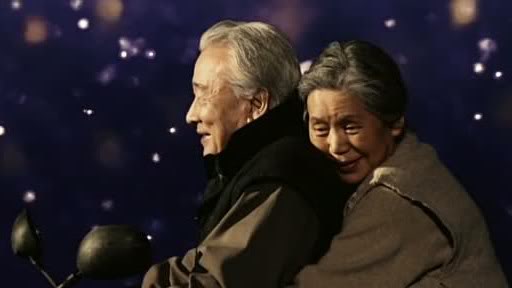
Man-seok and Song enjoy driving in the snow

Late Blossom (그대를 사랑합니다) – ★★★★☆

Late Blossom (그대를 사랑합니다)

Late Blossom (그대를 사랑합니다)

Love is, if celluloid is to be believed, the realm of young star-crossed lovers and those on the cusp of mid-life crises. The representation of youthful love is often accompanied by the intense passion of the first love, and the parental figures with whom they will undoubtedly clash. Middle-aged representations of love are acutely different incorporating a unique undercurrent of pessimism, the desire to end an elongated period loneliness and be married before the dreaded 40. But what of the eldest generation? By and large they tend to be ignored in the romance genre. Choo Chang-min‘s (추창민) Late Blossom (그대를 사랑합니다) helps to remedy the imbalance, offering deeply poignant and deeply romantic narratives featuring senior citizens.

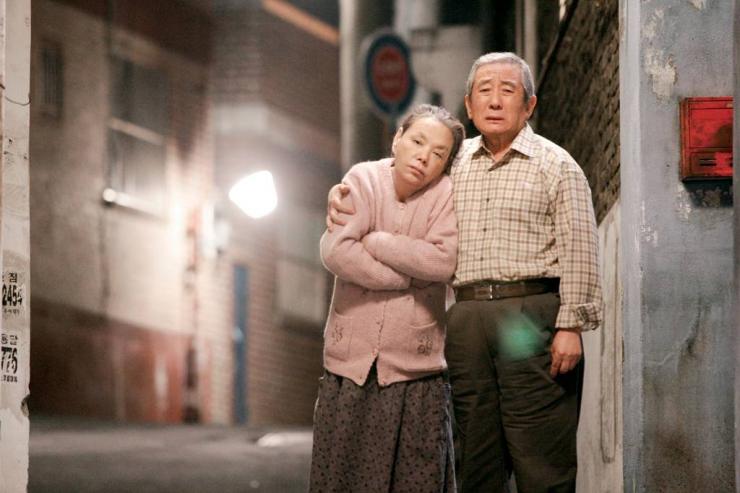
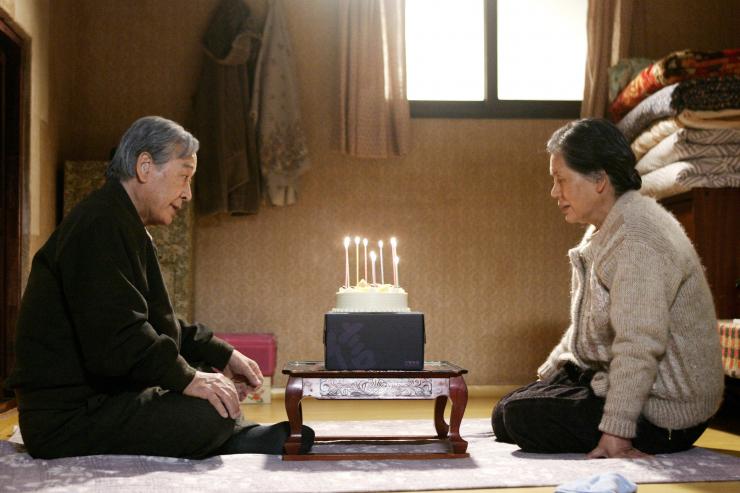
Kim Man-seok (Lee Soon-jae (이순재) is a foul-tempered and foul-mouthed milk courier who traverses the narrow alleyways of his neighbourhood on  his trusty moped. One winter Man-seok passes Song I-ppoon (Yoon So-jeong (윤소정), a poor woman of a similar age struggling to make ends meet by collecting cardboard and plastic. In spite of his ill-tempered disposition, Man-seok attempts to help her in the difficult icy conditions. Though annoyed, he finds himself drawn to Song and every morning waits to help her and his temperament gradually dissipates. In the same neighbourhood are another elderly couple, Jang Goon-bong (Song Jae-ho (송재호) and his wife (Kim Soo-mi (김수미). Goon-bong works all hours at the local parking lot while his Alzheimer’s suffering spouse stays home. That is, until one day Goon-bong forgets to lock the gate and she escapes, later bumping into Man-seok at the local park which sets off a chain of events that will bring the unlikely quartet together and in the process rediscover themselves.

Man-seok and Song enjoy driving in the snow

Man-seok and Song enjoy driving in the snow

Late Blossom is a delicately crafted, wonderfully poignant romantic tale. Screenwriters Choo Chang-min, Kim Sang-soo, Kim Yong-deok, and Lee Man-hee have carefully constructed an emotionally charged and heartwarming narrative that never feels forced. The way the relationships develop are subtle and organic, employing psychoanalytic depth to each protagonist amid the issues faced by senior citizens. Additionally, the mise-en-scene is sublime. Director Choo Chang-min uses the landscape to great effect, capturing the claustrophobic environment of the run-down old houses and the narrow labyrinthine streets. The town itself is situated on a mountain slope allowing for a variety of angled shots that highlight the change in power status between the central protagonists and the other inhabitants. The framing is also incredibly impressive serving to be both social-realist during the more bleak moments, and whimsically romantic in the melodramatic segments.

Goon-bong and his wife appear with dignity in the high-angled shot

Goon-bong and his wife appear with dignity in the low-angled shot

Just as Late Blossom is technically impressive, the acting is also very effective. While all the performances are competent, Lee Soon-jae and Kim Soo-mi are remarkable. As an Alzheimer’s patient, Kim Soo-mi evokes a multitude of emotions which earned her the Best Supporting Actress award at the 32nd Blue Dragon Awards. She conveys empathy, humour, mental illness and in rare moments of translucency, deeply moving sentiment. Lee Soon-jae is also wonderful as ill-tempered Man-seok, who gradually evolves due to his belated encounter with love. The narrative is mostly concerned with his evolution of character, which is a shame considering the additional talent involved, but Lee Soon-jae’s performance is so poignant that the narrative is consistently entertaining. Yoon So-jeong is restrained and subtle as illiterate Song I-ppoon, whose poverty-stricken life has beaten her into despair. Similarly, Song Jae-ho is wonderful as caring husband Goon-bong. His unselfish motivations are perhaps the most romantic within Late Blossom, convey adoration and heartache for his wife.

Man-seok and Song have a birthday celebration

Man-seok and Song have a birthday celebration

Verdict:

Late Blossom is a wonderfully moving film, conveying romance and dilemmas for an often under-represented generation. It is thought-provoking and poignant, eschewing the cliches often ascribed to more generic examples that are arguably naive in their representations of love. That said, the narrative is not equally shared amongst the quartet of protagonists which is a shame, as the character development is somewhat stifled for certain members. However, Late Blossom  is not only an incredible example of the genre, but amongst the best in representing romance for senior members of society.

★★★★☆

Reviews
Agent Yu and Northern commando Mu-Young are mirrors of each other

Shiri (쉬리) – ★★★★☆

Shiri (쉬리)

Shiri (쉬리)

There are select few films that can claim they were part of a movement that changed the course of national cinema. Shiri (쉬리) is such a film. With the change from a military to democratic government in the early 1990’s, and the resulting relaxation of censorship, Shiri proved to be one of the first films to tackle the relationship with North Korea that wasn’t represented wholly negatively. The film also proved that Korea had highly capable directors and actors, employing stylised and kinetic action sequences that had been the staple of 1990’s Hong Kong films and utilising them to express Korean socio-cultural anxieties. As such, Shiri became the biggest box office hit of 1999. Furthermore, the film gained international recognition promoting Korea as a country – and a film industry – to watch.

Agents Yu Jong-won (Han Seok-Kyu (한석규) and Lee Jang-gil (Song Kang-ho (송강호) work for the South Korean intelligence agency. Widely respected as the best in the agency, they ultimately fail to protect an arms dealer assigned to their care. The precision and perfection of the assassination leads to only one suspect – North Korean sniper Lee Bang-hee (Kim Yoon-jin (김윤진). Her return is a surprise as Hee has not been active for years after she assassinated a number of high profile government officials. Complicating matters further, a small band of renegade Northern commandos led by Park Mu-young (Choi Min-sik (최민식)  are en-route to the South, amid the backdrop of a football (soccer) game aimed at promoting ties between both people. Agents Yu and Lee are charged with finding and stopping Bang-hee and her compatriots, and uncovering why they have emerged to reek havoc once more.

Agent Ryu (류) must track down elusive North Korean sniper Hee (희)

Agent Yu must track down elusive North Korean sniper Bang-hee

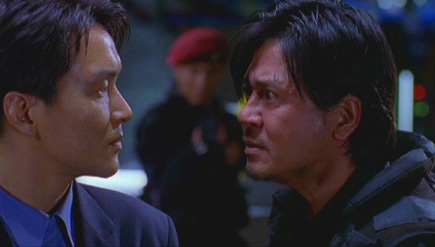
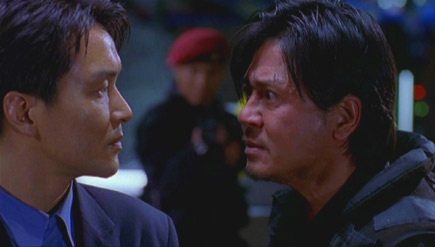
Director Kang Je-gyu (강제규), who also co-wrote the screenplay with Jeon Yoon-soo (전윤수), continually deconstructs the notions of ‘north’ and ‘south’ as oppositional (themes which he would later expand on in the seminal Taegukgi (태극기 휘날리며). Indeed, the title of the film ‘Shiri’ is the name of a fish that swims in the waters between the two countries, completely unaware of the political situation yet living in harmony. The film opens with the brutal military training regime Bang-hee must endure in the North, which are equally horrifying and dehumanising. Rather than representing the assassin purely as a monster, Kang Je-gyu also constructs empathy as she is forced to comply with barbaric demands. After she has infiltrated the South, empathy is invoked further as Bang-hee is a recovering alcoholic with social relationships, even managing her own business, conveying that precious little separates her from those in the South. Her fiancee is the unaware Agent Yu, and their union represents the reunification of both countries more succinctly than any treaty possibly could. Agent Yu must locate Northern terrorist Mu-young, who serve as mirrors of each other in their desire for reunification, albeit under different banners. During one of their confrontations Mu-young reveals his unbridled rage with the South, yet his reasons are not based on political rhetoric – rather, his jealousy of the high standard of living and the decadence within the country fuels his hatred, and in doing so conveys empathy towards his misguided violent attempts at reuniting the regions. While the politicians try to spur reunification through sport, it is ironically the ‘hero’ Agent Yu who destroys the only real way in which the countries can be unified, emphasising that neither side is inherently ‘good’ or ‘bad’ but misguided.

Agent Yu and Northern commando Mu-Young are mirrors of each other

Agent Yu and Northern commando Mu-Young are mirrors of each other

The actors all give good performances despite the tendency of ’90s action films for 2-dimensional characters. Such character development is generally limited in order for north/south relations to be at the forefront of the narrative, however the representation of the romance between Agent Yu and Bang-hee is touching and reinforces that the divide can be overcome with love. Choi Min-sik is by far the most talented and intense actor in the film, and acutely conveys the anger and frustration of those living in the North. His unrepentant attitude towards violence drives the narrative forward at a rapid pace and provides the thrills that lead to the ultimate showdown. The action sequences are kinetic and enjoyable, although they are far removed from the balletic slow-motion action of John Woo. Similarly, the introduction of new water-based super-weapon CTX is somewhat silly, yet it reinforces the notion of the adaptability and free-flowing nature of water in which the Shiri fish inhabit.

The kinetic action sequences are reminiscent of Hong Kong productions

The kinetic action sequences are reminiscent of Hong Kong productions

Verdict:

It is important not to understate the importance and influence of Shiri in Korean cinematic history. While it may not be a ‘perfect’ action film, it helped to insure not only that the national cinema had serious potential but also that a country that had struggled for years following the Korean War could be recognised for its cinematic output. The impact is still present to this day exemplified by the sensational 2009 TV drama IRIS which employed similar themes and motifs. Shiri proved that, while borrowing generic features from Hollywood and Hong Kong, a national cinema featuring national socio-cultural concerns was indeed possible and helped to form the foundation of a cinematic movement.

★★★★☆

Reviews
So-yeon (소연) is stalked by the ghost of a young girl

The Cat (고양이: 죽음을 보는 두 개의 눈) – ★★★☆☆

The Cat (고양이: 죽음을 보는 두 개의 눈)

The Cat (고양이: 죽음을 보는 두 개의 눈)

Certain visual motifs have always been prevalent in Asian horror films. It was arguably Hideo Nakata’s incredible Ring (1998) that introduced the majority of ‘Western’ audiences to such themes, most notably the ‘gwishin’ or girl spirit with long black hair and wearing a white nightdress. Additionally, water (particularly in Japan), the deconstruction of family ethics, the motif of the circle, technological advancements, and the supernatural are all features that continually recur. As the title suggests, The Cat (고양이: 죽음을 보는 두 개의 눈) uses felines as the conduits of horror in conjunction with other common motifs, and while entertaining, offers little in the way of originality or suspense.

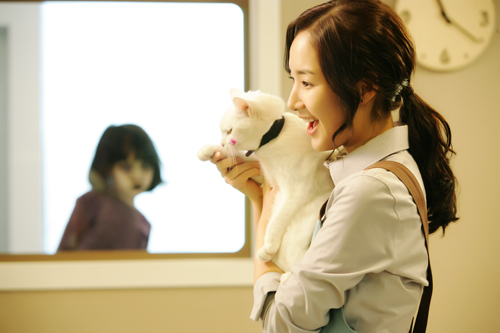
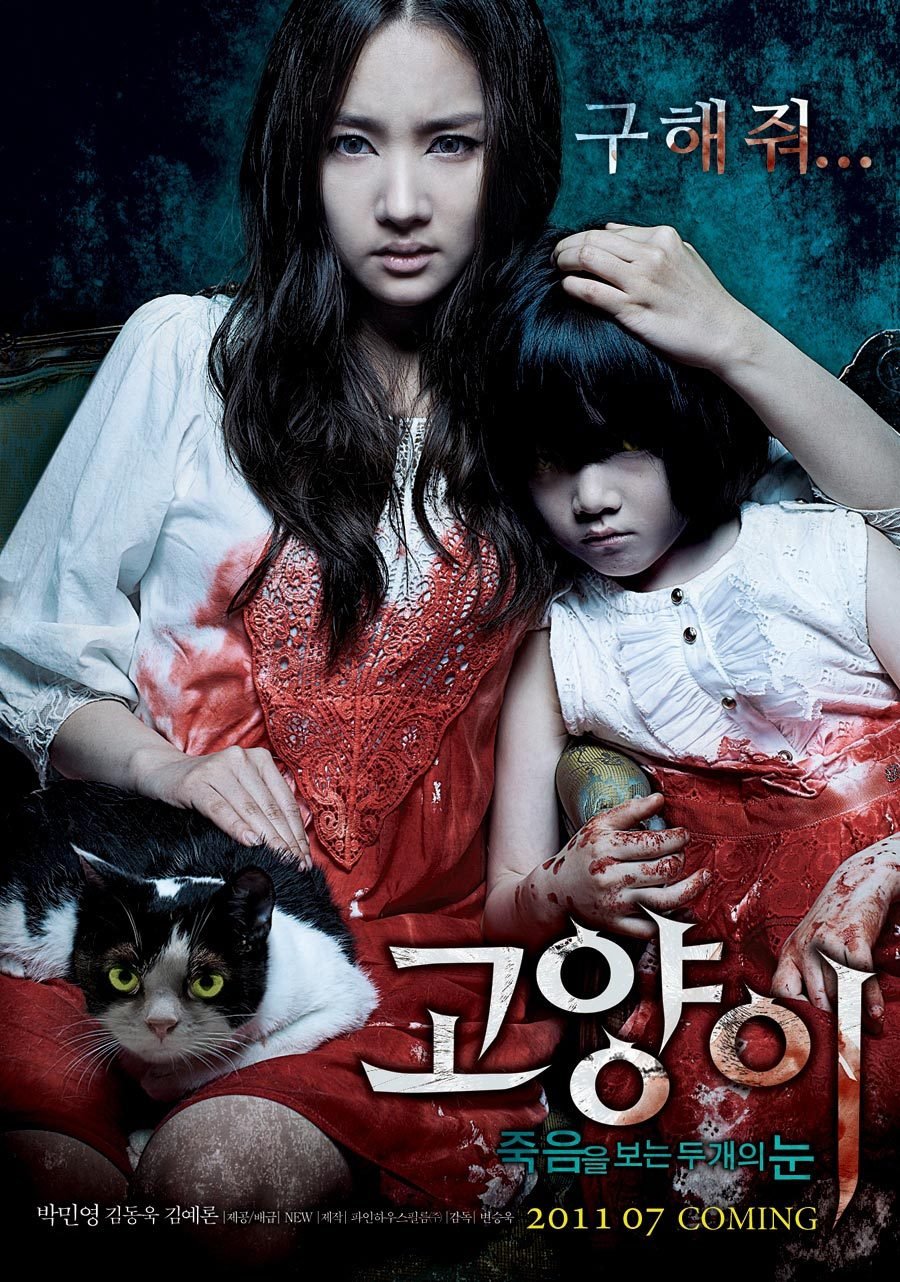
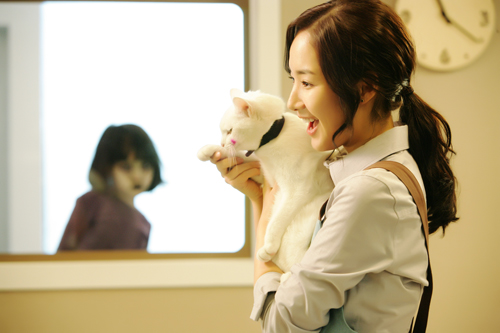
So-yeon (Park Min-yeong (박민영) works at a pet store grooming animals, supervised by the sinister flamboyant manager (Lee Han-wi (이한위). So-yeon suffers from claustrophobia due to an undisclosed childhood accident, visiting a psychiatrist and taking anxiety medicine, and as such has an acute fear of elevators and closed doors. After grooming cat ‘Silky’, the owner mysteriously dies forcing police officer Joon-seok (Kim Dong-wuk, 김동욱) to ask So-yeon to take care of the feline. But on taking Silky home, it becomes clear that something else has followed them – the apparition of a young girl called Hee-jin (Kim Ye-ron, 김예론) with cat-like eyes.

So-yeon (소연) is stalked by the ghost of a young girl

So-yeon (소연) is stalked by the ghost of a young girl

The trend to incorporate ‘western’ style scare tactics through rapid editing, rather than elongated atmospheric scenes, features heavily in The Cat. This is a shame, as the effects of such a style wear off as quickly as they are introduced and do little to perpetuate suspense and terror throughout the film. However director Byeon Seung-wook (변승욱) competently creates these scenes of horror, employing filters that seemingly drain colour from the mise-en-scene in anticipation of an upcoming shock. Unfortunately, the impact of the shocks are fleeting, and the lack of originality is painfully obvious. This is heightened due to the unwise decision of including scenes reminiscent of other superior horror classics, which detracts from the overall enjoyment. Attempts are made to make The Cat into more of a psychological horror due to So-yeon’s psychosis, with ghost Hee-jin as a mirror/conduit for her childhood trauma. Hee-jin – who bares more than a passing resemblance to So-yeon in her youth – stalks So-yeon yet does not harm her; only those who are unkind to cats feel her wrath. Yet the victims are also people that So-yeon dislikes or bears a grudge towards, and in this capacity Hee-jin becomes a supernatural tool implementing So-yeon’s subconscious will. Further supporting this argument is the fact that all the murders are conducted in confined spaces, an area that petrifies So-yeon yet is the source of her neurological condition. While there is certainly a mystery to be solved, the identity of the killer is ambiguous.

So-yeon attempts to solve the mystery

So-yeon attempts to solve the mystery

Park Min-yeong gives a solid performance as pet-groomer So-yeon, yet the role mostly requires her to look scared and doesn’t allow for a more penetrative exploration of her psychological condition or the foundation thereof. As such, the evolution of So-yeon as a protagonist is rather flat. Police officer and potential love interest Joon-seok is pitifully underdeveloped and adds little to the narrative, and as such Kim Dong-wuk’s performance is muted. Perhaps the most entertaining protagonist is the camp pet store owner, played by Lee Han-wi (이한위), who seems to relish portraying the flamboyantly vicious entrepreneur. The standard of acting is generally mediocre as director Byeon Seung-wook is more concerned with quickly moving from one horror set piece to the next, and the lack of character development clearly limits the performances provided.

Death visits those close to So-yeon

Death visits those close to So-yeon

Verdict:

While competently made, The Cat does not belong with premier examples of the genre. Attempts have clearly been made to construct depth through the inclusion of a leading protagonist with neurosis, yet the lack of development and the consistent references to other, more superior, horror films detracts from the overall experience. That’s not to say that The Cat isn’t enjoyable – far from it. While the unease of horror is unlikely to linger after the credits, the fast-paced quick thrills make the film an entertaining experience.

★★★☆☆

Reviews